

To set boundaries at work, decide what you can realistically deliver, say that limit out loud in plain language with a short reason attached, write it down, and repeat it the same way every time it gets tested. The hard part is not the first conversation. It is the fifth, and the twentieth.
Most people are not short of advice about boundaries. They are short of a specific sentence, said at a specific moment, that they can actually use with their manager. So this guide is built around steps and scripts rather than theory, and it works whether you are an individual contributor, a new hire, a manager who is always on, or someone working remote and losing track of the working day entirely.
A few things worth knowing before you start: boundaries are not rudeness, they are a description of what your job actually requires. One conversation will not fix a broken workload, and if the only person in your company answering messages at 10pm is you, that is a culture problem you can manage but not solve alone. What you can do is make your own limits visible, consistent and easy for other people to plan around.
Table of Contents
- What You Need Before You Set a Boundary
- Step-by-Step
- Common Mistakes
- Frequently Asked Questions
- How do I set boundaries at work with a difficult manager?
- What if my manager keeps messaging me after hours?
- How can I say no to an urgent request without seeming unhelpful?
- Should I document my work boundaries in writing?
- How do workplace boundaries differ in remote and hybrid jobs?
- What should I do when my workload is consistently unrealistic?
- Conclusion
What You Need Before You Set a Boundary
Walk into the conversation with four things prepared. The ones who stumble are usually the ones who arrive with a feeling instead of a plan.
A short priority list. Write down your top three to five commitments for the next month, in order. If a new request cannot be added to that list, you now know what your answer is before anyone asks. This is where the Eisenhower Matrix earns its keep: everything arriving at you is either urgent, important, both or neither, and the requests that hurt are the urgent, unimportant ones that keep arriving.
Two or three real examples. Vague complaints get vague answers. “I am too busy” invites “then prioritise better.” A short list of specific incidents does not: a request that landed at 9pm last Thursday, a project that quietly doubled in scope, a standing daily meeting that produces nothing. Bring three. People in r/productivity and r/corporate describe the same pattern: a documented task list lands far better than a feeling.
Your actual policies. Check your handbook or intranet for after-hours contact rules, PTO policy, on-call rotation and any right-to-disconnect provision. Several US states and a growing number of other countries now put some version of a right to disconnect into law, and Ireland’s provision is the one most often cited. Policies vary widely by country, state and employer, so treat this as background rather than legal advice, and raise anything specific with HR.
A calm communication plan. Decide the channel, the setting and roughly how long you will speak. A ten-minute private conversation beats a long email, and an email beats a complaint in a group chat. If your boundary is about written communication in general, it has to be a written boundary.
Step-by-Step

1. Identify the boundary you need
Turn the vague feeling into a specific statement about time, communication, workload, focus or after-hours contact. “I need better work-life balance” is a wish. “I do not answer non-urgent messages after 6pm on weekdays” is a boundary, because someone can comply with it.
Name the category so you know which tools to reach for:
- Time: start and end times, lunch, time off in lieu, no weekend work.
- Communication: which channel, which hours, how fast a reply is expected.
- Workload and scope: what is in your role, what is not, how much is on your plate right now.
- Focus: protected blocks for deep work, no-meeting mornings, interruptions.
- Emotional: how much of other people’s stress you are willing to absorb, and where it goes instead.
You will know the first step worked when you can write the boundary on one line and a colleague could tell from that line alone whether something is allowed.
2. Choose a clear, reasonable limit
A boundary needs three parts: the limit, the reason, and what you will do instead. Without the third part it reads as a refusal rather than a plan.
Make the limit specific and realistic. “I respond to non-urgent requests within two business days” beats “I will get back to you soon,” because it can be measured. Check that the limit is one you can sustain for months, not a heroic burst in week one. If your target is availability, state actual hours: online 9 to 5 Eastern, notifications off outside that, urgent line only for true outages.
Forum regulars are blunt about this part. The version you can hold is the version that costs you something small every time you follow it.
3. Plan the conversation and choose the right moment
Timing does more work than wording. Raise a boundary early in a working week rather than at 5pm on a Friday, in a private room or a private message rather than in front of your peers, and away from a deadline week. Do not stage it the day after you missed one.
Prepare the objection before you are asked it. Three come up almost every time: we are a team and everyone pitches in, the timing is bad but we will manage, and you seem to have changed lately. If you can answer all three in one calm sentence each, the conversation will be shorter than you expect.
Pick a moment where the person is not mid-crisis. You want their attention, not their panic.
4. State the boundary with a practical script
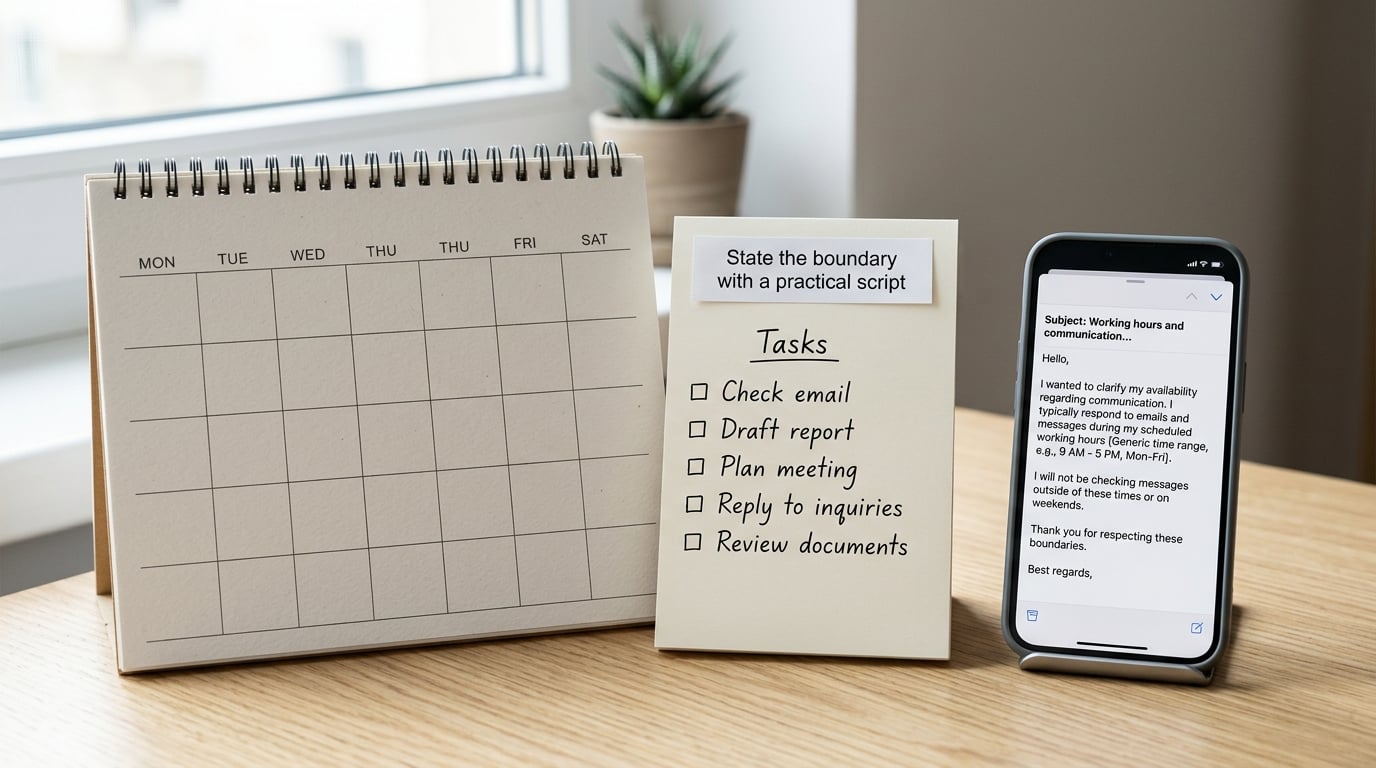
The format that works is an I-statement plus a limit plus a reason. It describes your side, names a concrete line, and explains once. Here are scripts you can use almost as written.
After-hours messages: “I am offline after 6pm and I do not read work messages until the next morning. If something is genuinely urgent, call the on-call number. I wanted you to know that so the team can plan around it.”
New work on top of a full plate: “I want to take this on properly, and right now I have A, B and C committed. If this is the priority, I can move B to next week. Which do you want?”
A colleague who keeps interrupting: “I am mid-task most mornings until about 11. Can we catch up at 11:15 instead? I will be much sharper and you will get a real answer.”
Scope creep: “The original scope was the data pull. Adding the dashboard changes the estimate. I can do both by moving the deadline two weeks, or the original scope on the original date. Which works?”
As a manager drawing a line with your own team: “Emergency only after 6pm. If the on-call number is not dialled, a message at 6pm will wait until the morning, and I do not want to model anything else in front of you.”
Where you can, follow the spoken version with a written one. In a same-day email, repeat the boundary in two lines: “To be clear on availability, I am online 9 to 5 and I do not monitor Slack after hours. The escalation path for anything urgent is in the team runbook.” People on r/ExperiencedDevs report that written boundaries hold better than verbal ones, because there is a record and you can restate calmly instead of arguing from memory.
One warning: an out-of-office auto-reply is a good backstop, not the conversation. It covers the holiday, it does not cover the person who assumes you are ignoring them.
5. Listen, negotiate, and keep the core need intact
Expect pushback, and treat it as information rather than rejection. Sometimes the boundary is genuinely wrong for the role. Sometimes there is a real staffing problem underneath it, and the person raising it does not know how else to say so.
Negotiate the terms, not the need. If what you need is uninterrupted focus in the morning, then a later deadline or a different channel can be negotiable; the focus is not. If the need is sleeping, a phone left face down at 9pm is negotiable; the sleep is not.
Watch for the exchange that quietly removes the boundary. You offer one exception, and a month later the exception is treated as the new normal. Agree an expiry in advance: “happy to cover that Thursday, and I am back to my normal close the following week.” Threads on r/OfficePolitics describe this as the most common way a boundary erodes, and it erodes politely, one favour at a time.
6. Document the agreement and follow through
Put the agreement somewhere durable: a task tracker, a team runbook, your own notes, or a short email recap. A one-line recap is enough. “Confirming what we agreed: new work comes through the tracker, and deadlines shift rather than stacking. Shout if I have that wrong.”
Then behave consistently. The strength of a boundary comes almost entirely from whether the same message follows it every time. Overcorrection, apology and negotiation each time it is tested tells the other person that the first answer was negotiable after all.
There is one more habit that comes up constantly in the forum threads on this topic: stop rescuing. If a boundary exists because you keep stepping in to fix things nobody asked you to fix, then every rescue teaches people that the boundary is optional. Let the task fail loudly once. It is the cheapest lesson you will ever deliver, and it is unpleasant for a day.
7. Review and adjust the boundary
Give it two to four weeks before you judge it, then check for signals. A working boundary looks like: questions arriving inside your stated hours, fewer 9pm pings, deadlines being moved in conversation rather than ignored, and nobody repeating the same request because they did not believe you.
If nothing changed at all, the problem is usually enforcement, not wording. Restate it once, in writing, in a slightly firmer register, and name the next step: “If this keeps happening I am going to raise it with our director, because I cannot plan around it.” You never have to get there. Saying it is what makes it true.
Adjust as your role changes. A boundary that was sensible during a slow quarter will not survive a reorganisation or a new boss. Review them alongside your calendar, and revise the ones that no longer describe your actual job.
Common Mistakes
Almost every boundary that fails does so in one of six predictable ways. Here is what goes wrong and the fix.
1. Overexplaining. Three paragraphs of justification turns a limit into a debate. One sentence of reason is enough. If the reason is not needed, it gets argued with.
2. Apologising for the boundary. “Sorry, I know you are all so busy, I just…” hands the decision straight back. State the limit and the reason without an apology attached. An apology is not politeness here, it is an opening bid.
3. Agreeing to exceptions with no plan. A boundary with unlimited exceptions is a preference. Put an expiry on every exception, in the same sentence where you grant it.
4. Vague language. “I am trying to focus more,” “I will get back to you soon” and “let us protect our weekends” cannot be complied with. Use hours, days, channels and numbers.
5. Expecting one conversation to fix a systemic workload problem. A six-week deadline that was set by someone else is not a boundary you can draw in a ten-minute meeting. Say clearly that you can deliver the list in order, or ask which items come off. If nothing comes off, that is a prioritisation decision for your manager to make, and your job is to have made the trade-off visible.
6. Rescuing, then blaming. Doing the work and resenting the person removes the evidence that the boundary is needed. Work chat about it changes nothing; the extra hours on your desk do all the talking.
Four habits prevent most of it. Say the boundary once and do not re-litigate it. Say it in writing where you can. Give a reason in one sentence. And review your boundaries on a schedule, because the job you had last quarter is not the job you have now.
One last thing on tone. Boundaries are not walls, and they are not a test of loyalty. On r/corporate and r/ExperiencedDevs, the same worry comes up again and again: that saying no marks you as lazy or not a team player. The fix is to make the boundary about the work rather than about you. Deep work time, a realistic response window, a workload that can be finished properly. Nobody has ever been called difficult for protecting a deadline.
Frequently Asked Questions
How do I set boundaries at work with a difficult manager?
Set the boundary the same way you would with anyone: specific, written, tied to the work. Difficult managers push back on the person more than the request, so avoid personal framing and stick to process. Say what you can deliver, by when, and what would need to move. Write the summary down the same day. If the behaviour is targeted or persistent, keep a private record with dates and raise it with HR or skip-level, because a documentation trail changes the conversation more than a firmer tone does.
What if my manager keeps messaging me after hours?
Answer once, clearly, in writing, and then apply it consistently. A short message setting your availability window, naming the escalation path for real emergencies, and noting that messages are read the next morning does most of the work. Most managers read this as information, not complaint. If the messages continue unchanged, a short follow-up about impact on your own time is fair. Persistent after-hours contact that ignores your stated availability is worth raising with HR or a skip-level, and it may also fall under your employer policy or local right-to-disconnect rules.
How can I say no to an urgent request without seeming unhelpful?
Never refuse the request itself, only the trade-off. Say what you can do and by when, then offer two options: do this one first and move the other back, or keep both dates and accept a lower-quality version of the new work. That framing keeps you inside the job rather than outside it. Adding one sentence about why helps, and no apology, because apologising signals that the answer was optional. Being helpful and being available at any cost are different things, and the second one is not sustainable.
Should I document my work boundaries in writing?
Yes, for anything recurring. Verbal boundaries drift because nobody remembers the exact terms a week later, and a written version lets you restate calmly instead of arguing from memory. A two-line recap after the conversation is enough: what was agreed, and what changes if circumstances change. Keep it in the channel where the work happens, not buried in a personal document. The point is not evidence, although it is useful evidence, but clarity for everyone involved.
How do workplace boundaries differ in remote and hybrid jobs?
Remote work removes the office clock, so availability has to be stated rather than assumed. Set core hours, turn off notifications outside them, and add your hours and expected response time to your email signature. Agree on team norms for chat versus email, for camera-on expectations, and for what counts as a genuine urgent message. Hybrid work adds a different problem: visibility. Remote workers often over-respond because they cannot be seen working, so regular written updates usually replace that pressure more effectively than staying online late.
What should I do when my workload is consistently unrealistic?
Bring the list, not the complaint. Write down every commitment with the hours you estimate and the dates involved, mark the items that are genuinely fixed, and take the meeting to your manager with a specific request: reprioritise, delegate, add capacity or move a date. One of those four has to be chosen, and the meeting is not finished until it is. If nothing changes after a cycle, the options are escalation to HR or a job search, and both are more reasonable than a slow burnout in the meantime.
Conclusion
Start with one boundary, and make it small enough that you can hold it this month. Set your availability window, put it in your signature, and repeat it the same way every time. Nothing else needs to change yet.
Boundaries are not walls, and they are not a favour you do your employer. They describe the conditions under which your job gets done properly: enough focus to think, enough recovery to keep going, and a workload that can be finished rather than merely started. When you frame it that way, saying no stops being a personality problem and becomes ordinary professional practice.