
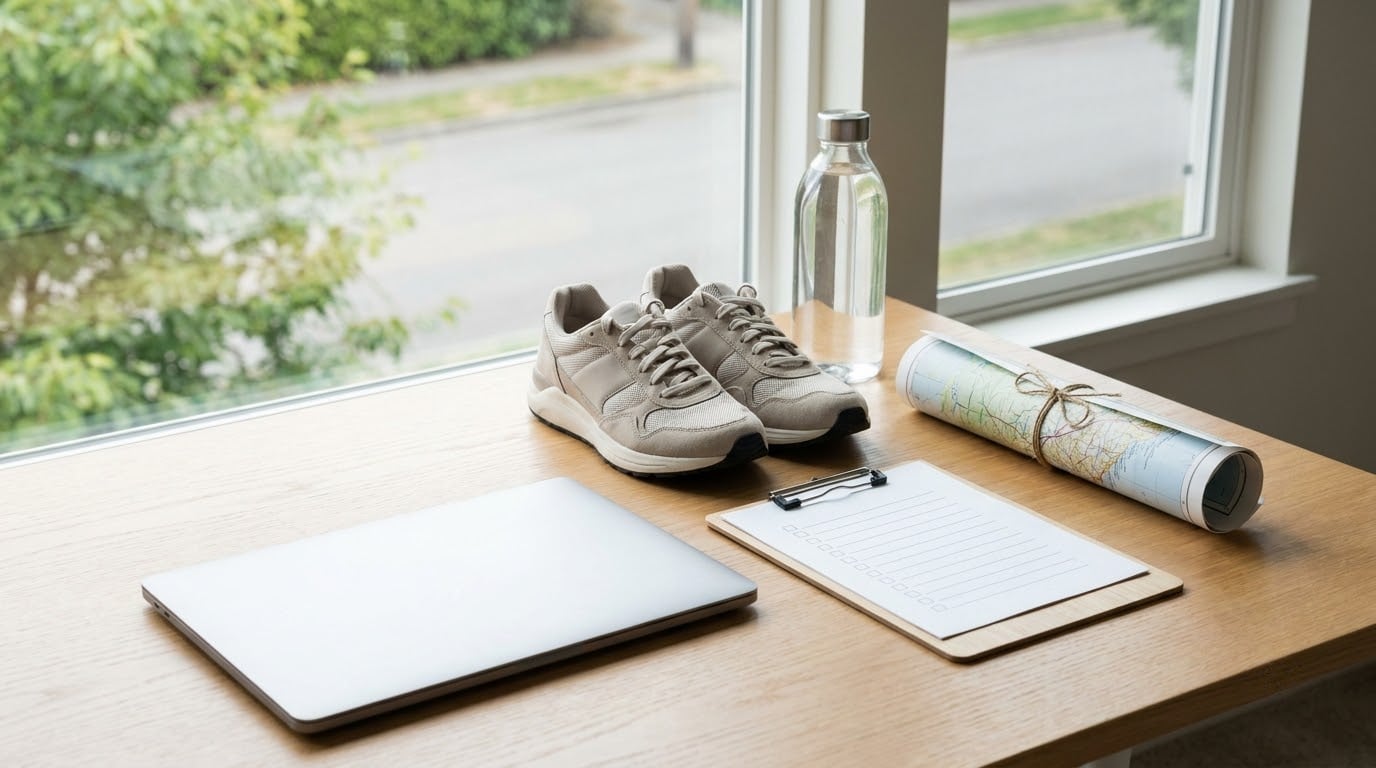
Workplace step challenge ideas are movement contests where employees track daily steps on a phone, smartwatch, or pedometer, either solo or as a team, over a set period. The formats below run from a one-week daily target to a four-week charity total, and each one works for a different team size, location, and mix of abilities.
The reason step challenges keep showing up in employee wellness programs is the barrier to entry. No gym membership, no special skill, no equipment. What decides whether one lands is everything around the steps: a goal people can actually hit, a format that includes the person who cannot walk far, and leaders who take part themselves.
This list covers twelve formats you can run as-is, with the setup details that decide whether people join. It is written for HR and people teams, office managers, and wellness coordinators running wellbeing week programming, plus leads of remote and hybrid teams who need something low-cost that works from any location.
Table of Contents
- Workplace Step Challenge Ideas at a Glance
- 1. Team Total Step Challenge
- 2. Daily Distance Challenge
- 3. Walking Meeting Challenge
- 4. Stair-Climbing Challenge
- 5. Neighborhood Walk-and-Talk Challenge
- 6. Step Bingo Challenge
- 7. Step Pairs Challenge
- 8. Department Relay Challenge
- 9. Lunchtime Walk Challenge
- 10. Commute-Step Challenge
- 11. Seasonal Step Challenge
- 12. Company-Walk and Wellness Fair Challenge
- How to Choose a Step Challenge That Fits Your Workplace
- Frequently Asked Questions
- What is a good step goal for a workplace challenge?
- How can a workplace step challenge be inclusive?
- Do workplace step challenges need to use apps or wearables?
- How long should a workplace step challenge run?
- How can employers create competition without putting employees under pressure?
- How should teams track steps and privacy?
- Conclusion
Workplace Step Challenge Ideas at a Glance
| Format | Best team setting | Participation requirement | Accessibility notes | Primary benefit |
|---|---|---|---|---|
| Team total step challenge | Office or hybrid, 10+ people | Any movement, steps optional | Scales per person, so small teams can compete | Shared purpose and steady encouragement |
| Daily distance challenge | Any, including fully remote | A daily walk target | Swap steps for minutes or distance | Builds a daily habit fast |
| Walking meeting challenge | Same-site or neighbourhood offices | Two or more colleagues | Call-in option keeps it accessible | Replaces sedentary meeting time |
| Stair-climbing challenge | Multi-floor office buildings | Stairs during the workday | Lift use never disqualifies anyone | Movement without leaving the desk |
| Neighborhood walk-and-talk | Teams located near each other | A short local walk | Flat routes, seated rest stops | Face-to-face connection |
| Step bingo challenge | Mixed ability, any size | Complete squares, not steps | Squares for chair users and remote staff | Keeps non-walkers in the game |
| Step pairs challenge | Teams of 20 or more | A walking partner | Solo participation allowed at all times | Peer accountability |
| Department relay challenge | Organisations with several teams | Team total over a period | Totals normalised per head | Friendly inter-team rivalry |
| Lunchtime walk challenge | Office-based teams | A 10 to 20 minute walk | Seated or indoor alternatives offered | Reliable routine around lunch |
| Commute-step challenge | Employees who travel to a site | A walk instead of part of a journey | Any employee can opt out cleanly | Extends activity outside work hours |
| Seasonal step challenge | Any, run in set calendar windows | Varies by season | Indoor backup plan for poor weather | Matches the weather and daylight |
| Company walk and wellness fair | Larger organisations, one-off events | Attendance, not performance | Seating, accessible routes, no ranking | Wellness education plus connection |
1. Team Total Step Challenge
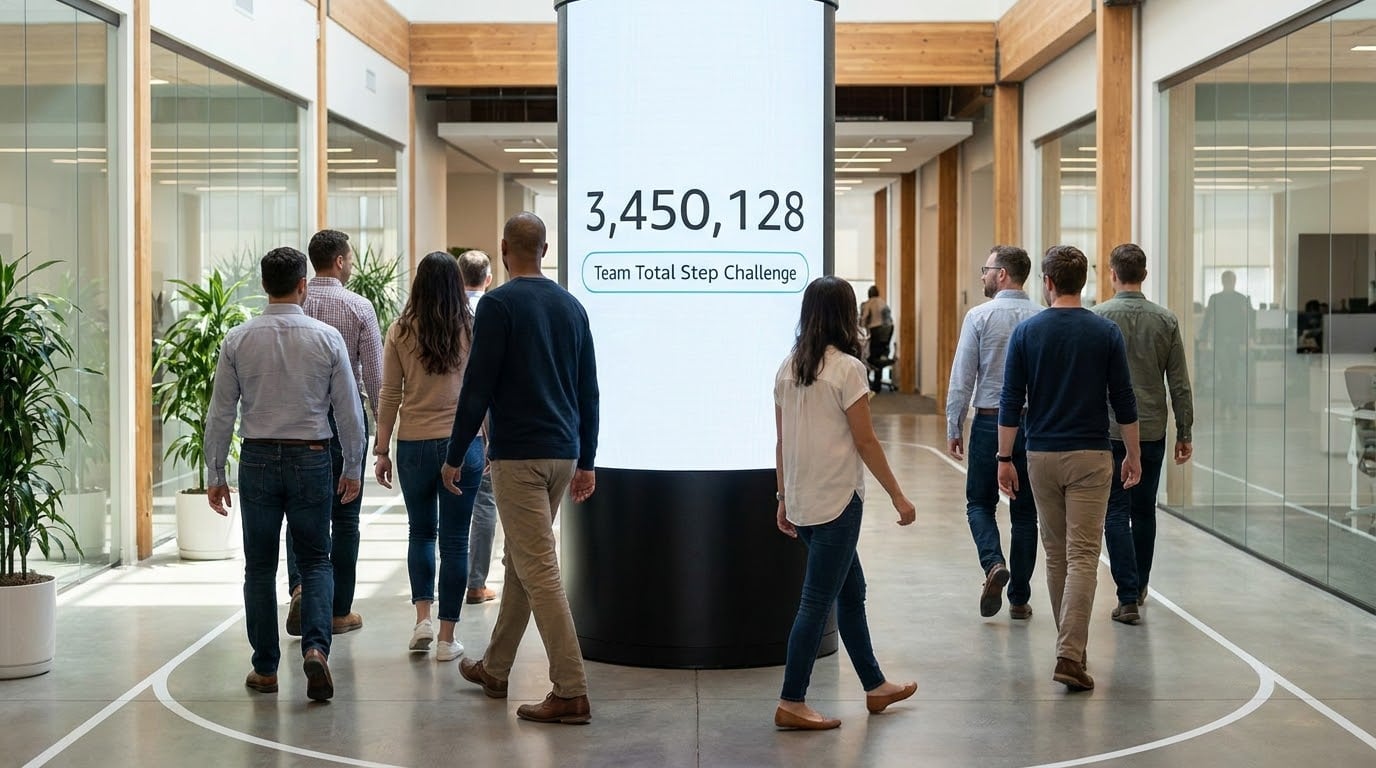
The team total challenge replaces individual targets with one shared number: the whole group commits to a cumulative step total over a week or a month. Because nobody is individually ranked, the pressure comes off individuals and lands on the group.
Set a realistic target by counting heads first. Multiply your headcount by a daily figure the group already averages, then stretch by 10 to 15 percent. Ten people averaging 6,000 steps a day is 60,000 a day, so a four-week goal around 1.7 million steps is a stretch but not absurd.
The thing that makes this format work is the mid-week nudge. A short Slack or Teams message each Wednesday with the running total keeps people walking when motivation normally dips. For hybrid teams, let each site keep a sub-total so office staff are not automatically beaten by people who walk at home.
2. Daily Distance Challenge
A daily distance challenge gives everyone one number to hit each day: a distance, a duration, or a step count. Distance works well for people who think in miles, minutes work well for people who cannot walk continuously, and step counts are the easiest to track automatically.
Calculating a manageable distance is straightforward. Take a typical workday baseline of around 6,000 to 7,000 steps and add a 1,500-step increment, which is roughly a fifteen-minute walk. Frame the goal that way rather than as a round number, so nobody has to guess what fifteen minutes looks like for them.
Let participants pick their unit before the challenge starts and publish both versions of the leaderboard. A weekly check-in in a shared channel is usually enough. Daily reminders get old by week two.
3. Walking Meeting Challenge
The walking meeting challenge converts a set number of recurring meetings into walks. You pick meetings that do not need a screen, usually status updates, retrospectives, or one-to-ones, and agree as a team which ones move.
Route planning matters more than most organisers expect. Pick a loop that is flat, shaded where possible, and returns to the building within about 25 percent longer than the original meeting slot. Agree the turnaround point in advance so nobody is checking the time the whole way round.
Weather needs a fallback, not an excuse. Pick an indoor route or keep the meeting as a call for anyone who cannot go outside, and say plainly that both versions count. The meeting objectives stay the same; if a walk stops people from finishing the agenda, the format failed, not the weather.
4. Stair-Climbing Challenge
A stair-climbing challenge counts flights climbed during the workday, which is the rare wellness activity that requires no commute, no gym, and no break in the schedule. It works best as a team total measured in flights over two to four weeks.
Competition here needs care. Rank teams on total flights, not average flights, so a larger office building does not automatically win. Then state plainly that taking the lift never disqualifies anyone and never appears on a board, which removes the main reason people with joint pain, pregnancy, or a lower-limb injury opt out.
Safe participation rules are short and worth publishing. Take stairs holding the rail, wear footwear with grip, and stop if anything hurts. Counting flights at home or on a commute counts too, using the same reporting method, so remote employees are not automatically last.
5. Neighborhood Walk-and-Talk Challenge
The neighborhood walk-and-talk works when most of a team works on the same site or in nearby buildings. It runs once a week for four to six weeks, at a fixed time, along a route you have walked yourself first.
Choose a route that is flat, has public seating, and has crossings rather than an unbroken kerb. Thirty to forty-five minutes is long enough to talk and short enough that people will actually come. Conversation prompts help on the first few walks, when the group does not know each other well enough for silence to be comfortable.
Publish the accessibility details with the invite: distance, surface, rest points, and whether there is a shorter option that rejoins the group halfway. A severe weather forecast moves the walk indoors to a large room or cancels that week, decided the evening before.
6. Step Bingo Challenge
Step bingo turns the challenge into a card of activities rather than a step total, which solves the inclusion problem neatly. Each square is something a person can do on an ordinary workday, and people mark squares as they complete them.
Useful squares include: a 15-minute walk during lunch, taking one call outdoors, reaching your personal daily goal, walking to a colleague’s desk instead of using chat, inviting someone to join a walk, walking the long way to a meeting in another building, and doing three flights of stairs. Add squares for seated movement and for chair-based or wheelchair movement minutes, and the card stops excluding anyone.
Run it for three to four weeks with a card that can be completed in that time. The first person to a full row wins, and everyone who fills most of the card gets recognised too.
7. Step Pairs Challenge
The step pairs format assigns each participant a walking partner and scores the pair. It works because nobody wants to let a colleague down, which is a stronger pull than a leaderboard and a much softer one than a manager watching.
Pair on similar availability and similar neighbourhoods where you can, then rotate partners every week so nobody is stuck with someone on a different shift or time zone. Keep solo participation open: a single participant can join the board with a self-selected partner or simply enter without one, and nobody asks why.
Score pairs on total steps and on days-above-target, and publish both. The second measure rewards consistency, which usually changes behaviour more than the first.
8. Department Relay Challenge
A department relay has each team contribute to a shared total over a set period, so the organisation moves toward one destination together. Give teams a distance, a set number of steps, or a fictional route like a climb up a mountain with markers at each level.
Uneven team sizes are the usual failure point. Normalise by dividing each department’s total by its headcount, then rank on the per-person figure and publish the raw totals beside it. That way a 400-person operations team is not permanently ahead of a 12-person design team.
Keep the tone friendly. Relay metaphors help if they stay playful; the moment the board looks like a performance review, participation drops and stays down.
9. Lunchtime Walk Challenge
The lunchtime walk challenge asks for one walk a day, no target distance, no scoring. That sounds thin, and it is exactly why it survives contact with a real calendar. People who fail a step challenge usually fail on time, not effort.
Offer a small menu of distances: ten minutes out and back, twenty minutes, and a longer weekend option. Start a walking group at a fixed time from a fixed lobby, and set up a second group for people who prefer walking alone or start later.
Remote employees can run the same thing locally, with a shared channel for anyone who wants company. Across a four-week run, this is often the format with the highest completion rate, because it survives bad weeks.
10. Commute-Step Challenge
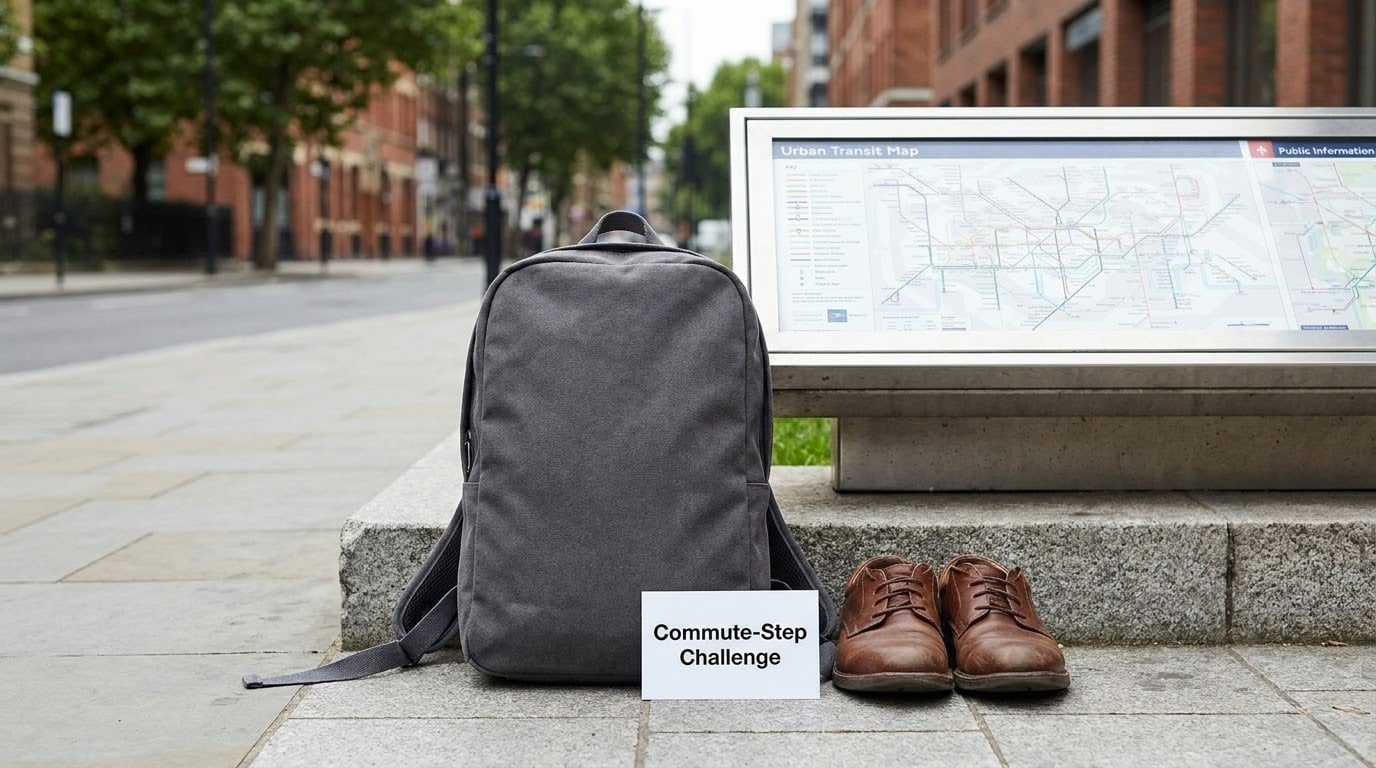
A commute-step challenge adds movement to the journey people already make: get off transit one stop early and walk, park further away, or walk the last fifteen minutes. Because the travel is already happening, the time cost is close to zero.
Safety is the whole design here. Never count walking along a high-speed road, a motorway shoulder, or an unlit stretch with no pavement. Give a list of acceptable options in writing, and let employees opt out without explanation, because shift patterns and caring responsibilities make early starts impossible for some people.
Run it as a team total over two to three weeks rather than a daily target. Nobody has a perfect commute streak, and totals do not punish the week the trains stopped running.
11. Seasonal Step Challenge
A seasonal challenge matches the format to the month. Spring and autumn suit neighborhood walk-and-talks and longer distances. Summer suits early or evening walks, because midday heat is a genuine safety issue rather than a scheduling preference. Winter suits stair climbing, walking meetings indoors, and mall or museum walks.
Adapt goals to daylight and weather. A 6,000-step goal is easy in June in most of the US and close to a full-time job in northern January, so set the winter number lower and stretch the duration instead. Publish an indoor alternative for severe conditions and say when it applies.
Seasonal programming also solves the participation slump that follows a successful spring challenge. Running one idea per season gives you four launches a year and keeps the idea fresh.
12. Company-Walk and Wellness Fair Challenge
The company walk combines a group walk with a wellness fair: local health organisations, benefits providers, a dietitian, a physio, an ergonomics assessment, and a blood-pressure station. It works as a one-off or as the closing event of a seasonal programme.
Keep the focus on participation. Do not publish step results for the day, and do not rank teams. The reward is the event itself, a shared lunch, or a donation made in the group’s name to a charity each participant nominates.
Plan the logistics properly: an accessible route, seating every 200 meters or so, a rest area, water, and a plan for rain. A one-day event only gets repeat attendance if people enjoyed walking it, and route quality decides that more than the booths do.
How to Choose a Step Challenge That Fits Your Workplace
Matching workplace step challenge ideas to your setup
Start with the shape of your workforce. Under 20 people, skip department competition and run a solo or pairs format, because a department relay across four teams needs more people than most small companies have. With several departments of 15 or more, the relay and team total formats start to pay off.
Work location decides the rest. Same-site and neighbourhood teams can run walk-and-talks and walk meetings. Fully distributed teams should default to daily distance, step bingo, or pairs, all of which work from a kitchen table.
Shift schedules are the most commonly overlooked constraint. A single weekly team walk excludes night and rotating-shift staff by accident, so if you run any group format, run a self-directed alternative at the same target alongside it.
Matching workplace step challenge ideas to your people
Physical ability deserves a decision before launch, not during it. Steps-only challenges exclude wheelchair users, people recovering from injury, and anyone with chronic pain, and losing them quietly is the most common way these programmes fail. Offer movement minutes and chair-based equivalents with equal standing in the scoring, and count any activity a person can do consistently.
Then check the privacy question honestly. Step data reveals a great deal about someone’s daily routine, so never require individual step totals to be visible to managers. Publish team aggregates, let people decide whether their name appears, and state in writing how long the data is kept and who can see it.
Finally, match the format to the goal. Habit formation suits daily distance and lunchtime walks. Team connection suits walk-and-talks and the company walk. Fundraising suits a team total with a charity attached. Employee movement after a long project sprint suits a short, intense four-week format with a fixed finish line.
Frequently Asked Questions
What is a good step goal for a workplace challenge?
Most adults already average around 6,000 to 7,000 steps on a workday, so a goal of 7,000 to 8,000 steps a day is a realistic stretch rather than a leap. Ask participants for their own baseline in week one and set the target 10 to 15 percent above it. For shorter challenges, lower the daily figure and extend the duration instead of chasing a total nobody can hit.
How can a workplace step challenge be inclusive?
Offer movement minutes and chair-based or wheelchair activity as equal-scoring alternatives, and score team aggregates rather than named individuals. Run group walks with flat routes, seating and a shorter option. Give shift and remote workers a self-directed version of the same target so nobody is excluded by location. Published rules should say plainly that opting out or taking the lift costs no one.
Do workplace step challenges need to use apps or wearables?
No. Phone step counting covers most employees at no cost, since most phones already track walking automatically. Smartwatches and fitness bands improve accuracy and remove the manual-entry burden, and platforms can aggregate team totals automatically, but a shared spreadsheet and a daily self-report works for small teams. Pick one method and state it in the rules so scoring stays fair.
How long should a workplace step challenge run?
Two to four weeks is the practical range. One week is too short to build a habit and usually gets won by the people who were already walking. Anything past six weeks loses most participants to injury, travel and life, and the ones who remain are the same handful each time. A two-week challenge for a first attempt, four weeks if you want time for a mid-point nudge.
How can employers create competition without putting employees under pressure?
Score teams instead of people, normalise team totals per head so department size does not decide the result, and rank on days-above-target rather than raw steps. Recognise every finisher, not only the winner, and keep individual results private by default. A leaderboard that nobody can be named on is friendly; a public individual ranking that updates daily is not.
How should teams track steps and privacy?
Collect only what the challenge needs and publish team aggregates rather than individual totals. Say in writing how long step data is retained, who can view it, and that managers do not see personal numbers, then get consent at sign-up rather than at launch. Let participants use a nickname if they prefer. If you rely on a third-party platform, check what employee data it stores and where before rollout.
Conclusion
Pick one inclusive format from the list above, write down exactly how steps get counted and how long the data is kept, set a goal about 10 percent above what your team already averages, and ask for feedback at the end before you scale anything up. Start small, run it twice, and let participation data tell you which idea deserves the next season.
This article covers workplace wellness programming in general terms. For a personal step target or any health condition affecting how much you should walk, ask your doctor or another qualified clinician.