
Handling workplace bullying well comes down to four things: a safe place for the person to speak, an accurate record of what happened, a fair process rather than a quick fix, and a real check on what happens afterward. Most managers get the first one right and stumble on the rest, usually because they were never shown the process. This guide walks through the sequence step by step, in the order it actually needs to happen. It takes about an hour to read and a good deal longer to run properly.
One framing point first, because it changes the whole approach. The employee being targeted is the person with the least control here. A manager can change reporting lines or shift a deadline; the target cannot. Everything below is built around that asymmetry.
Table of Contents
What You Need Before Handling Workplace Bullying
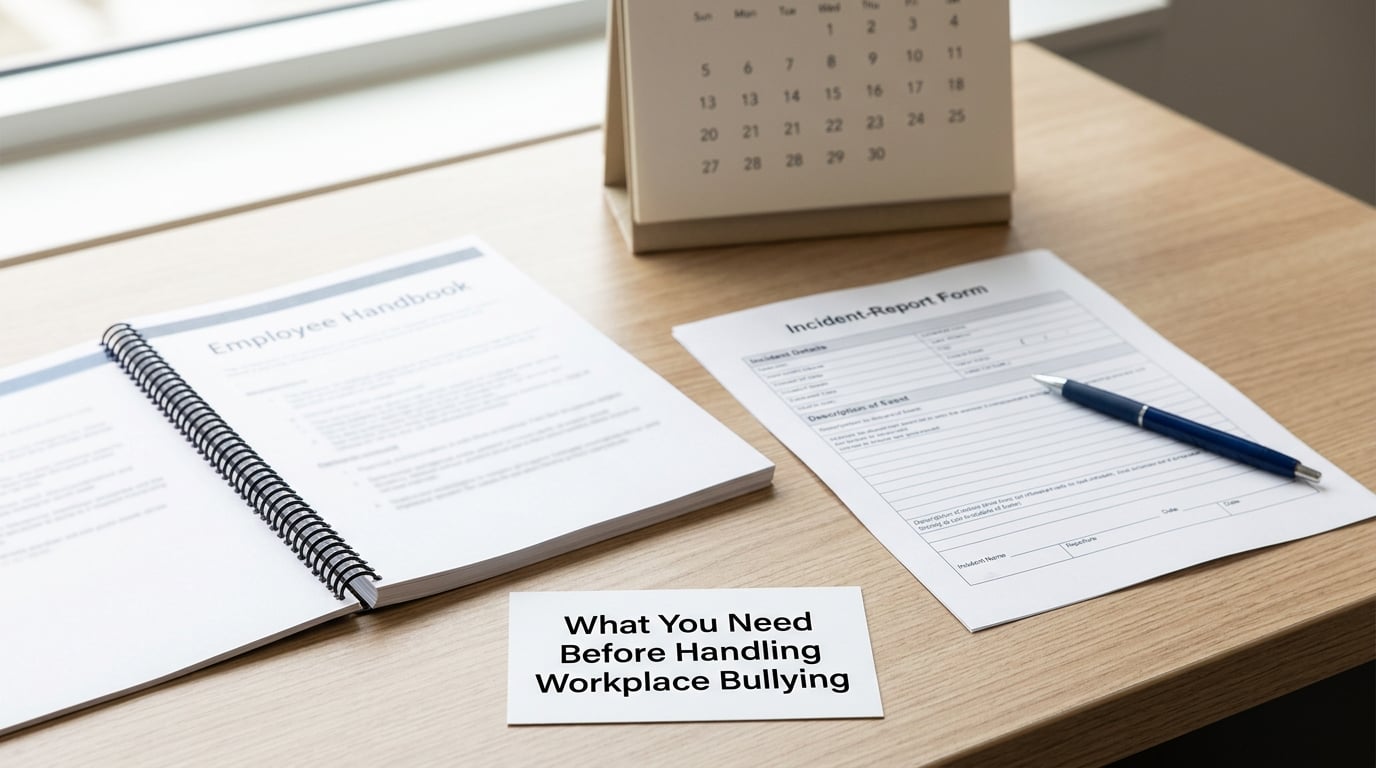
Gather these before you respond to anything, because doing it mid-complaint is what turns a manageable report into a mess.
- The employer’s policy. The employee handbook and any anti-bullying or dignity-at-work document, plus the grievance procedure it points to. Read it end to end and note which section covers the specific behaviour reported.
- The reporting channels that already exist. Who the named contact is, whether reports can be anonymous, whether a hotline exists, and what the stated response timeline is.
- Prior records. Earlier incident reports, sick absence dates, previous complaints this person has raised, and any notes from when concerns were first brushed aside.
- Contemporaneous notes from the person raising it. Dates, locations, what was said, who was present. Advice from CCOHS in Canada and Acas in the UK both stress that a journal written at the time carries far more weight than a summary written weeks later.
- Witnesses. Anyone who saw or heard it, including people who have not come forward yet. A bystander who witnessed an incident and said nothing is still a witness.
- Privacy safeguards. A clear answer to who will see the report. In most policies that is not HR alone, and telling an employee their report is fully confidential is the fastest way to lose their trust.
Two more practical items. Know who handles grievances versus investigations, because in a small organisation it is often the same person, which is a conflict you need to name early. And know your own obligations under health and safety law, which typically require a duty of care assessment regardless of what the bullying policy says.
How to Handle Workplace Bullying Step by Step
Six steps, in this order. Skipping ahead to the fifth one, deciding what to do, is the most common failure I see among managers new to this.
1. Listen and assess the immediate risk
Take the report seriously on its face, which means not interrupting and not explaining why it probably isn’t that bad. Let the person finish, then ask neutral, open questions: what happened, who else was there, how often, and what changed afterwards.
Neutral means neutral. Do not ask why they let it happen, whether they provoked it, or whether they are sure. Those questions convert a disclosure into a cross-examination within seconds.
Then assess risk, because not every report needs the same response. Physical contact, threats, or anything involving a protected characteristic or sexual harassment needs same-day escalation to HR, Employee Relations, or security, and it may change which body handles it entirely. Bullying that is happening in front of others every day is a different urgency from a pattern spread over months. If anyone is in immediate danger, contact local emergency services first.
2. Protect the reporting employee from retaliation
Retaliation is the reason many people lose their position after complaining, and it usually begins in the days before an investigation formally starts. The employer has a duty to take reasonable steps to prevent it.
Interim measures that work in most cases:
- Change reporting lines or the decision-maker so the accused does not control the target’s assignments, shifts, or performance rating.
- Move or reschedule a physical arrangement, such as shifts or desks, if the two are regularly in the same space.
- Preserve the status quo where nothing is urgently broken, because changing too much looks like the organisation believes the report.
- Limit who sees the file and who is told about the complaint.
- Name one contact person for the person raising it, so they are not chasing different answers from different departments.
Write the interim measures down and give a date to review them. An unwritten arrangement protects nobody.
3. Document the behavior and its impact
Record facts, not conclusions. A good entry describes what was observable and what the effect was, and it avoids labelling.
For each incident, capture seven fields: date, time, location, what was said in the exact words used where possible, who was present, the impact on work, and what evidence already exists. Keep it factual and unemotional — separate what was observed from what you inferred.
On evidence, ask the employee to preserve what already exists: emails, Teams or Slack messages, calendar invites, voicemails, and shared documents where comments were edited. Screenshots with dates are fine.
One caution people ask about constantly: covertly recording conversations is legal in some jurisdictions and a serious breach in others, and employer policies usually address it explicitly. Flag it rather than advising on it, and tell people to check their local position or ask their union first.
4. Investigate consistently and fairly

A fair investigation is not a long one. It is a process another reasonable manager would accept if they were the one being investigated.
What it should contain: a defined scope written down at the start, evidence review with all relevant documents, separate interviews rather than a group meeting, a chance for the person complained of to respond to the specific allegations, and a written outcome that sets out which findings are supported and by what evidence.
Two things ruin fairness more often than anything else. Interviewing the target and the accused together, which invites performance rather than evidence. And reaching a conclusion before the interviews, which shapes every question that follows.
Apply the same standard you would apply to a comparable case. If a similar complaint two years ago produced a warning, consistency means that is the likely outcome here too, whatever anyone wants. When HR is itself involved in the complaint, or HR reported it, an independent external investigator avoids a conflict that will otherwise be raised as an appeal ground later.
5. Decide and communicate the outcome
Apply the employer’s policy to the findings, rather than deciding first and looking for support afterwards. Weigh aggravating factors, which usually means repeated behaviour, a prior warning, or behaviour continuing through the investigation, against mitigating factors like a genuine first incident or a genuinely improved working relationship.
Common outcomes range from a documented conversation or written warning up to removal from the team, role change, or dismissal for serious or repeated conduct. Match the outcome to the conduct, not to how angry anyone is in the room.
Then write it down and communicate carefully. Share only what the person being told needs to know, and tell the target what was found about their complaint, what action was taken, and what happens next. Do not promise absolute confidentiality; you cannot keep it, and a broken promise is its own harm. Offer support routes in the same message.
6. Follow up and prevent recurrence
The end of the investigation is where most cases quietly fail. Book a real follow-up meeting four to six weeks out and put it in the diary now.
Before that meeting, correct the working conditions that let it happen: reporting lines, shift patterns, meeting invitations, who gets copied. A warning letter that changes nothing produces a second complaint.
At the check-in, ask what has changed rather than whether everything is fine. Give the person clear reporting options again. Watch for retaliation signals in the weeks after, which can include reduced responsibilities, cold performance reviews, exclusion from the visibility that used to come with the role, or sudden shifts in shift patterns.
At the team level, refresh expectations without naming anyone. Remind the whole team what the standard is, and confirm that the reporting route still works. If several unrelated people raise the same manager, that is a pattern in itself and belongs in the review, not in a private file.
Common Mistakes and How to Correct Them
These six come up repeatedly, and each has a straightforward corrective move.
- Dismissing the complaint as banter or personality clash. Do not. Correct it by acknowledging the report, recording it, and explaining what the process will be.
- Investigating informally, as a chat between two managers. Do not. Formalise it: define the scope in writing, name the investigator, and keep notes.
- Meeting everyone together in one room. Correct it by splitting into separate interviews and never letting the target and accused hear each other’s accounts first.
- Promising complete confidentiality. Correct it by telling the employee truthfully who will see the report, usually HR and the subject’s manager, and explain that information is shared on a need-to-know basis.
- Labelling the behaviour before reviewing evidence. Correct it by rewriting the summary in neutral terms. “Repeatedly raised concerns in writing and dismissed them” holds up. “Deliberately sabotaging” is a conclusion, and a premature one.
- Never checking for retaliation. Correct it by scheduling the follow-up meeting before the file closes, and by documenting that you did.
Frequently Asked Questions
How do I tell my manager I am being bullied?
Say it in writing, keep it short and factual, and attach your notes. A four-sentence message with two dated examples is harder to dismiss than a long account. Ask for a meeting, then send a short follow-up note recording what was said and what was agreed. If your manager is the person doing the bullying, skip that level and use the next one in the chain of command.
What evidence do I need to prove workplace bullying?
Bullying rarely leaves a single smoking gun, which is why a contemporaneous record matters most. Dates, times, locations, the exact words used, who was present, and what changed in your work afterwards form a pattern. Emails, chat messages, voicemails and screenshots add weight. Note that corroboration from a witness is helpful but not always required for a policy process.
Should I report bullying to HR even if I think nothing will come of it?
Usually yes, for three practical reasons. It starts the clock on the employer’s own policy, it creates a written record that you raised it, and it puts the organisation on notice for its duty of care. Yes, this can be dispiriting, since people describe HR as complicit often. Even where you expect no action, the written complaint protects your position later. Keep your own copy of everything you send.
What if my manager is the bully?
Go to the next level up, and most policies allow or require it. The options are HR or Employee Relations, the manager’s own manager, a director, a works council or union representative, or the named external contact. Check the handbook for the exact route. If the manager and HR are connected, or HR reported you, ask for an independent external investigator rather than accepting an internal one.
Is workplace bullying illegal?
It depends entirely on where you are, and this is general information rather than legal advice. In the United States, bullying is generally a violation of employer policy rather than a standalone federal offence, though related conduct can cross into unlawful harassment or discrimination where a protected characteristic is involved. Positions differ in the UK, Canada, Australia and New Zealand. Give the relevant body a call: the EEOC, Acas, or your local health and safety authority.
What should I bring to a formal workplace bullying meeting?
Bring your notes in date order, a short written summary of what you are asking for, and copies of any documents you want to reference. Ask in advance what the meeting is for and who will attend. Take a colleague or union representative if the policy allows it. Stay with observable facts, avoid speculating about motive, and ask what happens next and by when before the meeting ends.
Conclusion
If you are picking this up on a Monday, do five things. Listen without interrupting and write down what you hear. Put interim protections in place before the investigation starts. Document the behaviour objectively, with dates, exact words, and witnesses. Run a defined, fair process with a written outcome. Then book the follow-up meeting before you close the file.
The order is the point. Jumping to a decision is how a fair process becomes an indefensible one, and skipping follow-up is how a resolved case becomes a second complaint. Handle it once, handle it properly, and write everything down.