

Presenteeism at work is when someone turns up, or stays at their desk, while they are unwell, injured or simply exhausted. To address it, you fix the conditions that make people feel they have no choice: unmanageable workloads, thin staffing, punishing absence policies and managers who treat staying in as loyalty. The best-run employers treat it as a work-design problem rather than a character flaw.
That framing matters more than it sounds. Sickness absence is visible on a spreadsheet, while presenteeism hides inside your delivery figures. A team can hit every target while a third of it is being carried by people running on empty, and the bill arrives later as burnout, turnover and illness passing through the office.
This guide covers what to gather before you start, a six-step plan for reducing presenteeism, the mistakes that undermine it, and what to say when someone arrives unwell. It is written for HR leads, occupational health professionals and line managers in US workplaces, though the policy logic travels.
Table of Contents
- What You Need Before You Change Anything
- Step-by-Step: How to Address Presenteeism at Work
- Step 1: Presenteeism at Work How to Address It With Better Data
- Step 2: Identify the Causes Behind Working While Unwell
- Step 3: Reduce Workload and Work Strain
- Step 4: Support Employees Who Need Recovery or Care
- Step 5: Train Managers to Recognize and Respond Productively
- Step 6: Measure Whether the Plan Is Working
- Common Mistakes Employers Make
- Frequently Asked Questions
- Conclusion: Start With the Conditions That Make Work Harder
What You Need Before You Change Anything
Four things have to be in place before an organisation can genuinely address presenteeism at work. Without them, the effort turns into another wellness email that nobody reads.
A baseline built on voluntary, aggregated data. You need to know how widespread working while unwell is and which groups carry it. That means absence patterns, overtime records, turnover data and short anonymous well-being surveys. You do not need, and should not seek, individual medical records. Anything collected should be reported in groups of ten or more so no one can be identified from a small team breakdown.
A leave policy people can actually use. Read your absence policy as an employee would. Does sick pay cover part of your income or none of it? Are there attendance warning triggers that fire at three short absences? Can someone take a sick day for mental exhaustion without a note? Policies with financial penalties quietly create presenteeism, because the employee pays for the illness and then again for the absence.
Visible support from leadership. If senior leaders praise visible effort while quietly rewarding output over recovery, no policy change will hold. Name presenteeism as a priority in the same forum where you discuss delivery risk.
Privacy guardrails agreed in advance. Agree with legal and HR what data is never collected, how long it is kept, who sees it and what happens if someone discloses a health condition. Get it in writing before the first survey goes out, not after someone raises a concern.
Step-by-Step: How to Address Presenteeism at Work
Step 1: Presenteeism at Work How to Address It With Better Data
Start by measuring what employees report, not by inferring anything from health or leave records.
A short, anonymous pulse survey is the most reliable starting point. Ask four questions on a five-point scale: how often people work through illness, how often they work beyond contracted hours, how confident they feel taking a sick day, and how manageable their current workload feels. Run it quarterly, keep the sample sizes large, and report only group-level results.
Pair the survey with administrative data you already hold. Absence frequency and duration, overtime hours, and turnover intent all tell a story about strain without touching anyone’s diagnosis. Sickness absence and presenteeism are different things and one does not explain the other, so treat them as separate indicators rather than assuming low absence means healthy staff.
To calculate an absence rate for a team, divide total days absent by total working days available in the period and multiply by 100. Do it at team level, over twelve months, and compare trend lines rather than single months.
One caution: never try to infer presenteeism from protected leave, disability accommodation or occupational health records. That data exists to support people, and repurposing it destroys the trust your survey depends on.
Step 2: Identify the Causes Behind Working While Unwell
The causes are nearly always organisational, so look there before you look at individuals. Common drivers include workload that cannot be completed in the hours available, chronic understaffing, unpredictable schedules, breaks that get treated as optional, job insecurity in a tight labour market, sustained psychological stress, physically demanding roles with poor equipment, and managers who imply that leave is a career risk.
Ask through confidential channels. Short interviews, an anonymous question box and a survey free-text field tell you far more than a manager’s own account of their team’s workload, because managers rarely see the pressure their reports absorb between meetings.
Six concrete behaviours tend to show up in that material, and each points at a different fix:
- Cancelling or shortening a sick day because a deadline is close
- Arriving at work with a fever, a contagious illness or a heavy injury
- Working through weekends or evenings to catch up on a backlog that never clears
- Skipping lunch regularly so the day still adds up to enough hours
- Logging in at night or across weekends because the culture expects visible availability
- Hiding the early stages of illness to avoid being seen as a burden on the team
The last one matters most for how you intervene. Research on presenteeism keeps surfacing the same thread: people work sick because they do not want to let colleagues down, and because a vague sense of job security sits in the balance. Coercion explains part of it. Duty explains the rest.
Step 3: Reduce Workload and Work Strain
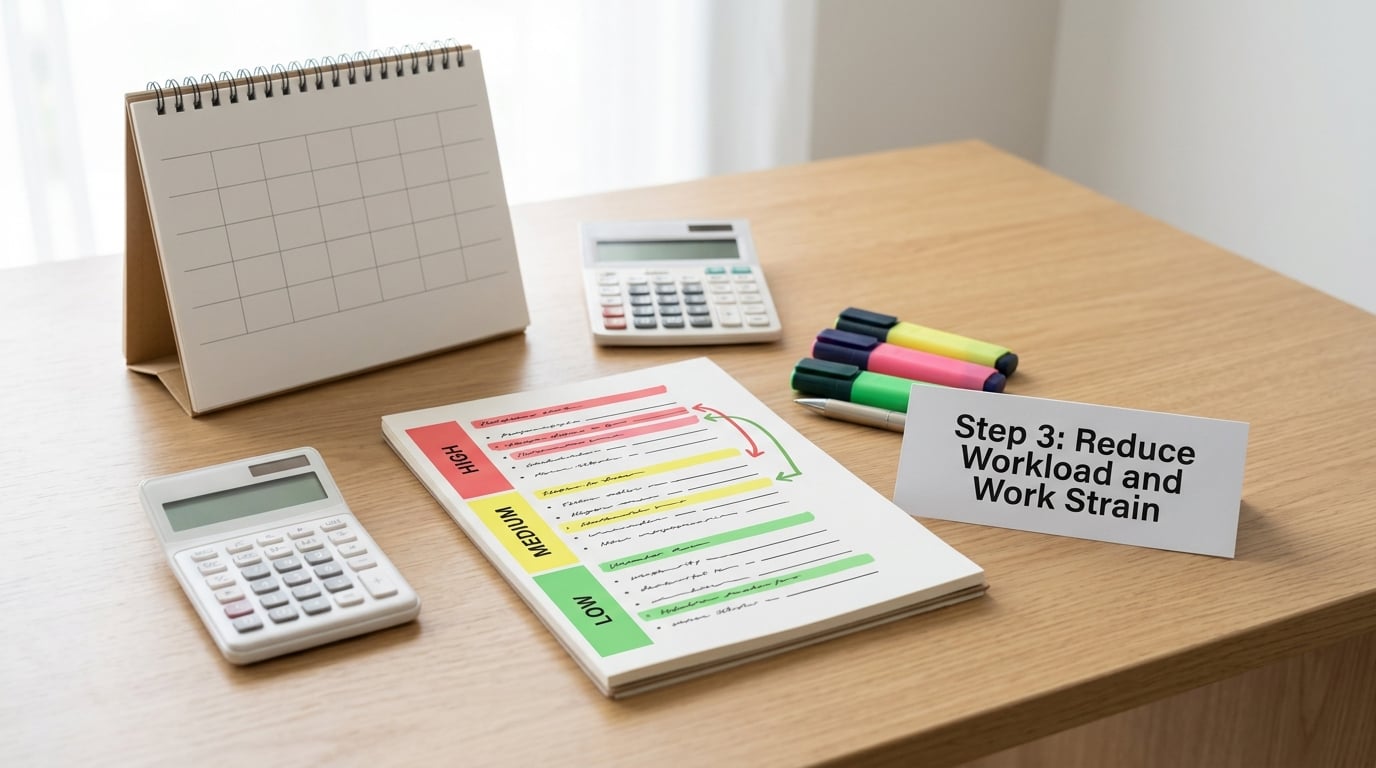
This is the step with the largest effect and the least political cost, because it touches planning rather than individual behaviour.
Reprioritise openly. When a team cannot do everything, name what gets dropped instead of letting every deadline stay nominally alive. Set deadlines against capacity rather than aspiration, distribute work by current load instead of habit, and stop treating a protected break as negotiable when a meeting is late in the day.
Review the physical and emotional load of specific roles. A production supervisor covering three shifts is not a resilience problem. Neither is a claims handler reading the same bereavement file all week. If a task is emotionally taxing, build in rotation rather than expecting tolerance to stretch.
Concrete moves for the next planning cycle: cap weekly hours on chronically overstaffed projects, add a cover arrangement for every single point of failure, run a capacity check before committing to new work, and audit who has had a real break in the past fortnight. A common pattern in operations teams is halving a recurring Sunday shift rota and seeing short-notice sick days fall within a quarter, without touching a single policy.
Step 4: Support Employees Who Need Recovery or Care
Support has to be reachable without embarrassment, because the employees who most need it are usually the ones least willing to ask.
Make sure people know where confidential occupational health services sit and who can refer them. Check that sick pay is genuinely usable, that flexible and adjusted schedules are documented rather than informal, and that a gradual return-to-work conversation exists as an option after longer illness. Where an employee assistance programme is offered, promote it without a wellness spin attached, and treat a referral as a support step rather than a performance signal.
Where an employee’s condition is affecting their work, the conversation belongs with an occupational health professional or their own clinician, not with you. Give general guidance here and be clear about the limits of your role: nothing in this plan diagnoses a condition or replaces medical advice. Anyone with persistent or worrying symptoms should be encouraged to speak to a qualified health professional, and that encouragement belongs in your policy language rather than in a manager’s assumptions.
Step 5: Train Managers to Recognize and Respond Productively
Most managers are given attendance expectations and no guidance on what to do when someone turns up clearly unwell. That gap is where presenteeism takes hold.
Train managers on four behaviours: notice change, ask privately, respond supportively and document the work impact rather than the health detail.
Notice the things you can actually observe. Someone is slower than usual, missing detail they normally catch, making errors in work they do well, or repeatedly working outside normal hours. Do not build a case around speculation about why.
Ask privately, once, without an audience. Language that works: “You have looked rough this week and I am not asking for details. How can I take some pressure off?” Or, when someone arrives visibly unwell: “Go home. Nothing you do today is worth passing this around.” The blunt version, repeated across workplace forums for years, is that never taking sick days is not a flex, and treating it as one is exactly what keeps people working through illness.
Document the impact, not the condition. Note that deadlines slipped, work needed review, or hours rose. Never write a diagnosis into a management record, and never pass on what someone told you in confidence.
Step 6: Measure Whether the Plan Is Working
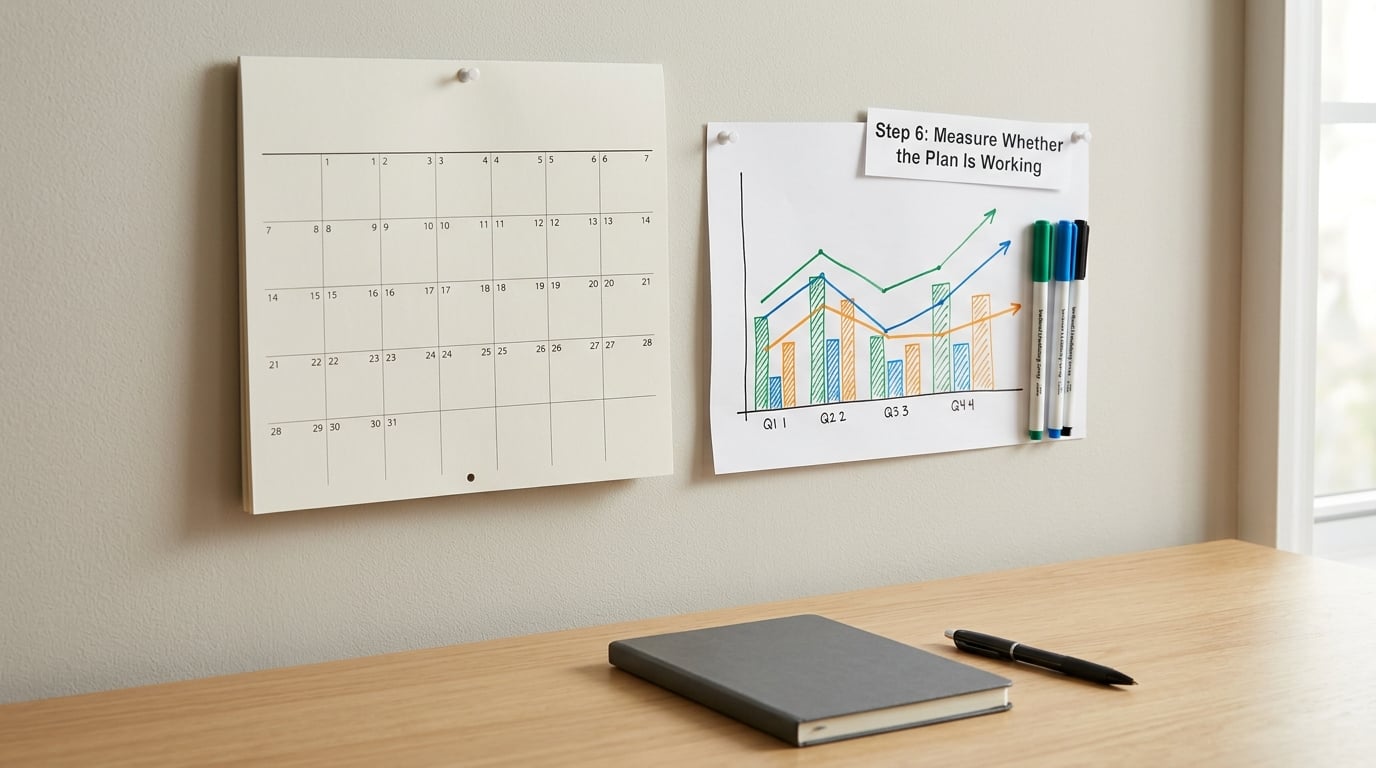
Review at 90 days and again at six months, using the same voluntary and aggregated indicators you set up in Step 1.
At 90 days, ask whether people believe they can take leave without career cost. Look at whether the deadline you dropped actually got dropped, whether protected breaks are being taken, and whether managers are using the scripted responses instead of improvising. If people still report the same pressure, the workload changes did not go deep enough and you go back to Step 3 rather than adding another benefit.
At six months, look at the trend: reported ability to work safely and effectively, workload and stress scores, schedule control, short-term absence patterns, and turnover intent. Interpret every improvement alongside your privacy and equity checks. If a group that was previously high-risk has improved, ask why and replicate it. If the numbers improved while a particular team got worse, the change has been uneven and needs explaining before it gets reported as a success.
Common Mistakes Employers Make
Most failed presenteeism programmes fail for the same three reasons. Each has a straightforward correction.
Common Mistakes: Treating Presenteeism as a Wellness Problem
A meditation app and a gym reimbursement do not fix a team carrying three workloads. Individual wellbeing advice sits on top of working conditions, and if those conditions stay the same, the advice has nothing to work with.
The correction is an organisational audit: for each high-presenteeism group, list workload volume, staffing ratio, schedule predictability, break protection, equipment quality and decision latitude. Fix the worst two items. Notice that the audit itself often produces a bigger culture signal than any wellness campaign, because it tells employees their time is worth a planning session.
Common Mistakes: Monitoring Employees Too Closely
Tracking individual attendance to the decimal, mining email or badge data to infer illness, or flagging anyone who works while unwell treats people as sources of risk rather than the reason the organisation functions. It also produces bad data, because people under scrutiny simply work differently rather than working better.
Replace it with aggregated, voluntary measurement and hard limits on sharing personal information. Publish what you collect and what you never will, make the survey anonymous beyond a reporting threshold of ten, state plainly that disclosure carries no penalty, and have legal review the policy before launch. Where data comes from an employee assistance programme or occupational health, treat it as entirely separate from performance management.
Common Mistakes: Using a One-Size-Fits-All Solution
Presenteeism in a laboratory, a construction site and a contact centre has almost nothing in common in cause or consequence. A single global intervention will land in one of three ways: irrelevant, resented, or both.
Bring the diagnosis to the people who live it. Ask each department what makes working while unwell feel unavoidable, then test adjustments separately in two or three groups and compare responses. Research-led sector reviews consistently point to the same pattern: pharmaceutical and science, professional services and construction carry the heaviest burden, while legal, banking and manufacturing run noticeably lower. That gap is useful, because the higher-risk groups usually already know which specific constraint is biting.
Frequently Asked Questions
What does presenteeism mean at work?
Presenteeism is when an employee attends work, or keeps working, while unwell, injured or too exhausted to function at their normal level. It is the hidden opposite of sickness absence: instead of missing days, they show up and perform below capacity. It also covers working well beyond contracted hours. It is difficult to see in delivery data, so employers usually detect it through anonymous wellbeing surveys rather than records.
Can you give me an example of presenteeism?
A warehouse operative with a bad back finishes the shift because the rota cannot be covered. A consultant cancels a sick day to hit a client deadline. A developer works evenings and weekends because the team is two people short. A parent works a fever because they think staying home will look bad. Every one of these trades reduced capacity for the sake of appearing committed, and each hides inside normal-looking performance figures.
How do I calculate an absence rate for an employee?
For a team, divide total days absent by total working days available in the period, then multiply by 100. Use twelve months rather than a single month so seasonal and one-off events settle out. Compare the trend against the same period a year earlier and against comparable teams. Run it at team level, never per person: individual rates turn absence data into a performance score, which pushes people to work while unwell.
Is it inconsiderate to go to work when I am sick?
Usually the opposite is true. Many infections spread easily in offices, meeting rooms and shared vehicles, so an unwell colleague turning up exposes the whole team. Colleagues who then catch the illness end up absent themselves, which is part of why high-presenteeism sectors also show higher absence rates. If leaving early feels wrong, the fix belongs in the policy: adequate sick pay, cover plans, and managers who make staying home easy.
Can I leave work early if I feel sick?
In most US workplaces you can, and in many cases your employer is required to let you. Federal rules such as the FMLA protect eligible employees who need leave for a serious health condition, and state sick leave statutes add protection in some places. Tell your manager you are unwell and need to go home; you do not owe a diagnosis at that moment. If you are contagious or severely unwell, staying is a risk to yourself and your colleagues.
Should managers discipline employees who work while sick?
No. Treating visible effort as commitment creates presenteeism, and treating a spreading illness as a breach punishes the person who needs support while exposing everyone else. The productive response is to notice, ask privately what help is needed, and adjust the work rather than the person. Document the effect on output, not the health condition. Attendance discipline still applies to unexplained absence, which is a separate conversation.
Conclusion: Start With the Conditions That Make Work Harder
If you only do four things this quarter, do these: run one anonymous pulse survey and publish the group results, audit your absence policy for financial penalties, pick the single team carrying the heaviest workload and drop something real from it, then give every manager the script for sending someone home.
Presenteeism rarely comes from employees who want to work while ill. It comes from a workplace where the cost of resting is higher than the cost of going in, and it stays there until someone changes that arithmetic. Treat it as work design, protect the privacy of the people doing the work, and let the numbers move. Anyone who needs guidance about their own health should speak with a qualified clinician rather than a manager.