
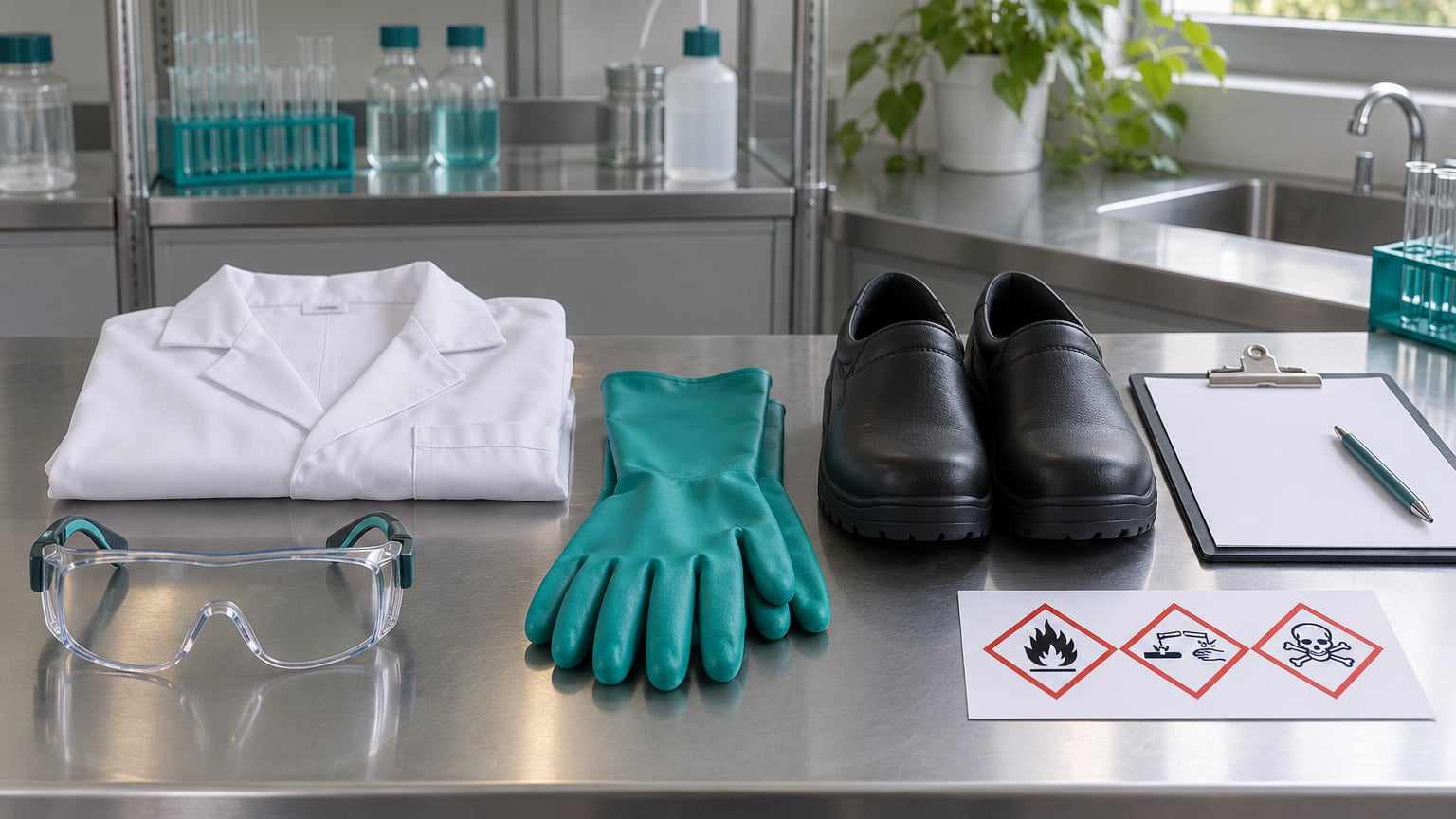
Lab safety rules are the set of habits, checks, and written procedures that keep people working around chemicals, biological samples, heat, electricity, and pressure from getting hurt. Whether you run a teaching lab, a quality control bench, or a research suite, the same core expectations apply: know your emergency procedures, wear the right protection, read the hazard information before you start, and report anything that goes wrong. This guide breaks those expectations into ten rules you can train on, post at the bench, and check during a walkthrough.
Most lab incidents that make the news were not exotic failures. They were ordinary tasks done with a missing glove, an unlabeled bottle, or a hood that had not been checked in months. That is good news for employers and safety teams, because the fixes are boring and cheap.
Table of Contents
- Lab Safety Rules at a Glance
- 1. Know the Laboratory’s Emergency Procedures
- 2. Wear the Right Personal Protective Equipment
- 3. Identify Chemical Hazards Before Starting Work
- 4. Never Eat, Drink, or Smoke in the Laboratory
- 5. Handle Chemicals and Glassware Safely
- 6. Keep Work Areas Clean and Well Organized
- 7. Use Equipment Only After Training and Inspection
- 8. Work Safely with Heating, Electrical, and Pressure Equipment
- 9. Report Spills, Exposures, Injuries, and Near Misses Immediately
- 10. Keep Training, Labels, and Records Current
- Frequently Asked Questions
- What are the four main lab safety rules?
- What PPE is required in a laboratory?
- How should chemicals be labeled and stored in a lab?
- What should you do after a chemical spill or eye splash?
- How often should eyewash and safety shower equipment be tested?
- Do lab safety rules differ for students and professional staff?
- Conclusion
Lab Safety Rules at a Glance
Use this table as a walkaround checklist. Each row names the hazard it controls, the action that prevents it, and the person who should be able to confirm it is being done.
| Rule | Primary hazard | Required action | Who verifies |
|---|---|---|---|
| 1. Know emergency procedures | Delayed response to fire, spill, exposure | Locate exits, eyewash, shower, alarm signals, assembly point | Supervisor at orientation |
| 2. Wear correct PPE | Skin, eye, and inhalation exposure | Eye protection, coat, compatible gloves, closed footwear | User and safety officer |
| 3. Identify chemical hazards first | Toxic, corrosive, flammable, reactive materials | Read label and Safety Data Sheet before use | User, verified by chemical hygiene officer |
| 4. No food, drink, or smoking | Contamination and ingestion | Consume only in designated break areas | All personnel and visitors |
| 5. Handle chemicals and glassware safely | Spills, breakage, splashes, reaction | Use carts, secondary containers, labels, inspect glassware | User, audited by safety officer |
| 6. Keep work areas clean | Slips, trips, broken glass, cross-contamination | Clear aisles, discard waste, wipe surfaces at end of shift | Everyone; checked in walkthroughs |
| 7. Train before using equipment | Machine injury, electrical shock, pressure failure | Authorization, manual review, pre-use inspection | Manager or equipment owner |
| 8. Work safely with heat, power, and pressure | Burns, fire, shock, implosion | Approved equipment, clearances, ventilation, temperature control | Facilities and equipment owner |
| 9. Report incidents and near misses | Repeat injuries, hidden damage, lost time | Report immediately, preserve facts, document near misses | Safety officer and manager |
| 10. Keep training and records current | Outdated practice, unlabeled chemicals, lapsed inspections | Orientation, task training, refreshers, updated inventories | Safety officer and records owner |
1. Know the Laboratory’s Emergency Procedures
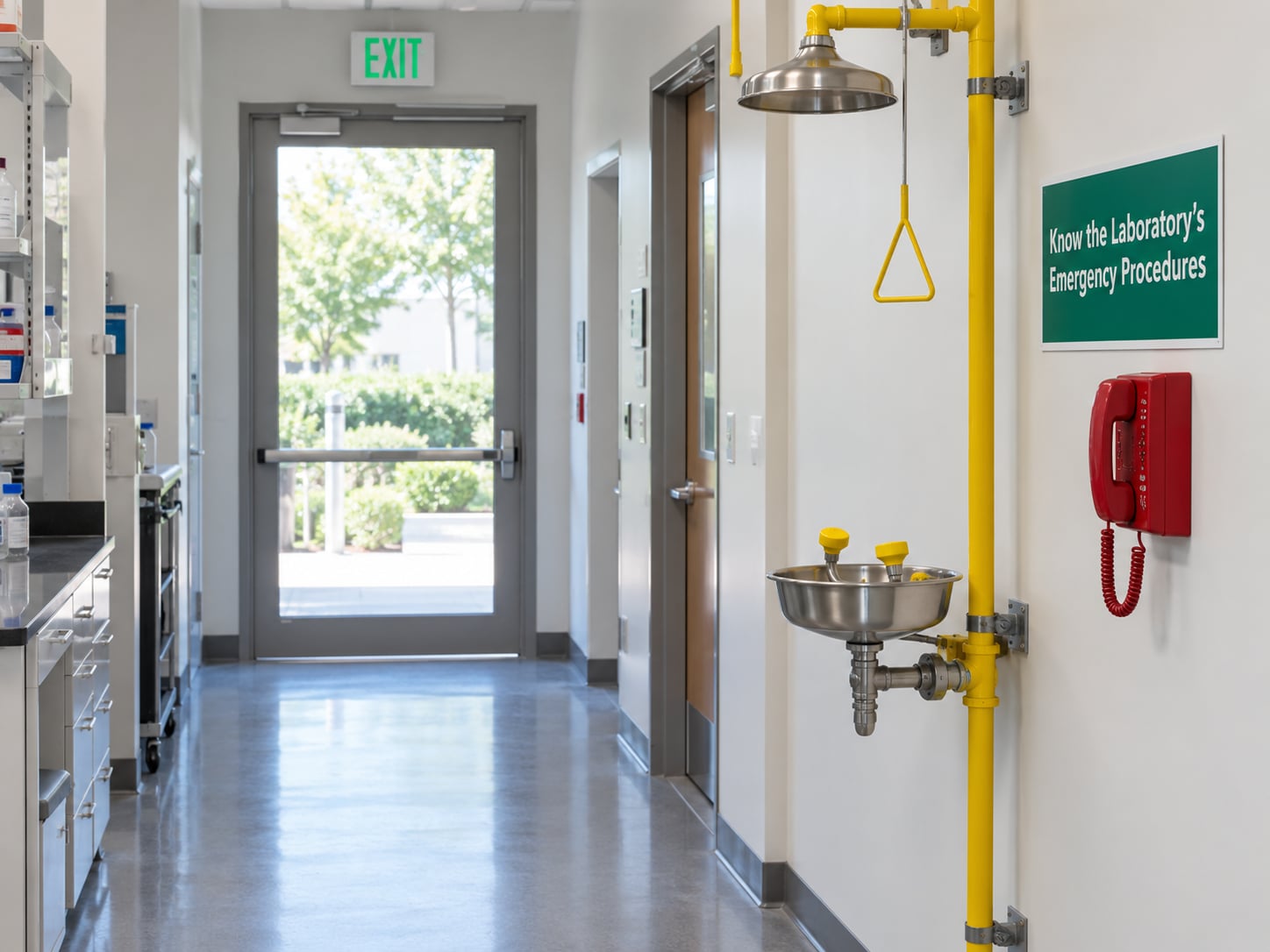
The first rule is the one people skip because nothing has gone wrong yet. Walk the two exits from your bench, note where the alarm sounds from, and find the eyewash and safety shower within the time it takes you to walk there.
Know what the alarm means in your building, because a continuous tone and an intermittent beep often point to different problems. Write down the emergency number for your institution and the address you would give a paramedic, since labs are often hard to find from the street.
Ask where the assembly point is and who calls emergency services. Supervisors should be able to confirm that the eyewash and shower were activated that week, which is a routine check that catches failed valves and blocked drains.
A new starter should be able to point at the spill kit, the fire extinguisher, and the first aid kit without hunting. If they cannot, that is an orientation gap, not a worker failing.
2. Wear the Right Personal Protective Equipment
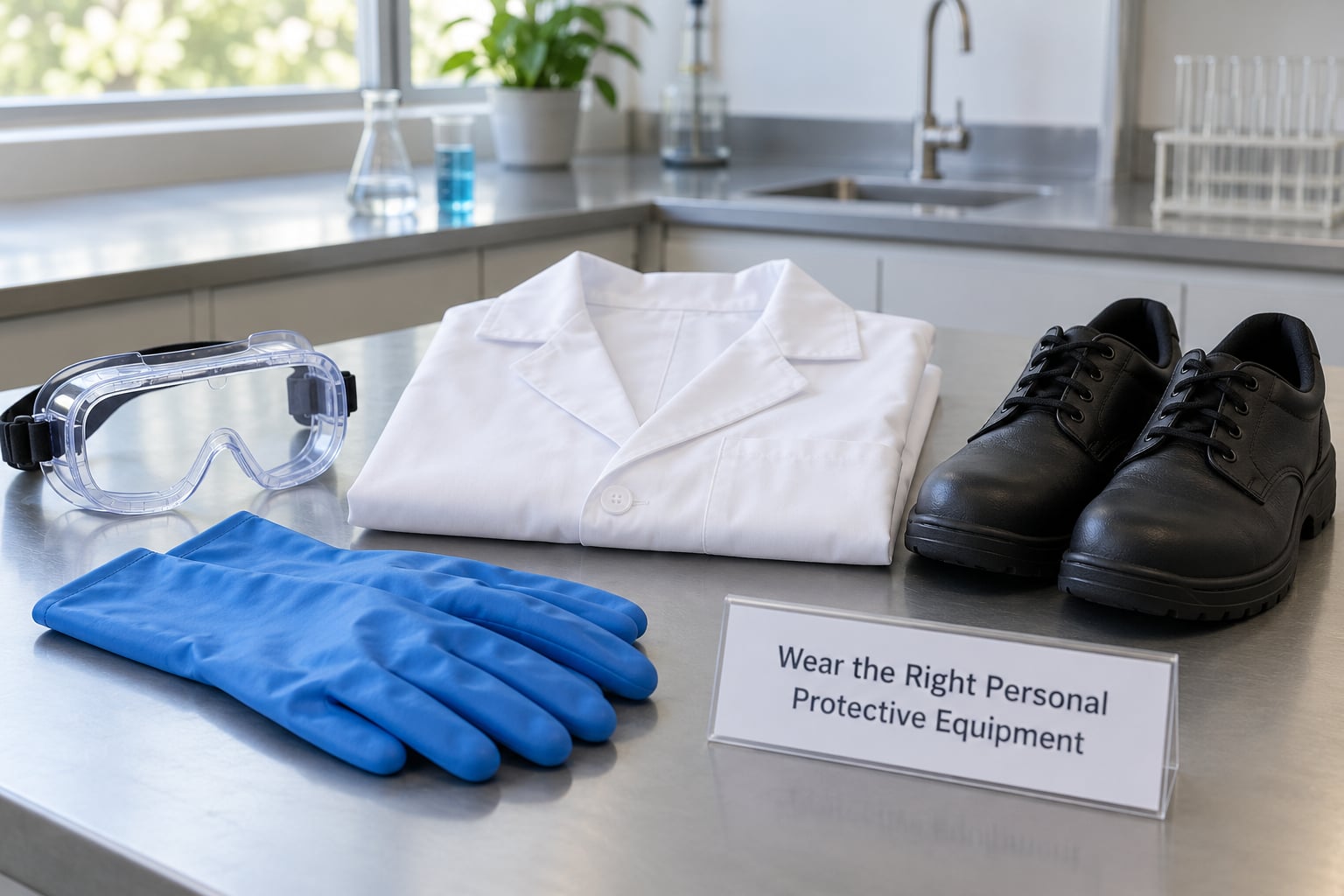
Personal protective equipment is the last line of defence, and it only works if it is the right item. Safety glasses protect against flying fragments and low-energy splashes; goggles seal around the eye and are the minimum for chemical handling at a bench.
Hands need the same attention as eyes. Nitrile suits many routine solvents, but it degrades quickly with some chemicals, and latex offers almost no chemical resistance at all. Check the glove chart in your Safety Data Sheet rather than guessing from the colour of the box.
How to match PPE to the task
- Eye and face: sealed goggles for liquid splashes, a face shield over goggles when pouring or working with cryogens
- Body: buttoned lab coat as a minimum, flame-resistant coat for furnaces and high-heat work, chemical apron for large transfers
- Feet: closed-toe, closed-heel shoes with a low heel; open sandals and canvas shoes are not acceptable
- Respiratory: only under a written program with medical clearance, fit testing, and cartridge change schedules
Dress code details catch people out. Long hair must be tied back, dangling jewelry and drawstrings stay away from moving parts and flames, and synthetic clothing melts. Adjust an apron or sleeve cuff so nothing loose hangs over a hot plate or a rotating shaft.
Inspect equipment before putting it on. A scratched lens, a torn glove cuff, or a coat with a hole in the sleeve is not personal protective equipment any more; it is a piece of clothing.
3. Identify Chemical Hazards Before Starting Work
Every container in a working laboratory carries a label that tells you what it is and what it will do to you. Read it before you pick the bottle up, not after you have already opened it. If the label is missing or illegible, treat the contents as unknown until someone identifies them.
The Safety Data Sheet is the deeper document behind that label. Sections 2 and 3 give hazards and composition, section 4 covers first aid, section 7 handles handling and storage, and section 10 lists stability and reactivity, which is where incompatibilities appear.
Then check ventilation. Volatile, toxic, or carcinogenic work belongs in a functioning fume hood with the sash at working height, not on an open bench. If airflow at the hood face is not reading normal on its indicator, treat the hood as out of service and find out why before proceeding.
Stop work when information is missing. A procedure that names a reagent you cannot find, or a spill with no data on the substance involved, is the moment to ask rather than improvise. Our guide to reading a chemical Safety Data Sheet walks through the sections that matter at the bench.
4. Never Eat, Drink, or Smoke in the Laboratory
Food in a laboratory is a contamination route in both directions. A dropped crumb supports bacterial growth, a cup of coffee leaves a ring that hides a chemical film, and an open drink is a vapour exposure waiting for someone to lean over it.
Hand washing protects the other way. Gloves carry whatever they touched, so phones, door handles, and notebooks get contamination moved out of the hood and into the office.
Set up a designated break area away from the bench, and keep water in a closed, labelled personal container rather than a lab beaker. Visitors, contractors, and delivery drivers all fall under the same rule, which is why it belongs in visitor sign-in and induction material.
5. Handle Chemicals and Glassware Safely
Carry chemicals in a cart or in a suitable carrier, not cradled in your arms while opening a door. Use a bottle carrier for larger containers and never carry more than you can see over.
Put any chemical that leaves its original bottle into a compatible secondary container, and label that container with the chemical name, concentration, date, and hazard warnings. Unlabeled secondary containers are the single most common finding in laboratory inspections, and the fix costs a marker and two minutes.
Glassware fails for predictable reasons. Inspect flasks and beakers for chips, star cracks, and etched or frosted joints before use, discard damaged glass into a rigid puncture-resistant container, and never fill a container that has been heated while it is still warm. Thermal shock and joints that stick are how most breakage injuries start.
Storage follows compatibility, not convenience. Flammables belong in an approved cabinet, corrosives in a dedicated one, and anything that reacts violently with air or water needs its own arrangement. Segregate waste by hazard class and label every container, including the waste stream itself.
6. Keep Work Areas Clean and Well Organized
Clutter turns small problems into injuries. A cluttered bench hides a cracked beaker, a blocked aisle becomes an exit route during an evacuation, and a spill left for ten minutes is walked through by someone carrying a laptop.
Clean as you go: wipe the surface when you change tasks, cap and label anything in progress, return reagents to their home rather than crowding the bench, and take waste out before the container is full.
Housekeeping is also a shared discipline. Leaving a mess for the next person is the most common complaint graduate researchers hear from staff, and it is one of those habits that quietly signals that nobody is accountable for the room.
Long bench sessions also create injuries that never show up in an incident report. Pipetting for hours, awkward reach, and repeated lifting are worth reviewing, and ergonomics for lab workers covers the adjustments that keep a career from shortening.
7. Use Equipment Only After Training and Inspection
Authorization comes first. If nobody trained you on the instrument, you are not cleared to run it, regardless of how simple the control panel looks. Read the manual, watch the training session, and record the authorization in writing.
Run the documented pre-use check every time: guards fitted, interlocks functioning, emergency stop reachable, chamber or rotor balanced, cables and hoses intact. Anything that fails goes out of service with a tag, not a note on a sticky sheet.
Report malfunction rather than working around it. Disabling an interlock, wedging a lid, or bypassing a lid sensor converts a designed safeguard into a guess. Our tool safety inspection checklist is a usable format for recording those checks.
8. Work Safely with Heating, Electrical, and Pressure Equipment
Hot plates, furnaces, and water baths need ventilation, clearance from flammables, and a working temperature control that you have confirmed rather than assumed. A beaker of solvent on a hot plate in a hood is a different decision from the same beaker on an open bench.
Electrical faults in wet areas kill faster than people expect. Inspect cords for damage, keep connections dry, and never use an extension cord as a permanent supply. Equipment should be approved for the environment and grounded, and damaged plugs get replaced rather than taped.
Pressure and spin equipment need their own discipline. Balance centrifuge rotors properly, never open a pressure vessel while it is hot, and let autoclaves depressurise on their own cycle. Soundproofing a centrifuge does nothing for a rotor that is unbalanced, and closing the lid hard is not a substitute for a working interlock.
9. Report Spills, Exposures, Injuries, and Near Misses Immediately
Small spills get handled with the lab spill kit if the material and quantity are within what your procedures allow and you are trained for it. Large spills, anything released outside a hood, and any release of a flammable or highly toxic material mean you evacuate, warn people, and call emergency services from a safe position.
Exposure is an emergency even when it looks minor. Flush to the eyewash or safety shower immediately and continue flushing for the time your posted instructions require, then get medical evaluation. Delayed attention to a small splash or a mild inhalation is how a manageable exposure turns into a reportable injury.
Near misses matter as much as injuries. A dropped beaker that broke nothing, a hood alarm that turned out to be a fan failure, or a solvent poured into the wrong waste stream are all free lessons. Record the facts, the sequence, and the corrective action, then share the outcome with the people who work in that room.
Keep records honest rather than tidy. People under-report when reporting feels like an admission of fault, so supervisors who thank the reporter and fix the cause get far more information than those who start an investigation the moment a form appears.
10. Keep Training, Labels, and Records Current
Rules decay. A container relabelled during a busy week, a cabinet whose segregation drifted after a move, and an inspection nobody logged are all drift, and drift is how a compliant lab stops being compliant.
Build the basics into the calendar: orientation for every new person, task-specific training before independent work, and refresher sessions on a schedule rather than after an incident. Keep an inventory of chemicals in the room, equipment that is in service, and the last check date for each eye and emergency wash station.
Close the loop on findings. A chipped beaker reported in March should be gone in March, and a corrective action with no owner and no date is just a complaint with a form attached. Supervisors who walk the floor on a schedule catch the small items while they are still small.
In the United States, OSHA’s laboratory standard and the hazard communication standard set the floor, and state plans add their own requirements. Institutional environmental health and safety offices handle the local interpretation, so ask them rather than relying on a checklist you found online.
Frequently Asked Questions
What are the four main lab safety rules?
Four rules cover most laboratory risk. Wear the correct protective equipment for the task, including eye protection, a lab coat, compatible gloves, and closed footwear. Know the emergency procedures before you start work, including exits, alarms, eyewash and shower locations, and the assembly point. Read the label and Safety Data Sheet for every chemical before using it, and check storage compatibility. Report spills, exposures, injuries, and near misses immediately.
What PPE is required in a laboratory?
At minimum, most laboratories require sealed safety goggles, a buttoned lab coat, chemical-resistant gloves selected for the substances in front of you, and closed-toe, closed-heel shoes. Add a face shield when pouring or handling cryogens, a flame-resistant coat near furnaces and high-heat work, and a chemical apron for larger transfers. Respiratory protection is only used under a written program with medical clearance and fit testing.
How should chemicals be labeled and stored in a lab?
Every container needs a readable label with the chemical name, concentration, hazard warnings, and the date it was placed or opened. Anything transferred to a secondary container carries the same information, and waste containers are labeled with their contents and hazard class. Store flammables in an approved cabinet, corrosives separately, and reactive materials apart from anything they could attack. Compatibility governs placement, not convenience.
What should you do after a chemical spill or eye splash?
For a small spill you are trained and authorized to handle, use the lab spill kit with the correct absorbent and follow your posted procedure. For a large spill or an unknown substance, evacuate, warn others, and call emergency services from a safe position. After any eye or skin contact, flush at the eyewash or safety shower immediately and keep flushing for the posted time, then seek medical evaluation.
How often should eyewash and safety shower equipment be tested?
Plumbed eyewash stations and safety showers should be activated routinely, often weekly, with the result recorded, and they need a fuller inspection and service on a schedule set by your institution. Portable eyewash units need their solution replaced and expiry dates checked. Confirm activation paths stay clear at every test, because a blocked access route makes a working station useless.
Do lab safety rules differ for students and professional staff?
The core expectations are the same, including PPE, labeling, housekeeping, and incident reporting, and students working in a teaching lab are supervised under institutional rules. The differences are in oversight and scope. Staff typically work independently, maintain the chemical inventory, perform equipment inspections, and own waste disposal, while students work from an assigned protocol with the instructor present and are told which tasks they are not permitted to do alone.
Conclusion
Start with the room you are responsible for. Walk it, confirm the emergency procedures and equipment locations still match reality, and check that everyone working there has the training and protective equipment their tasks require.
Then set the rhythm that keeps these lab safety rules alive: a documented orientation, routine inspections with recorded results, and a reporting culture where a near miss gets thanked rather than punished. Safety holds up in a laboratory one ordinary task at a time.