
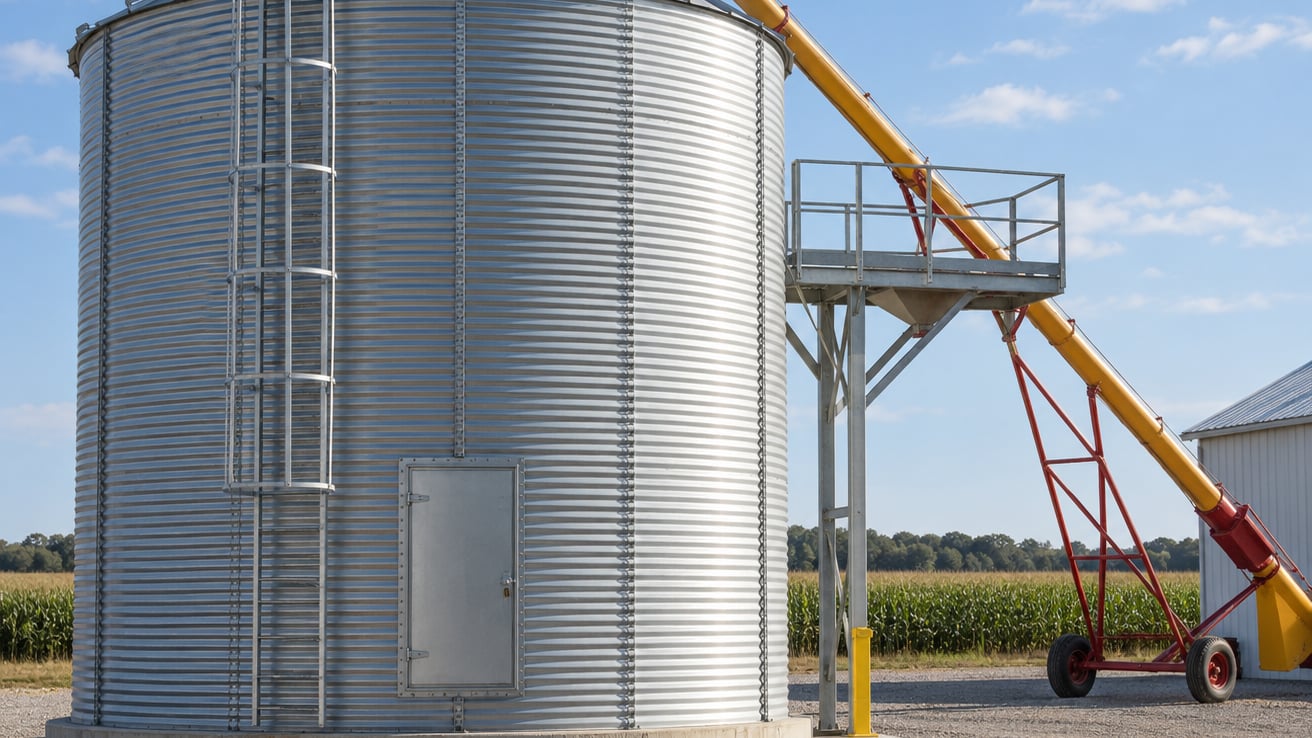
Grain bin safety is the set of rules, equipment and work habits that keep people from being trapped, suffocated or killed in and around grain storage bins. Working grain is not a person-trapping substance the way quicksand is a movie version of one: a worker standing on a grain surface can sink to the waist within seconds, and the grain packs tighter around the legs with every movement. Nobody enters a bin without a written permit, a hazard assessment and a trained rescue capability standing by outside.
Most bin deaths happen to experienced people doing ordinary jobs in a hurry. Harvest pressure, a short afternoon of daylight and a bad afternoon of grain condition are the three ingredients in nearly every report. This guide walks through what goes wrong, how to prevent it, what a compliant entry actually involves, and what to do in the first minute after someone goes under.
The rules below apply to on-farm storage, commercial grain elevators, seed plants, feed mills and any contractor emptying bins for someone else. A bin that someone else owns is still the bin where your employee can die.
Table of Contents
- Grain Bin Safety: Essential Practices for Safer Workplaces
- What Are the Main Grain Bin Hazards?
- How Do You Prevent Grain Bin Entrapment and Engulfment?
- Grain Bin Safety Requirements Before Anyone Enters
- What Equipment Is Needed for Safe Grain Bin Work?
- How Can Grain Dust Explosions Be Prevented?
- How Do You Train Workers and Supervisors Safely?
- What Should You Do if a Worker Is Trapped in Grain?
- How Can Employers Audit Grain Bin Safety?
- Frequently Asked Questions
- Can a worker walk on the grain surface inside a bin?
- Why does grain bridge, and why is it dangerous to break up?
- When is a grain bin considered a confined space?
- Do respirators and dust masks make bin entry safe?
- What should you do in the first minute after someone falls into a bin?
- Why can a worker drown in sorghum but usually not in wheat?
- Conclusion
Grain Bin Safety: Essential Practices for Safer Workplaces
The core practice is simple to state and hard to live up to: treat entry as the exception, not the routine. Grain bin safety programs work by removing the reasons people feel they need to go inside. That means keeping grain in condition so it never crusts over or hangs up, fitting bins with external sampling and level monitoring, and giving supervisors the authority to refuse entry without anyone losing face over it.
The hazards are not exotic. They are engulfment, entrapment, bridged grain that fails without warning, powered equipment that pulls people in, combustible dust that ignites, falls from ladders and roof openings, and air inside a sealed bin that will not support life. Several of these arrive at the same time, which is what makes a bin entry dangerous rather than merely unpleasant.
How fast does grain trap a person?
Extension publications from land-grant universities consistently describe the same timeline: a person standing on flowing grain becomes immobile in about four to five seconds, and a person submerged in grain can be fully engulfed in under twenty seconds. Once the chest is compressed, the grain does not leave air pockets the way water would. A person buried to the neck cannot lift their own head, and an arm lost in grain often cannot be pulled free by one person pulling on it.
That is why the recommended survival position matters so much. The grain is denser than the body, so movement toward the surface has to come from the narrowest available route, which means straight up rather than sideways. People who survive report the same three things: they stayed near the bin wall, they stopped thrashing, and they kept their hands above the grain.
How many people die in grain bins?
Purdue University’s agricultural confined space incident tracking recorded 34 grain entrapments in 2024, 14 of which were fatal, roughly a 25 percent increase over the year before. Canadian data covering 2011 through 2020 counted 27 asphyxiation fatalities in that period alone. Entrapment and engulfment now sit among the leading causes of death in United States agricultural work, behind tractors and machinery, and each year the incidents cluster in the same window of days after harvest when bins are fullest and the work is most rushed.
None of those deaths require unusual weather or unusual equipment. They require one person, one bin and one moment of convenience.
What Are the Main Grain Bin Hazards?
Each hazard below has its own failure mode and its own first control. Learning to tell them apart in the moment matters, because the correct response in the first ten seconds differs between a bridged crust, a flowing auger hazard and a toxic atmosphere.
| Hazard | Typical situation | Immediate control |
|---|---|---|
| Engulfment | A worker steps onto grain in a bin that is flowing, unloading or being emptied | Never enter a bin with grain moving; work from outside or from a floor with grain fully removed |
| Entrapment | A worker sinks into grain that is not flowing at all, usually wet or crusted | Eliminate the need to enter; treat any grain surface as an engulfment hazard |
| Bridged grain or hung-up grain | Grain forms a stable arch or a vertical wall that blocks the flow channel | Never enter to break it; use an external pole or a vibrator from a safe position |
| Mechanical entanglement | Hands, clothing or a limb reach an operating auger, sweep or conveyor | Lock out and tag out every drive; verify zero energy before any entry |
| Toxic or oxygen-deficient air | A sealed bin holds depleted air, fumigant residue, mold spore clouds or a mixture of gases | Test the atmosphere before entry; supply ventilation and test the entrant |
| Falls | Climbing a ladder inside a narrow bin, working near an open floor or side door, standing on grain | Guardrails and fixed access; full-body harness with an external anchor point |
| Combustible dust | Dust hanging in the air from handling, sweeping or conveying grain | Housekeeping, dust collection, bonding and grounding, ignition source control |
Two of these deserve more attention than they usually get. The first is bridged grain, because the failure is delayed: the arch holds for hours, then a vibration from an auger or a scoop breaks it and the column moves as one body. The second is atmosphere, because a bin that has been sealed since last season can hold air that a person will not notice is wrong, because the first breath feels fine.
How Do You Prevent Grain Bin Entrapment and Engulfment?
Prevention follows the hierarchy of controls, from most effective to least. Most grain bin safety failures happen because a site skips to the bottom of the hierarchy and relies on personal protective equipment alone, which is the weakest layer available.
1. Eliminate the need to enter
The most reliable control is not entering. That means storing grain so it stays in condition, fitting bins with external level indicators and temperature cables, using an inspection door or camera rather than climbing in to look, and coring a bin from an auger instead of digging into it by hand. Cooling, coring, cleaning and checking is the sequence most extension services recommend for keeping spoilage from creating an entry in the first place.
2. Work from outside the bin
Hung-up grain can usually be cleared from outside with a long pole, a vibrator or a grain spade applied through the roof hatch from a platform, with everyone standing clear of the discharge. Sampling can be done with a probe. Unloading a plug from a sweep head can be done by watching the head from a distance and reversing the auger from a safe control point. Most of the tasks that get people killed have a slower outside-the-bin alternative.
3. Physically isolate the stored grain
Where entry cannot be avoided, the stored grain itself has to be removed or isolated. Clearing grain down to the floor removes the engulfment hazard outright, which is why floor-level entry in an emptied bin is a fundamentally different job from entry above the grain line. Ladder cages inside bins, fixed stairs and rest platforms reduce the fall hazard that remains even in an empty bin.
4. Lock out and tag out every energy source
Every auger, sweep, conveyor, elevator leg and gate drive must be de-energized, locked and tagged before entry, and the lock must be verified as zero energy rather than assumed. Hydraulic and pneumatic systems need their own isolation and bleed-down. Controls that can be operated from outside the bin should be locked out so nobody restarts equipment on a curious impulse while someone is inside.
5. Use a written procedure, not a verbal one
A spoken assurance across a yard is not a control. The written procedure should name the bin, the material, the hazards, the roles and the rescue arrangement for each specific entry. If your operation does not have one, how to write a standard operating procedure for safety is a practical starting point, and adapting that format to bin entry is a small job compared with the consequences of skipping it.
One more point deserves emphasis: walking on the grain surface inside a bin is never acceptable, including when the grain looks firm and dry. A crust can hide a hollow, and the crust breaks without warning under a person’s weight.
Grain Bin Safety Requirements Before Anyone Enters
Entry into a bin with stored grain or a hazard atmosphere is treated as a permit-required confined space under United States occupational safety rules, and the general grain handling standard, 29 CFR 1910.272, sets the requirements for grain handling equipment and preventive maintenance. The exact classification of a given bin depends on what is stored inside it and on the hazard assessment, but the safe operating assumption is that a full bin is a permit-required confined space and needs the full process.
The minimum elements before anyone crosses the threshold are: the bin and its contents identified, engulfment and atmospheric hazards assessed, entry authorized by a responsible person, the atmosphere tested where required, all energy isolated and verified, communication established with the outside attendant, and a trained rescue capability on hand.
The pre-entry checks and how to verify each one
| Pre-entry check | How to verify it |
|---|---|
| Bin and contents identified | Bin number, crop, approximate level and condition written on the permit and matched to the bin in the field |
| Engulfment hazard assessed | Documented decision on whether grain can be removed to the floor, and what the flow condition of the grain is |
| Atmosphere tested | Calibrated instrument, tested before entry and continuously monitored by the entrant, with results recorded |
| Energy isolated | Every drive locked and tagged, controls locked, and zero energy confirmed by trying a start and by bleed-down of hydraulics |
| Access controlled | Warning signs posted, side doors and ladders secured so no one can walk in or start equipment mid-job |
| Fall protection in place | Full-body harness connected to an external anchor point above the opening, with the lifeline and winch outside the bin |
| Communication established | Tested radio or hard-line communication between entrant and attendant, plus a method for an unconscious entrant to be detected |
| Attendant assigned and outside | Named on the permit, trained, sober, with no other duties while the entry is in progress |
| Rescue service available | Confirmed on site or on the phone, with rescue equipment pre-positioned and able to respond immediately |
| Permit signed and hung | Authorized by the supervisor and posted at the entry point for the duration of the work |
Who does what during bin entry
Confusion about roles causes most of the near misses people read about in forums and enforcement reports. The entry supervisor can and often should go inside, but someone stays outside for the entire entry, and the permit holder keeps the authority to stop it.
| Role | Who fills it | What they are responsible for |
|---|---|---|
| Entrant | Trained worker going into the bin | Uses the harness, monitors their own air supply and condition, keeps communication open, and exits on any alarm or change |
| Attendant | Trained worker stationed outside, no other tasks | Maintains contact, tracks time, keeps everyone else away from the entry, and calls rescue the moment contact is lost |
| Entry supervisor | Person authorizing and overseeing the entry | Completes the permit, confirms every control, decides on cancellation, and confirms the bin is clear at the end |
| Rescue service | Trained first responders or a qualified rescue provider | Performs extraction with pre-positioned equipment; never improvises a pull from the bin ladder |
NIOSH guidance has long recommended a minimum of three people present for a bin entry, and many operations adopt that as policy because it guarantees an attendant, a supervisor and someone available to call for help. What matters is that no one is ever alone at a bin, and that the attendant has nothing else to do.
What Equipment Is Needed for Safe Grain Bin Work?
Equipment has to match the bin, the material and the specific risk assessment. A harness that fits one worker can fail on the next, and a gas detector set for one gas does not read a different one. Nobody should enter a bin with gear they have not inspected, and nobody should rely on equipment the site owns but nobody has opened since last harvest.
| Equipment | What it is for | Fit and condition note |
|---|---|---|
| Full-body fall arrest harness | Stops a fall into grain or to a lower level inside the bin | Must fit the wearer; chest strap and leg straps adjusted before use |
| External anchor point and lifeline | Gives the harness something to hold and keeps the line and winch outside the bin | Rated above the bin’s rated capacity and reachable from the roof or a platform |
| Winch or retrieval system | Lets the attendant raise a worker who is incapacitated | Operated only by trained staff; the rescuer should not have to climb down into the grain |
| Portable gas detector | Reads oxygen level and target gases before and during entry | Bump tested and calibrated; chosen for the gases actually present, including fumigants |
| Respiratory protection | Protects against dust, mold spores and fumigant exposure | Respiratory protection only changes the hazard; it never replaces atmospheric testing or a permit |
| Lockout and tagout devices | Keep drives de-energized for the duration of the entry | Each worker applies a personal lock; group lock boxes for contractors and shifts |
| Radios or hard-line communication | Keeps the attendant in contact with the entrant | Tested before entry and checked on a schedule during long jobs |
| Rescue tube or vacuum system | Removes grain around an engulfed victim for extraction | Pre-positioned near the bin and sized for the bin; useless if it is in a shed across the yard |
| Grain level indicator and temperature cables | Remove the reason to climb in and check | Installed at commissioning; the cheapest entry-elimination tool a facility can buy |
One misconception needs clearing up. A dust mask or respirator does not make a bin safe to enter. It addresses one exposure and does nothing about engulfment, entanglement, falls or atmosphere, and it can add a problem of its own if a tight-fitting respirator is worn by someone who then cannot be found quickly.
How Can Grain Dust Explosions Be Prevented?
A grain dust explosion needs three things in the same place at the same time: combustible dust suspended in air, an ignition source, and something for the pressure to push against. Storage facilities supply the first ingredient every day without trying, because handling, sweeping, conveying and grinding put fine dust into the air, and dust settles into beams, ducts and equipment housings where it accumulates until something shakes it loose.
The dust concentration band where an explosion is most likely runs roughly from 35 to 150 percent of the minimum explosible concentration for grain dust, which is why housekeeping matters so much. Dust that has settled on a surface is a stored energy reserve, and it is exactly the dust that gets stirred up by a vehicle starting, a conveyor transition or a pneumatic line.
The controls are mostly unglamorous and mostly continuous: routine housekeeping to keep dust off horizontal surfaces, dust collection designed for the process rather than added afterwards, regular inspection and cleaning of electrical equipment in dusty areas, bonding and grounding of equipment to prevent static discharge, control of ignition sources including smoking and non-rated motors, and a permit system for hot work in the facility. Larger facilities go further with dedicated explosion venting, suppression systems and structural design for the pressures involved. On a farm-scale operation the honest answer is that dust control is mostly about not letting dust build up, not about installing a suppression system.
Housekeeping is also where the pressure of harvest shows up again. A bin that gets swept out on the same day it gets filled is how dust clouds form indoors, and cleaning during bin filling is worse than cleaning afterwards because dust and ignition sources are present at the same time.
How Do You Train Workers and Supervisors Safely?
Training is where grain bin safety programs succeed or quietly fail. Experience is not a substitute for it. A worker who has entered bins for twenty years without incident has usually been protected by conditions that were favorable that day, and the memory of a near miss is not a reliable predictor of what grain will do this season.
A workable training sequence covers hazard recognition and the difference between engulfment and entrapment, the zero-entry rule and how to raise a concern, the permit process and who may authorize entry, lockout and tagout including verification of zero energy, communication with the attendant, atmospheric testing and what each reading means, fall hazards and harness use, the limits of what rescue equipment can and cannot do, emergency response, and stop-work authority for every role.
Scenario training works better than slides here, because the decisions are situational. Walk a crew through a plugged unloading auger that a new operator wants to clear by hand; walk them through a bin with a crust that has been cut open to check moisture; walk them through a full bin on a Saturday afternoon with a single worker on site. Ask what each person would actually do, then ask what the written procedure requires. The gap between the two answers is the training you need to deliver.
Supervisors need their own session, because the pressure to skip steps usually arrives from above or from the weather. That session should cover authorizing entry, cancelling an entry on bad evidence, and backing workers who stop a job. If how to run a safety orientation for temporary workers covers the basic structure, the grain-specific content slots into that same format, and seasonal hires need it more than full-time staff do.
Access control belongs in training too: warning signs on every bin, ladders and roof hatches secured against casual access, and an absolute prohibition on anyone under 16 entering a bin under any circumstances.
What Should You Do if a Worker Is Trapped in Grain?
The emergency is the moment when grain bin safety either works or fails, because rescue attempts by untrained bystanders are one of the most reliable ways to turn one victim into three. Someone who runs to the bin and grabs a scoop handle will end up in the grain beside the person they came to help.
In the first sixty seconds
- Call emergency services immediately and give the exact bin location, the number of victims and the material stored.
- Do not enter the bin. Nobody goes in without rescue training and equipment, including the supervisor.
- Stop all grain movement from a safe control point: shut down and lock out the auger, sweep and conveyors so nothing adds to the flow.
- Keep other people back from the bin, ladders and discharge area so nobody becomes a second victim.
- Talk to the person if they are conscious. Stay calm and keep them talking, which tells the attendant whether they are still with it.
- Confirm which trained rescue service is available and how quickly it can respond. Pre-positioned equipment is the difference between minutes and a fatality.
If the person is trapped but not fully submerged
The person in the grain should stay as still as possible, because movement drives the grain deeper and pulls the legs inward. Move the arms and upper body straight up toward the surface, keep the legs together and as close to the body as possible, and work toward the nearest bin wall or structural element, which is easier to push against. If a rescue tube or vacuum hose is available, the priority is cutting the vacuum right at the person’s back and shoulder, not at the feet, because the legs are what stay buried.
If aeration fans are running, an aware trapped worker may be able to signal for them to be switched off, since moving air over grain can help the surface stay reachable. Nobody climbs in to make that happen.
Extraction by trained crews with rescue tubes or vacuum systems can be completed in minutes, but only when the equipment is on site and the crew has drilled on this bin. Once a rescue team is on the way, the attendant’s job is to stay in contact with the victim and keep the perimeter clear.
How Can Employers Audit Grain Bin Safety?
Audits fail when they are checklist exercises done from a desk. A walkthrough with someone who actually runs the bins finds more in an hour than a policy review finds in a day, because the person who unloads the bin knows exactly where the written procedure and the real procedure come apart.
Ask these questions on the floor, not in a meeting room: which bins are currently holding grain that has caked or crusted, and what is the plan for each; where is the bin entry permit and when was it last used; which bins have entry locks and external anchors installed and which do not; are unloading augers and sweeps locked out before entry, and can you see the locks; are temperature cables and level indicators working on every bin; are ladders caged and are roof hatches secured; is combustible dust present on horizontal surfaces, and is there a cleaning schedule with names attached; are warning signs posted; is the emergency plan current and does it list the rescue service with a phone number; and what does a new seasonal hire receive before their first day of work near a bin.
Audit the people too. Interview entrants, attendants and supervisors separately, because a supervisor who believes entry is fine without a permit will have trained a crew that agrees with them. Check the training records and the rescue drill schedule, and check the last drill actually involved this site’s bins rather than a generic classroom session.
Contractors deserve their own line in the audit. Custom operators who empty bins for someone else are bringing their own crew, their own habits and their own time pressure into your yard, and they need to be held to the same permit and isolation rules as employees. If you are building a formal audit program, the safety audit checklist for a small business is a reasonable base to adapt.
Frequently Asked Questions
Can a worker walk on the grain surface inside a bin?
No. A grain surface can look firm and dry while hiding a hollow underneath, and the crust fails without warning under a person’s weight. Workers have sunk to the waist standing on apparently stable grain that was not actually flowing at all. Treat every grain surface inside a bin as an engulfment hazard, work from outside, and use an inspection door, probe or camera instead of climbing in.
Why does grain bridge, and why is it dangerous to break up?
Grain bridges when kernels interlock into a stable arch over an opening, which happens more often in wet, high-moisture or oddly shaped grain. The arch looks solid for hours, then a vibration from an auger or a scoop collapses it and the whole column moves at once. Entering a bin to knock a bridge down puts a person directly under several tons of suddenly moving grain with no time to react.
When is a grain bin considered a confined space?
A bin that holds stored grain, or that can hold a hazardous atmosphere, is normally treated as a permit-required confined space because a worker can be engulfed or exposed to depleted or fumigant-contaminated air. Some sites also classify empty bins as confined spaces for fall and access reasons. The classification should come from the hazard assessment for that specific bin rather than from a general assumption in either direction.
Do respirators and dust masks make bin entry safe?
No. Respiratory protection addresses one exposure and does nothing about engulfment, entanglement, falls or atmospheric hazards, and a tight-fitting respirator makes an incapacitated entrant harder to find. Dust masks and respirators belong alongside atmospheric testing, lockout and tagout, a full-body harness with an external anchor, an attendant and a rescue plan, never instead of them.
What should you do in the first minute after someone falls into a bin?
Call emergency services and give the exact location and number of victims. Do not enter the bin yourself, and keep other people away so nobody becomes a second casualty. Stop all grain movement from a safe control point, then stay in contact with the worker and keep them calm and still. Trained crews with pre-positioned rescue tubes can extract someone in minutes, which is why the rescue arrangement has to exist before the emergency does.
Why can a worker drown in sorghum but usually not in wheat?
The difference comes down to bulk density and how the kernels pack. Small, heavy, uniform sorghum kernels flow tightly around a body and let very little air through, so a person sinks fast and suffocates in a dense mass. Wheat kernels are larger and irregular, leave more air pockets, and often support a partially submerged person for longer. Either way the outcome is unpredictable, which is why the entry rules do not change with the crop.
Conclusion
If your operation has no written rule against unplanned bin entry, that is the first thing to fix. Write the procedure, then make it real by verifying zero energy before every entry rather than assuming it, posting the permit at the bin, and keeping an attendant outside with nothing else to do.
Next, find out which bins are forcing entry because grain is out of condition, and fix conditioning, coring and monitoring on those first. Then train supervisors separately from the crew, confirm your rescue arrangement with the local fire department or rescue provider in writing, and run a drill on your own bins. A competent safety review of the whole program by someone qualified will find the gaps you have stopped being able to see.