
A driving for work safety policy is the written document that tells every person who drives on the business’s behalf what the rules are, who is allowed to drive which vehicle, and what happens when something goes wrong. Drafting one takes a focused afternoon once you know your driver population, your vehicles and your legal duties. Here is the process I would walk any US employer through, with notes on UK, EU and Australian requirements where they differ.
The uncomfortable truth is that most employers have one of three states: nothing at all, a two-page document nobody has read since onboarding, or a genuine operating program. Only the third one holds up after a crash. Everything below builds toward that.
Table of Contents
- What You Need
- Step-by-Step: Build Your Driving for Work Safety Policy
- Step 1: Define Who the Policy Covers
- Step 2: Set Driver Eligibility and Authorization Rules
- Step 3: Establish Vehicle Safety Requirements
- Step 4: Define Safe-Driving and Work-Time Rules
- Step 5: Build Procedures for Weather, Night, and Road Conditions
- Step 6: Create an Incident, Near-Miss, and Complaint Process
- Step 7: Set Training, Recordkeeping, and Enforcement Rules
- Step 8: Approve, Publish, and Review the Policy
- Common Mistakes
- Frequently Asked Questions
- Does a driving for work safety policy cover employees who use personal vehicles?
- What should an employer do after a workplace driving crash?
- How often should employer driving policies be reviewed?
- Are employers required to check employees’ motor vehicle records?
- How should a policy address drowsy driving and extended work shifts?
- What is the difference between a company driving policy and driver training?
- Conclusion
What You Need
You need five things before you draft a single clause. Gathering these first is what turns a generic template into something that survives an insurance audit.
1. A map of who actually drives
List every person who drives for work, not just the fleet team. That includes field technicians, sales staff visiting client sites in their own cars, couriers, remote workers who drive to occasional site visits, and anyone moving between locations after a shift. Ask each manager to name the last four people who drove on a work task last month.
2. The legal duties that apply to you
In the US there is no single federal workplace driving standard, so most obligations flow from the OSHA general duty clause, state auto safety laws, state workers’ compensation rules and your own insurance terms. Elsewhere the duty is more explicit. This table covers the main difference.
| Jurisdiction | Main duty on the employer | Typical reference |
|---|---|---|
| United States | General duty to provide a workplace free from recognized hazards; no specific driving standard, so state law and insurance terms fill the gap | OSHA general duty clause, state motor vehicle codes |
| United Kingdom | Explicit duty to have systems and procedures that reduce risk to employees and others | Health and Safety at Work Act 1974, HSE, DVSA guidance |
| European Union | Framework directives requiring workplace health and safety management, including road travel | EU Framework Directive 89/391/EEC and national implementing law |
| Australia | Due diligence duty of officers plus a primary duty of care for workers and others | Work Health and Safety Act 2011, state regulators, ANCAP ratings |
If you operate outside the US, check the local regulator before you rely on anything in this guide. Rules vary by country and state, and they change.
3. Fleet and insurance records
Pull the vehicle list with registration details, current insurance certificates, service history and any open defect reports. Then confirm what your policy actually covers. Most US employers need commercial auto liability plus hired and non-owned coverage, which extends to vehicles the business rents, borrows or asks an employee to use.
4. A risk assessment
Rank your driving by exposure: distance driven, time of day, road type, load carried, number of passengers, weather exposure and whether anyone else is in the vehicle. High-exposure roles justify stricter rules than a quarterly errand in a personal car.
5. An owner, a budget and a review date
The policy needs a named person who maintains it, usually in safety, HR or fleet, and a manager who approves it. Decide now when you will first review it and put that date in the document.
If your organisation has no written safety framework at all, the wider policy work is worth doing too. A guide to writing a workplace health and safety policy covers the document hierarchy this one sits inside.
Step-by-Step: Build Your Driving for Work Safety Policy
Eight steps take you from a blank page to an enforced policy. Work through them in order; each one feeds the next.
Step 1: Define Who the Policy Covers
Scope is where most policies fail, because they say “all employees who drive company vehicles” and stop. That leaves out the grey fleet, which is where a lot of real exposure sits.
Cover at minimum: company-owned and leased vehicles, rental vehicles, employees using their own cars for business, employees driving between sites or home after a shift, business travel, contractors, temporary staff, volunteers and gig or app-based drivers working on your behalf.
Then draw the line around the edges. Commuting from home to a fixed workplace is normally outside the policy, but a site visit from a home office is driving for work. One misconception worth killing early is that the driver carries the whole responsibility. Your duty does not disappear because someone else is holding the wheel.
Step 2: Set Driver Eligibility and Authorization Rules
Authorization should be a process, not a checkbox. Specify the licence class and entitlement required for the vehicle, how licence and insurance evidence is verified, and how often it is re-checked.
For anyone driving on your behalf, run a motor vehicle record check and a background screen appropriate to the risk. Many employers also check a driving record annually and after any incident or moving traffic offence.
Set age rules, minimum insurance limits and a medical authorization process so that an employee who reports a condition affecting their vision, sleep or concentration gets a documented conversation rather than a silent judgment call. Scale all of this by role. A part-time errand driver does not need the same package as a long-haul operator.
Step 3: Establish Vehicle Safety Requirements
Every work vehicle needs a defined inspection routine, a defect reporting route and a clear rule that a vehicle with a safety-critical defect does not get driven.
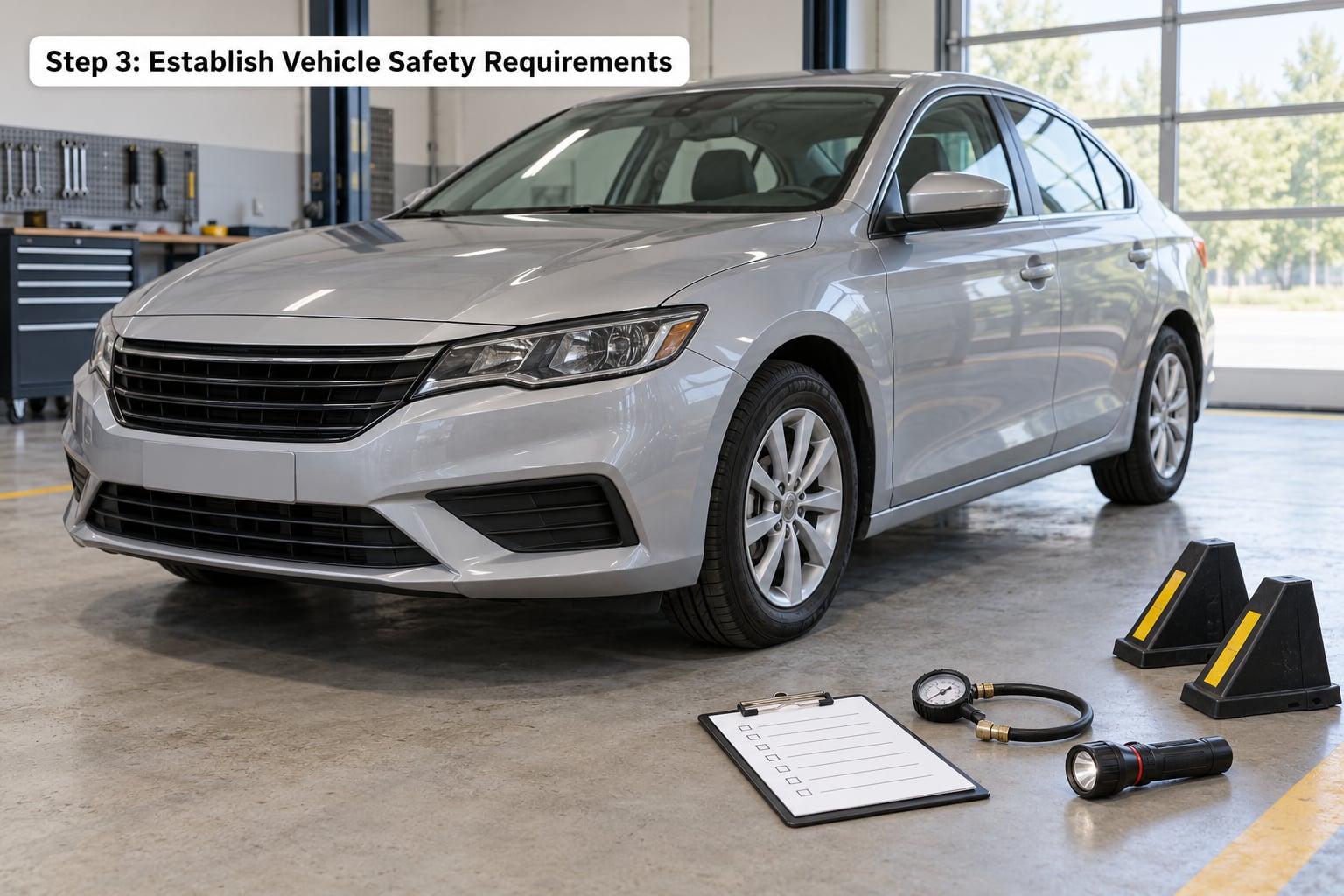
Define the checks: tyre condition and pressure, headlights, brake lights, indicators, wipers, washer fluid, mirrors, horn, seat belts, windscreen visibility, and no warning lights left on. Require a documented pre-trip check for high-mileage roles and a weekly walkaround for others.
Give drivers a simple, fast way to report a defect. The most common failure I see is a form that takes longer to submit than the defect takes to fix, so defects simply get absorbed until someone is pulled over.
When you buy vehicles, check the independent crash safety rating before price and appearance. Where you have a choice, favour vehicles with the highest rating in your segment.
Step 4: Define Safe-Driving and Work-Time Rules
This is the section workers read most carefully, so be concrete. Set rules on seat belts for everyone at all times, mobile phone use, speed, following distance, overtaking, intersections, passenger loads, child restraints where applicable, fuelling, parking, reversing and giving way.
Handle the phone question head-on. Say whether a device may be mounted, whether the hands-free rule is an administrative expectation or a hard prohibition, and what a supervisor should do if someone answers a work call while driving. Vague wording on this is a reliable source of arguments later.
Add alcohol, drugs and prescribed medication rules in the same section. The useful sentence is the one that names the consequence: no driving before a shift, during a shift or after driving on company business, and tell your manager about any medication that causes drowsiness.
Fatigue needs numbers, not an aspiration. Many employers have adopted a rule of two hours of driving followed by a fifteen-minute break for light vehicles, and longer mandatory breaks for commercial operations with stricter hours-of-service rules. Pick thresholds that match your real journey times and write them down.
Our article on drowsy driving prevention for commercial drivers covers the physiology and the scheduling patterns that cause it.
Step 5: Build Procedures for Weather, Night, and Road Conditions
State who checks the forecast, who authorizes travel and what triggers a delay or a stop. Name the roles rather than saying “management will decide”.
Define minimum equipment for poor conditions, such as winter tyres, chains, a charged phone, a spare tyre or roadside assistance, and set restrictions on route choice in severe weather. Solo night driving deserves its own rule, and so does any journey where a lone driver would be stranded. Our delivery driver safety tips cover the check-in protocols that make solo work safer.
Step 6: Create an Incident, Near-Miss, and Complaint Process
Write down the sequence a driver follows after a crash: make the scene safe, call emergency services, get medical help first, contact the named manager or number, then wait for instructions before moving the vehicle except for safety.
Set a reporting deadline, such as immediately by phone and in writing within 24 hours, and preserve evidence: photos, dashcam or telematics data, police and medical documentation. Investigate without delay, look for the root cause, and feed the finding back into training, routes or schedules.
Two protections make the rest of this believable. There is no retaliation for reporting a crash or a near miss in good faith, and any employee may refuse a journey they reasonably believe is unsafe without disciplinary fallout. Without both, near-miss reports stop arriving within a month.
Step 7: Set Training, Recordkeeping, and Enforcement Rules
Decide who needs training and when: induction before first drive, refresher on a set cycle, and immediate training after an incident or a policy change. Content should match the exposure, so a courier’s induction differs from a sales rep’s.
List the records you keep: licence and insurance verification, motor vehicle record checks, inspection and maintenance logs, defect reports, training completion, signed policy acknowledgments and incident investigations. State how long you retain them.
Consequences should escalate predictably, from a documented conversation through retraining to formal discipline, with a serious or repeated breach ending authorization. Apply them the same way regardless of seniority, and reward good practice too, because recognition is part of what keeps the standard in place.
Step 8: Approve, Publish, and Review the Policy
Assign the owner and the approver, then get legal review if you operate across state lines or countries. Publish it where drivers will actually see it, not only in an HR portal nobody opens.
Collect a signed acknowledgment from everyone in scope within 30 days of issue. A signed acknowledgment is the difference between a policy and a piece of paper.
Set a scheduled review, at minimum once a year, and shorter after any significant change: a new vehicle type, a new jurisdiction, an incident pattern, or a change in insurance terms. Block the time in a calendar the day you publish, so the review happens on a date rather than whenever someone remembers.
Common Mistakes
The policies that fail share a small number of repeating patterns. Each has a straightforward correction.
Vague accountability. “Drive safely” cannot be audited. Replace it with named behaviors and a threshold, such as no handheld devices and a 15-minute break after two hours of driving.
One rule for everyone. A single standard applied to a long-haul operator and someone making two client visits a month creates either absurd compliance or silent non-compliance. Split the policy by risk tier.
Ignoring personal vehicles. Grey fleet drivers are frequently left out, and that is precisely where the insurance gap and the liability confusion live. Cover them explicitly and confirm your non-owned coverage.
Reporting with no route. A near-miss form that nobody reads is worse than nothing. Name the recipient, set the deadline and publish what changed as a result.
Enforcement that only punishes. Policies enforced only for the worst moments get gamed the rest of the time. Pair consequences with coaching and with recognition for clean driving.
Fatigue rules with no numbers. “Manage fatigue appropriately” tells a tired driver that judgment is expected exactly when judgment is impaired. Set break durations and maximum driving periods.
One more deserves its own paragraph: a policy that reads as liability-shifting. Workers notice when the document protects the company and does nothing for them, and they tell each other. Lead with the duty of care, not the disclaimer.
Frequently Asked Questions
Does a driving for work safety policy cover employees who use personal vehicles?
Yes, in most cases. If an employee uses their own car for site visits, client calls or deliveries, that is driving for work and the policy should cover it. Set minimum insurance limits, require a valid licence and motor vehicle record check, and confirm your hired and non-owned auto coverage extends to that use. Ordinary commuting from home to a fixed workplace is normally excluded.
What should an employer do after a workplace driving crash?
Secure the scene, call emergency services and get medical help first, then notify your named contact immediately and submit the written report within your stated deadline. Preserve the vehicle, photos, telematics data and any police or medical records. Begin investigation quickly, look for root causes such as scheduling or maintenance, and share the outcome so the same hazard does not repeat.
How often should employer driving policies be reviewed?
At least once a year, and sooner after any significant change: a new vehicle type, a new state or country of operation, a cluster of incidents, a change in insurance terms or a revision to relevant law. Many employers also trigger an off-cycle review after any serious crash or a license suspension, since driver eligibility may have changed overnight.
Are employers required to check employees’ motor vehicle records?
There is generally no blanket federal US requirement to check motor vehicle records for every employee, but several states require it for commercial drivers, and checking is a recognized risk control that courts and insurers look for. Whatever your state requires, check records for anyone driving on company business, repeat it annually, and check again after any incident or traffic offence.
How should a policy address drowsy driving and extended work shifts?
Set concrete limits rather than general guidance: maximum continuous driving periods, a minimum break after each stretch, mandatory overnight rest between long shifts, and a rule that a driver who feels unfit does not drive. Schedule so that a shift cannot be extended by travel time, and treat fatigue pressure created by targets as a management issue that the policy itself must answer.
What is the difference between a company driving policy and driver training?
The policy is the written rulebook: who is authorized, what vehicles and journeys are allowed, what is reported and what follows a breach. Training is how people learn and practise those rules. The policy is a legal and operational document you can produce on request; training is the ongoing program that makes the policy real. You need both, and neither substitutes for the other.
Conclusion
Start by writing down who drives for your organisation and what they drive. That one afternoon produces the scope, the risk tiers and the insurance questions that the rest of the policy depends on.
A driving for work safety policy only works when role-specific training, real vehicle controls, a reporting route people trust and a scheduled review sit behind it. Written in 2026 and enforced the same way for everyone, it is the document that shows you took reasonable steps before something went wrong.