
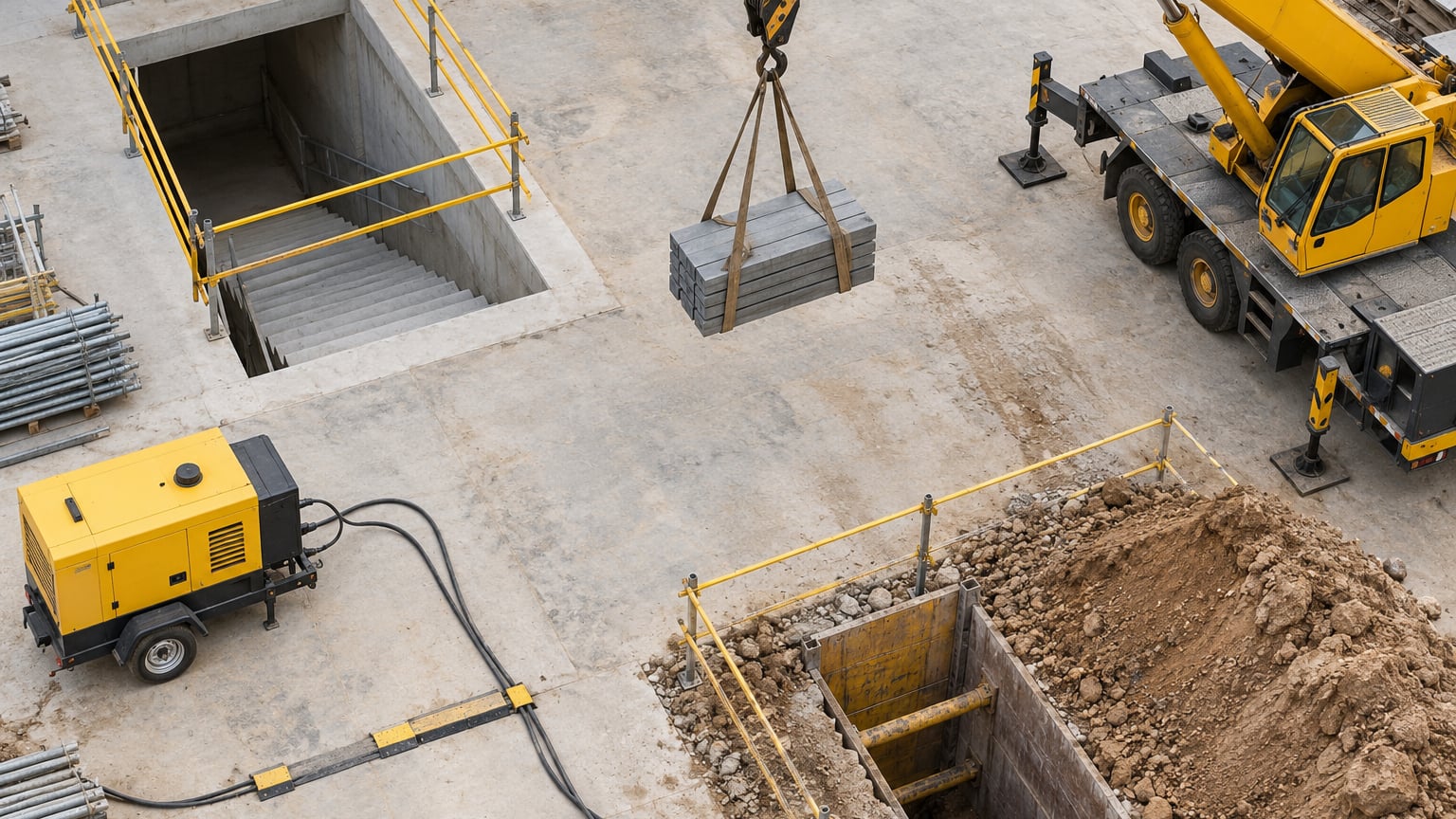
OSHA’s Fatal Four are the four hazard categories that account for the large majority of construction worker deaths in the United States: falls from height, struck-by incidents, electrocutions, and caught-in-or-between events. This guide breaks down the fatal four construction hazards explained here, including what causes each one and the controls that actually stop them.
Construction is one of the most dangerous industries in the country, and the deaths are not spread evenly. A handful of mechanisms cause most of them, which is why OSHA ranks hazards and publishes outreach training around the ones that kill the most people.
If you supervise a crew, run a safety program, or work a site yourself, knowing these four hazards well is the fastest way to a safer shift. Here is how each one happens and what stops it.
Table of Contents
What Are the Fatal Four Construction Hazards?
The Fatal Four are the four hazard categories that cause roughly three-fifths of all construction worker deaths in the United States, as identified by the Occupational Safety and Health Administration (OSHA): falls from height, struck-by incidents, electrocutions, and caught-in-or-between events. Together they account for a share of construction fatalities that has stayed in roughly the 57 to 65 percent range across data years, depending on how the underlying census data is grouped.
OSHA does not create the term from a statute. It comes from the way the agency and the Bureau of Labor Statistics (BLS) record fatalities: every death reported under the Occupational Safety and Health Act of 1970 is coded by mechanism and exposure, and the categories are ranked by frequency. The four that consistently top the ranking are published as the Fatal Four and mirrored in the agency’s Focus Four outreach training.
That concentration is the whole point. Falls alone account for roughly a third to two-fifths of construction fatalities, while electrocutions, struck-by events and caught-in-or-between events each add several percentage points. Fires and explosions, exposure to harmful substances, transportation incidents and contact with overhead power equipment also kill construction workers, but none of those categories reaches the combined body count of the Fatal Four.
So the Fatal Four are not a rule, and no standard is titled “Fatal Four.” They are a prevention priority built from OSHA recordkeeping data, and they are also where OSHA concentrates its inspections, outreach materials and enforcement expectations.
How the Fatal Four Differ from OSHA’s Focus Four
The two terms get mixed up constantly, so it is worth separating them. The Fatal Four is a statistics-based ranking of hazard categories. The Focus Four is the name of OSHA’s 10-hour construction outreach training program and its five-day version, whose four modules cover Fall Protection, Caught-In or -Between, Struck-By and Electrocution.
The topics match one for one, so most people use the words interchangeably on site. The distinction matters when you are reading a rule, an audit checklist or a training record: “Fatal Four” points at the data, “Focus Four” points at the curriculum. A site can be trained on the Focus Four and still have a fall problem, because training is not the same as a functioning fall protection program.
Fatal Four Construction Hazards at a Glance
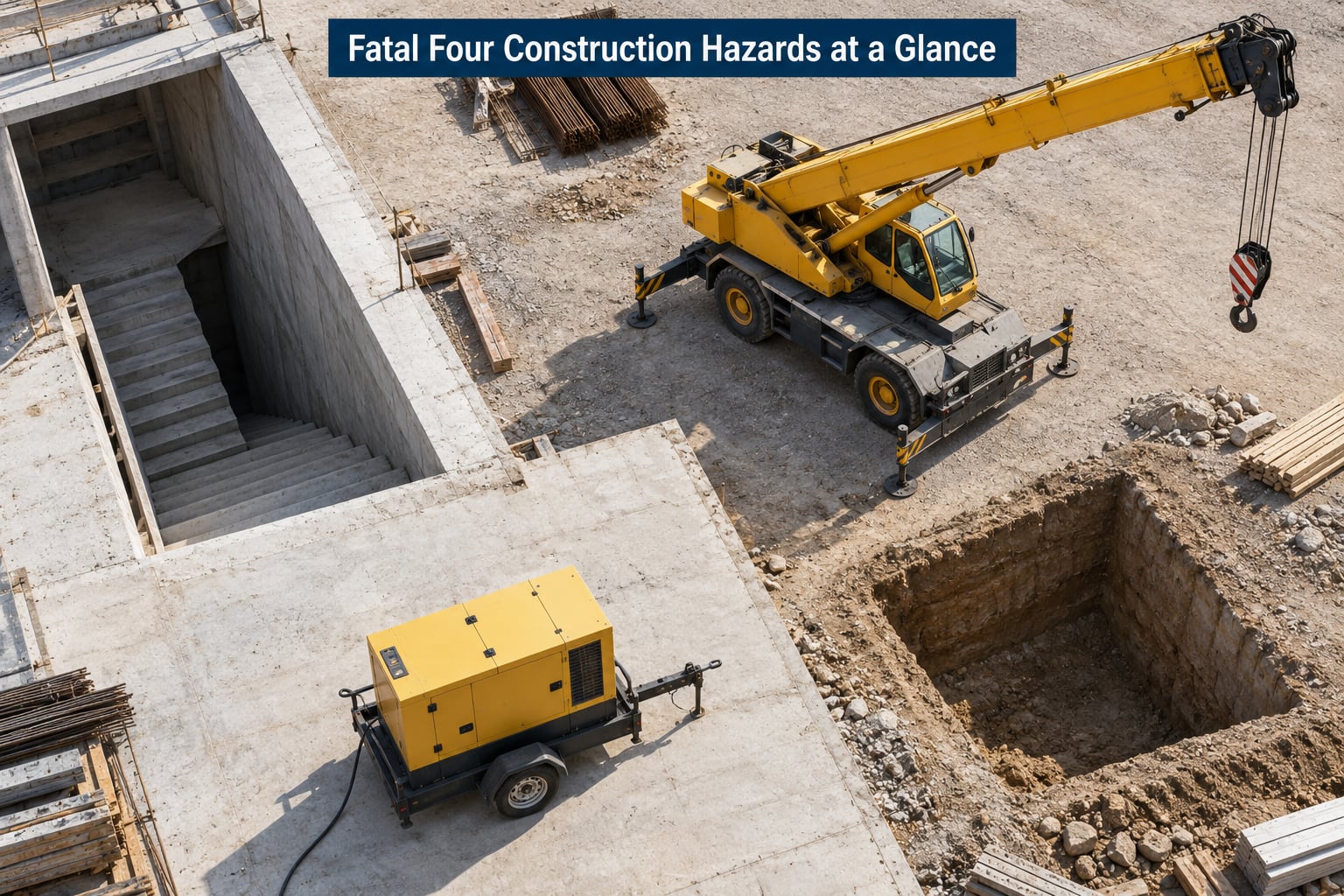
The table below is the short version of the whole topic. It pairs each hazard with the tasks that produce it, the prevention strategy that works, and the standards most often cited for it.
| Hazard | Common tasks and causes | Main prevention strategy | Key OSHA standards |
|---|---|---|---|
| Falls from height | Roofing, steel erection, ladders, scaffolds, unprotected floor openings, leading edges | Eliminate the exposure first, then guardrail, warn, restrict and protect | 29 CFR 1926 Subpart M, including 1926.501 and 1926.502 |
| Struck-by | Backing trucks, excavator swing, cranes, suspended loads, rotating equipment, falling or flying material | Separate people from equipment and control the traffic | 29 CFR 1926.601, 1926.602, 1926.555, 1926 Subpart N |
| Electrocutions | Contact with energized conductors, damaged cords, temporary power without protection, overhead lines, inadequate grounding | De-energize, then lock out, tag and verify | 29 CFR 1910.147, 1910.212, 1926.404, 1926.405 |
| Caught-in-or-between | Excavator swing radius, trench collapse, unguarded machinery, moving material, confined space entry | Isolate the energy and physically keep people out of the crush zone | 29 CFR 1926 Subpart P, 1910.212, 1926.651 |
Why Each Fatal Four Construction Hazard Is Dangerous
The four hazards differ in the physics that kill. Falls are a fall in gravity. Struck-by events are a mass in motion. Electrocutions are a body completing a circuit. Caught-in-or-between events are a body trapped by two surfaces. That is also why the controls differ, and why a rule written for one hazard rarely fixes another.
Falls: How to Prevent Falls from Height
Falls are the single largest cause of construction worker death, accounting for roughly a third to two-fifths of all construction fatalities depending on the data year. Most fatal falls happen on unprotected sides and edges, through floor and roof openings, from ladders, and from scaffolds, and a large share of those deaths involve a worker who had no fall protection or inadequate fall protection at the moment of the fall.
The numbers that matter most on a jobsite are specific. In construction, fall protection is required at six feet above a lower level for unprotected sides and edges, and at six inches at a leading edge where an employee could fall to a level below. General industry uses a lower trigger height of four feet, and utility and pole work has its own requirements. Getting this wrong is the most common way a site ends up citing itself.
Controls start with planning. A fall protection plan names who is competent to set up each system, what gets erected before work starts and who inspects it. Guardrails on every unprotected edge come first because they remove the hazard rather than the consequences. Personal fall arrest systems, restraint and positioning systems, safety nets and controlled access zones come after that, in the order the hierarchy of controls requires.
Equipment only works when it is inspected and worn correctly. A full-body harness, a double lanyard or self-retracting lifeline rated for the fall height, a properly sized anchor point and a competent rigger are the working combination. Anchorage has to hold, connectors have to be inspected before every use, and damaged or contaminated components come out of service immediately.
Two requirements get skipped more than any others. Workers need training from a qualified person on equipment selection, fitting, use and limitations, and every worksite above six feet needs a rescue plan. Suspension trauma after a fall arrest turns a survivable injury into a fatal one when nobody can reach the worker quickly, so the rescue method must exist before the first harness goes on.
Struck-By Incidents: How to Control Moving Equipment and Materials
Struck-by incidents are the second major Fatal Four hazard, typically accounting for around eight percent of construction fatalities. A struck-by injury happens when a worker is hit by a moving object, a vehicle or piece of equipment, a flying or falling object, or a rotating attachment. Backing trucks and mobile equipment are the classic case, and they account for a large share of the deaths in this category.
The hazard exists wherever people and machines share ground, and that includes areas that feel safe. A pedestrian walking from the trailer to the laydown yard crosses a truck route. A laborer standing on the back of a pickup in the loading zone is inside a crush point. A boom operator swings a section of pipe over a crew that was told to stand clear but not shown where.
Controls start with an internal traffic control plan that defines routes, crossings, speeds, signage and right-of-way, and with physical separation where you can get it. Pedestrian walkways, barriers and stored material placement keep workers out of vehicle paths instead of relying on attention. High-visibility apparel helps, but it is personal protective equipment and it belongs at the bottom of the control list.
Technology helps in specific ways: backup alarms, cameras, proximity alerting and radar systems on mobile equipment, and lights that switch on automatically in reverse. Signal persons need training, a defined communication method, and a position where the operator can see them and nobody else stands there. Suspended loads need a tag line, a designated zone kept clear of workers, and no one under the load at any point in the lift.
Material control closes the other half of this hazard. Store tools and small equipment in designated areas rather than on scaffold platforms and stair landings, secure lumber and sheet goods so they cannot shift, and install toe boards on platforms where material can roll off. Falling objects are a struck-by event even when nobody touched a machine.
Electrocutions: How to Prevent Contact with Live Electrical Systems
Electrocutions cause roughly seven to eight percent of construction fatalities, a share that has stayed fairly steady for years while many other rates moved. The common causes are contact with energized power lines, contact with energized equipment, a boom contacting a power line, damaged equipment and cords, and indirect contact through tools or materials.
Current follows the path of least resistance, and the human body is a good conductor, especially when it is wet or when the skin is broken. That is why temporary power during construction is so risky: extension cords run across walkways, GFCI protection gets bypassed with a two-prong adapter, panels get opened by people who assume somebody else locked them out, and grounds get removed for convenience.
The control sequence has one order and no shortcuts. De-energize first. Then every person who could be exposed applies a lock and a tag to the energy-isolating device, and the person doing the work verifies zero energy with a properly rated tester before touching anything. Our guide to the lockout/tagout procedure walks through the full sequence.
Only qualified people do electrical work and work on energized systems, and everyone else treats exposed conductors as live. Overhead and underground lines get the same respect: locate them before you dig or lift, keep cranes and booms a safe distance away, and treat any line that has lost its insulation as energized even if the utility says it is not.
Caught-In-or-Between Events: How to Prevent Entrapment and Crushing
Caught-in-or-between events are OSHA’s category for a worker who is squeezed, caught, crushed, pinched or compressed between two objects. It is the smallest of the Fatal Four by share, and the most often misunderstood. It is the one crews tend to blur with struck-by, and the one left vague in most fatal four construction hazards explained material. A struck-by event is a collision with something moving. A caught-in-or-between event is entrapment in a closing gap.
Above ground, the classic mechanisms are excavator swing radius, a machine’s backhoe or boom against a fixed object, a truck backing into a fixed surface, a vehicle running into a barrier, a winch or conveyor in motion, and material shifting on a stack. Below ground, it is the trench. Excavations at five feet or more deep require a protective system, and even shallower trenches have killed workers by collapse.
Controls above ground are mostly about guarding and separation. Machine guards cover nip points and rotating parts where they are exposed; interlocks and presence sensing stop motion when a guard opens or a field is interrupted; a stored energy discharge, brake and hydraulic lockout remove the motion hazard during maintenance; and an exclusion zone keeps everyone out of the swing radius and the crush point between a machine and a wall, tree or parked vehicle.
Controls below ground are the competent person. Sloping, benching, shoring or shielding must be chosen for the soil and the load, utility locating has to happen before the dig, spoil piles and equipment need to be set back from the edge, and access and egress have to be provided. Spoil pile placement is a good example of a rule that looks like a detail and functions as a safety control: material at the edge of a trench is both an extra load and a reason for someone to stand where they should not.
Confined spaces add their own layer, since a permit program, atmospheric testing and a standby outside the space are what keep a rescue from turning into a second fatality.
How Employers Can Prevent the Fatal Four
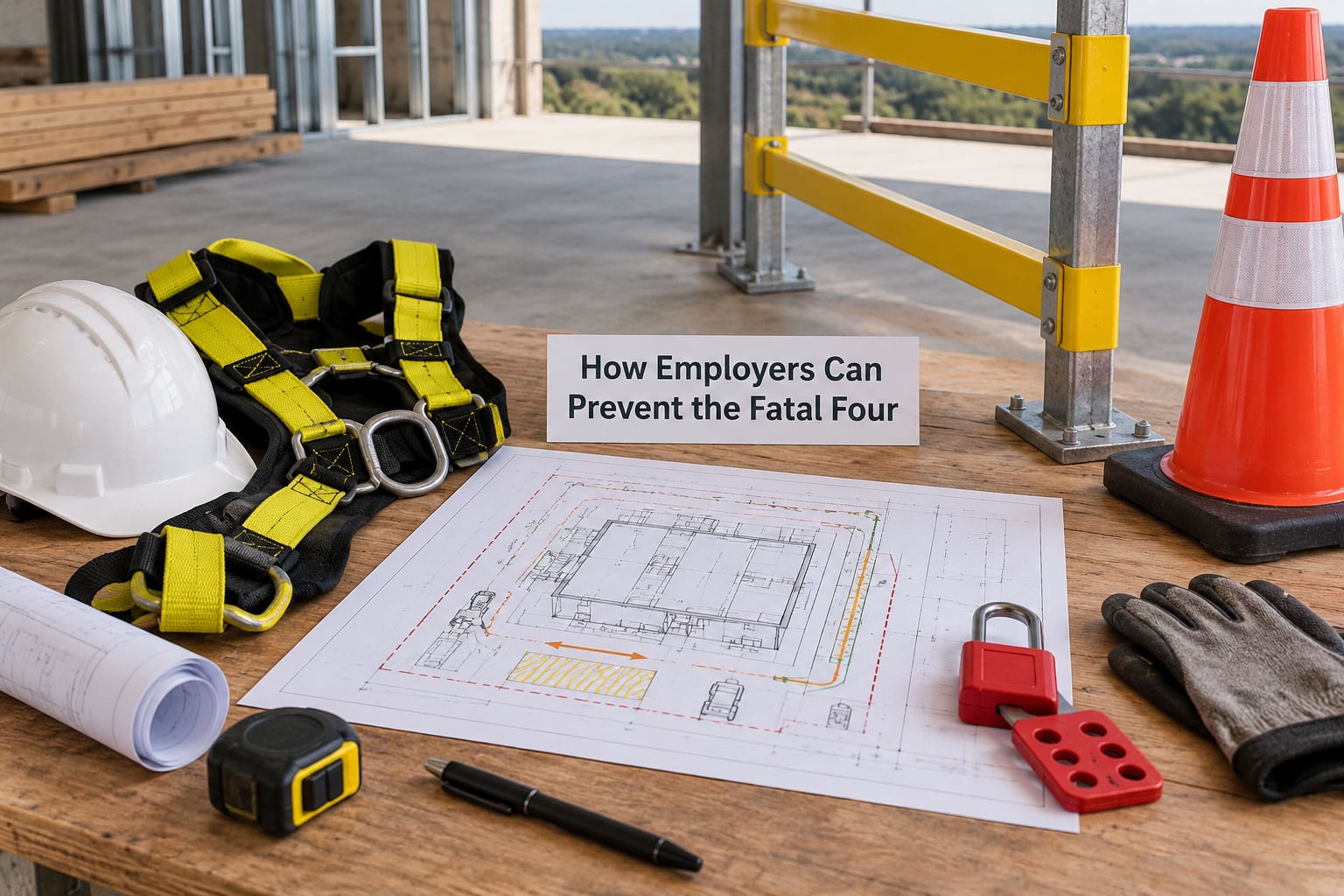
Controls only work when someone owns them and checks them. The employer side of Fatal Four prevention is a management system, not a binder of policies, and it has a handful of repeating parts.
Appoint competent people and give them authority. Under 29 CFR 1926.32, a competent person is someone with the training, experience and knowledge to perform an assigned task safely, and that person has to be able to stop work. An excavation inspection, a fall protection setup and a crane lift plan all need a named person.
Write a plan before the work, not after the incident. Fall protection plans, excavation protective system plans, lockout procedures, traffic control plans and rescue plans are all things you can write in an afternoon and pay for every time you do not use them.
Train on the actual work, in a language the crew understands. OSHA’s Focus Four outreach curriculum is free, but a class is not the same as task training on your own site with your own equipment. Workers who have been pulled from a task need training before they go back to it.
Inspect on a schedule and log it. Scaffolds, fall protection equipment, excavation protective systems, machine guards and temporary power arrangements all degrade with use. A written inspection record is what proves the control existed.
Make near-miss reporting easy and non-punitive. A cord pinched by a forklift that gets reported is an electrocution prevented. See our guide to preventing electrical hazards at work for one area where that habit pays off.
Plan for rescue and for the emergency call. Site address, access point, first aid, and a plan to reach a suspended worker. Then verify that the controls in the plan are the ones being used at 7 a.m. on a Tuesday, because that is the only audit that counts.
On a multi-employer site, the general contractor coordinates the site, each employer is responsible for its own employees, and no employer may rely on another company’s crew to provide fall or electrical protection. That responsibility split should be written down at preconstruction meetings, not worked out afterwards.
What to Do After a Fatal Four Hazard Causes an Incident
This is not medical guidance and it does not replace your own emergency plan. It is the general safety and reporting sequence that applies when a Fatal Four hazard causes an injury or a death on your site.
Stop the exposure first. If the hazard is still active, isolate the area, shut down or lock out the equipment and keep people back. Nobody goes back into a trench, climbs onto a damaged scaffold or handles an energized system to reach someone until the scene is made safe or the rescue is handed to trained responders.
Call for help early and get emergency services on the way. Then give first aid only within your training and your site’s plan, and have someone direct the responders to the scene. Site address, access route and the specific location of the incident get communicated to dispatch before arrival.
Preserve the scene and the equipment as it was once the area is safe. Do not reenergize a circuit, straighten a guardrail or move a suspended load before the scene has been documented. Conditions change fast, and the physical state of the equipment is evidence.
Report it the way the law requires, which in the United States means notifying OSHA within the statutory timeframe for a fatality, a hospitalization, an amputation or a loss of an eye, and keeping the required records. State plan states have their own routes, so check the plan for where you work.
Then review what happened without turning it into a blame exercise. Walk the task, find out which control failed or was never built, and fix that before the next shift touches the same work. If the site had a plan and the plan did not survive the day, the plan is what needs rewriting.
Frequently Asked Questions
Are the Fatal Four the same as OSHA’s Focus Four?
The topics are identical but the terms describe different things. Fatal Four is a statistical ranking of the hazard categories causing the most construction deaths. Focus Four is OSHA’s construction outreach training program name, built on four modules: Fall Protection, Caught-In or -Between, Struck-By and Electrocution. Passing Focus Four training does not by itself put fall protection on your roof.
What height requires fall protection in construction?
In construction, employers must provide fall protection when a worker can fall six feet or more to a lower level at an unprotected side or edge, and at six inches when working at a leading edge where there is a drop to a lower level below. General industry uses a four-foot trigger height, and utility pole work is covered by its own rules. Confirm the applicable standard for the work you are doing.
Who is responsible for Fatal Four prevention on a multi-employer jobsite?
Each employer is responsible for the safety of its own employees, and no employer may depend on another company’s crew to supply fall protection or electrical protection. The general contractor coordinates the worksite and has its own duties for the site as a whole, including control of hazards created by the project. On a two-employer site, a host employer can owe a compliance duty to the other employer’s workers for certain conditions.
Is OSHA’s Fatal Four an enforceable rule?
No standard is titled Fatal Four, so there is nothing to cite in a citation letter. The Fatal Four is a prevention priority drawn from OSHA and Bureau of Labor Statistics fatality records. The enforceable duties sit in the specific standards, such as 29 CFR 1926.501 for fall protection, 1910.147 for the control of hazardous energy and 1926 Subpart P for excavations. Failing those standards is what OSHA cites.
How does Fatal Four prevention connect to Total Worker Health?
Fatal Four controls address immediate physical hazards, while a Total Worker Health approach also looks at workload, recovery, mental health, chronic conditions and the working conditions behind injuries. The two fit together: a crew that is exhausted, dehydrated or dealing with pain is measurably more likely to have a fall or skip a lockout step. Our overview of the Total Worker Health approach covers how employers put that wider view into practice.
Conclusion
Falls, struck-by incidents, electrocutions and caught-in-or-between events are all preventable, and each one has a known set of controls that works. The fatal four construction hazards explained above are not a list of unavoidable outcomes. They are the four places where a site either built the control in or skipped it.
The first action for any employer is a site-specific hazard assessment: walk the active work areas, look for unprotected edges, live electrical work, moving equipment and unprotected excavations, and write down the corrective action with an owner and a date for each one.
Then follow the controls, inspect them on a schedule, and treat a near-miss report as a save rather than a complaint. That approach, applied alongside the wider priorities in our guide to the Total Worker Health approach, is how a site gets people home at the end of the day.