
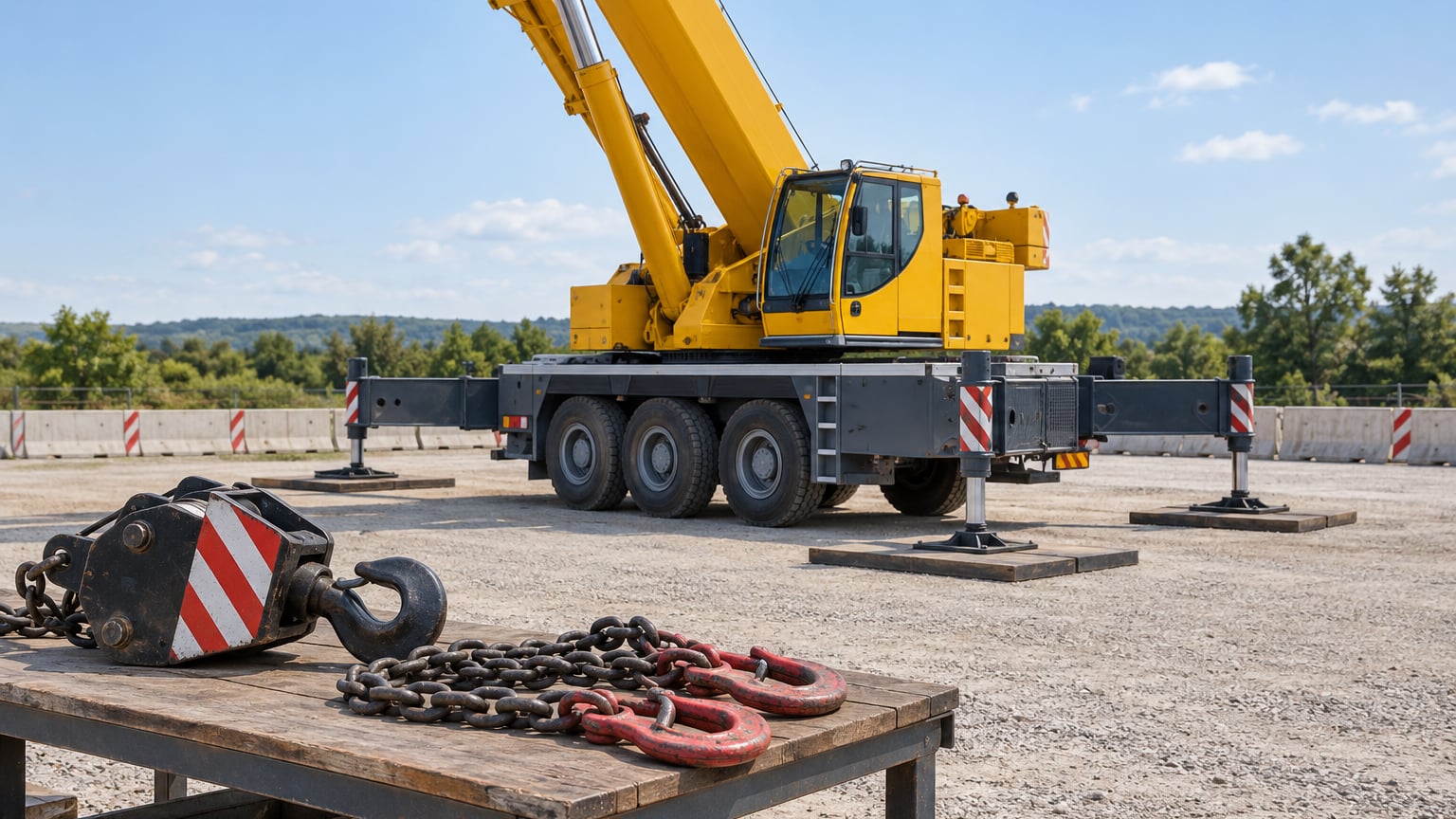
Crane safety basics are the planned checks, inspections, and controls that keep people out of harm’s way while a crane moves, suspends, or places a load: know the hazard zones, plan every lift, inspect before use, keep people out of the exclusion zone, stay clear of power lines, and stay inside rated capacity. Only trained, authorized people operate or signal the crane.
That definition matters because crane work kills more bystanders than operators in a lot of jobsite incidents. Loads travel over areas nobody thinks of as part of the job, and the failure modes are rarely exotic: soft ground under an outrigger, a load heavier than the chart allows, a sling without a legible SWL tag, a bad signal over a radio.
Jurisdiction matters for the rules. The references here follow the US federal baseline in 29 CFR 1926 Subpart CC and ANSI B30.5. State plans and other countries add requirements on top, so check what applies where you work. Last reviewed for October 2026.
Table of Contents
- What Crane Safety Basics Cover on a Worksite
- What to Check Before a Lift
- How to Inspect the Crane and Lifting Accessories
- How to Set Up the Crane Safely
- How to Plan Loads and Stay Within Capacity
- How to Control the Lifting Area
- How to Communicate During the Lift
- How to Manage Wind, Weather, and Site Changes
- What to Do When Something Goes Wrong
- How to Build Crane Safety Into the Work Plan
- Frequently Asked Questions
- Conclusion
What Crane Safety Basics Cover on a Worksite
Crane safety basics cover five things, and a lift is only safe when all five hold at once: the right equipment, competent people, a written plan, a controlled work area, and continuous inspection.
Mobile cranes travel on outriggers and lift from a truck-mounted boom. Tower cranes stand on a foundation, work at height, and have a much larger radius. Overhead and EOT bridge cranes run on rails inside warehouses, mills, and plants. Same hazard family, very different worksite.
Three danger zones drive nearly every rule that follows: the load itself, the crane, and the swing radius around it. Every control in this guide maps back to one of those three.
Who the rules apply to
Operators, riggers, signalmen, lift directors, controlling contractors, ground workers, and pedestrians. Most free training material is written for operators, which leaves the larger group underserved.
What to Check Before a Lift
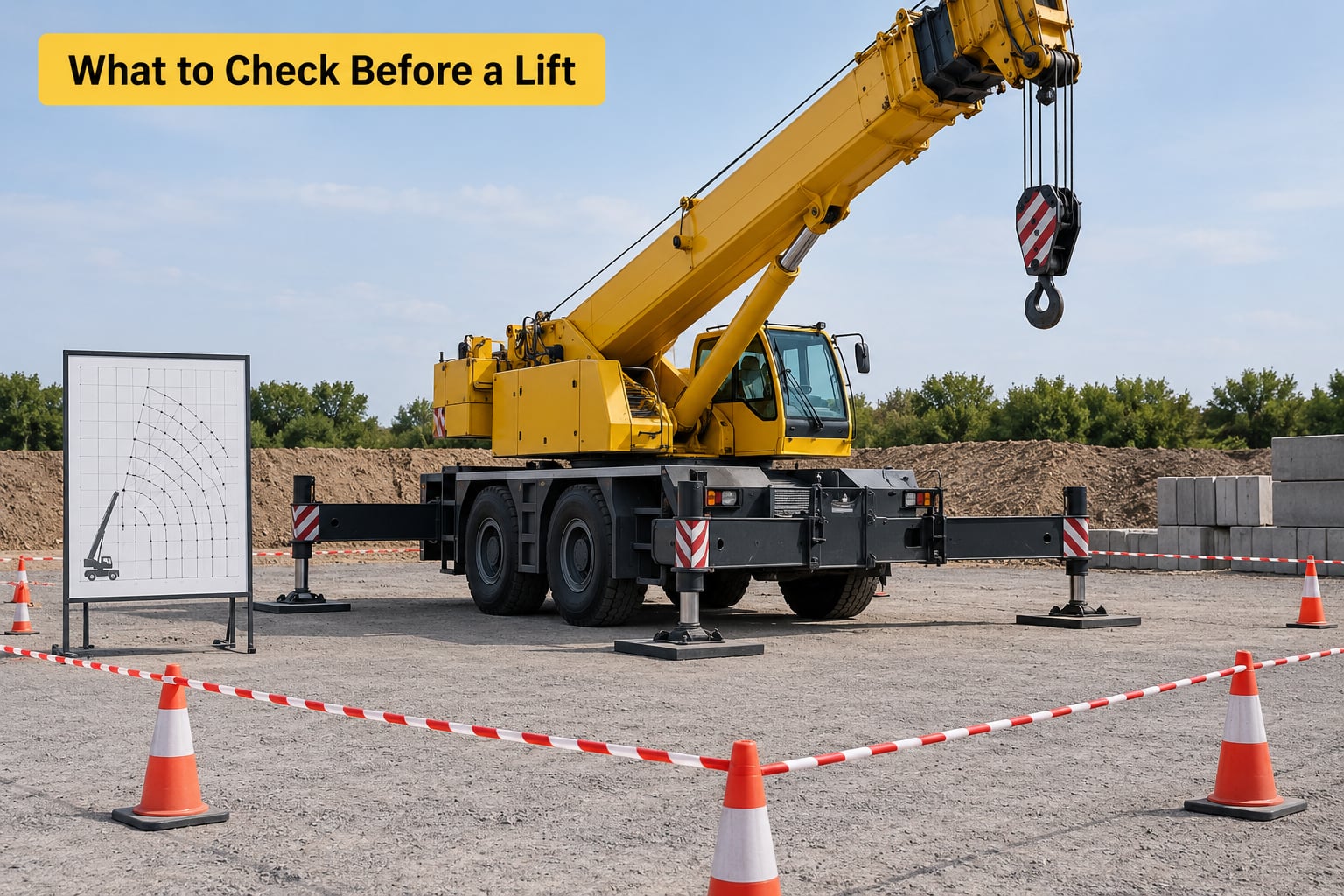
Run the pre-lift checklist before the crane moves, not after. If any answer is uncertain, the lift waits until it is resolved.
- Lift plan. A written plan exists for anything non-routine, and the crew has read it.
- Load weight and dimensions. Verified, not estimated from a drawing. Weight includes the rigging.
- Equipment capacity. The chosen crane and boom length cover the load at the required radius on the relevant load chart.
- Ground conditions. Bearing capacity confirmed; no fill, trench, or buried services under the setup.
- Site hazards. Power lines, structures, cranes, and other overhead obstructions measured, not eyeballed.
- Weather. Wind, visibility, and lightning checked against manufacturer limits.
- Inspections current. Daily check done, periodic inspections in date, defects cleared.
- Communication. One designated signaller, agreed hand signals or radio channel, and a working method for lost line of sight.
- Authorization. The lift director or competent person has said to proceed.
The tool safety inspection checklist uses the same logic for hand tools: a short repeatable check beats a long inspection done once a month.
How to Inspect the Crane and Lifting Accessories
The operator performs the daily check before the shift. Competent persons handle periodic and annual inspections, and a qualified third party performs the thorough examination where the rules require it. Keep written records for each.
On the crane, check ground conditions around the machine, the boom or jib for dents and cracks, the counterweight and mounting, the hoist rope for broken wires, kinks, birdcaging, or corrosion, the hook for gape or twist, and the safety latches.
On the accessories, every sling, shackle, and spreader needs a readable SWL or WLL tag. Missing tag means out of service until a competent person rates it.
How to handle a defect
Tag it out, isolate the equipment so it cannot be operated, and record the defect in writing. Only a competent person decides whether it is repaired or replaced. A verbal “it’s fine” from a supervisor is not a defect clearance.
How to Set Up the Crane Safely
Setup decides whether the lift is stable. Manufacturer instructions and the lift plan both apply, and where they conflict the more conservative one governs.
- Assess the site. Walk the setup area for fill, soft spots, trenches, culverts, and buried utilities.
- Confirm ground bearing capacity. If the soil is unknown or marginal, use engineered pads or mats sized by a competent person.
- Position the crane. Set it level and square, with the boom clear of obstructions in the full radius of travel.
- Extend outriggers fully onto proper supports and lock them. Outriggers are not stabilizers for weak ground; they transfer the load, they do not fix weak soil.
- Check overhead. Measure to the nearest power line or structure using the utility’s figures, and confirm the approach distance before the boom moves.
- Barricade the area. Post the swing radius and keep unauthorized people out from the moment the boom moves.
- Load test within limits. Test at a fraction of rated load, confirm brakes and controls, then release the check load.
How to Plan Loads and Stay Within Capacity
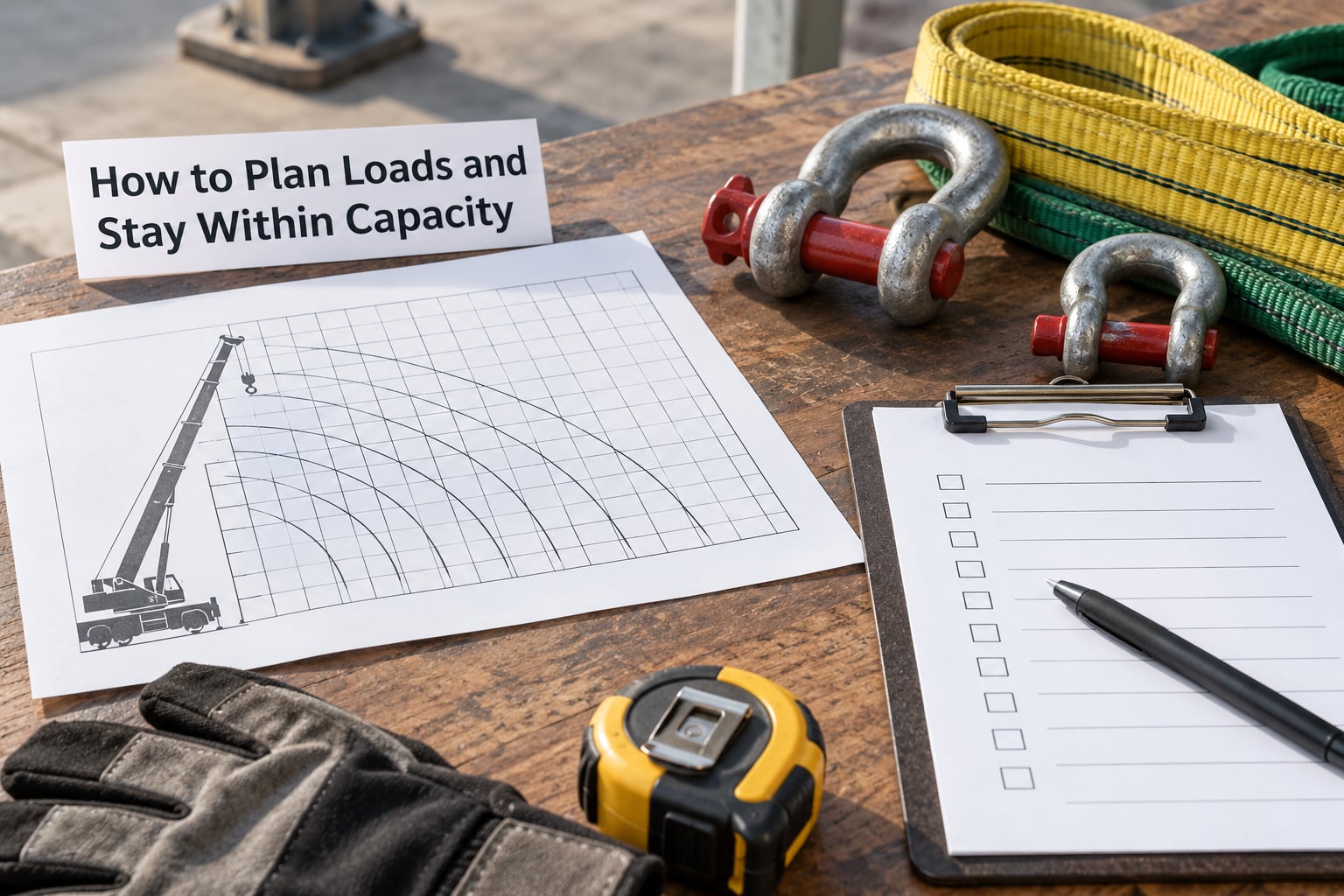
Verify the load weight from the best available source, then add the rigging weight and any dynamic effects the manufacturer requires. A load chart reduces to three numbers: the weight you are lifting, the radius you are working at, and the boom or jib length you have rigged. Find the cell where those intersect and read the rated capacity. Stay under it, always.
Rated capacity falls as radius grows. A 20-tonne machine can often hold far less at full extension than the headline number suggests, which is why reach and capacity travel together in every conversation about crane selection.
A load moment indicator, or the newer electronic load capacity system, warns when you approach or exceed limits. Treat an alarm as a stop, not a prompt to work faster.
The 3-3-3 rule for personnel
Where personnel lifting is permitted by the equipment and the rules, the 3-3-3 rule applies: no personnel lift over 50 pounds of gross weight, no lifting above 50 feet of height, and no lifting over 50 miles per hour of speed. It is a tight ceiling, and many cranes, hoists, and sites prohibit personnel lifting outright. Check before assuming any lift with a person in it is allowable.
How to Control the Lifting Area
No worker may work under or pass beneath a suspended load. There is no exception for a short lift, a light load, or a load held still. Set the barricade at the swing radius plus the load’s clearance distance, and expand it when wind or boom length increases that radius.
Use hard barricades or fencing where vehicles and the public can reach, and designate a spotter to control access. Keep pedestrians and mobile equipment out of the area entirely; a reversing truck near a swing radius is a separate hazard with its own rules, covered well in our forklift safety rules for pedestrians.
Attach tag lines to loads that spin or catch air, keep loads low while travelling, and never leave a load hooked and unattended within reach of the operating controls.
How to Communicate During the Lift
Hold a pre-lift meeting so the operator, riggers, signalman, and lift director share one plan. Designate one signaller. Two people giving conflicting signals is how loads get set down on people who thought the lift had stopped.
Use standardized hand signals or a dedicated radio channel. Agree the channel before the lift, keep radio traffic to essential messages, and never let a signal be given to anyone other than the operator, including by a bystander.
Signalman and operator need a working method when line of sight breaks: stop on lost visual, use radios, or reposition. Assume the operator stops when they stop seeing you and confirm they have before you step back into the area.
How to Manage Wind, Weather, and Site Changes
Read the manufacturer’s limits for wind, and treat them as hard thresholds. Many cranes stop well below the point where a light crane feels like it is moving much. Monitor conditions at the crane, not at the site office.
Stop for lightning, for visibility that prevents the operator seeing the load or the signalman, and for rain or ground conditions that reduce bearing capacity. Temperature affects hydraulics and rope, cold makes grease stiffen and hydraulic response sluggish.
Reassess when the site changes: another trade moves in, a structure is erected, the ground is disturbed, or the wind shifts. A lift planned at 7am against a clear morning may not be valid at 3pm.
What to Do When Something Goes Wrong
For a dropped or unstable load: stop, warn everyone below and around, keep people out, and let the operator settle or bring the load to a safe place if it can be done without increasing risk. Never run under a falling load to retrieve a tag line.
For crane instability, ground failure, or tip-over risk: stop operations immediately, get clear of the machine, and account for everyone. Do not attempt to re-level or re-raise a crane that has shifted.
For contact with a power line: treat every line as live, keep everyone away, and call the utility emergency line. Nobody enters the vehicle or approaches the crane until the utility confirms the line is de-energized.
For personnel injury or entrapment: call emergency services, stop the lift, secure the machine, and follow the site emergency action plan. Trained responders only handle releases.
How to Build Crane Safety Into the Work Plan
Safety that lives in a folder fails on a Thursday afternoon. Operators need documented qualification and authorization, workers need training records, and supervisors need inspection records that are reviewed rather than filed.
Run a toolbox talk before crane work starts, and after any near miss. A near-miss report that leads to a change is worth more than a flawless inspection record nobody reads, so make reporting easy and blameless.
Multi-contractor sites need one controlling contractor owning the lift plan, one exclusion-zone plan, and one emergency plan. Our safety audit checklist for a small business covers how to structure that verification when the work is smaller than a full site team.
Frequently Asked Questions
What qualifications should a crane operator have?
Operators need documented training for the specific crane type and capacity they will run, demonstrated competence on that machine, and formal certification where the jurisdiction requires it. In the US, OSHA 29 CFR 1926.1427 sets employer qualification duties, and NCCCO certification is the widely accepted third-party credential for boom and tower cranes. ANSI B30.5 covers mobile and overhead crane training. State plans can add requirements.
How do I read a crane load chart?
Start with the load weight including rigging, find your working radius from the centre of rotation to the load, and identify the boom or jib length rigged on the machine. The chart cell at that radius and length gives the rated capacity for that configuration. Compare your load to it, and remember rated capacity drops as radius increases. The load moment indicator and the crane manual together confirm the reading.
What wind speed is unsafe for a crane lift?
The limit is whatever the manufacturer states for that crane and configuration, and many cranes require a stop well before weather feels severe on the ground. Large-sail-area loads such as panels or precast elements have far lower limits than compact ones. Treat the chart and manual as the authority, measure wind at the crane rather than the site office, and suspend the lift when the threshold is reached.
Should workers stand beneath a suspended load?
No. Nobody works under or passes beneath a suspended load under any circumstance, including for short or light lifts. The load can shift, snag, or fail without warning, and a rigged load carries more energy than its weight suggests. Control access with barricades at the swing radius plus clearance, use tag lines so loads stay controllable, and keep the area clear for the entire time the load is off the ground.
What should happen when a crane defect is found?
Take the crane out of service immediately, tag and lock out the controls, and record the defect in writing. Only a competent person may judge whether it can be repaired or must be replaced. Operating a crane with an unresolved defect on a brake, rope, hook, or limit device is illegal under the federal crane rules and, more practically, the defect that kills people is rarely the one they noticed that morning.
When should a lift be stopped immediately?
Stop when the plan cannot be followed as written, when wind or visibility hits a threshold, when anyone enters the exclusion zone, when communication with the operator is lost, when the load weight turns out to exceed the plan, when the ground or setup changes, or when a defect appears. Any person on the crew can call a stop, and no one should need permission to call one. Stopping a lift costs minutes; a dropped load costs far more.
Conclusion
Five actions cover most of what keeps a lift safe. Identify the hazards in the load zone, at the crane, and around the swing radius. Verify the equipment and the load against the load chart. Inspect the ground, the machine, and the rigging. Confirm communication and who is in charge of the area. Stop if the plan cannot be followed as written.
Do those before the boom moves, not after the first near miss.