
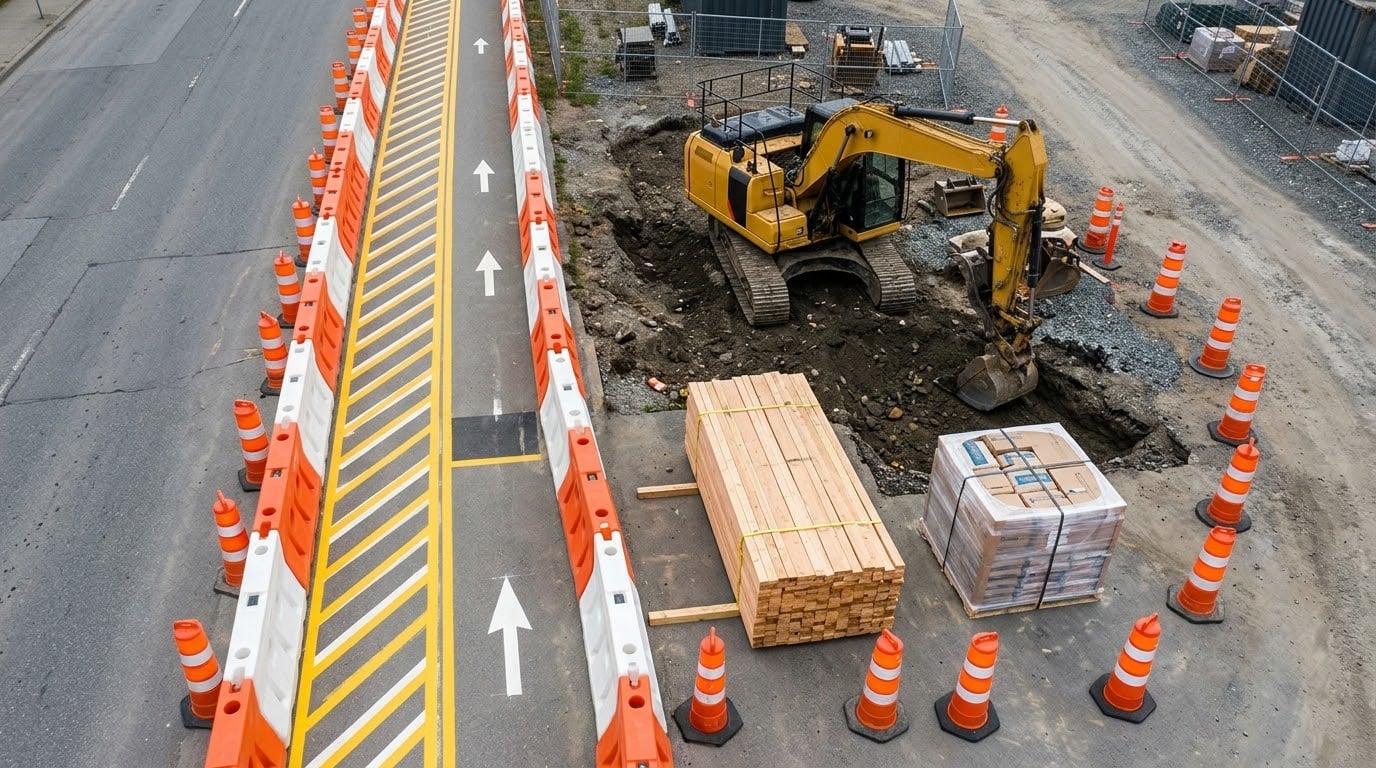
A struck-by accident is any injury in which a worker is hit, crushed, pinned or knocked down by an object or piece of equipment that is flying, falling, swinging or rolling. It is one of OSHA’s Fatal Four and the second most common cause of construction deaths after falls. Understanding how to prevent struck by accidents in construction takes eight steps, and each one is a control a site can put in place this week.
The numbers explain why employers keep asking. OSHA groups the hazard into four categories: flying objects, falling objects, swinging objects and rolling objects. The 2020 Census of Fatal Occupational Injuries broke construction deaths into parts, including 468 killed by an object or equipment struck by, 217 by a falling object, 56 by an object that fell from a vehicle or machine, and 12 by an object that slipped or swung, as reported in safety research cited by the Safety & Health Foundation network. CPWR data covering 2011 to 2021 put the four Focus Four hazards at roughly 65% of all construction fatalities.
Non-fatal numbers follow the same pattern. NIOSH research, as cited in industry writing on falling objects, found that most non-fatal struck-by injuries involve solid building materials, hand tools and debris, with HVAC and sheet metal workers hit hardest. Eye injuries from small metal fragments are the version crews complain about most often, and the prevention is unglamorous: guards, face shields, exclusion zones and tethering.
Here is the process, step by step.
Table of Contents
- What You Need
- Step-by-Step
- How to identify struck-by hazards before work starts
- How to separate workers from vehicles and equipment
- How to control suspended materials and falling objects
- How to inspect and maintain equipment controls
- How to train workers to recognize and report hazards
- How to verify controls during each work shift
- How to investigate and correct near misses
- How to maintain continuous protection across contractors
- Common Mistakes
- Frequently Asked Questions
- Conclusion
What You Need
You cannot run these steps with a hard hat and a good attitude. Before work begins, put together the following.
Planning documents and a current hazard assessment
You need a written site logistics or traffic management plan, a job hazard analysis for the day’s tasks, and an overhead work permit if any trade will be working above others. On a multi-employer job, someone has to own the coordination plan and circulate it before the first delivery arrives.
Competent-person knowledge on site
At least one person on every shift needs to be competent in the equipment in use and in the lifting operations on site. That person authorizes lifts, sets exclusion zones and knows the swing radius of the machines they are working around.
Communication tools that match the crew
Radios with an agreed channel, a whistle, hand signals that everyone on site actually knows, and a written list of who signals whom. Workers new to the site or new to the language need a walk-through of these before their first task. Crews are also usually quicker to raise a hazard once they know who to tell, which is worth pairing with a clear briefing on how to prevent workplace violence at work so reports go to a person who will act on them.
Physical barriers
Guardrail, barricade tape, cones, jersey or water-filled barriers, toe boards, debris netting and hard barricades around fixed objects. Improvised barriers made of rope or scrap lumber are the ones that fail first.
Warning and detection devices
Working backup alarms, lights, reversing cameras, proximity detection and mirrors. Technology helps, but it is an addition to separation, not a replacement for it.
Personal protective equipment for struck-by work
Hard hats, high-visibility clothing, safety glasses or a face shield for grinding and cutting, gloves and steel-toe footwear. PPE is the last line of defense, and only for the parts of the body it actually covers.
What your site needs in detail depends on the project, the equipment, the ground conditions and the OSHA standards that apply to your work.
Step-by-Step
How to identify struck-by hazards before work starts
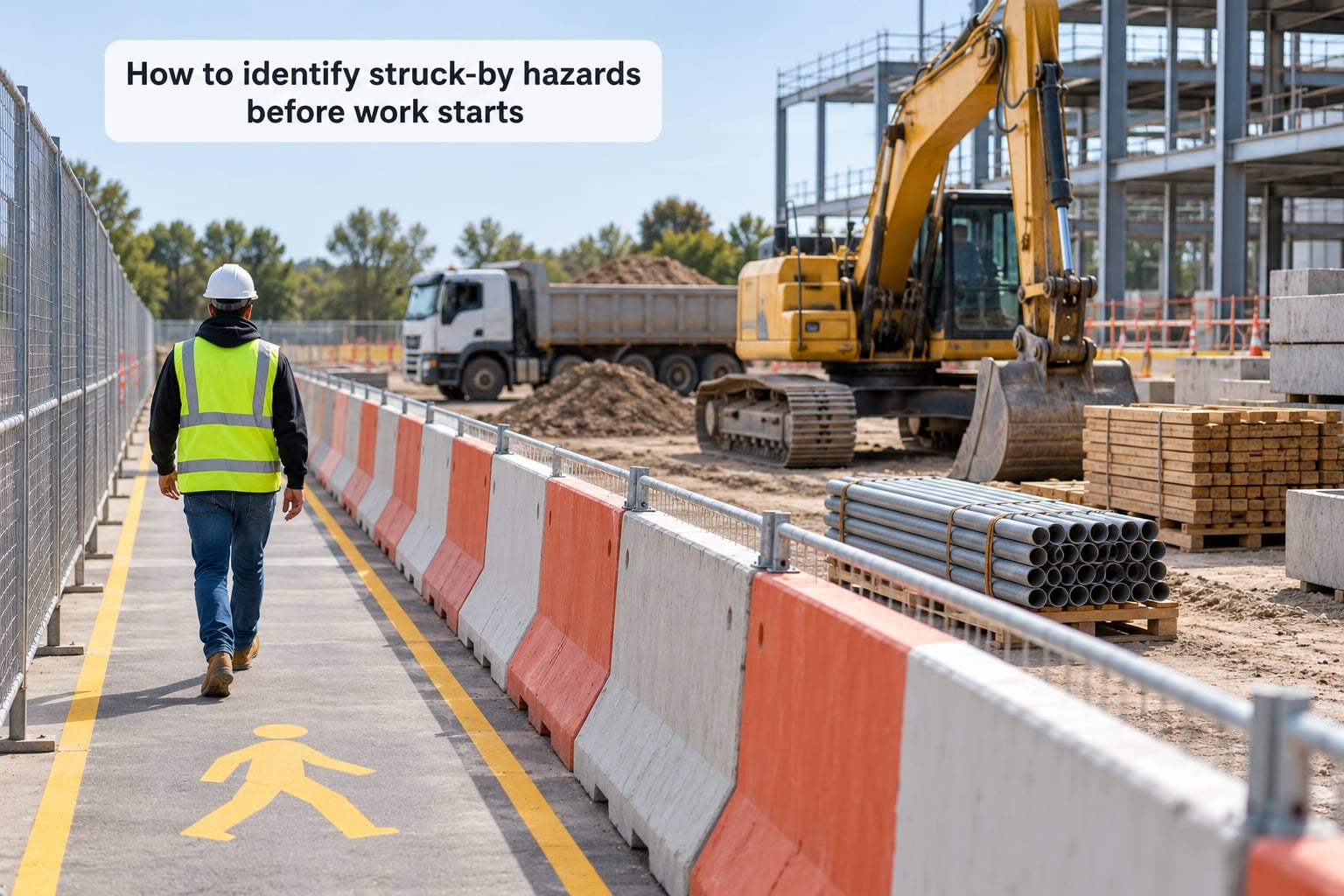
Walk the work area before the crew does and map every place a person could be hit. Look at traffic routes, equipment travel and swing paths, suspended materials overhead, stacked material that could shift, openings in the deck and work happening in adjacent areas. Write each one down with a name and a location.
The evidence of completion is a signed hazard map or JHA with the control assigned to each entry. The responsible role is the supervisor or competent person, and verification means walking the map on the ground and confirming each hazard still looks the way it did on paper.
How to separate workers from vehicles and equipment
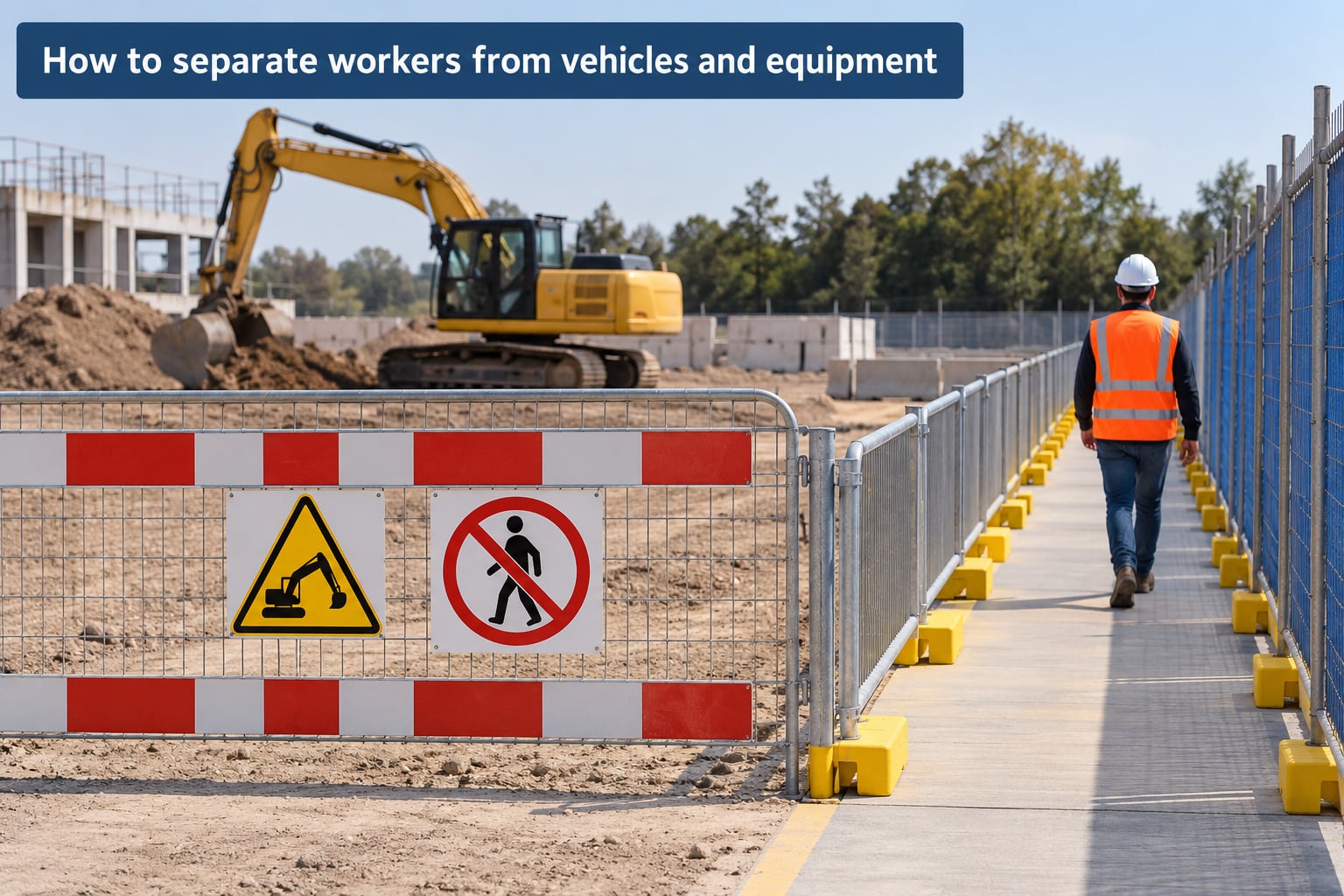
Physical separation does the heavy lifting. Establish designated walkways, controlled crossing points, one-way vehicle routes and, where the machine is working, a physical exclusion zone nobody crosses without authorization. Where separation cannot be built, use a spotter or signal person who stays out of the machine’s path and in the operator’s line of sight.
Keep people out of the equipment travel zone, the swing radius and the crush zone between a fixed object and a moving machine. Any minimum distance you adopt has to come from your own risk assessment and the equipment’s limits, not from a number copied off a poster.
Verification is simple: can a supervisor stand at any point on the route and point to where a pedestrian should be standing? If not, the route is not finished.
How to control suspended materials and falling objects
Work above other trades needs a permit, a written plan and physical protection underneath: toe boards, debris nets, screened platforms, guardrails or a covered deck. Barricade the ground below and keep it clear while the overhead work runs, and plan material drops so nobody is under the load path.
Tether hand tools when you are working at height, store materials so they cannot roll or slide, and never stack anything where a vehicle or a person passes underneath. The verification step is to ask a ground-level worker to describe what is above them right now. If the answer is vague, the overhead control has failed.
How to inspect and maintain equipment controls
Run a documented pre-start check on excavators, skid steers, forklifts, trucks and hoists. Alarms, lights, cameras, mirrors, guards, interlocks and operator visibility all belong on the list, along with a check that the operator can see the ground crew before the first movement of the day.
Critical safeguards get maintained or the machine leaves the site. That includes backup alarms that do not work, a cracked windshield that hides the rear view, a missing guard on a cutting tool or a seat belt defeated with a wrench in the pocket.
The competent person records the check, the operator signs it, and the supervisor reviews the sheet. A check with no signature is a guess.
How to train workers to recognize and report hazards
A five-minute daily toolbox talk beats an annual course. A workable structure: name the task, name the struck-by hazards for that task, walk the exclusion zone and the escape path, cover the hand signals and radio protocol for the day, confirm who can stop work, and end with one near miss somebody has seen.
New and incoming workers need the same talk plus a site induction covering signals, blind spots and site rules. Make stop-work authority explicit, and make sure leadership responds visibly when someone uses it. Crews report that near misses go unreported when raising them produces nothing.
The evidence is a signed attendance sheet, the talk topic on the board, and a list of who was briefed.
How to verify controls during each work shift
Controls decay. A barrier gets moved for a delivery and never goes back, a walkway gets blocked by a pallet, a radio fails and nobody replaces it. Supervisors need a short daily walk that checks barricades, signage, access routes, communications and housekeeping, with anything out of place corrected on the spot.
Re-check controls whenever conditions change: a new delivery route, a revised lift plan, weather, a new trade moving into the area. A control verified last Tuesday is not evidence for today.
How to investigate and correct near misses
Treat a near miss as free information. People describing incidents in construction forums are consistent about one thing: the near miss that gets reported usually shows up again as a real injury later, often months after everyone moved on.
Record what happened without blaming a person, identify the conditions that allowed it, revise the hazard assessment, tell the crews what changed, and confirm the new control holds. Track a few leading indicators such as near-miss reports, completed JHAs and daily control checks, and look at them monthly. Where nothing gets reported, nothing gets learned.
There is a human side to this work as well. If people are being pushed to skip the check to keep production moving, the reporting problem is a workload problem, and it belongs on the same agenda as the safety conversation. Our guide to construction worker mental health support covers the pressure side of site life in more detail.
How to maintain continuous protection across contractors
Most struck-by events on shared sites come from an interface, not from a single crew’s mistake: a delivery driver who never signed in, an electrician working under an active lift, a visitor walking into an operating zone. Coordination means a shared site plan, named responsible contacts for each employer, interface meetings before the work starts, and one stop-work rule everybody accepts.
Control site access with sign-in and sign-out, and make unauthorized entry a conversation you stop work to have. Require every subcontractor’s operators to carry the site’s radio channel and signals, not just their own crew’s.
Verify by asking each contractor’s competent person to describe the exclusion zones on the site today. If two of them give different answers, the coordination has failed.
Common Mistakes
Treating PPE as the control. A hard hat reduces the severity of a head strike and does nothing at all for a worker inside an excavator’s swing radius. Fix: build the separation and the barricade first, then issue the PPE.
Letting workers stand in travel or swing zones. It is the shortest route to a fatal crush and it usually starts with someone stepping aside for a moment to let a pipe pass. Fix: a physical exclusion zone nobody crosses without authorization from the competent person.
Using improvised barriers. Rope, a pallet or a stack of scrap lumber gets moved, and then the zone is decorative. Fix: fixed or weighted barriers with signage, inspected at the start of each shift.
Assuming visibility means the hazard is controlled. A reversing camera or a proximity alarm helps the operator, but neither changes where the machine is. Fix: keep separation as the primary control and treat detection technology as an addition. The same logic applies across safety categories, including preventing electrical hazards at work.
Not communicating changes. A new delivery time, a revised lift plan or a swapped operator that nobody announced leaves the controls built for the old arrangement. Fix: a named contact on each crew and a short brief whenever anything changes.
Assuming new workers know your signals. Anyone who joined the site this week, or who works in a second language, will not know your hand signals. Fix: a short induction and a translator before first task, every time.
One closing tip: give every worker the authority to stop a lift or a move, and back them up in public the first time they use it. That single habit changes how much of the rest gets used.
Frequently Asked Questions
What is the definition of a struck-by hazard?
OSHA groups struck-by hazards into four categories: flying objects, falling objects, swinging objects and rolling objects. A struck-by accident is any injury where a worker is hit, crushed, pinned or knocked down by an object, material or piece of equipment in one of those groups. It also covers collisions with vehicles and mobile equipment moving around the site.
What PPE prevents struck-by injuries?
A hard hat with a chin strap protects the head from falling material, high-visibility clothing or a vest makes the operator see you earlier, safety glasses or a face shield stop flying fragments, gloves improve grip on tools and steel-toe boots protect the foot. None of it replaces separation from the hazard. PPE only protects the body part it covers, and it does nothing at all inside an equipment swing radius.
Do hard hats prevent struck-by injuries?
Partly. A properly fitted hard hat with a chin strap reduces the severity of an impact to the head from falling objects and swinging loads, and that is meaningful. It does not stop a worker being hit, and it does nothing for someone crushed between a machine and a wall. Head protection is the last layer, never the first one.
What are blind spots in safety?
A blind spot, or blind arc, is the area around a vehicle or machine that the operator cannot see from the seat. Rear counterweights, the frame between the wheels, low stockpiles and parked trucks all create them, and they move as the machine turns. Workers must stay out of those arcs and outside the swing radius, with spotters used where separation cannot be built.
What should a worker do when a vehicle approaches?
Get out of its path immediately and make yourself visible, then get behind a barrier rather than trying to signal past the machine. Make eye contact with the operator and stay in their line of sight. If the operator cannot see you, assume they will not stop. Stop-work authority applies here: anyone can halt a move they believe is unsafe.
How should employers handle changing site conditions?
Reassess before the change takes effect, not after. A new delivery route, a revised lift plan, a different equipment operator, weather or a trade moving into an active zone all need a fresh look at the hazard assessment and the exclusion zones. Brief every affected crew on what changed and verify the controls on the ground the same shift.
Conclusion
Start with the zones. Map where people could be hit, separate them physically from vehicles, equipment and suspended materials, and make sure everyone knows the boundaries. Then inspect the controls before the shift, brief the crew in five minutes, and check again before you leave. That loop, repeated daily across every employer on site, is how employers prevent struck by accidents in construction.