
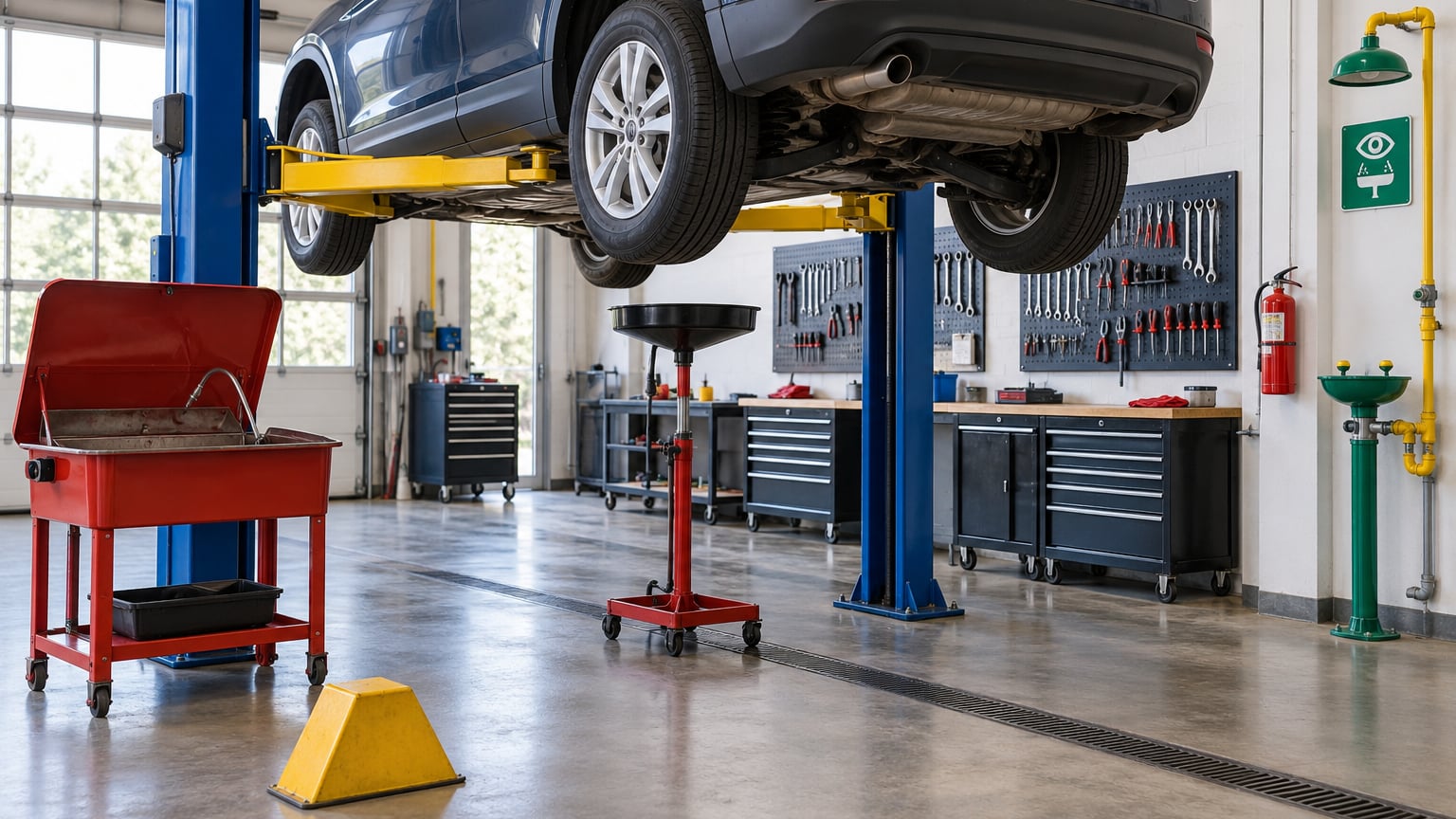
Auto mechanic safety hazards fall into a small number of repeating categories: moving vehicles and lifts, power-driven tools, hot work and fluids, chemicals, fumes, noise, vibration, awkward body positions, electricity and fire. Auto repair ranks among the most injury-prone occupations in the country, and the injuries it produces are often severe rather than trivial, because gravity, rotating equipment and chemicals rarely fail gently.
Most shop incidents trace back to the same pattern. An energy source met a worker who had no control in place, either because the control was missing or because nobody checked that it still worked. This guide is written for technicians doing their own risk assessment, shop owners building a written program, and safety coordinators who need something a whole team can actually follow.
Everything below pairs a hazard with a control you can act on this week. Rules vary by country and state, so follow your own regulations, your equipment manual and your shop’s written procedures where they go further than what is described here.
Table of Contents
- What Are the Main Auto Mechanic Safety Hazards?
- How Do Vehicles, Lifts, and Shop Equipment Cause Injuries?
- Which Chemical and Fluid Exposures Should Mechanics Control?
- How Can Shops Reduce Noise, Vibration, and Ergonomic Injuries?
- How Do Fire, Electricity, and Manual Handling Create Additional Risks?
- What Should a Mechanic Do Before Starting a Job?
- How Can Auto Shops Build a Strong Safety Program?
- Frequently Asked Questions
- What are the most common auto mechanic safety hazards?
- What personal protective equipment should auto mechanics use?
- How should a mechanic inspect a vehicle lift before use?
- What is the safest way to handle gasoline, oil, solvents, and coolant?
- How can auto shops reduce noise and vibration exposure?
- Should mechanics report minor near misses and early injury symptoms?
- Conclusion
What Are the Main Auto Mechanic Safety Hazards?
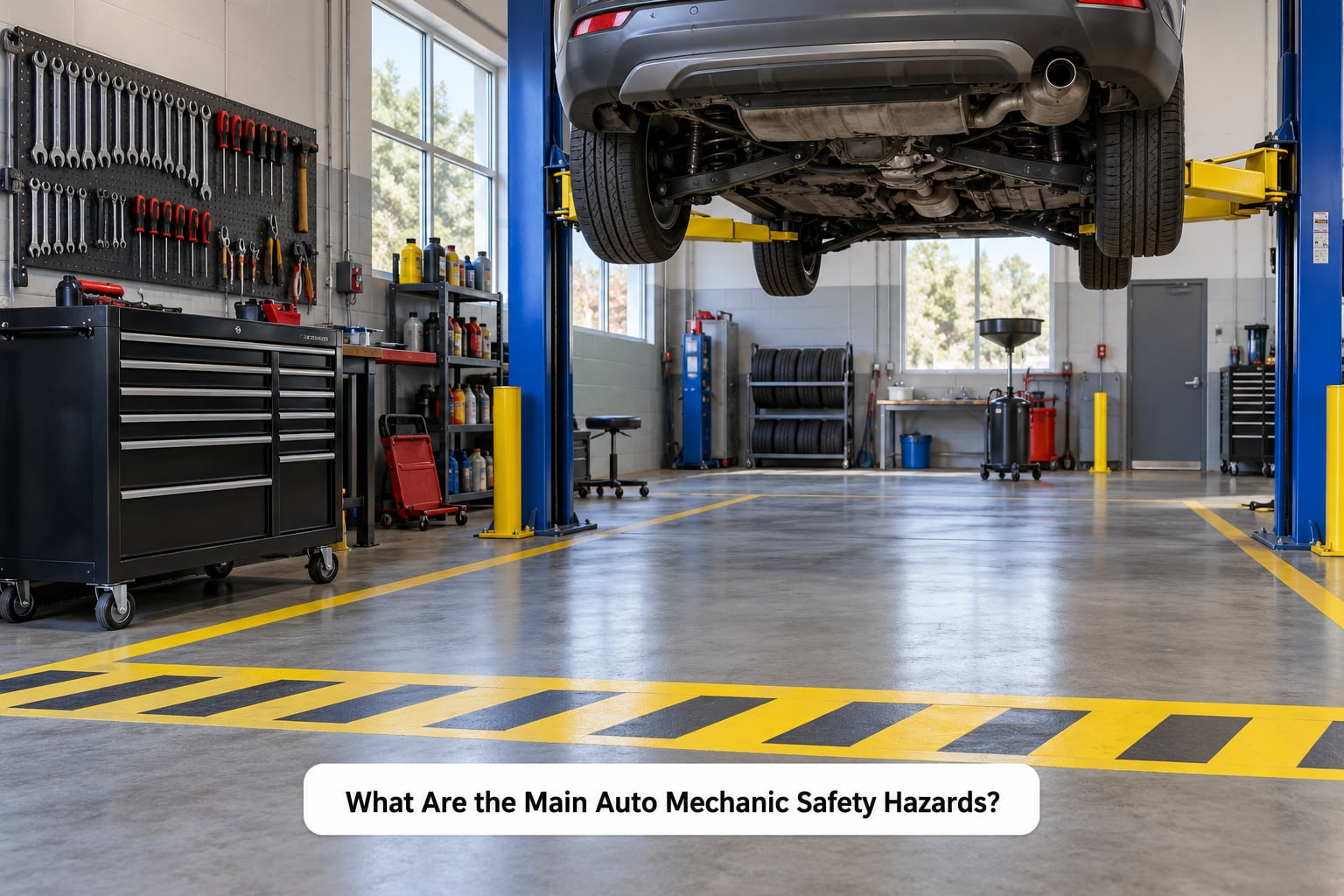
Any condition in a shop with the potential to cause injury, illness or property damage counts as a hazard. The practical version is narrower: it is an energy source that can reach a person. In a repair bay that energy shows up as the weight of a raised vehicle, the rotation of an impact wrench, the heat of an exhaust manifold, the vapour above a solvent drum, the charge in a battery, or the repeated strain of a hundred lifts a day.
| Hazard | Typical source | First prevention priority |
|---|---|---|
| Vehicle movement and falls | Unsecured vehicle, in-gear ignition, unset parking brake | Chock, park, key control, no one in the bay |
| Lift and jack failure | Outdated or overloaded equipment, worn locks | Documented pre-use inspection, rated stands only |
| Rotating and flying debris | Impact wrenches, grinders, drill presses, air guns | Eye protection, guard in place, correct speed |
| Pinch and crush points | Springs, shocks, lift arms, presses, parts shelves | Isolate the energy before reaching in |
| Hot surfaces and fluids | Exhaust manifolds, brakes, coolant, oil at temperature | Cool-down time, heat gloves, face shield |
| Chemical exposure | Fuel, solvents, degreasers, coolant, brake fluid, refrigerants | Inventory with safety data sheets, ventilation |
| Fumes and dust | Exhaust, welding fume, brake and silica dust, paint booth overspray | Source extraction, correct respirator, booth airflow checks |
| Fire and explosion | Fuel vapour, hot work, charging batteries, solvents | No ignition sources, extinguisher within reach |
| Electricity | 12V systems, EV high voltage, damaged cords, wet floors | Isolate before service, inspect cords, keep panels closed |
| Noise and vibration | Air guns, impact wrenches, grinders, extraction blowers | Low-vibration tooling, hearing protection, exposure checks |
| Ergonomic strain | Under-vehicle posture, repetitive hand work, lifting wheels | Lift and creeper access, rotation, task redesign |
How Do Vehicles, Lifts, and Shop Equipment Cause Injuries?
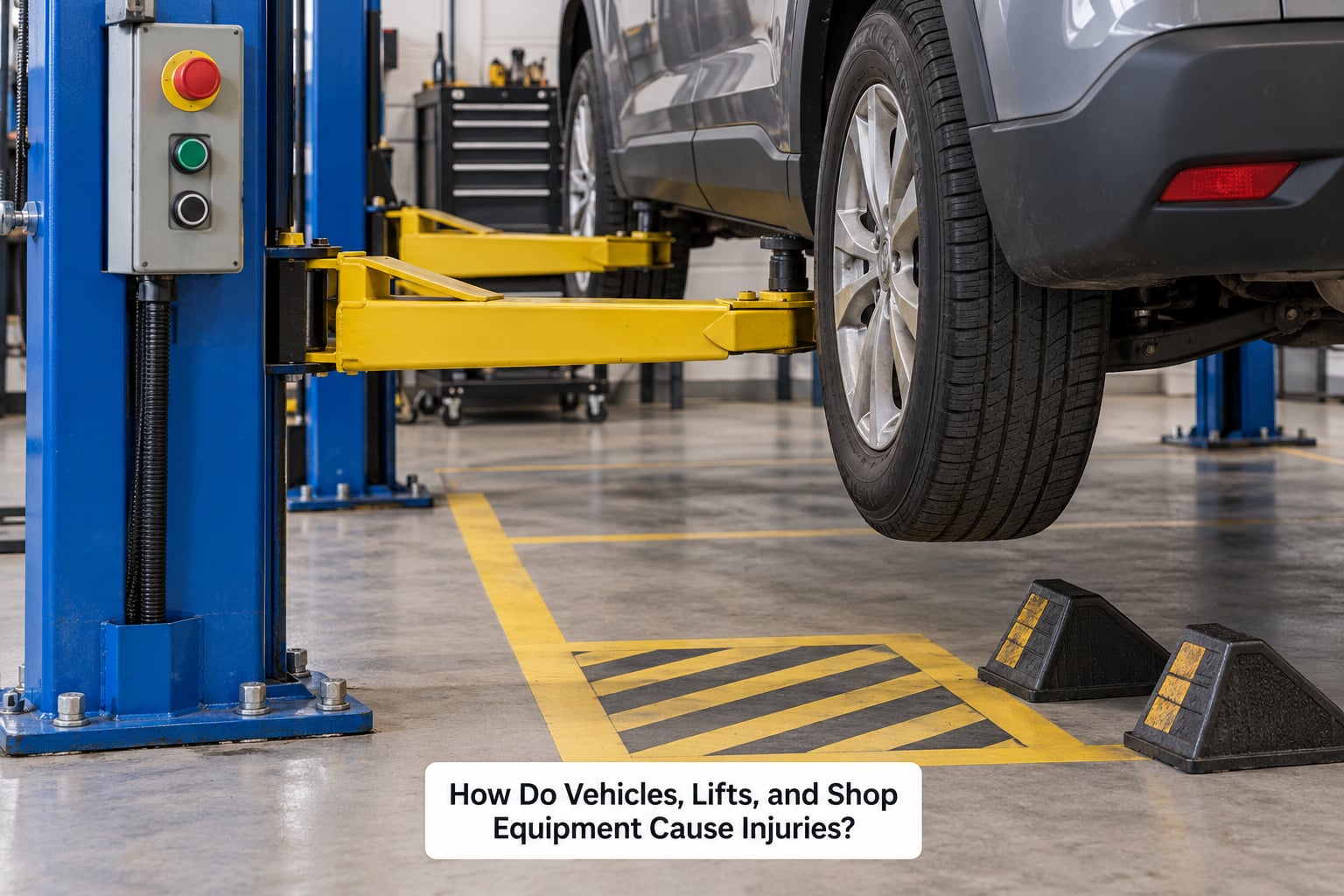
A raised vehicle is the single most dangerous object in most shops, because a two-post lift can hold well over a tonne overhead and every one of its failure modes ends with a person underneath it. The mechanism is not exotic. It is usually a vehicle left in gear, a wheel past a chock, a control left in the run position, or a lift arm resting on a spot frame instead of a rated support point.
Routine technicians describe eye injuries from debris off grinding and impact wrenches as the hazard they think about most often, and that concern is well placed. Fine metal fragments, rust scale and belt particles leave the tool faster than people expect, and the eye is the part of the body with the least recoverable function. A face shield is the right answer for grinding and high-torque work; wraparound safety glasses are the minimum everywhere else.
Then there are the tools themselves. Impact wrenches with worn sockets, air hoses with cracked jackets, frayed extension cords, grinder guards flipped back out of position and drill presses with the belt guard removed are all routine sightings. Technicians on r/MechanicAdvice and r/mechanics repeatedly raise the same point about this job: the danger is rarely exotic, it is a worn tool used one more time because the deadline is close.
Pre-use checks worth doing every single time
- Lift inspection: look at the locks, the arms, the cables or chains, the post base, the floor anchor points and the hydraulic lines. Confirm the rated capacity covers the vehicle, including added accessories and passengers’ luggage still in the car.
- Jack and stand inspection: check for bent stands, cracked saddles, rust on screw mechanisms and missing locking pins. Stands are a backup, never a support.
- Tool condition: guards present and working, cords and hoses free of damage, sockets undamaged, air pressure at the maker’s figure, no bypassed safety switch.
- Vehicle control: transmission in park or neutral with the parking brake set, engine off, key removed and controlled by whoever is doing the job, wheels chocked on a slope.
Isolating the vehicle before you reach in
Follow the manufacturer’s procedure and your shop’s written lockout rules rather than a habit. The standard sequence for most non-hybrid work is: park or neutral, parking brake on, chock the wheels, key removed, battery negative terminal disconnected when the task requires it, then the lift is raised and the arms are set on the specified points. Mechanical lockout or tagout applies whenever you will be near rotating or energised parts.
Mark the bay. Once a vehicle is raised and locked, nobody walks under it, through it, or past the swing path of the arms unless they are part of the job. On a shop where this is not written down and enforced, it becomes normal to wander through a working bay, which is a habit worth breaking now rather than later.
When a lift is behaving oddly, tag it out and take it out of service. Our recommended tool safety inspection checklist gives you a documented pass to work from, which matters because an undocumented lift is hard to defend and an undocumented habit is hard to correct.
Which Chemical and Fluid Exposures Should Mechanics Control?
A shop holds a working chemistry set: petrol and diesel, engine oil and coolant, brake fluid and DOT fluid, transmission fluid, solvent, degreaser, parts cleaner, penetrating oil, paint, adhesives, refrigerant and acid. Most are labelled only on the drum, and many of the smaller shops have no safety data sheet on the floor where the chemical is used. A safety data sheet under 29 CFR 1910.1200 tells you the hazards, the required protective gear and the first-aid measures for a product, and it should be reachable without leaving the bay.
Chronic exposure is the quiet half of this problem. Acute burns are obvious; the long-latency conditions are not. Brake and clutch dust can contain asbestos on older vehicles and silica on brake rotors, and both cause scarring lung disease years after exposure. Solvent vapour and benzene from fuel are linked to blood cancers and central nervous system effects. Cleaning parts in a sink or a parts washer with no extraction puts fine oil mist into the air the whole bay breathes.
What good chemical control looks like
- Inventory and data sheets: a live list of every container on site with a current safety data sheet, kept where staff can reach them.
- Labelled containers: original container, or a clearly labelled compatible one. No solvent in a drink bottle, ever.
- Ventilation and extraction: general dilution plus local exhaust at parts washers and mixing points. Older independent shops are the ones most likely to have neither, as technicians on r/mechanics have pointed out.
- Glove choice by chemical: the wrong glove is worse than none because it feels like protection. Our guide to choosing safety gloves for a job covers the differences between nitrile, neoprene and the solvents each one actually resists.
- Eye and face protection: safety glasses for splash, a face shield for draining, pressure testing and spraying.
- Spill response: a stocked spill kit within reach of the drain area, a defined cleanup procedure, and a rule that a spill gets cleaned before the job continues.
- Storage: closed containers, upright, away from ignition sources, with incompatible materials separated and the floor bunded where volumes justify it.
- Handwashing and hygiene: wash after handling, before eating or smoking, and change contaminated workwear before it goes home.
If a spill contacts skin or eyes, get to the eyewash or running water straight away and follow the first-aid section of the product’s data sheet. For anything inhaled, ingested or involving a serious burn, move the person to fresh air or safety and call emergency services rather than trying to treat it on the floor.
How Can Shops Reduce Noise, Vibration, and Ergonomic Injuries?
Noise damage is the hazard people notice last, because hearing loss is gradual and painless until it is advanced. Impact wrenches, air guns, grinders, air hammers, chippers and extraction blowers routinely push levels well past what shift-long exposure tolerates, and technicians on forum threads about shop safety say the same thing repeatedly: nobody misses the ringing in their ears until the damage is done.
Hand-arm vibration syndrome is the mirror image. Grinders, angle grinders, polishers and rotary sanders send vibration through the wrist and forearm on every job, day after day. The early signs are numbness, tingling and a sense of stiffness in the fingers at the start of a shift, and they are worth acting on before they become permanent. Our guide to vibration exposure from power tools covers the exposure limits and the tooling choices that reduce it.
Ergonomics is the neglected one. Most technicians spend the day with the neck rotated, the back arched under a car and the wrists bent over an engine bay. Design students researching shop layouts have argued, reasonably, that the real problem in most shops is the bench, the creeper access and the storage height rather than the crew’s willingness to wear gloves.
| Task | Main exposure | Practical controls |
|---|---|---|
| Impact wrench use | Noise, hand-arm vibration, flying debris | Low-vibration or hydraulic tools, correct socket rather than a cheater bar, hearing protection, breaks between bursts |
| Grinding and cutting | Noise, vibration, silica and metal dust, eye injury | Local extraction, face shield, guarded tool, correct disc and speed, restricted access while running |
| Air gun blow-off | Noise, flying debris, others nearby | Pressure at the maker’s figure, safe distance, never aimed at a person or a colleague’s hands |
| Under-vehicle work | Awkward posture, neck strain, manual handling of tools | Creeper stools and under-vehicle stands, tool trays, headlamp, rotating the task rather than the body |
| Wheel and tyre service | Manual handling, repetitive force, awkward knee position | Wheel lift or assist device, tyre roller, two-person handling for heavy assemblies |
| Parts washing | Solvent vapour, skin contact | Parts washer with a lid or extraction, correct gloves, no spraying of solvent for cleaning |
| Long diagnostic sessions | Fatigue, screen posture, concentration loss | Task rotation, scheduled breaks, shift handover of unfinished jobs |
Controls that cost almost nothing: rotate noisy and quiet tasks so nobody takes the full day of noise, keep tools at the right height instead of stacked on the floor, put a creeper stool and an under-vehicle board where everyone can reach them, and raise anything you would otherwise lift from a low shelf. Report early symptoms rather than working through numbness, and remember that fatigue multiplies all of this. A tired technician at the end of a long week skips the chock, and skipping the chock is how a Tuesday turns into a claim.
How Do Fire, Electricity, and Manual Handling Create Additional Risks?
Fire is the hazard with the worst odds and the shortest warning. Fuel vapour, solvent vapour, hot work, a running engine, a space heater and a charging battery can all produce an ignition source in the same bay. The controls are mostly administrative and boring, which is exactly why they work: hot-work authorisation, no smoking or open flames near fuel storage, batteries charged in a ventilated area away from ignition sources, extinguishers and a spill kit located on the route out rather than across the bay, and a shop layout where the parts washer is not next to the battery charger.
Electricity ranks close behind. Wet floors, damaged extension cords, chafed leads under a mat, a missing panel cover, and jump-starting in the wrong sequence are the usual sources of shock. Isolate before service, disconnect the battery when the procedure calls for it, inspect cords rather than assuming, and treat any vehicle with visible orange high-voltage cabling as a different job entirely. Hybrid and EV work adds a category that did not exist in older shops: high-voltage isolation follows the manufacturer’s procedure, involves waiting for a specified discharge period, and is never improvised. Insulated tools rated for the voltage are not interchangeable with standard ones, and a technician without formal high-voltage training has no business opening that system.
Manual handling is the quiet cause of long careers ending early. Engines, transmissions, brake rotors, wheels, batteries and parts shelving all add up to thousands of lifts a year. Watch storage heights, set a weight limit beyond which a second person or a hoist is used, keep the route to the parts room clear, and treat a blocked walkway as a lifting hazard rather than a tidiness issue. Crush injuries from parts tumbling off shelving and falls from unstable step platforms belong here too.
Compressed air deserves its own line. Anyone who has been hit in the ear or the eye by a stray jet of air knows why: pressure at the maker’s figure, never above it, never used to clean skin or clothing, and no blowing dust off a worker’s body or into another bay.
What Should a Mechanic Do Before Starting a Job?
A repeatable pre-job routine is what separates a shop that reacts to injuries from one that prevents them. Six steps, every job, no exceptions for the easy ones.
- Identify the task and every energy source. Gravity, rotation, heat, electricity, chemical, pressure and the person’s own body movement. Ask what could go wrong and who is standing nearby.
- Inspect the vehicle and the work area. Walk the bay before you start. Check the lift, the tool, the floor and the lighting. Note the spill you are about to step in and the cable you are about to trip over.
- Review the instructions and the data sheets. The service manual for the procedure, the safety data sheet for every chemical involved, and the equipment manual for the tool you are about to use.
- Choose your controls and PPE before you start. Controls first: isolate, lock out, chock, ventilate, extract. PPE second: eye protection, gloves matched to the chemical, hearing protection, respiratory protection, footwear with a toe cap and slip-resistant sole.
- Tell someone and secure the vehicle. Brief the bay on what you are doing and how long it should take. Set the brake, remove the key, chock the wheels, set the exclusion zone and lift lockout where the procedure requires it.
- Stop if the conditions change. A spill, a light failure, a tool fault, a lost key control, a visitor walking in, or a job starting to feel rushed. Stopping is a professional decision, not a refusal.
Two habits from that list are worth dwelling on. First, technicians on r/mechanics report being pushed to finish jobs that really needed the correct procedure, including work that should have been done with the wheel off on the ground rather than with the car unsupported. Second, unauthorised visitors in a working bay is a real exposure that customers rarely consider and owners rarely address. Both are solved by the same two minutes of step five.
If your shop does not have this written down, the eight-step tool and equipment inspection checklist is a practical starting point for turning the habit into a record.
How Can Auto Shops Build a Strong Safety Program?
A program is not a poster on a wall. It is a set of written procedures someone checks, and the difference shows up in how people behave. The strongest version is fairly simple to build:
- Documented inspections. Daily pre-use checks on lifts, jacks, tools and extinguishers, signed. A defect found on paper is a repair; a defect found during an injury investigation is a lawsuit.
- Training that matches the task. New technicians are trained and signed off before they work on equipment they have not used. Refresher training is scheduled rather than assumed, including for experienced staff. Time and attendance are recorded, which is also your evidence.
- Near-miss reporting with no blame. The near-miss is free information. Someone losing a socket that bounced off the roof, or a small spill that would have been worse on a slippery floor, is telling you where the next injury goes.
- Equipment maintenance on schedule. Lifts serviced at the maker’s intervals, cords and hoses replaced rather than taped, filters changed on exhaust extraction.
- Chemical reviews. The inventory checked against what is actually in the shop, data sheets current, damaged containers removed, and gloves available in the right type and size.
- Emergency preparation. Eyewash station that works, first aid kit with full contents, spill kit, emergency contacts, a posted evacuation route and drills that include a fire and a spill.
- Follow-through. Every report gets a response and an owner. Reports that vanish teach people not to report.
Review the whole program whenever vehicles, tools, tasks or shop conditions change, because the hazard assessment is only valid for the job and the equipment it was written for. Adding EV servicing, moving to a two-post lift arrangement, or bringing on a new chemical means the assessment is out of date until it is redone.
One last point from the technician side. If your employer will not repair a faulty lift, supply gloves, or let you have training on equipment you are expected to operate, document what you asked for and who said no, and use your right to refuse that work. Workers on shop safety threads are often told to just be careful. Being careful does not fix a lift with worn locks.
Frequently Asked Questions
What are the most common auto mechanic safety hazards?
The most common auto mechanic safety hazards are moving or falling vehicles and lift failures, rotating tools and flying debris, pinch and crush points, hot surfaces and hot fluids, chemical exposure to fuels and solvents, exhaust fumes and dust, fire, electrical shocks including EV high-voltage systems, noise, hand-arm vibration, and repetitive strain from awkward under-vehicle work. Slips from oil and coolant spills run close behind. Almost all of them share one cause: an energy source with no control in place.
What personal protective equipment should auto mechanics use?
Safety glasses as a minimum in every bay, with a face shield for grinding, draining, spraying and pressure work. Gloves matched to the task: cut-resistant for handling sharp components and torn edges, chemical-resistant for fluids and solvents, heat-resistant for hot parts. Hearing protection where impact tools, air guns and grinders run. Steel-toed, slip-resistant footwear. Respiratory protection only where assessment and ventilation cannot keep exposure below limits. Matched PPE must be clean, intact, correctly sized and actually worn.
How should a mechanic inspect a vehicle lift before use?
Check the rated capacity against the vehicle weight, then inspect the arms, locks, cables, chains, saddles, hydraulic lines, post base and floor anchors. Confirm the arms sit on specified support points, not spot frames or fragile panels. Verify the control station and any lowering device work, and that maintenance and inspection records are current. Never work under a lift with damaged components or missing locks. Tag defective equipment out of service, and have it repaired by a qualified technician.
What is the safest way to handle gasoline, oil, solvents, and coolant?
Keep every product in a labelled, compatible container with its current safety data sheet reachable from where it is used. Store closed, upright and away from ignition sources, with incompatible materials separated. Provide general ventilation plus local exhaust at mixing points and parts washers. Wear chemical-resistant gloves chosen for that specific product and safety glasses for splash. Keep a spill kit on the route, and clean spills immediately rather than leaving them for the next job.
How can auto shops reduce noise and vibration exposure?
Cut the exposure at the source first: lower air pressure, use low-vibration or hydraulic impact tools, maintain and balance grinders, and fit local extraction so noisy equipment runs inside a hood. Use a silencer or exhaust away from the bay where it helps. Where exposure remains, provide correctly fitted hearing protection and rotate technicians so nobody takes a full shift of noise. For vibration, add rest breaks, vary the grip and tool, avoid pressing the tool into the work, and act on early finger numbness.
Should mechanics report minor near misses and early injury symptoms?
Yes, both. A near-miss report is free information: the dropped socket or the small spill that nearly caught someone tells you where the next injury lands, and nothing was hurt. Report early symptoms too, especially finger numbness, tingling or stiffness, ringing in the ears after a shift, and persistent back or shoulder ache, because these point to exposure or strain that is easier to fix early. Keep a personal record with dates and exposures, and see a doctor for diagnosis and treatment decisions.
Conclusion
Almost every auto mechanic safety hazard comes down to energy meeting a person with no control in place, so the priorities are straightforward. Know what energy the job holds, inspect the vehicle and the equipment before you touch anything, isolate and lock out before you reach in, control fumes and chemicals at the source, wear the protective equipment that matches the task, and report anything unsafe including the near-misses.
Start with a written hazard assessment for the jobs your shop does most, a documented pre-use inspection for every lift and jack, and a chemical inventory with safety data sheets at the bench. Those three things, done consistently, remove more risk than any piece of equipment you can buy this year. Review the assessment whenever the vehicles, tools or tasks change, and keep reporting the small things.