
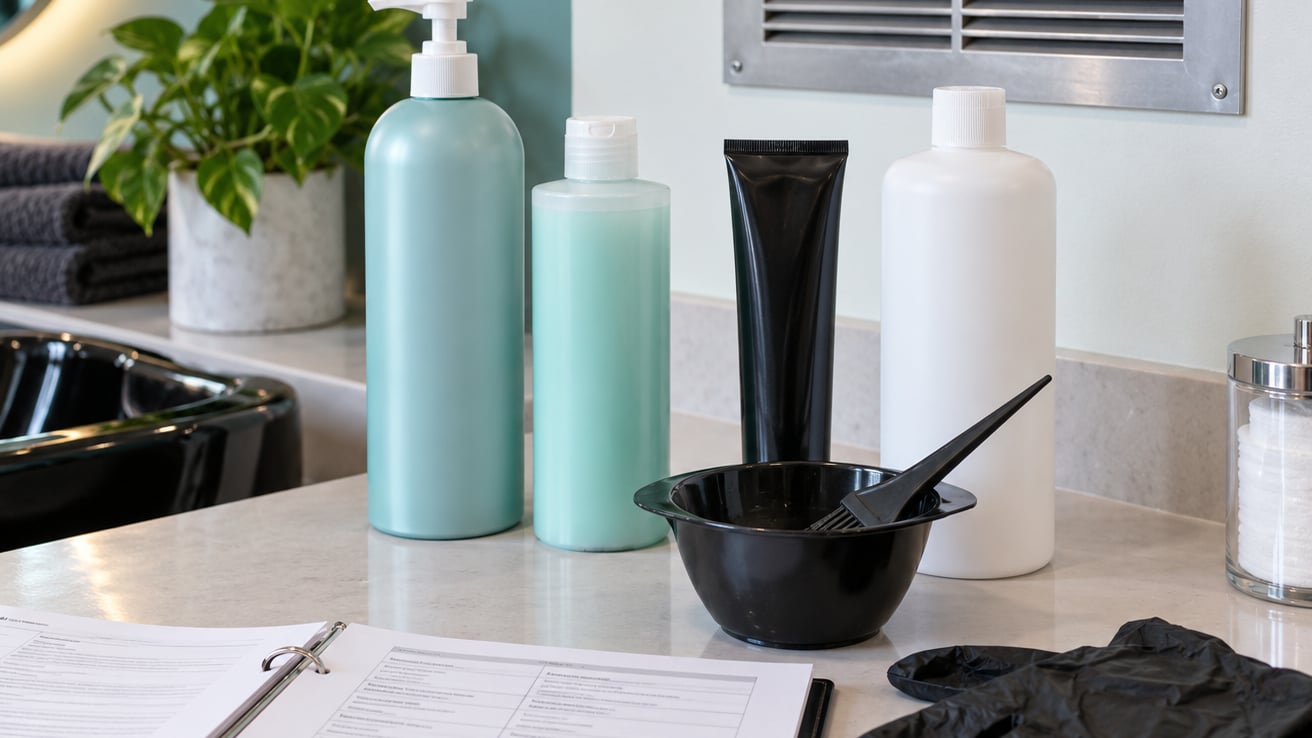
Hair salon chemical exposure risks come down to one thing: stylists, barbers and clients breathe, touch and swallow trace amounts of the same irritants and carcinogens every working day. Dyes, bleach, ammonia developers, straightening agents, disinfectants and aerosol sprays release vapors that build up indoors, and the harm often shows up years later rather than at the chair.
Most salons treat this as a smell problem. It is a dose problem, and dose depends on the product, the room, the task and how long someone does it. This guide covers what the chemicals are, how they reach you, who absorbs the most, and which controls actually move the numbers.
Table of Contents
- Key Takeaways
- What Chemicals Are Common in Hair Salons?
- What Are the Health Effects of Hair Salon Chemicals?
- How Does Hair Salon Chemical Exposure Risk Happen?
- Who Is Most at Risk?
- How Can Salon Workers Assess Chemical Hazards?
- How to read safety data sheet sections
- What to record during a salon walkthrough
- What Controls Reduce Hair Salon Chemical Exposure Risk?
- Ventilation and air movement
- Work practices
- Personal protective equipment
- What Should a Salon Do After an Exposure or Spill?
- How Can Salon Owners Build a Chemical Safety Program?
- What to record in an incident log
- Frequently Asked Questions
- Are natural hair salon products always safer?
- Is ventilation alone enough to protect salon workers from chemicals?
- Should pregnant salon workers avoid all hair chemicals?
- What should a salon do with an unlabeled or unidentified product?
- Can hair salon chemicals affect clients as well as workers?
- Conclusion: Start With the Products Used Most Often
Key Takeaways
- The highest exposures happen at the moment of mixing, not during application.
- Ventilation is the control that changes indoor levels; gloves only protect hands.
- A safety data sheet tells you what a product contains and what to do after exposure, and every worker should have access to one.
- Symptoms like headaches, dizziness and sore throats are easy to dismiss and worth tracking over time.
- Reproductive questions and long-term conditions belong with a clinician, not a search bar.
What Chemicals Are Common in Hair Salons?
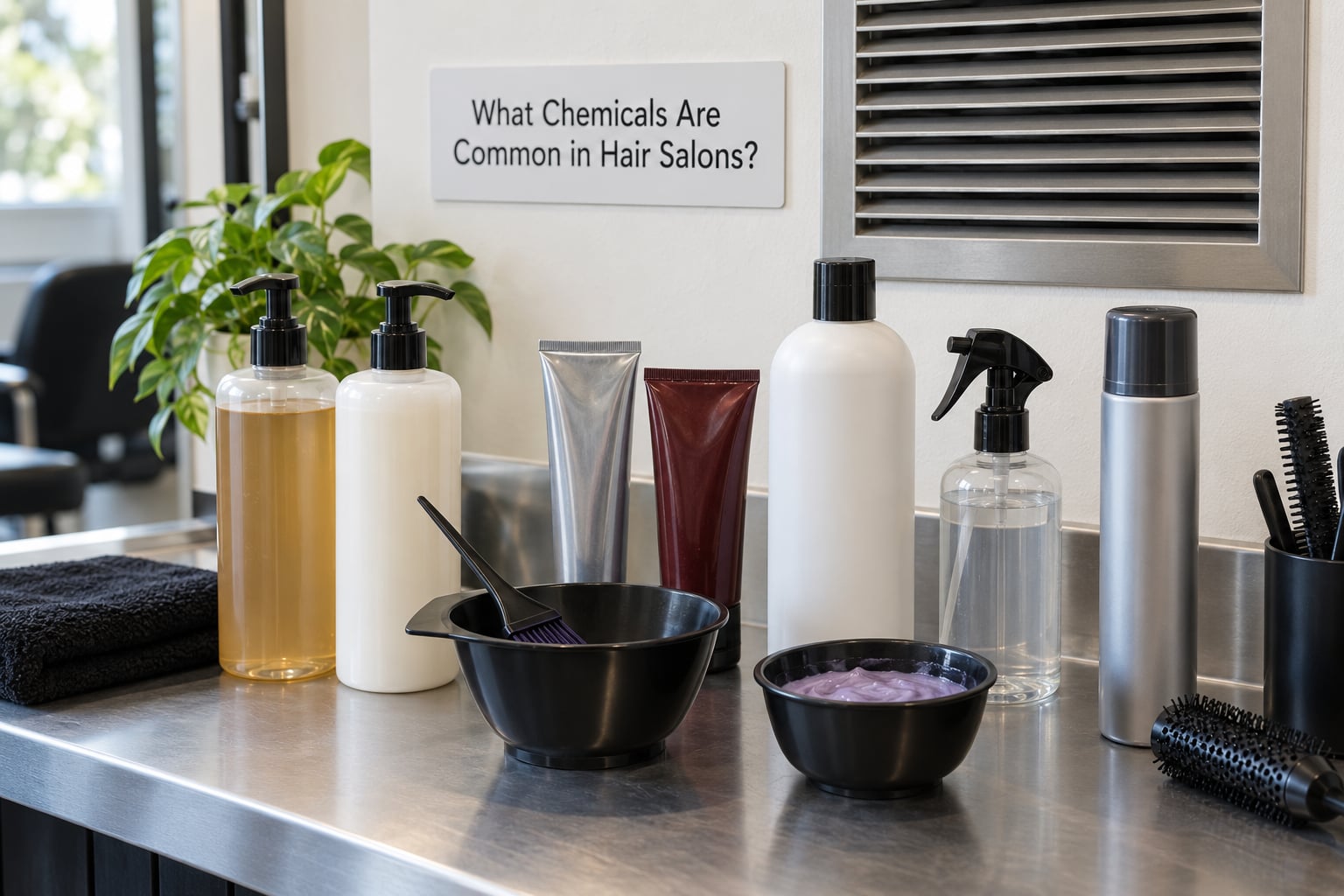
Salons work with six chemical groups, and most workers touch all of them in a single shift. Solvents such as alcohol-based carriers evaporate fast and travel into the air. Oxidizers like hydrogen peroxide and ammonia-based developers irritate eyes and airways. Oxidizing dyes and preservatives such as paraphenylenediamine, or PPD, and methylisothiazolinone are common sensitizers. Fragrance compounds are added to nearly everything and are a leading cause of contact allergy. Aerosol propellants and formaldehyde-releasing agents from smoothing and straightening services round out the list.
No single product is usually the problem. It is the mixture, the frequency and the room. A stylist who mixes forty bowls of developer a week, in a small room with one window and an open door, has a very different exposure profile from someone doing the same service in a suite with source extraction. Health guidance for other cleaning-heavy workplaces follows the same logic, and our janitorial worker chemical safety action plan covers the assessment method in more depth.
| Chemical or group | Where it shows up | Primary concern |
|---|---|---|
| Solvents (alcohol, glycol ethers) | Sprays, serums, primers, adhesives | Airborne irritation, headache, dizziness |
| Hydrogen peroxide | Developer, bleaching powder | Eye and airway irritation, burns at high contact |
| Ammonia | Lighteners, color developers | Strong airway irritant, asthma trigger |
| PPD and other oxidative dyes | Color, bleach, highlights | Skin and airway sensitization |
| Preservatives (MI, parabens) | Shampoos, conditioners, styling | Contact dermatitis |
| Fragrance compounds | Nearly every product | Allergic contact dermatitis |
| Aerosol propellants | Hairspray, dry shampoo | Inhalation of fine droplets |
| Formaldehyde-releasing resins | Smoothing and straightening services | Acute airway irritation, longer-term concern |
| Quaternary ammonium disinfectants | Tool and chair cleaning | Skin, eye and respiratory irritation |
What Are the Health Effects of Hair Salon Chemicals?
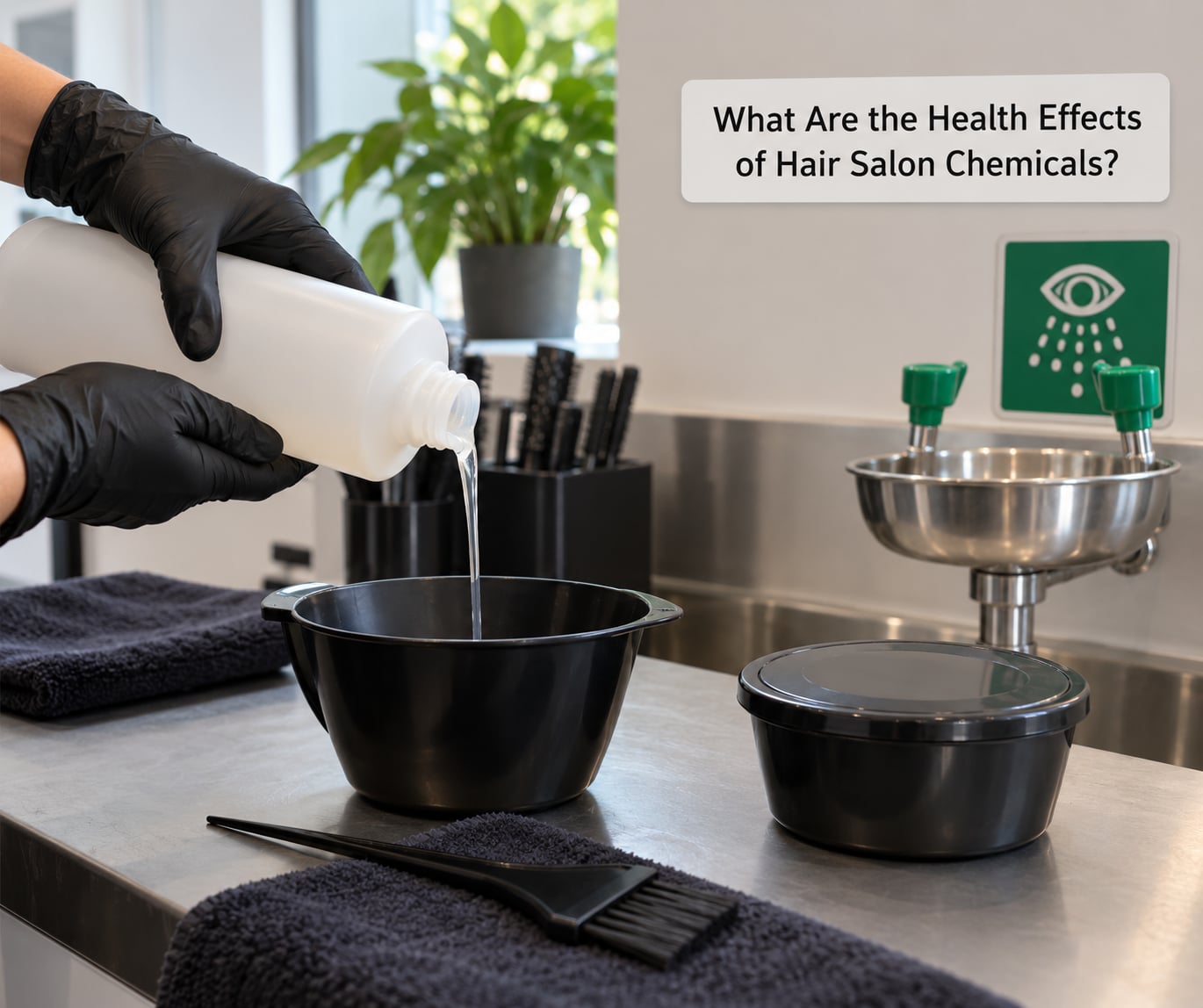
Effects run from immediate irritation to conditions that surface decades later, and the difference is mostly about dose and duration. Eyes sting and water, skin goes dry then cracked, throats feel raw after a bleach-heavy day. Those are irritation effects, and they usually settle once the exposure stops.
Sensitization is different and more serious. The immune system learns a substance on first contact, then reacts harder on every contact after that. A stylist who tolerates PPD for six years can develop a rash that no amount of glove-wearing will prevent. Sensitization is permanent, which is why early protection matters more than heroic cleanup later.
Longer-term concerns reported in occupational research on hairdressers include bladder and laryngeal cancer, leukemia, asthma, persistent dermatitis, miscarriage and some neurological conditions. These are population-level findings from workers with decades of exposure, not predictions about one person. Our guide to solvent exposure health effects at work explains how that kind of evidence is gathered and why individual risk varies.
Symptoms also lag. A headache during a mixing session is obvious; memory lapses, chronic fatigue or a rash that flares for weeks are easy to blame on something else. If symptoms persist after a shift, or keep recurring, take them to a physician or occupational health clinic. Anyone with breathing difficulty, swelling or a severe reaction needs urgent medical care, not a forum thread.
How Does Hair Salon Chemical Exposure Risk Happen?
There are five routes, and a busy day uses all of them. Inhalation is the big one: vapor leaves an open bottle at mixing, drifts through the room and settles into the breathing zone of whoever is closest. Skin contact happens every time you dip bare hands into a bowl, handle a client’s hair that’s still wet with developer, or wipe a spill with a towel instead of a glove.
Eye splash is the third route, and the least forgiving. A tilted bottle, a splash while rinsing out a bowl, or a drip running down your forearm toward your face all put liquid straight into the eye. Ingestion happens quietly, when you touch a mixing bowl handle with product on your fingers and then eat, touch your phone, or brush it into an injury. It also happens when a contaminated bottle is stored next to drinking water.
Surface contamination is the route people forget. Product residue dries onto scissors, combs, clipper guards, chair arms and towel hooks and transfers to the next client. Shared cleaning products add their own load. Back-bar and washing stations are the least ventilated corners of most salons, so the products you use at cleanup concentrate in the air while you are bent over them.
Who Is Most at Risk?
Exposure is not evenly distributed. The highest inhaled doses go to colorists and barbers who mix multiple formulas a day, shampooers and stylists working in enclosed rooms, and braiders and specialists who run relaxer and straightening services back to back. Workers in salon suites and booth rentals often have the least control over ventilation. Cleaning staff handling used towels and disinfectants pick up dermal exposure that nobody accounts for in the staffing plan.
Susceptibility runs on a separate axis. Existing asthma or reactive airways make a workplace irritant much harder to tolerate, and compromised skin barrier or a history of fragrance or dye allergy means far less contact is needed to trigger a reaction. People who are pregnant, planning a pregnancy, or trying to conceive have specific questions about reproductive exposure that belong with an obstetric clinician, not a product label.
Disproportionate risk is also structural. Workers who are overrepresented in chemical-intensive services are more likely to work in older buildings with shared air systems and less likely to have a say in the product list. Any salon that treats air quality as an owner-only decision will miss the people most affected by it.
How Can Salon Workers Assess Chemical Hazards?
Start with what is in the room, not with what you think you can smell. Odor is a poor indicator because you tire out and stop noticing, and some hazardous compounds are essentially odorless at low levels. Assess by product, quantity, task and room. Four questions do most of the work: what chemicals are here, how much is used at once, how long does the task take, and what air does it move through?
How to read safety data sheet sections
Every professional chemical product should come with a safety data sheet, and the one for a janitorial product explains the format in detail in our guide to reading a safety data sheet in seven steps. For salon work, concentrate on four sections. Section 2 lists hazards, Section 4 gives first-aid measures, Section 7 covers handling and storage, and Section 8 sets exposure limits and recommended protection.
Section 8 is the one most owners skip, and it is where regulatory limits live. It also tells you whether the product is meant for professional use with specific protection. If you cannot find the sheet for a product, ask the distributor for it in writing. A product without one is not the same as a safe product, and it is a legitimate reason to stop using it until the paperwork arrives.
What to record during a salon walkthrough
Walk the room with a phone and record nine things: every product name and where it sits, which tasks generate vapor, where air enters and leaves the room, whether bottles are opened or closed during service, how long a typical task runs, where towels and contaminated clothing go, whether an eyewash station exists, which cleaning products are used, and how many people share the air. Add the room’s square footage and window or vent count. That single list turns an opinion about “it feels stuffy” into something you can act on or hand to a professional.
What Controls Reduce Hair Salon Chemical Exposure Risk?
Work through the hierarchy of controls rather than jumping to gloves. Elimination and substitution come first because they remove the hazard entirely, which no respirator can do. Then come engineering controls, then administrative ones, then personal protective equipment. A salon that buys gloves before fixing its air is treating the smallest part of the problem.
Ventilation and air movement
General room ventilation dilutes vapors; local exhaust ventilation removes them at the source. A fume hood or a task capture arm over the mixing station is the difference between capturing vapor at 6 inches and letting it fill a room for eight hours. Use fans to move air from the mixing area toward an open window or exhaust point, never across a customer’s face. Have any system you rely on checked and maintained, and treat a blocked filter or a switched-off unit as an exposure event, not a nuisance.
Work practices
Mix in small batches, keep lids closed, and cap bowls as soon as pouring stops. Open bottles once per shift, not continuously. Move the chair back from the mixing station while the developer is working, take service breaks outside the room when you can, and put your towels and contaminated clothes straight into a lidded bin rather than wearing them home. Store products upright, closed and away from heat or sunlight, and separate incompatible groups. Switch aerosol hairspray to a pump where the performance holds.
Personal protective equipment
Chemical-resistant gloves for mixing and handling, chosen for the product rather than by habit, are the baseline for anyone doing chemical work. Change them immediately if they tear or if product gets inside. An N95-style respirator helps with particulates and some vapors only when it fits, so any use beyond casual needs should come with fit guidance and a plan. Add a face shield or splash goggles for pouring and cleaning, wash hands at the back station before eating or leaving, and keep a dedicated apron for chemical services that you never wear to eat in.
What Should a Salon Do After an Exposure or Spill?
Respond fast, follow the safety data sheet, and get help when the reaction is more than irritation. For eyes, flush with clean running water for at least 15 minutes, hold lids open, remove contact lenses if easy, and get medical attention if burning or vision changes continues after flushing. For skin, remove contaminated clothing and gloves, wash with soap and water, and seek care for a spreading reaction, blistering or a delayed allergic flare.
For inhalation, move the person to fresh air and keep them at rest. Call for emergency help if breathing is labored, if chest tightness or coughing persists, or if the exposure was significant and symptoms develop hours later. For ingestion, do not induce vomiting, rinse the mouth, and contact a poison control center or a clinician, ideally with the product label in hand.
For a spill, restrict access, open windows and run ventilation, then absorb the liquid with the material named on the product’s safety data sheet. Put contaminated absorb material in a closed, labeled container for chemical waste disposal rather than the regular trash or a drain. Log what happened, which product it involved, and what action was taken, because repeat exposures are usually the same source being missed twice.
How Can Salon Owners Build a Chemical Safety Program?
A working program is short and written down. Keep a current product inventory with purchase dates and supplier contacts. Hold a safety data sheet for every product, accessible to staff without asking permission, and check it when you swap a distributor. Train new hires on mixing, ventilation use, glove selection, spill response and eyewash location before they work a station unsupervised. Post emergency contacts and eyewash locations where they are visible from the chair.
Schedule ventilation inspection, filter checks and eyewash function checks on a calendar rather than waiting for a complaint. Define who buys product and require written hazard information before any new line enters the back bar. Review the inventory twice a year and drop products that duplicate an existing function. If you operate salon suites or booth rentals, put shared ventilation responsibility in the lease in writing, including who pays for filter maintenance and what happens when the system fails.
What to record in an incident log
Each entry needs date and time, the product and task, who was involved, what happened, first aid given, whether anyone left early or went to medical care, and what changed afterward. Review the log quarterly and look for patterns rather than individual events. If the same product or the same station keeps appearing, that is your next substitution or engineering decision, and the answer is not “be more careful.”
Frequently Asked Questions
Are natural hair salon products always safer?
Not always. Plant-derived and marketing-natural formulas can still contain solvents, preservatives and fragrance allergens that irritate skin and airways, and a natural claim tells you nothing about ventilation needs or exposure limits. Read the ingredient list and the safety data sheet the same way you would for any product, and judge it by what it contains and how often you use it rather than by the label language on the front.
Is ventilation alone enough to protect salon workers from chemicals?
No, and it should not be asked to carry that weight on its own. Ventilation is the strongest engineering control available in a salon, but it does nothing for skin contact, and dilute ventilation still leaves residue on tools and towels. Pair good air movement with closed containers, small-batch mixing, hand protection, handwashing and a written spill procedure to cover the routes air cannot reach.
Should pregnant salon workers avoid all hair chemicals?
There is no single rule for every product and every person, so this is a question to bring to an obstetric clinician or an occupational health professional rather than to a label. Some ingredients carry specific reproductive cautions, and your doctor can weigh them against your actual tasks, your symptoms and your stage of pregnancy. In the meantime, stronger ventilation, reduced mixing duties and correct gloves are sensible for any worker regardless of status.
What should a salon do with an unlabeled or unidentified product?
Do not use it, and do not pour it down a drain. Put it in a closed container, label it as an unidentified chemical with the date found and where, and keep it away from food and shared supplies. Ask staff who brought it in, then contact the distributor or manufacturer for a safety data sheet. If it cannot be identified, treat it as chemical waste and dispose of it through the proper local route.
Can hair salon chemicals affect clients as well as workers?
Yes, though clients usually get shorter and less frequent doses than the person doing the service all day. Colouring, bleaching and straightening can irritate skin and eyes, and dye ingredients can trigger allergic contact dermatitis that shows up hours later, sometimes only after a person has had several appointments. Good ventilation and careful handling protect everyone in the room, and clients with known allergies should tell their stylist before the appointment.
Conclusion: Start With the Products Used Most Often
The first move is inventory, not equipment. List what you use, pull the safety data sheet for each one, and mark which products are mixed in quantity and which tasks create the most vapor. Those two answers tell you where to spend money, and usually they point at substitution and source capture rather than at gloves.
Fix the air before anything else, because hair salon chemical exposure risks are decided mostly by how much vapor a worker breathes over a shift. Then tighten work practices, train the team on gloves, handwashing and spill response, and keep an incident log so repeat problems become visible. Keep up to date on labeling and disclosure requirements in your state, since those rules still change as of 2026.
If you are unsure whether a symptom is chemical-related, whether a room’s ventilation is adequate, or what to do about a reproductive concern, talk to a physician or an occupational safety professional. They can assess your actual situation in a way no checklist can.