
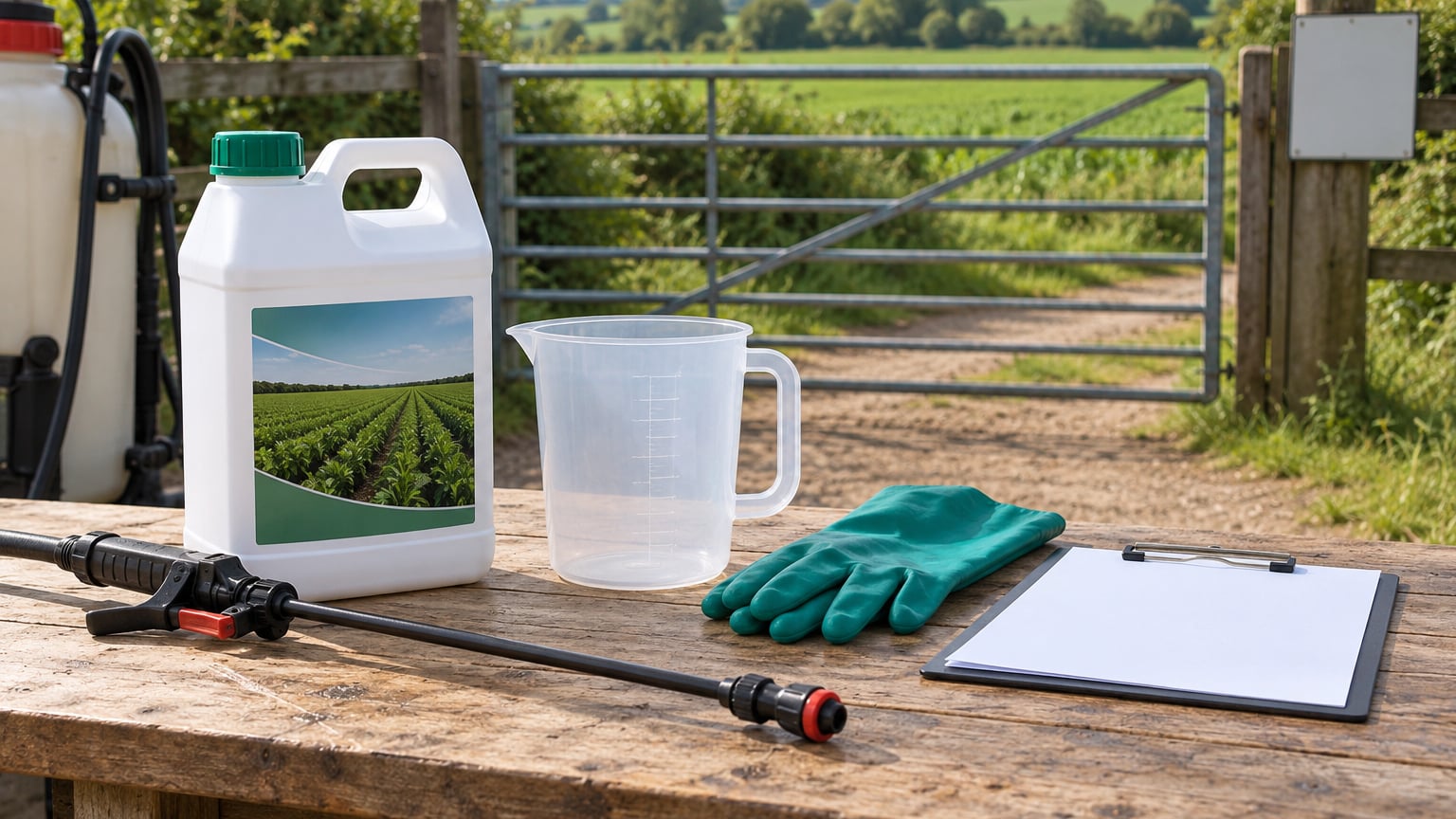
Pesticide exposure safety for farmworkers comes down to four things: the label, the personal protective equipment it requires, the restricted-entry interval on that product, and knowing what to do in the first hour after a suspected exposure. Most exposure happens not while mixing concentrate but during ordinary contact with dilute residues on leaves, dust and work clothing. This guide is written for migrant and seasonal workers, pesticide handlers and field crews, and for the supervisors who are responsible for training, equipment and clean water.
This is general safety information, not medical advice. If you think you have been exposed and you feel unwell, get help rather than waiting it out. In the United States, Poison Control answers free, 24 hours a day, at 1-800-222-1222, and 911 handles severe symptoms.
We keep this guide updated as guidance changes. Review date: 2026.
Table of Contents
- Pesticide Exposure Safety for Farmworkers at a Glance
- How Do Farmworkers Get Exposed to Pesticides?
- What Health Effects Can Pesticide Exposure Cause?
- How Can Farms Reduce Pesticide Exposure?
- What Should Workers Know Before Mixing and Applying Pesticides?
- What Personal Protective Equipment Protects Farmworkers?
- How Do Restricted-Entry and Reentry Intervals Protect Workers?
- How Should an Exposed Worker Remove Clothing and Wash?
- How Can Training Work for Multilingual and Seasonal Farmworkers?
- What Should a Farm Do After a Suspected Pesticide Exposure?
- Frequently Asked Questions
- Should a farmworker shower immediately after pesticide exposure?
- Which pesticide exposure symptoms require emergency medical care?
- Can farmworkers refuse work until they understand the pesticide label?
- How should contaminated clothing, vehicles, or living spaces be handled?
- When does a farmworker need a respirator for pesticide work?
- What Should Farmworkers Do First?
Pesticide Exposure Safety for Farmworkers at a Glance
Pesticide exposure occurs through four main routes: skin contact, breathing, swallowing, and carry-home residue on clothing and vehicles. Everything else in this article is a variation on how to block those four routes. The table below is the short version.
| Exposure route | How it happens in the field | Main prevention |
|---|---|---|
| Skin contact | Spills while mixing, spray drift on wet foliage, plant material rubbed against arms and legs during thinning, weeding and harvesting | Label-required gloves, long sleeves or coveralls, washing with soap and water before breaks and at end of shift |
| Breathing | Aerosol or mist during spraying, dust from recently treated fields, vapour in tunnels, greenhouses and other enclosed spaces | Correct respirator where the label requires one, staying out of the application exclusion zone, reentering only after the interval |
| Swallowing | Eating, drinking or smoking with contaminated hands, touching the mouth after field work, sharing a bottle or cup | No food, drink, gum or tobacco in the field or during handling; wash hands and face before eating |
| Carry-home | Pesticide residue on work clothes, boots, gloves and the family vehicle, then transferring to a house, couch, bed or child’s hands | Removing outer layers before entering the vehicle, keeping contaminated clothing out of the home, washing separately and hot, showering after work |
Four record sets should exist on any farm using pesticides, and a worker should be able to see them:
- The pesticide label. The label is the legal instruction. It outranks any informal workplace advice about how long to wait or what to wear.
- The application record. What was applied, where, when, by whom, at what rate, and under what conditions.
- The restricted-entry interval and entry posting. The time after application before workers or bystanders may enter, and the sign that communicates it.
- Training and decontamination records. When training was delivered, in which language, and where water, soap and eyewash are kept.
Urgent actions after suspected exposure: move away from the source, get into fresh air, remove contaminated clothing, wash skin with soap and water, rinse eyes with clean running water for 15 to 20 minutes, and call for medical help if symptoms appear. Poison Control is 1-800-222-1222; call 911 for severe symptoms.
How Do Farmworkers Get Exposed to Pesticides?
Skin contact accounts for the largest share of measured exposure in agricultural work. Research on occupational behaviour and farmworker pesticide exposure has found that gloves and handwashing are the two behaviours that most reliably reduce dermal exposure in field settings.
Dermal contact is the route most field crews actually experience
Handlers get the concentrated product. Everyone else gets the dilute residue that is still sitting on the plant. A thinner working an orchard canopy pushes through treated foliage with bare forearms, a weeder bends repeatedly through treated rows, and a harvest crew picks up residue with every handful.
That distinction matters because the crews with the most physical contact are often not the crews required to wear protective equipment or receive training under federal rules. Orchard thinning is the clearest example, and it is worth asking your supervisor directly which tasks on your operation count as pesticide work.
Breathing in drift, dust and vapour
Airborne exposure happens when a spray is applied nearby, when wind carries fine droplets across a worksite, when disturbed dust lifts from recently treated soil, and when chemicals evaporate inside a closed structure. Enclosed spaces are the harder case because concentrations build up and there is nowhere for vapour to go.
Swallowing pesticide by hand-to-mouth
Oral exposure is usually accidental rather than intentional: a hand to the mouth, a shared water bottle, a cigarette held with a gloved or unwashed hand, or food eaten straight from a field container. Workers who cannot wash before a break are relying on luck.
Take-home exposure through clothes, boots and vehicles
Residue on work clothing is not a household problem only after it reaches the house. It rides in the vehicle, sits on the seat, and transfers to hands and steering wheels. Field research on pesticide exposure by job task found detectable pesticide residue in home and vehicle dust samples from workers who thinned orchards, at higher rates than from other job categories, and children in those households carried higher levels of certain metabolites.
Two practical consequences: keep contaminated outer layers out of the cab if you can, and treat the vehicle as a work surface to be cleaned rather than a passenger space.
What Health Effects Can Pesticide Exposure Cause?
Immediate effects usually show up within hours of a high exposure, while the concerns associated with repeated lower-level contact build over seasons and years. Which of these applies to any one person depends on the product, the dose, the route and the person’s health history, which is exactly why only a clinician can make that call.
| Aspect | Acute exposure | Repeated lower-level exposure |
|---|---|---|
| Timing | Minutes to hours after exposure | Over months and seasons |
| Typical features | Headache, dizziness, nausea, sweating, fatigue, muscle twitching, coughing, throat irritation, watering or burning eyes, skin rash | Concerns raised in research about the nervous system, respiratory function, kidney function and hormone regulation |
| Duration | Often improves within a day or two once exposure stops, though some symptoms linger longer | Not something a person can feel or self-assess |
| What to do | Decontaminate, rest, watch symptoms, call Poison Control or a clinic if anything feels wrong | Tell a clinician about the work and the products, and request blood testing if they judge it useful |
Warning signs that deserve prompt medical evaluation
Do not simply wait these out:
- Breathing difficulty, wheezing, chest tightness or persistent cough
- Difficulty walking, unsteadiness, slurred speech, confusion, or muscle twitching that will not stop
- Fainting, seizure, or a heart that feels like it is racing
- Vomiting that will not stop, or symptoms that get steadily worse instead of easing
- Eye exposure with continuing pain, blurred vision or light sensitivity
- Any symptom in a child or in a pregnant worker
How Can Farms Reduce Pesticide Exposure?
Reduce exposure in the order of control that actually works. Personal protective equipment is the last layer, not the first one. Most farms start at the wrong end of this list because PPE is the visible, purchasable part.
- Remove the need. Eliminate an application that is not needed. This is the only control that fully removes exposure.
- Choose less hazardous options. Select products with lower toxicity classifications, fewer hazard words on the label, or that target the pest without requiring worker reentry into the treated area.
- Reduce the dose that reaches a worker. Use targeted application, better calibration, drift-reducing nozzles and buffer zones instead of blanket spraying.
- Separate people from the hazard. Mix and load in a dedicated, well-ventilated area away from other workers, keep children out of it, and store pesticides in a locked location that cannot be reached by untrained people.
- Keep equipment sound. A leaking hose, a worn gasket or a cracked tank puts a handler into direct contact every time. Inspect and repair before the season, not during it.
- Train people who actually do the work. Cover early symptoms, routes of exposure, label content, emergency contacts and the right to refuse unsafe work, in a language the crew understands.
- Use correctly fitted PPE. See the task table below. A respirator without a written program, medical evaluation and fit testing where required is not protection.
Current EPA, NIOSH and CDC guidance, plus the specific product label, are the right references when any of these decisions is unclear.
What Should Workers Know Before Mixing and Applying Pesticides?
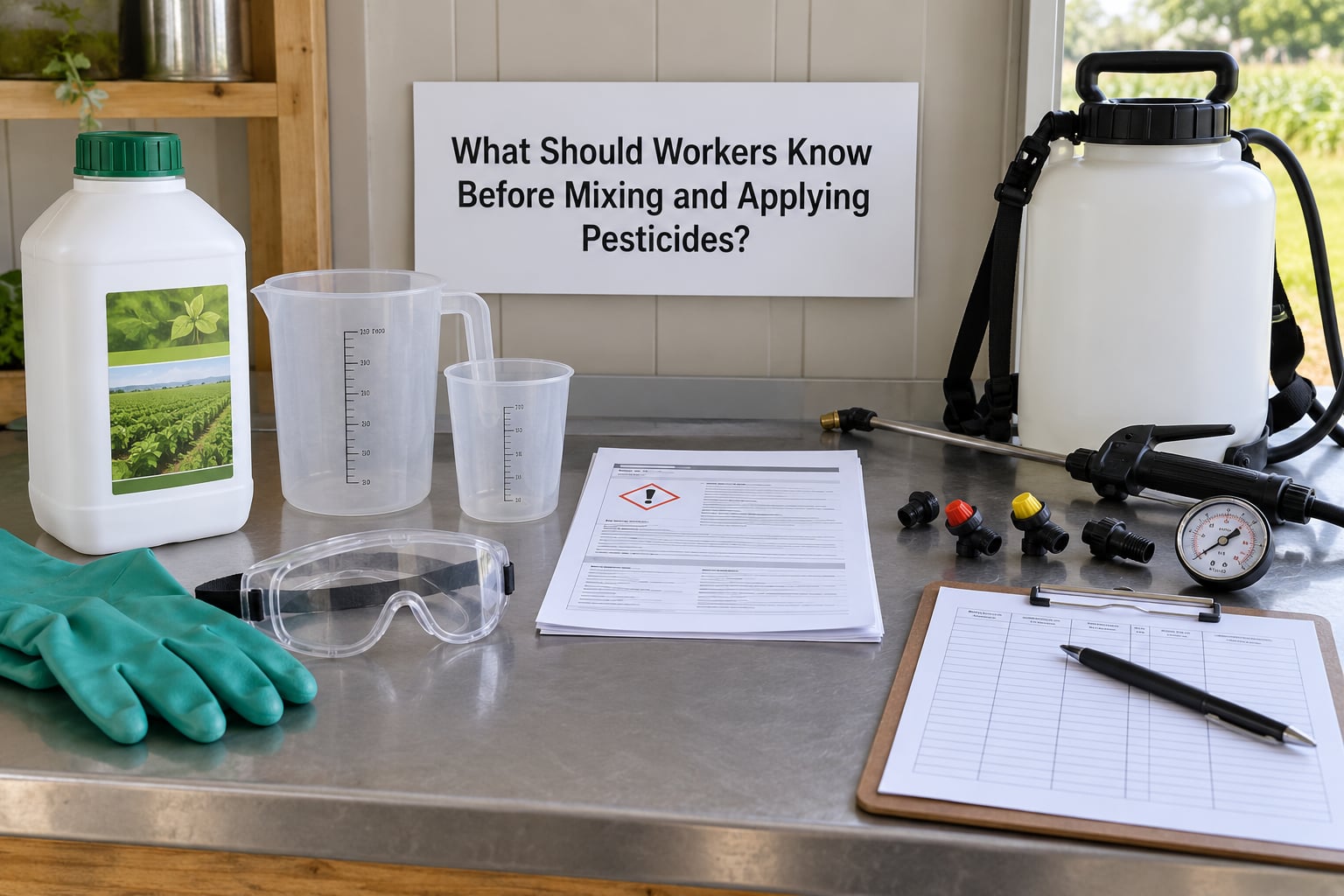
Before a container is opened, the person handling it should be able to answer a short set of questions from the label alone. If they cannot, the job is not ready to start. The label is the legally enforceable document, and it takes priority over habit, over a supervisor’s shortcut, and over anything this article says.
- Which product and active ingredient. Two products can look alike and behave nothing alike. Confirm the name, the active ingredient and the concentration.
- Hazard and signal words. The signal word on the label tells you the acute hazard category and drives the personal protective equipment requirements.
- Target crop and site. Many products are labelled for specific crops only. Using it on another crop is both an illegal exposure and a residue problem.
- Application rate and dilution order. Over-concentrating a mix increases exposure for everyone downstream.
- Weather and timing limits. Labels restrict application during rain, high wind or high temperature for good reason: drift, runoff and vapour movement all rise with the wrong conditions.
- Required protective equipment. Gloves, eye and face protection, clothing, footwear and respiratory protection, exactly as written, for the exact task.
- Compatibility. Whether tank-mixing is allowed, and in what order, so the mix does not separate or generate heat.
- Spill and disposal procedure. What to do with an accidental spill, where the wash water goes, and how containers are rinsed and disposed of.
- Application records. Date, time, product, rate, location, weather conditions, applicator and restricted-entry interval.
If a label instruction and what the crew normally does conflict, the label wins and the discrepancy should be raised with the supervisor and written down.
What Personal Protective Equipment Protects Farmworkers?
Protective equipment is specified by the label, task by task. The table below is a plain-language orientation, not a substitute for reading the label on the product actually being used.
| Task | Typical protection | Fitting and care notes |
|---|---|---|
| Mixing and loading concentrate | Chemical-resistant gloves, coveralls or long sleeves and trousers, boots, eye and face protection, label-specified respirator | Gloves must resist the specific chemical; thin disposable gloves are not for concentrate. Replace immediately if torn or inside out. |
| Applying with a sprayer | Long-sleeved shirt and trousers or coveralls, gloves, boots, eye protection, respirator where the label requires one | Open cuffs and a gap between glove and sleeve let spray run inward. Tape or close the seam where practical. |
| Working in recently treated rows | Long sleeves and trousers, gloves for the contact task, closed boots | Wet foliage transfers residue. This is the exposure most crews underestimate. |
| Working in a tunnel, greenhouse or other enclosed space | Label-required coveralls, gloves, boots, eye and face protection, appropriate respiratory protection | Enclosed air concentrates vapour. Entry restrictions and air monitoring matter more here than anywhere else. |
| Handling harvested product or containers | Gloves for residue contact, clean work clothing | Contamination moves on hands and clothing long after the spray stops. |
Fit, inspection, removal and laundering
A respirator that does not seal is a filter pouring into the lungs. Where respirators are required, employers must run a written program that includes medical evaluation before fit testing, the fit test itself, training, and maintenance. Workers should be able to ask what the fit test was and when it happened.
Inspect gloves, boots and eye protection before each use and discard anything cracked, holed or hardened. Remove protective equipment in a way that keeps the contaminated outer surface away from your skin and away from the clean inner layer, and never take contaminated clothing into the cab or the home.
Launder work clothing separately, on a hot cycle, and keep it out of the family laundry until it has been washed. Chemical-resistant gloves and coveralls have their own care instructions; storage and replacement intervals come from the manufacturer, not from the look of the item.
Heat and PPE together
Chemical-resistant clothing in a summer spray season is a heat-stress problem as much as a chemical one. Heavy layers trap heat, and heat illness can masquerade as chemical symptoms or the other way round. Watch each other for confusion, stumbling, headache and cessation of sweating, build in shade and water breaks, and see our guide to agricultural worker heat safety for the rest of the picture.
How Do Restricted-Entry and Reentry Intervals Protect Workers?
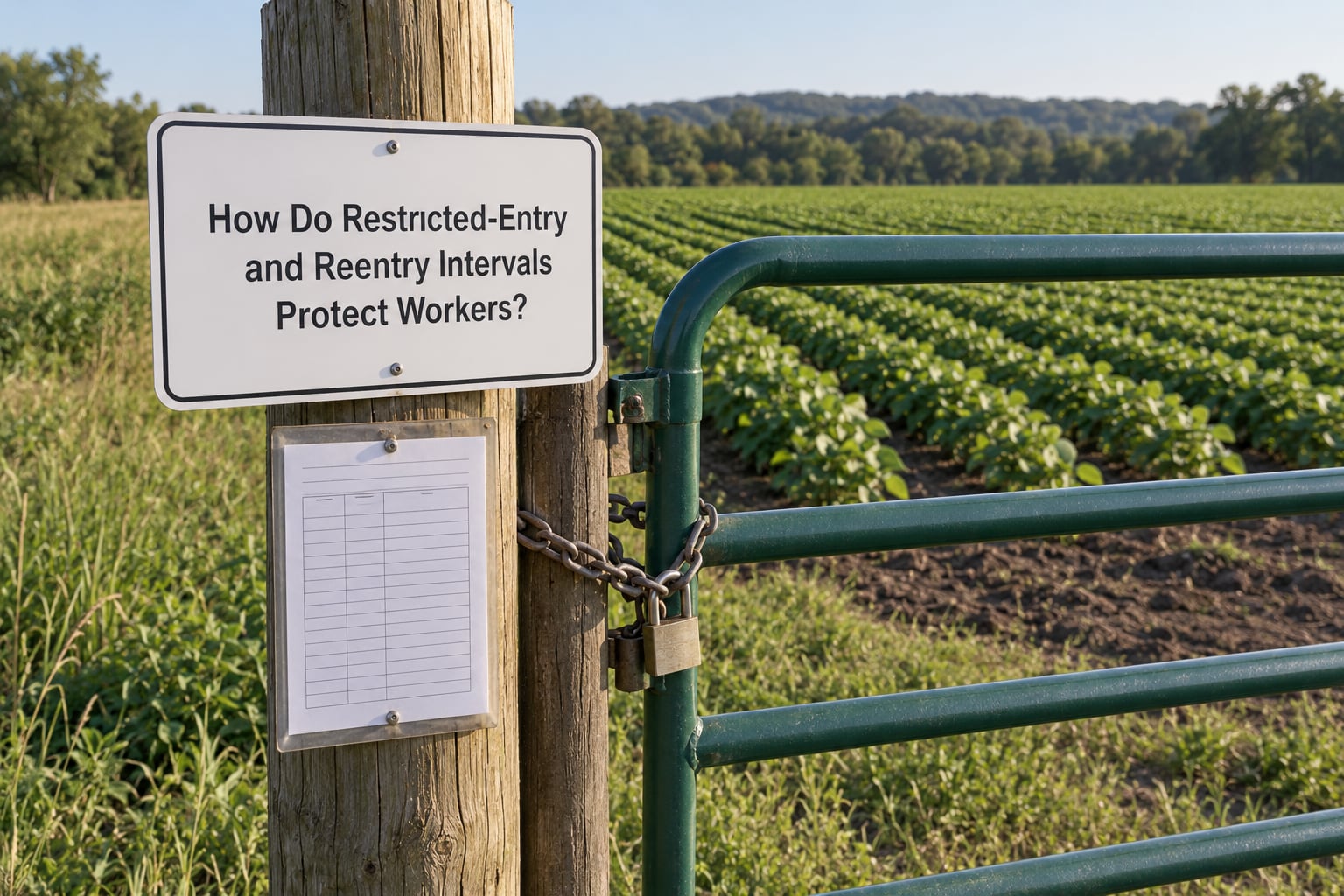
A restricted-entry interval is the time after an application during which workers and bystanders must stay out of the treated area. It appears on the label and in the application records, and the application itself triggers it whether or not anyone was standing there at the time. A reentry interval is the practical term used for the same clock in the workplace.
No universal waiting time exists. The interval is product-specific and can differ between two similar products, two application methods, or the same product applied to different crops. Some labels require no interval at all; others specify days. This is why a worker should never answer “how long do we wait” from memory.
Three places the protection has to hold up in practice:
- Open fields. Signage at the treated block’s edge, entry restrictions recorded against the application, and workers told before the spray starts which blocks are affected.
- Tunnels and greenhouses. Concentration rises inside a closed structure and takes longer to clear. Entry controls have to be enforced by a person, not just a sign.
- Shared equipment and vehicles. Anything that can carry residue out of the treated area before the interval ends defeats the restriction.
Employers should post the restriction where workers will see it before they enter the area, keep the record available, and communicate it in the languages used on the crew. If a worker does not know which products were applied or when, that gap is itself a safety problem worth raising.
How Should an Exposed Worker Remove Clothing and Wash?
Decontamination works as a sequence, and speed matters most in the first few minutes. Do not delay to find a supervisor or finish a task.
- Stop work and move away. Get out of the treated area or away from the spill into fresh air. Do not walk through other work areas to get there.
- Remove contaminated clothing. Take off outer layers, and anything the product soaked through, without shaking it. Keep contaminated items out of the vehicle and out of the home.
- Wash skin. Wash exposed skin with soap and plenty of running water. Hot water opens the pores and works better for removal; cold water may be all that is available, and cold still beats no washing.
- Rinse eyes. Rinse with clean running water for 15 to 20 minutes, holding the lids open. Get medical help if pain or vision changes persist.
- Get help if symptoms appear. Do not drive yourself while unwell, and do not go home and sleep it off in contaminated clothing.
Employers are expected to provide the means for this to work: water, soap, towels and, for tasks where the label requires it, an eyewash that can run at least 15 minutes at the worksite. A farm with no water at the field edge has a decontamination plan on paper only.
How Can Training Work for Multilingual and Seasonal Farmworkers?
Training works when it is delivered in the crew’s preferred language, built around the actual labels in use, and demonstrated rather than only written. A signature on a form in a language someone cannot read is paperwork, not training.
- Use the products actually on the farm. Generic talks leave workers unable to find hazard statements and signal words on the container in front of them.
- Show, do not only tell. Put on gloves and remove them properly. Demonstrate the eyewash. Demonstrate decontamination with soap and water.
- Cover the concrete content. Product names, routes of exposure, early symptoms, the correct personal protective equipment for each task, emergency contacts, and how to read a reentry posting.
- Do not assume literacy or prior knowledge. Picture-based materials and spoken practice work better than a dense handbook.
- Repeat it. Seasonal crews turn over constantly. A one-time briefing in spring is not coverage for a crew hired in August.
- Answer the retaliation fear out loud. Workers need to hear plainly that asking for protective equipment, asking for training, or declining work they believe is unsafe is protected under the law.
There is a worker right to understand the label and the training before handling hazardous product. If that is not happening, it is a workplace safety failure rather than a learning problem.
Our piece on how to train non-English-speaking workers on safety covers the delivery side in more detail.
What Should a Farm Do After a Suspected Pesticide Exposure?
After a suspected exposure, the first hour determines how much damage is done and how well the event gets documented. The sequence below works for both the worker and the supervisor.
- Remove the worker from the source. Fresh air, away from the treated area, away from the vehicle and away from other people who might be exposed too.
- Decontaminate. Remove clothing and wash with soap and water, rinse eyes, follow the sequence above.
- Identify the product. Bring the container or a photo of the label. If the product cannot be identified, treat the situation as more serious, not less.
- Get the label or the safety data sheet. Both carry the hazard, first-aid and toxicity information a clinician needs. Keep it with the worker.
- Arrange medical evaluation. Call Poison Control at 1-800-222-1222 for guidance, or 911 for severe symptoms. Encourage evaluation even when symptoms seem mild, because some effects are delayed.
- Document the event. Product, task, time, route of exposure, symptoms, first aid given, who was notified, and the medical care sought.
- Review the work practices behind it. Was protective equipment present and in usable condition? Was water available? Was the reentry interval known and respected? Was training current and in the right language? Fix the cause, not the person.
US emergency guidance, plain and short: 911 for severe symptoms, Poison Control 1-800-222-1222 for advice at any hour, and EPA’s pesticide information line for label and regulatory questions. For solvent and vapor exposures on the job, our guide to solvent exposure health effects at work is worth a read alongside this one.
Frequently Asked Questions
Should a farmworker shower immediately after pesticide exposure?
Yes. If you have been working around pesticides, showering as soon as you get home is one of the most effective steps against carry-home exposure. Washing with soap and water at the worksite first, then showering at home, removes residue from skin and hair before it transfers to bedding, furniture and other household surfaces. Keep work clothes out of the home and launder them separately on a hot cycle.
Which pesticide exposure symptoms require emergency medical care?
Call 911 for breathing difficulty, chest tightness, seizure, fainting, confusion, slurred speech, or severe muscle twitching. Eyes that stay painful or blurred after a 15 to 20 minute rinse also need prompt attention. Do not drive yourself if you feel unwell, and do not wait to see whether symptoms improve. Poison Control answers free at 1-800-222-1222 any hour and can tell you whether the situation needs an emergency department.
Can farmworkers refuse work until they understand the pesticide label?
Workers have rights around pesticide work, including receiving hazard information and training, and in many situations may decline work they believe will expose them to a hazard. Because losing work is the biggest barrier to speaking up, ask your supervisor early, in writing if you can, and keep a copy of any request you make. Keeping the label with you is not a request you have to make in advance, and if you are injured on the job, seek care.
How should contaminated clothing, vehicles, or living spaces be handled?
Remove contaminated clothing before entering the vehicle and before entering the home, bag it, and wash it separately on a hot cycle rather than with family laundry. Wipe or wash hard surfaces and vehicle interiors where residue may have transferred, and take off boots before coming inside. Do not shake out clothing indoors, because that spreads residue into the air. If contamination of the home has happened, tell the employer so it can be documented and addressed.
When does a farmworker need a respirator for pesticide work?
You need respiratory protection when the pesticide label requires it for the task, such as certain mixing, loading and application jobs or work in enclosed spaces where vapour can accumulate. Because respirator protection depends on a proper seal, employers must run a written program that includes medical evaluation before fit testing, fit testing itself, training and maintenance. A mask issued without that program offers far less protection than it appears to.
What Should Farmworkers Do First?
Start with the label for the product in front of you, not with what you were told last season. Know when it was applied and when the restricted-entry interval ends, and check that before entering a treated block. Use the protective equipment the label requires, fit and inspect it, and confirm that water and soap are within reach before you begin.
Then take the carry-home problem seriously: remove contaminated outer layers before the vehicle, keep work clothes out of the house, wash separately, and shower at the end of the shift. If you feel unwell after exposure, decontaminate first and then call Poison Control on 1-800-222-1222, or 911 for severe symptoms. Ask for training in your language and for the reentry information you need, and keep a copy of any request you make.
This guide is educational information about pesticide exposure safety for farmworkers. It does not replace the product label, the EPA Worker Protection Standard, or advice from a physician or pharmacist about an individual health concern.