
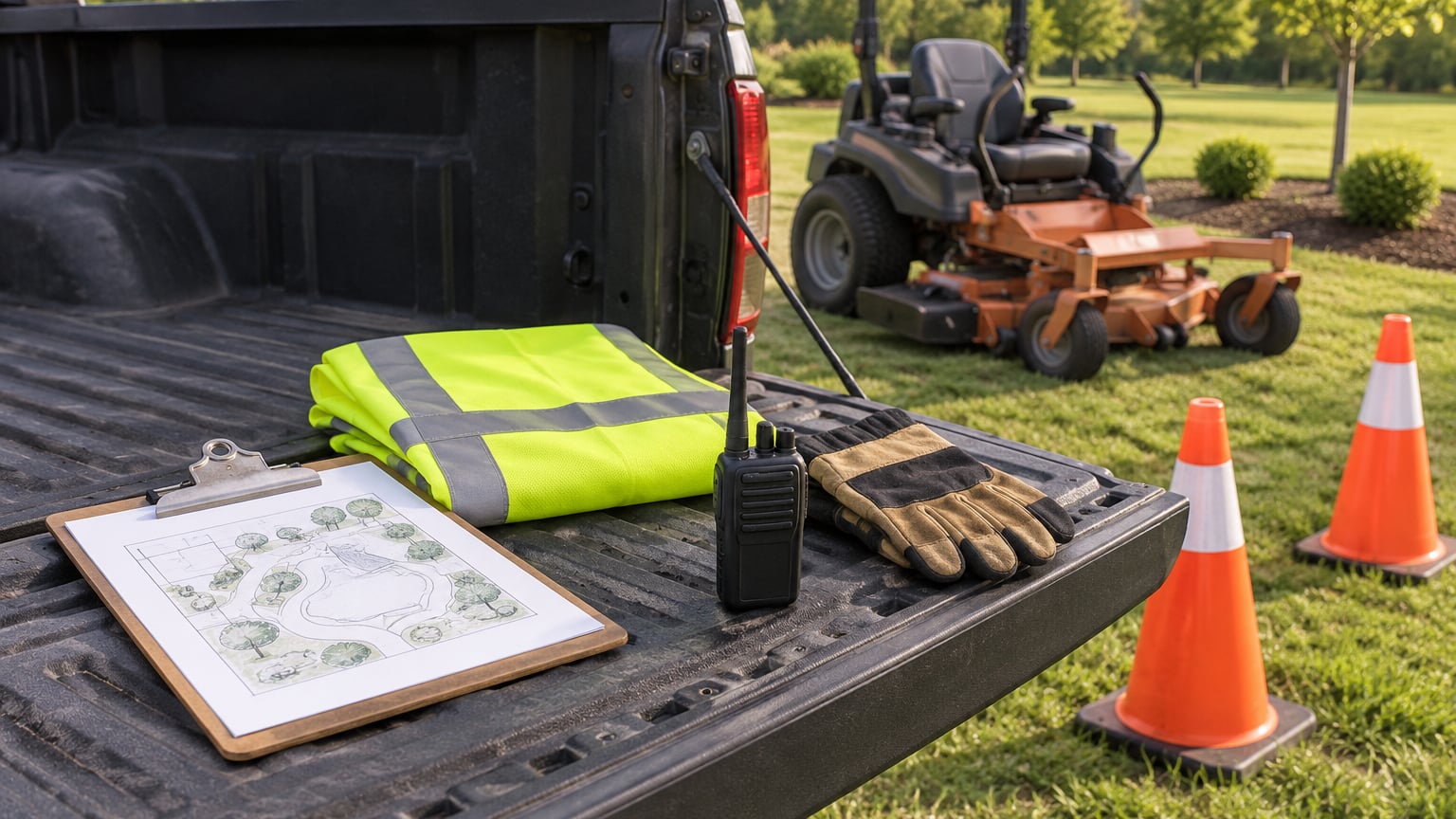
Landscaping crew safety tips come down to a handful of habits a crew lead repeats every morning: assess the site, brief the crew, keep equipment in serviceable condition, and control who can get hurt by what. The Bureau of Labor Statistics recorded 102 deaths among landscaping and groundskeeping workers in 2023, and grounds maintenance workers are injured at roughly twice the rate of workers across all occupations. Most of those incidents trace back to equipment, heat, traffic, and chemical handling, not to rare disasters.
This guide is written for both audiences at once. Owners and safety managers will get the compliance and program structure, and crew members will get the specific behaviors that keep them out of the emergency room. Work through it in order once, then use the table as a daily reference.
Table of Contents
- Landscaping Crew Safety Tips at a Glance
- 1. Conduct a Worksite Risk Assessment Before Starting
- 2. Hold a Daily Crew Toolbox Talk
- 3. Control Vehicle and Equipment Traffic
- 4. Inspect and Use Lawn Equipment Safely
- 5. Use the Right PPE for Every Task
- 6. Use Ladders, Aerial Lifts, and Pruning Tools Correctly
- 7. Handle Pesticides and Other Chemicals Safely
- 8. Prevent Slips, Trips, Falls, and Trench Collapse
- 9. Protect the Crew from Heat, Cold, and Severe Weather
- 10. Lift, Move, and Stack Materials Safently
- 11. Make Emergency and First-Aid Plans Usable
- 12. Lead, Observe, and Improve the Safety Program
- Frequently Asked Questions
- What PPE should a landscaping crew use?
- How should employers protect landscaping workers from heat?
- Do employees need training before operating lawn equipment?
- What should happen after a pesticide spill?
- How do landscaping crews control vehicles and pedestrians?
- What should be included in a daily landscaping worksite safety briefing?
- Conclusion
Landscaping Crew Safety Tips at a Glance
The table below is the shortest version of this whole guide. Each row pairs a hazard with the preventive action and the specific thing a supervisor should physically confirm before the crew starts work.
| Hazard | Preventive action | What the supervisor verifies |
|---|---|---|
| Unseen site conditions | Risk assessment before assigning work | Ground, utilities, slopes, and water hazards walked and noted |
| Unbriefed crew | Five to ten minute toolbox talk | Every worker can name today’s task hazards and the emergency plan |
| Vehicle and pedestrian strikes | Separated routes, spotters, and a no-pedestrian zone | Spotter assigned, routes marked, backing rules briefed |
| Equipment failure or contact | Pre-use inspection and shutoff discipline | Guards present, blades sharp, controls and shutoff tested |
| Flying debris and noise | Task-based personal protective equipment | Eye, hearing, foot, and hand protection worn before startup |
| Falls from height | Stable setup, exclusion zones, fall protection | Ladder feet level, lift inspected, ground area cleared |
| Chemical exposure | Label compliance and controlled mixing | Labels readable, required gear on, storage secured |
| Slips, trips, and trench collapse | Housekeeping and qualified excavation support | Hoses routed, debris removed, trenches protected |
| Heat, cold, and storms | Acclimatization, water, rest, and shade | Water within reach, shade available, heat plan posted |
| Manual handling injuries | Mechanical aids and load limits | Carts available, routes clear, loads secured in the truck |
| Delayed emergency response | Written, site-specific response plan | Site address given to 911, first aid stocked, contacts posted |
| Repeat incidents | Near-miss reporting and corrective action tracking | Reports reviewed, actions assigned, workers told what changed |
1. Conduct a Worksite Risk Assessment Before Starting
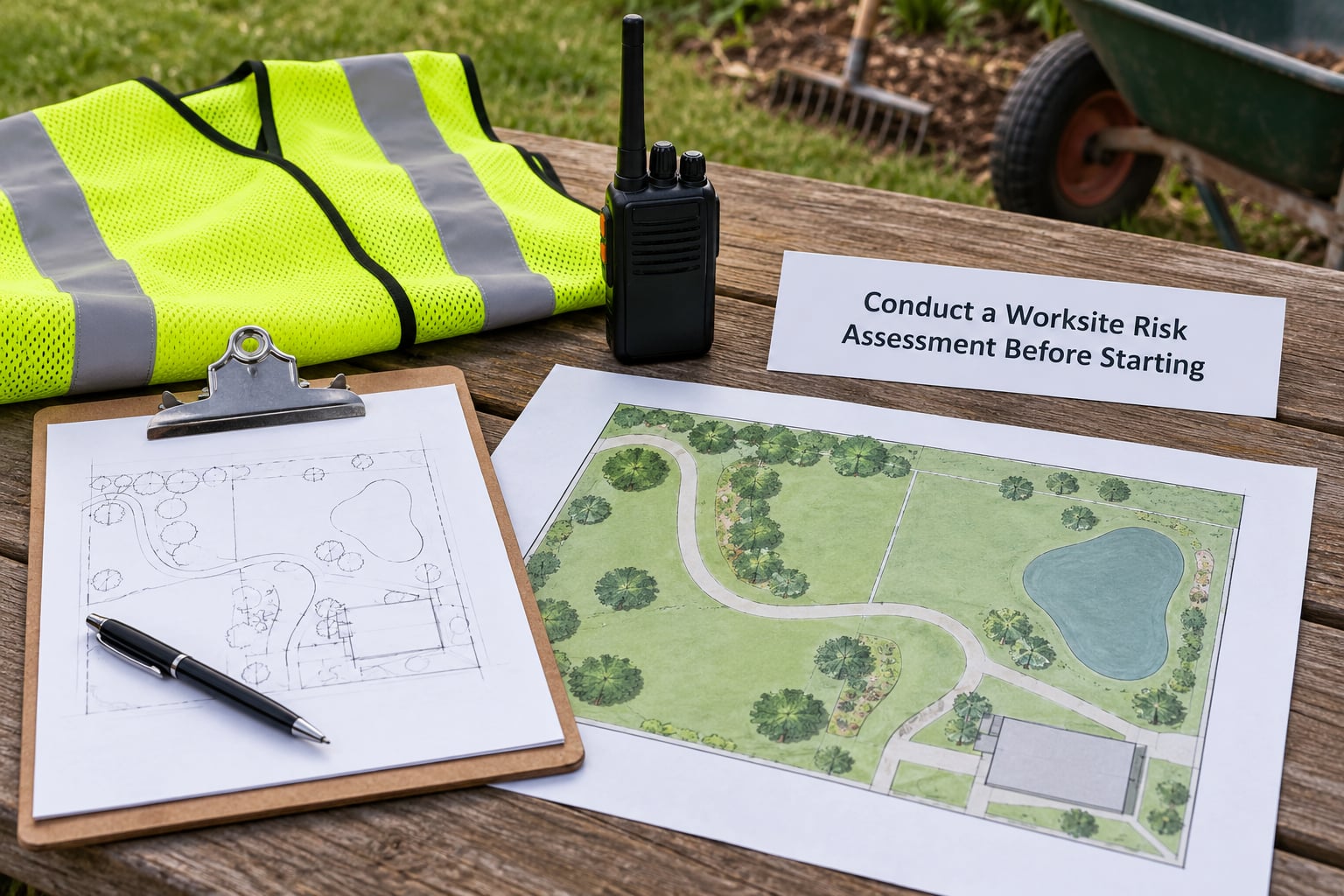
A risk assessment is a ten-minute walk-around that happens before anyone picks up a tool. The crew lead looks for unstable or wet ground, overhead utility lines, live traffic, steep slopes, ponds and irrigation channels, buried irrigation lines, equipment access points, and any chemical stored on site.
Write down what you find and turn each finding into an assignment. If a slope is too steep for the mower, the answer is a different tool or a different day, not a faster operator. If a line is overhead, the answer is calling the utility before anyone raises a pole saw or a liftgate.
New workers rarely know where the irrigation valves are, and that is exactly the kind of gap an assessment surfaces. Assign an experienced person to walk new hires through the property before day two.
2. Hold a Daily Crew Toolbox Talk
A daily toolbox talk is the cheapest control you will ever add, and the only one that reaches the whole crew at once. Five to ten focused minutes is enough if you cover the right things.
Cover today’s specific tasks, anything that changed since yesterday, the weather and heat forecast, the equipment in use, the hazards particular to that property, and the emergency plan for that address. Then ask each operator to confirm the shutdown procedure for the machine they are about to run.
Keep it practical rather than a lecture. Workers on r/lawncare and r/landscaping ask for safety content that matches how the job actually runs, and crews disengage fast from talks that read like a manual. Two minutes on a specific near-miss from your own yard outperforms a general warning every time.
Longer training days still matter for operating a new machine, but they do not replace the daily talk. A crew member who just learned a procedure on Monday has to hear about it again on Tuesday morning.
3. Control Vehicle and Equipment Traffic
Backing a truck into an unseen driveway is one of the most dangerous things a landscaping crew does, and it is entirely preventable. Set a rule that no truck or trailer reverses without a spotter, and that no one stands behind or between vehicles while engines are running.
Separate people from machines physically wherever the site allows. Walk routes, parking areas, and haul paths should be distinct from mower and compact-equipment operating areas. When space is tight, cones and barriers mark the boundary and the spotter’s only job is watching that edge.
For work along a road, plan a temporary traffic control layout before the first truck arrives. A written plan that follows Part 6 of the Manual on Uniform Traffic Control Devices should include an advance warning area, a transition area, the activity area, and a termination area. Trained flaggers in high-visibility apparel handle lane control, and everyone wears high-visibility clothing whenever the crew is on or near a roadway.
Watch for the blind spots your own equipment creates. A riding mower, a dump trailer, and a truck with a liftgate each hide a different zone, and the zone moves when the vehicle turns.
4. Inspect and Use Lawn Equipment Safely
Run a pre-use inspection on every machine before the first start of the shift. Check that guards, shields, and deflectors are present and undamaged, that the blade or cutting head is sharp and intact, that fuel, oil, and hydraulic lines are not leaking, and that the throttle, shutoff, and safety interlock controls work.
Never make adjustments, clear blockages, or refuel a hot engine with the motor running. Clearing a chute or untangling a trimmer head is the moment when hands get amputated, and it happens because someone was in a hurry at the end of a long day.
Train every operator on the specific machine before they use it alone. Lock out or disconnect the spark plug, battery, or fuel source before anyone reaches into a machine, and follow the manufacturer’s manual for the model in your fleet. Keep the tool safety inspection checklist in the shop so inspections are done the same way every time rather than from memory.
Clear the turf first. Rocks, sticks, toys, irrigation heads, and buried wire cause the majority of mower and trimmer contact injuries, and no amount of guarding fixes a debris-filled property.
5. Use the Right PPE for Every Task
Personal protective equipment is the last line of control, which is exactly why it needs a written program and someone enforcing it. Standard eye protection meeting ANSI Z87.1, steel-toe work boots, and task-appropriate gloves should be the baseline, not the goal.
- Mowing and trimming: safety glasses, steel-toe boots, hearing protection, and close-fitting long trousers. Avoid loose clothing and open cuffs that can catch in a spinning head.
- Chainsaw and pole saw work: cut-resistant chaps, helmet, face shield, and chain-brake gloves.
- Chemical application: chemical-resistant gloves, a long-sleeved coverall or apron, and the respirator specified on the product label.
- Hardscaping and concrete cutting: a respirator for respirable crystalline silica, since dry cutting and grinding of stone and masonry generates dust that carries a federal exposure limit of 50 micrograms per cubic meter.
- Overhead work and lifts: hard hat, high-visibility apparel, and fall protection where the height and the task require it.
- Anywhere near a road: ANSI-compliant high-visibility apparel, worn even during short setup tasks.
Noise is the control crews fight hardest. An 8-hour time-weighted average of 85 decibels triggers hearing conservation requirements, so if a blower or chipper runs all morning, earplugs need to be in the truck, worn consistently, and the right type. Compliance drops fast when supplies are not at hand, so stock them like any other consumable.
6. Use Ladders, Aerial Lifts, and Pruning Tools Correctly
Set ladders on firm, level ground at the correct angle, and never on boxes, mulch piles, or stacked stone. Three points of contact on every climb, no reaching past the side rails, and no one works alone on a ladder long enough to need rescue.
Keep the ground beneath elevated work clear. Prune before the crew arrives, not after they set up a lift, and mark an exclusion zone so nobody walks under a raised bucket, a ladder, or a hanging branch.
For aerial lifts and bucket trucks, inspect the unit before use, check outriggers on a stable surface, confirm the load rating, and use a harness in a bucket every time. Experienced crews on r/landscaping raise harness use unprompted for tree and elevated work, which tells you it is understood as real protective practice rather than paperwork.
Carry pruning tools in a scabbard or on a belt, never loose in a hand while climbing, and hand sharp tools handle-first to the next person.
7. Handle Pesticides and Other Chemicals Safely
The product label is the legal instruction, and following it exactly is the minimum acceptable behavior. That means the listed personal protective equipment, the listed application rate, the listed re-entry interval, and the listed storage instructions.
Mix chemicals in a designated area away from drains, wells, and open water, and never mix more than you can use in the current application. Keep the container closed and labeled when it is not in use.
Store products in a locked, well-ventilated cabinet or a secured shed that is not reachable by children, pets, or untrained visitors. Separate fertilizers from pesticides so a spill of one does not contaminate the other.
Plan for a spill before it happens. Know where the nearest eyewash or clean water is, keep a spill kit on the truck, and know who you call. Protect pets, children, water features, and neighboring properties, and post signage per the label after an application and for the duration of the re-entry interval.
8. Prevent Slips, Trips, Falls, and Trench Collapse
Wet grass, uneven ground, irrigation heads, hoses, and debris piles cause more lost-time injuries in this trade than any single machine. Route hoses away from walkways, coil them out of the path, and clear sticks and clippings as you work rather than at the end of the week.
Footwear matters more than most crews admit. Slip-resistant, water-resistant boots with good traction on wet turf turn a lot of near-falls into nothing at all.
For excavation, anything deeper than a foot or two carries a real cave-in risk, and spoil piles must not be placed within two feet of the trench edge. Do not let workers enter a trench to remove a pipe or a boulder. Call in qualified excavation-safety support and protect or shore the trench, because no landscaping task justifies improvising around a collapse.
Pond edges, retaining walls, and banks with undermined soil need the same caution. Mark them and keep the crew away.
9. Protect the Crew from Heat, Cold, and Severe Weather
Heat illness is preventable and the prevention is unglamorous: water, rest, and shade, plus acclimatization. New hires and workers returning from time off are the most vulnerable in the first week, which is why the ramp matters more than the thermometer on a July afternoon.
Provide water within reach of the work area, not at the truck two hundred feet away, and schedule real rest and shade breaks rather than promising them. Fatigue degrades judgment long before it produces a visible injury, and managing that is covered in our fatigue risk management program basics. Broader heat guidance lives in our agricultural worker heat safety guide.
Watch for the warning signs and know the difference. Heavy sweating, headache, dizziness, nausea, and cramps point to heat exhaustion, where stopping work, cooling, and fluids help. Confusion, fainting, hot dry skin, and a body temperature above 103 degrees point to heat stroke, which is a medical emergency: call 911, cool the person immediately, and keep cooling them until help arrives. Dark urine after heavy work can signal rhabdomyolysis, which also needs urgent medical care.
On the cold side, watch for icy mornings, wet leaves hiding black ice, and de-icing salt that turns a loading area into a slip surface. Stop work when lightning enters the area and when wind makes ladder and lift work unsafe. Poor air quality from wildfire smoke also matters; check the local air quality index and move or reschedule outdoor work when it turns unhealthy.
10. Lift, Move, and Stack Materials Safently
Evaluate the load before you move it. If a bag of wet mulch is heavier than you can comfortably lift, split it, use a cart, or get a hand from another worker. Overexertion and musculoskeletal injuries are the most common category of landscaping injury, and they accumulate quietly from years of awkward lifting.
Keep the load close to your body, lift with your legs, avoid twisting, and pivot with your feet. Clear the route first so nobody carries stone through a hose or across uneven ground.
Overuse is the quieter risk. Rotating tasks through the morning, varying tools, and taking brief recovery pauses keeps backs and shoulders from absorbing the same motion shift after shift. Anti-vibration handles on powered tools help for the same reason.
Secure everything before the truck moves. Stack heavy materials low and near the front of the bed, use the tailgate and liftgate features rather than climbing onto the load, and confirm that straps or chains are tight enough that nothing can shift in a hard stop.
11. Make Emergency and First-Aid Plans Usable
An emergency plan fails on details that look trivial until they are the reason nobody can help. For each property, know the exact street address and any gate codes or access instructions, because a 911 call that only says the road name costs minutes your injured worker does not have.
Post emergency contacts and the site address in the cab, carry a stocked first aid kit on every truck, and confirm someone on the crew is trained in first aid and CPR rather than assuming. Refresh the kit inventory monthly; a bottle of antiseptic from last spring is not a first aid kit.
Plan the response for the incidents that actually happen on these sites: equipment strikes and amputations, falls from height, chemical exposure and eyes, and heat illness. For an amputation, apply direct pressure with a clean pad and do not remove a severed part; for a chemical splash, flush with water immediately and check the label for the required rinse duration; for heat stroke, cool aggressively while waiting for responders.
Check that phones actually work at the site. Dead batteries and a truck parked where there is no signal are both avoidable.
12. Lead, Observe, and Improve the Safety Program
The strongest programs are built by supervisors who do the work the safe way themselves, because crew members follow what they see far more than what they are told. If you are exempt from the PPE rule, wear it anyway. The gap between the leader’s example and the crew’s belief is where injuries hide.
Document near-misses. A near-miss is any event that did not cause injury but could have, and it is the cheapest safety information you will ever collect. A simple paper log with date, location, what happened, and what was done about it is enough for a small crew.
Review the log monthly, assign a corrective action to each entry with an owner and a date, and tell the crew what changed as a result. That last step is what turns reporting from a formality into a habit.
Investigate injuries without blaming the person who was hurt. Ask what allowed the incident to happen, and fix the system, the equipment, the training, or the staffing that allowed it. Review PPE policies when equipment, processes, or crew composition change, and provide training in the language each worker actually reads, which for many crews means Spanish as well as English.
Frequently Asked Questions
What PPE should a landscaping crew use?
Baseline protection includes ANSI Z87.1 safety glasses, steel-toe slip-resistant boots, and task-appropriate gloves. Add cut-resistant chaps, a helmet, and face shield for chainsaw and pole saw work, chemical-resistant gloves and a label-specified respirator for pesticide application, a silica respirator for dry cutting and grinding of stone or masonry, a hard hat for overhead work, and high-visibility apparel anywhere near a roadway. Provide these at no cost and enforce consistent use.
How should employers protect landscaping workers from heat?
Use the three Ps: water, rest, and shade. Keep drinking water within reach of the work area rather than only at the truck, schedule genuine rest and shade breaks, and acclimatize new and returning workers over their first week, when heat illness risk is highest. Train supervisors to recognize heat exhaustion and heat stroke, and treat confusion, fainting, or a body temperature above 103 degrees as an emergency requiring a 911 call and immediate cooling. A written heat illness prevention plan should be posted for the crew.
Do employees need training before operating lawn equipment?
Yes. Every worker needs hands-on training on the specific machine before operating it alone, covering pre-use inspection, start-up, safe operating technique, shutdown, and the lockout procedure before clearing a blockage or making an adjustment. Follow the manufacturer’s manual for each model in your fleet, and document the training. Refresher training should follow any equipment change, process change, or incident involving that machine.
What should happen after a pesticide spill?
Contain the spill immediately, prevent it from reaching drains, wells, or open water, and keep unprotected people away from the area. Follow the first aid instructions on the product label, including the required eyewash or water flushing duration, and have the affected person evaluated if symptoms appear. Notify the supervisor, document what spilled and how much, and dispose of contaminated materials and absorbents according to the label and local rules.
How do landscaping crews control vehicles and pedestrians?
Physically separate people from machines wherever the site allows, with distinct walk routes, parking areas, and mower operating zones. Prohibit backing without a spotter, and keep workers from standing behind or between running vehicles. For roadside work, follow a written temporary traffic control plan based on Part 6 of the MUTCD, using an advance warning area, a transition area, the activity area, and a termination area, with trained flaggers in high-visibility apparel managing lane control.
What should be included in a daily landscaping worksite safety briefing?
Cover today’s specific tasks, anything that changed since the last shift, the weather and heat forecast, the equipment in use, the hazards specific to that property, and the emergency plan including the site address. Ask each operator to confirm the shutdown procedure for the machine they are about to run, and name the spotter for any vehicle movement. Five to ten focused minutes is enough, and a short talk on a real near-miss from your own yard works better than a general warning.
Conclusion
Start tomorrow morning with a ten-minute site walk and a five-minute toolbox talk, and let those two habits set the tone for everything else on the crew. The first action for any supervisor is a short site-specific risk assessment followed by a brief, honest conversation about what could go wrong that day.
Then fix what you find the same day: a missing guard, a mower with a dull blade, an unstocked PPE truck, a truck reversing without a spotter, a trench nobody protected. None of those corrections takes long, and every one of them removes a hazard that landscaping crew safety tips cannot fix after someone is hurt. Track near-misses, act on them, and tell the crew what changed, because a program that visibly improves is the one that holds.