

If you are an employer or manager preparing for an employee’s return after maternity leave, the single most useful thing you can do is build the transition around what she actually wants, not around what worked for someone else. These return to work after maternity leave tips cover timing, flexibility, workspace adjustments, lactation access, safety and the review cycle, so the first weeks back feel structured instead of improvised. Most employers spend weeks arranging leave paperwork and about ten minutes on the return itself. That imbalance is where returns go wrong.
Most of the pressure in a maternity leave transition lands on the returning employee, so shifting some of that load onto good employer habits is worth the effort. The plan below assumes a US employer working with a full-time hourly or salaried employee and can be adapted to state and local rules, which vary.
Table of Contents
- Return to Work After Maternity Leave Tips at a Glance
- 1. Start the Return-to-Work Conversation Early
- 2. Offer Flexible Work Arrangements
- 3. Assess and Adjust the Physical Workspace
- 4. Create a Return to Work After Maternity Leave Plan
- 5. Clarify Performance Expectations and Priorities
- 6. Refill the Employee’s Knowledge Gently
- 7. Respect Recovery, Fatigue, and Health Limitations
- 8. Provide a Clear Lactation and Breastfeeding Space
- 9. Make Safety and Ergonomic Adjustments
- 10. Establish Regular Check-Ins Without Micromanaging
- 11. Build a Support Network for the Employee and Manager
- 12. Review and Improve the Transition
- Frequently Asked Questions
- When should an employee return to work after maternity leave?
- Can an employer offer a phased return after maternity leave?
- What should an employer avoid asking about the employee’s medical condition?
- How should managers communicate the employee’s return to coworkers?
- What if the employee cannot immediately perform every usual duty?
- When might a workplace accommodation or occupational health review be appropriate?
- Conclusion: Start With the Employee’s Preferred Plan
Return to Work After Maternity Leave Tips at a Glance
| Action | Primary benefit | Owner | Example outcome |
|---|---|---|---|
| Open the return conversation early | More time to plan around the employee’s preference | HR or manager | Leave end date confirmed with three weeks to spare |
| Offer flexible arrangements | Smoother re-entry, fewer early exits from leave | HR | Four-day week for the first quarter |
| Adjust the workstation | Fewer aches, easier focus in the first month | Facilities and manager | Sit-stand desk and footrest delivered before day one |
| Write a written return plan | Shared expectations instead of guesswork | Manager | One-page plan agreed two weeks out |
| Define first-month priorities | Lower stress, realistic workload | Manager | Three priority items instead of eleven |
| Run a short knowledge update | Faster reorientation without overload | Manager and team | 30-minute update plus a written summary |
| Respect recovery limits | Fewer avoidable health setbacks | Manager and HR | No solo lifting requirement until cleared |
| Provide proper lactation space | Supports feeding goals and retention | Facilities | Lockable room with a chair, outlet and fridge |
| Review safety and ergonomics | Reduces incident and strain risk | Safety lead | Task rotation agreed for the first six weeks |
| Set a check-in cadence | Catches problems before they build up | Manager | 30-minute check-in at weeks 1, 3 and 6 |
| Map the support network | Reduces the mental load on one person | HR | Named HR contact and EAP details on day one |
| Review and improve | Better arrangements for the next person | HR | Written lessons learned filed with the leave record |
1. Start the Return-to-Work Conversation Early
Reach out six to eight weeks before the leave end date, and make the first message about logistics rather than feelings. That timing leaves room to solve childcare, scheduling and equipment problems while solutions still exist.
Three topics are safe to raise early: her preferred return date, any scheduling constraints she already knows about, and how she would like to be contacted while you finalize details. Topics that are not yours to press: why she needs the arrangement, medical details, or whether she is certain about returning.
A message that works: “Your leave is scheduled to end on the 14th. Do you want to talk about the return over a call in the next week, or would you rather I send a short summary of the options in writing?” It gives her a choice about the format, which is itself a small accommodation.
Write down what she tells you. Note the preferred start date, any hours or days she needs, whether remote work is workable, and her preferred check-in rhythm. Put those preferences in a shared HR file, not in your personal notes.
2. Offer Flexible Work Arrangements

The most useful return to work after maternity leave tips start with one question: what would make the first three months workable? Then match your answer to options you actually have the authority to grant.
- Phased return. Reduced hours for two to four weeks, then a full schedule. Useful when recovery, commuting or childcare drop-off is still the hard part.
- Remote or hybrid days. Often the fastest accommodation to approve, and it can protect commute time during the early weeks.
- Shifted start and finish times. Aligns the day with daycare pickup and drop-off windows. Costs nothing and gets surprisingly little attention.
- Temporary schedule changes. Cluster meetings into two or three fixed blocks so focus time is not shredded all day.
- Job sharing. Two people split one full-time role. Worth raising for roles with a clear split between client-facing and back-office work.
Check each option against the role’s actual requirements before you offer it. A customer-facing role cannot be fully remote, and a safety-regulated role may not allow schedule shifts. Saying no to a specific arrangement is fine as long as you say why and offer the nearest alternative that is genuinely available.
Run these return to work after maternity leave tips through HR and your own manager first. An arrangement approved on the spot and reversed in month two is worse for everyone than a slow, clear yes or no.
3. Assess and Adjust the Physical Workspace
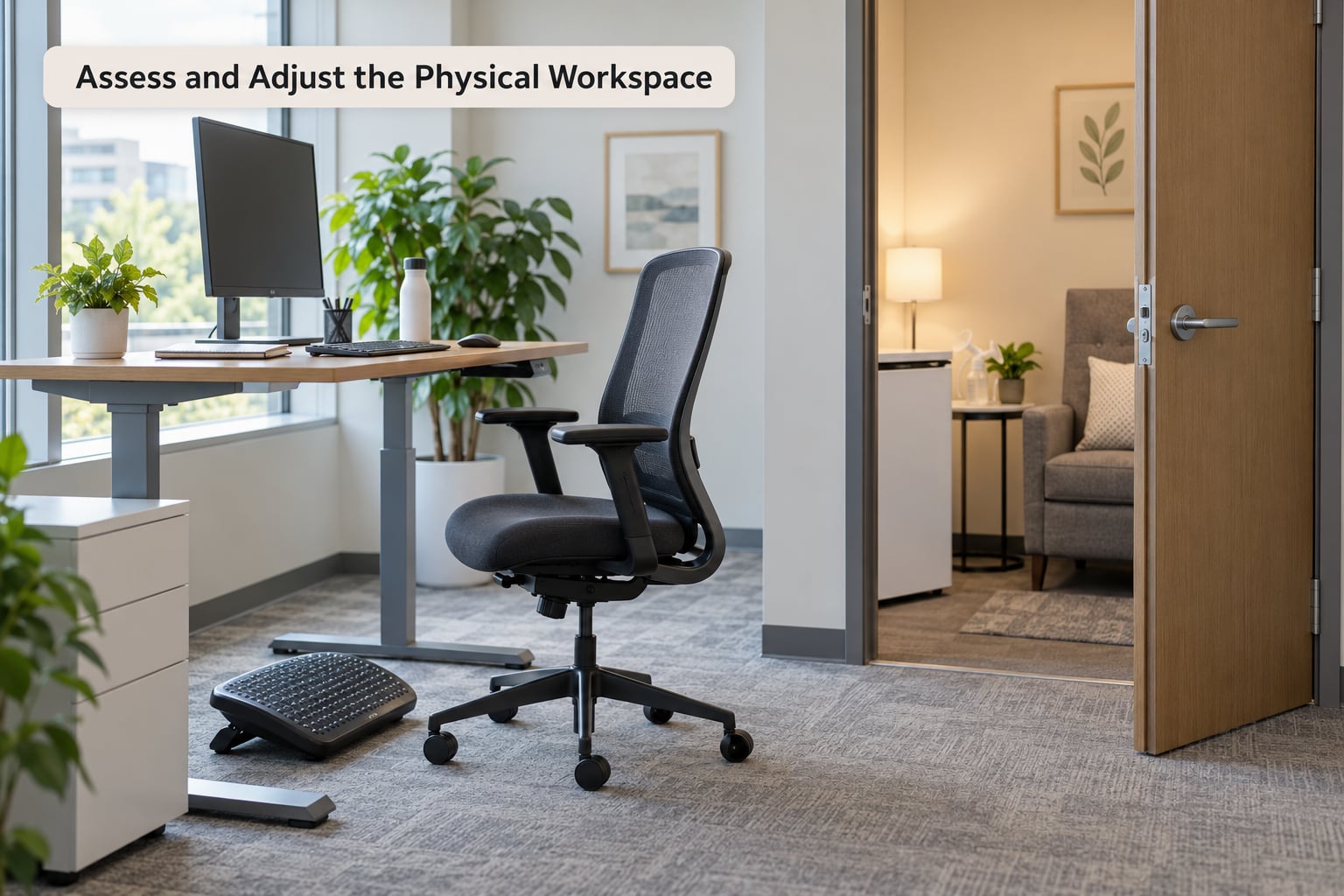
Ask what the workstation looked like before the leave and what needs to change now, then make the changes before the first day rather than after a bad week. You do not need a medical reason to rearrange a desk.
- Chair and desk height. A sit-stand desk, a supportive chair and a footrest cover most needs and are usually a catalog request.
- Screen and lighting. Longer reading distance and screen height matter more after months of looking at a phone.
- Noise and interruption. A desk in a walk-through area needs a different fix than a quiet-room request.
- Storage and parking. Confirm locker, badge and parking arrangements so nobody is searching on the first morning.
- Pumping access. Confirm the room exists, where it is, and whether it is usable before day one, not after a bad week.
If you already run a broader accommodations process for the physical workspace, how to accommodate workers with disabilities at work covers the documentation side in more depth.
Keep medical detail out of the workspace conversation entirely. Ask what the equipment should do, not what the employee was diagnosed with.
4. Create a Return to Work After Maternity Leave Plan
A one-page written plan removes most of the uncertainty from the first fortnight, for both of you. Circulate it two weeks before the start date so corrections are easy.
What a return to work after maternity leave plan contains
- First day and time. Exact date, arrival time and where to go, including badge or parking pickup.
- Schedule for weeks one and two. Which days, which hours, and which are in-office.
- Priorities. Three items that define success in the first month, plus what is explicitly not expected yet.
- Required training. Compliance modules with realistic due dates, separated from role-specific training.
- Accommodations. Equipment, schedule changes and workspace adjustments, with who is delivering each one.
- Support contacts. Named HR partner, manager, and the lactation or safety contact.
- Review dates. When you will both check in and adjust the plan.
Keep it to one page. A document nobody reads past the first week is wasted effort, and a short plan is easier to adjust.
5. Clarify Performance Expectations and Priorities
Say plainly what good looks like at week four, then defend the rest. Managers who want an easy transition should reduce the load early rather than complain about it later.
Sort every regular duty into one of four buckets for the first month: keep as-is, reduce, reassign, or defer. Reassigning is the bucket most employers forget, and it is the one that protects the employee best when the team is busy.
Make expectations measurable and dated. “Catch up on the backlog” fails; “review the eight highest-priority open items and comment on each” works, because it can be finished and closed.
Extra work and stretch assignments are worth declining during the first month. Protected focus time is a legitimate accommodation here, not a favour to ask for twice.
6. Refill the Employee’s Knowledge Gently
Ten months away means a lot of context has changed, and cramming it into a day produces exhaustion rather than competence. Aim for a 30-minute update plus a written summary she can reread on her own time.
- Organisation changes. Who reports to whom, and what moved.
- Current priorities. The three things the team is actually judged on this quarter.
- Essential updates. Policy, tooling and client changes that affect her role.
- Key contacts. Who to ask about each area, so she is not holding every question herself.
Send the written summary before the meeting, not after. Reading first, then discussing, uses the same hour far more efficiently.
Book team coffee or lunch only if she wants it. Some people find a surprise welcome overwhelming in week one.
7. Respect Recovery, Fatigue, and Health Limitations
Treat recovery as an ongoing process with a real timeline rather than a clearance form. Postpartum recovery, sleep disruption and any pregnancy-related condition vary a lot between people and month to month.
- Accept the schedule she has proposed without testing it. If she asked for four days, four days is the plan.
- Do not ask whether she is really recovering, or how she is feeling in detail. Ask what the work needs to be true so you can adjust it.
- Refer personal health questions to her own clinician. Employers do not assess readiness; licensed providers do.
- Watch for persistent exhaustion, sadness, anxiety or difficulty concentrating that lasts more than two weeks, and share your employee assistance program and health plan resources without commenting on symptoms.
Return to work after maternity leave tips sometimes get framed as productivity advice. They are mostly about load management during a period when the employee is recovering from childbirth and adjusting to a new sleep pattern at the same time.
Anything beyond general workplace guidance here belongs with a doctor, midwife or qualified health professional, not with a manager.
8. Provide a Clear Lactation and Breastfeeding Space
US federal law under the Fair Labor Standards Act generally gives covered nursing employees reasonable break time and a private, non-bathroom space other than a bathroom for expressing milk during the workday. Many states add requirements that are broader, and they change, so check your state rules rather than assuming the federal baseline is the whole picture.
What a usable room actually contains: a lock from the inside, a chair, a flat surface, an outlet and good lighting. Add a small refrigerator for milk storage if there is not a shared one nearby, and confirm who controls the key.
Block pumping time in the shared calendar so meetings do not land on it, and set a default duration with buffer rather than a tight slot that meetings always overrun.
Tell her who to contact when the room is locked or occupied, and give that person authority to resolve it on the spot. Reviewers repeatedly report bathrooms and improvised closets being the fallback, which is exactly the outcome the requirement exists to prevent.
9. Make Safety and Ergonomic Adjustments
Physical work demands often return before the body is ready for them, and this is where a thoughtful transition prevents an injury rather than managing one.
- Lifting limits. Set a clear ceiling for the first six weeks and communicate it to the whole team, not just the returning employee.
- Task rotation. Alternate demanding and light tasks so no single person carries the load all week.
- Rest breaks. Schedule them visibly rather than leaving them to goodwill.
- Early incident reporting. Tell her how to report discomfort or a near miss without feeling that she is complaining.
- Named safety contact. Someone other than her direct manager who can act on an ergonomic change request.
Employers covered by the Occupational Safety and Health Act can also route requests through a safety committee or a competent person, which is often faster than a facilities ticket.
If discomfort does not settle with adjustments, encourage her to raise it with her own clinician. You can adjust the workstation; you cannot diagnose the reason it hurts.
10. Establish Regular Check-Ins Without Micromanaging
Set the cadence in advance so it reads as structure rather than scrutiny. Thirty minutes at weeks one, three and six, then monthly, covers the transition without a daily stand-up about someone’s recovery.
Four agenda questions work well: is the workload realistic, does the workspace function, is anything blocking access you needed, and is the schedule still right? That last question matters most, because preferences shift as childcare patterns settle.
Capture answers in a shared document the employee can see. How to disconnect from work after hours is worth sharing early if evening messages are already her default.
Keep two topics out of the check-in: medical details and childcare decisions. Workload, access and schedule are yours to solve.
11. Build a Support Network for the Employee and Manager
The returning employee should not be the only person managing the transition, and the manager should not carry it alone either. A named network prevents both sides from absorbing everything.
- HR partner. Someone she can contact about policy, leave records and accommodations, not only her manager.
- Manager. Owns priorities and workload, and writes down what was agreed.
- Coworkers. One or two named contacts for practical questions, agreed with her rather than assigned.
- Occupational health. For equipment, assessments and referral, where the organisation has that function.
- Employee assistance program. Offered with a link in the plan, framed as available to everyone rather than as a referral.
Give her the same information you would give any new hire, plus the recovery adjustments. Employees who cannot find the parental leave policy or the lactation contact in the HR system will assume neither exists.
You may also find that how to reduce absenteeism at work overlaps with what you are already doing, since a well-supported return is the cheapest attendance intervention there is.
12. Review and Improve the Transition
Treat the first quarter as a program to evaluate, not a probation of one person. Then write it down, because the next manager will not remember your notes.
Look at four inputs: what she said in the check-ins, whether any deadlines slipped, which accommodations were used and which were never touched, and what the manager observed directly. Turn those into specific changes, such as shortening the ramp-up to three weeks instead of six.
At the ninety-day mark, decide what stays. A schedule that works in month one often needs revision in month three when childcare or a nursing schedule shifts, so put a scheduled review on the calendar now.
File a short summary with the leave record: which arrangements worked, which were declined and why, and any equipment requests worth repeating. That note is usually the difference between a thoughtful return next time and a fresh negotiation.
Frequently Asked Questions
When should an employee return to work after maternity leave?
Return is usually set by the end date in the leave approval and confirmed six to eight weeks ahead. Some employees use accrued leave or a phased schedule to adjust, which means the leave end date and the reduced-hours end date are different. Confirm the date in writing, note any phased arrangement separately, and check your state rules, which sometimes set minimum notice periods or job-protection terms.
Can an employer offer a phased return after maternity leave?
Yes, and it is one of the most effective return to work after maternity leave tips available. A phased return means reduced hours or days for a defined period, usually four to twelve weeks, with a written end date and full schedule at the end of it. Check that the role can absorb reduced coverage, put the schedule in the return plan, and treat the ramp as temporary rather than as a permanent reduction.
What should an employer avoid asking about the employee’s medical condition?
Avoid asking for a diagnosis, asking what is wrong, or requesting medical records. Under the FLSA break time provision, an employer may ask only whether the employee needs a break for nursing purposes and may not retaliate for the request. For genuine disability or health-based accommodations, documentation rules differ by framework. Refer personal health questions to the employee’s own clinician and keep workplace logistics with HR.
How should managers communicate the employee’s return to coworkers?
Share the date, the working pattern and the practical help the team provides. Leave out the reason for the leave, the medical details and any feeding schedule. Name one person as the go-to for questions so the returning employee is not fielding all of them, and send the message before her first day rather than on the day itself.
What if the employee cannot immediately perform every usual duty?
Sort duties into four buckets for the first month: keep, reduce, reassign and defer. Reassigning is the one most employers skip. Set expectations as measurable outcomes with dates rather than task lists, record the arrangement in the written plan, and revisit it at the thirty-day review. If the gap persists, involve HR early, because extended capability changes can have legal implications depending on the reason.
When might a workplace accommodation or occupational health review be appropriate?
A review makes sense when an equipment adjustment, schedule change or lifting restriction is needed for longer than a few weeks, or when fatigue and concentration are affecting safety-sensitive tasks. Occupational health, where the organisation has it, can assess workstation needs and equipment and keep medical information separate from your file. The manager supplies the functional requirements; the clinician or occupational health professional supplies the clinical judgment.
Conclusion: Start With the Employee’s Preferred Plan
Most employers get this right by doing five things in order: start the conversation early, listen before solving, write the plan down, set a check-in rhythm, and adjust when she asks. The order matters more than the details, because each step removes surprises from the one after it.
The return to work after maternity leave tips in this guide are all reversible. When an arrangement is written down, reviewed at fixed dates and changed as needed, a return stops being an event and becomes a managed transition. That is the whole job.