

To support employee mental health at work, build three things: managers who know how to respond, a route to qualified help that costs the employee nothing in dignity or money, and real fixes to the working conditions causing the distress. Wellness apps and a poster in the break room do none of those things. A workable plan takes about 90 days to stand up, and most of the work sits with HR, leadership and line managers rather than with any outside vendor. This guide walks through the pieces in order, including the legal accommodation duty US employers carry, what managers must never attempt, and how to tell whether any of it is helping.
One boundary first, because it shapes everything below. An employer can improve working conditions, remove barriers, offer resources and adjust schedules. An employer cannot diagnose anyone, run therapy, or replace clinical care. If you need a diagnosis, a treatment plan, or a fitness judgment, that belongs to a licensed professional working with the employee, on the employee’s time. Everything in this guide sits on the employer side of that line.
Table of Contents
- What You Need Before You Start
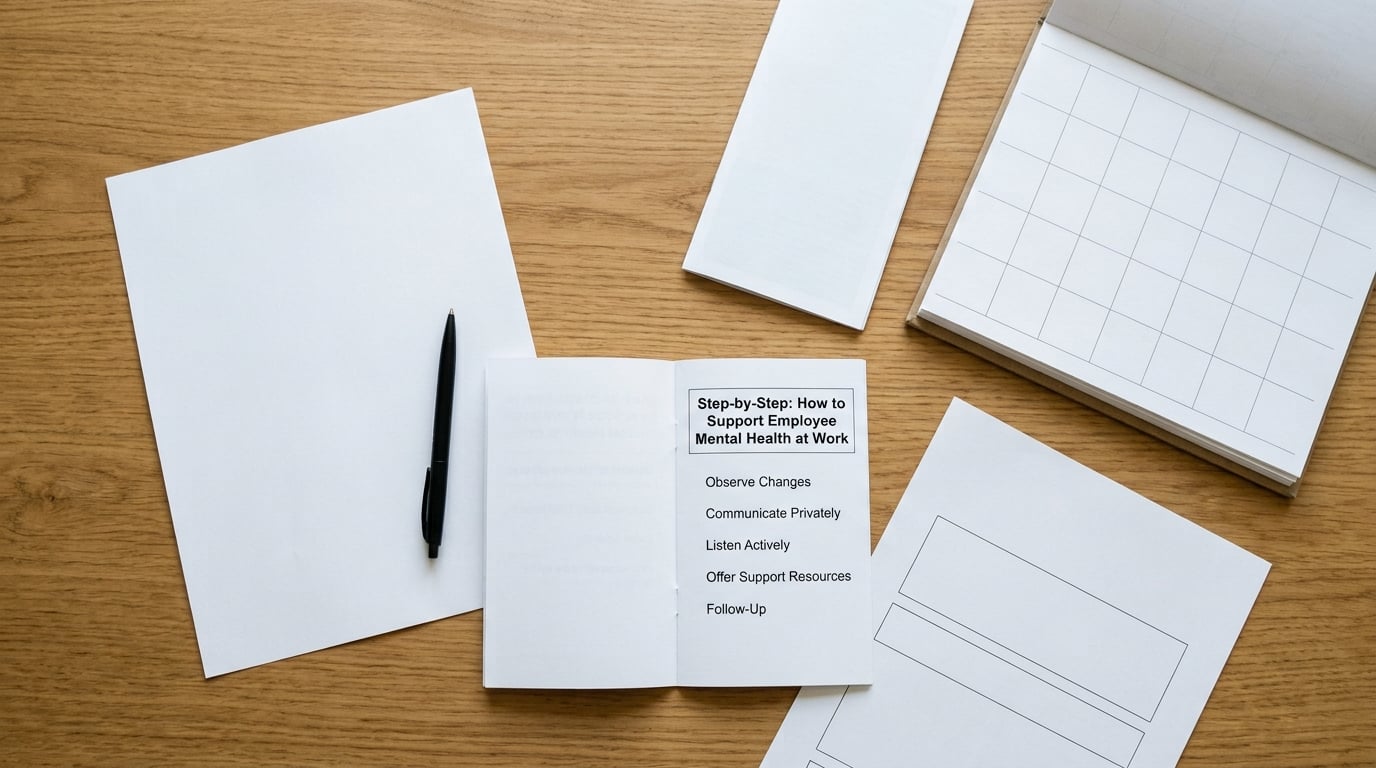
- Step-by-Step: How to Support Employee Mental Health at Work
- Step 1: Assess Needs Without Turning Health Data Into Surveillance
- Step 2: Train Managers to Recognize and Respond Constructively
- Step 3: Build Your How to Support Employee Mental Health at Work Foundation
- Step 4: Make Qualified Support Easy to Access
- Step 5: Change Work Conditions, Not Just Employee Coping
- Step 6: Prepare a Clear Crisis Response and Accommodation Process
- Step 7: Measure Participation, Experience, and Work-Condition Changes
- Common Mistakes That Undermine the Plan
- Frequently Asked Questions
- What should an employer do to support employee mental health?
- Can managers ask employees whether they are struggling mentally?
- Are employers required to provide mental health accommodations?
- Should workplace mental health programs be confidential?
- How can employers measure whether their mental health support is working?
- When should an employee contact a healthcare professional or crisis service?
- Start With Manager Trust and Workload
What You Need Before You Start
Most workplace wellbeing programs fail in the first quarter, usually because nobody assigned ownership of the work. Before you announce anything, get seven things in place.
Named leadership commitment. A named executive who says out loud that workload and psychological safety are business priorities, and who backs it when a deadline gets tight. Without that, managers get mixed signals and employees read the program as cover.
A baseline. Three to six months of absence patterns, turnover by team, engagement scores, and any existing EAP or counseling usage data. You cannot show improvement without a starting number.
Qualified external resources. At least two licensed counseling providers or an employee assistance program, plus a plan for employees whose provider is out of network or who need a language other than English.
A protected-time policy. A written statement of how counseling or medical appointments are covered, so nobody has to invent sick days to go to a therapist. State plainly who pays and what documentation is or is not required.
A communication plan. What gets said, by whom, and when. A single all-hands paragraph that names the resources, states the confidentiality limits, and points to where the policy lives beats a month of posters.
A confidential feedback channel. A route for employees to raise a work-condition problem without it tracing back to them. It needs to be genuinely separate from the performance file.
A measurement baseline. Decide now which five or six numbers you will review quarterly, and who owns each one. Changing the metric set later is how programs end up looking good and changing nothing.
Step-by-Step: How to Support Employee Mental Health at Work
Step 1: Assess Needs Without Turning Health Data Into Surveillance
Start by looking at conditions, not people. Anonymous pulse surveys, aggregate EAP and counseling utilization, focus groups, and team-level absence and turnover patterns will tell you far more than any individual disclosure would.
Set privacy thresholds before you collect anything. A common rule: report results only when five or more people responded in a group, and never publish anything a person could be identified from. Say the threshold out loud in the survey invitation, because a survey that promises anonymity gets a much truer answer than one that promises discretion.
Keep participation voluntary and keep individual health information out of the assessment entirely. What belongs in scope is workload distribution, deadline frequency, clarity of priorities, manager behavior, harassment exposure, scheduling inflexibility, and whether leave requests are easy to make. What stays out is anything resembling a list of who appears unwell.
You will tell the difference quickly. When a team shows high absence in a specific week alongside a crunch period, that is a scheduling problem. When a team reports low psychological safety across three consecutive surveys, that is a management problem. Neither requires knowing anybody’s diagnosis to fix.
For a small business the same method costs almost nothing. One anonymous survey, one conversation with the two or three people who joined longest, and a look at the last two quarters of scheduling. That is usually enough to name the single biggest stressor, and naming it is the hardest part.
Write the findings down before you act, and keep the raw comments. The purpose is not a diagnosis of the workforce but a decision about which work condition to change first. Resist building a ranked list of twenty initiatives. A finding you can act on this quarter beats a strategy document nobody opens.
Run the same questions again once the change is in place rather than designing a new instrument. Consistent wording across quarters is what turns a survey into a trend line, and a trend line is what survives a budget conversation.
Step 2: Train Managers to Recognize and Respond Constructively
Line managers are where most workplace mental health support is either built or destroyed, and most managers have never been taught how to do it. A short training, repeated annually, beats a one-off certification that nobody refreshes.
Give managers a five-part framework: notice a change in behavior, open a private conversation, listen without diagnosing, respond with a concrete adjustment, and refer to a qualified resource when appropriate.
On noticing, managers should look for sustained changes in attendance, punctuality, focus, irritability, withdrawal from team contact, and work quality. One bad week is not a signal. A pattern over several weeks is a reason to check in.
On the conversation itself, opening lines matter more than most people expect. Managers can say, “I have noticed you have missed a few morning standups recently, and I wanted to check in rather than assume,” or “Something has seemed different for a couple of weeks, and I would rather ask than guess.” Neither asks for a diagnosis.
Then listen, and resist the two traps. The first is the amateur diagnosis, the “sounds like burnout” or “you seem anxious” comment, which lands as a label and closes the conversation. The second is the pivot straight to solutions, which teaches the employee that venting was costly.
Responses that work are concrete and reversible: a moved deadline, a handoff of one recurring task, a quieter workspace, a temporary schedule change, a clear statement that using a health-related leave or accommodation will not affect their standing.
Set the boundaries firmly. Managers do not diagnose, do not ask for medical details, and do not promise that anything stays off the record when it does not. Confidentiality has real limits, and pretending otherwise is the fastest way to lose the trust the program depends on. Any decision that affects pay, role, or schedule is documented, and the manager tells the employee in advance exactly what will be written and who will see it.
Two details get skipped and both matter. First, train managers on what to write down, because the instinct in a difficult conversation is to justify the decision afterward, and a paragraph of speculation about someone’s condition is a liability with no upside. Second, give managers a way to ask HR for advice in the moment, so a borderline case gets handled by someone who knows the policy rather than by whoever is most confident at the weekly meeting.
And when a good performer starts making mistakes, resist the reflex to treat it as a performance problem. Ask what changed. The underlying condition may be temporary and treatable, and the work adjustment that helps them is usually also the right performance intervention.
Step 3: Build Your How to Support Employee Mental Health at Work Foundation
Culture is the layer that decides whether everything else gets used. Write a short set of shared principles and publish them in plain language, not legalese. Six are usually enough.
- Psychological safety. People can raise a workload problem, a conflict, or a hard week without penalty.
- Anti-stigma language. Say “someone experiencing depression” rather than “a depressed person.” Leaders model this by talking about their own load plainly.
- Nondiscrimination. Mental health conditions are protected in the same way as any other health condition.
- Role clarity. Managers know what they are expected to notice, what they must handle, and what must be referred onward.
- Confidentiality with honest limits. Private stays private except where safety or a legal process requires otherwise, and that limit is stated in advance.
- Manager accountability. Reviewed in the same cycle as delivery, with a named owner for the program itself.
Two behaviors do more work than the rest. First, leaders respond visibly when someone raises a problem, because every response teaches the room whether raising problems is safe. A problem reported and then ignored costs more trust than the original problem did. Second, remove policies that make asking for help risky, such as vague attendance rules, performance language that treats a leave of absence as a failure, or an approval chain that requires an employee to disclose a reason they would rather not give.
You also want leaders to model the behavior. A manager who says, “My week was rough and I am going to protect tomorrow’s focus block,” does more for cultural permission than any poster in the building.
Step 4: Make Qualified Support Easy to Access
Resources that people cannot find, cannot afford, or are embarrassed to use do not exist. Build a one-page, plain-language menu and put it somewhere an employee can reach in under a minute.
Include employer-sponsored counseling sessions, an employee assistance program with a stated number of sessions, primary care as an entry point, licensed mental health professionals in network, community and peer support options, and crisis services. State eligibility, session counts, and any cost to the employee. Ambiguity about cost is one of the most common reasons people quietly give up on getting help.
Offer a real person to navigate it. A short orientation call or a dedicated contact who can answer questions about the process takes minutes and materially increases use. Offer language access, and make accommodations for the appointment itself easy, because scheduling a therapy session around a rigid shift pattern is its own barrier.
Watch the fine print. Some employee assistance programs report aggregate utilization back to the employer, and some do not. Know which yours does and say so directly, because an assumption either way causes damage.
And keep the boundary. Listing resources is signposting, not endorsement. Do not recommend a specific therapist for a specific condition, and do not steer anyone toward treatment they have not chosen.
For hybrid and fully remote teams, add two things. Offer in-person options rather than phone-only ones, since a video-only benefit quietly disadvantages anyone who finds a video call draining, and pay attention to what remote staff raise most often: isolation, unclear expectations, and difficulty switching off rather than a shortage of apps.
One more piece of work pays off quickly: check whether your benefit actually works for the people most likely to need it. Part-time staff, shift workers, and contractors often fall outside the plan by construction. Finding that out before someone needs it is cheaper than finding out afterwards.
Step 5: Change Work Conditions, Not Just Employee Coping
This is the step most organizations skip, and skipping it is why wellbeing initiatives get mocked. Resilience workshops layered onto an unmanageable workload ask employees to meditate their way out of a structural problem. The complaint managers voice most often is a simple one: people are not short of breathing exercises, they are short of control over their calendars.
Work through the stressors the assessment found. Look at workload distribution and on-call load, how often deadlines move, whether priorities are actually ranked, management behavior including bullying and gaslighting, physical and psychological safety, scheduling flexibility, and whether requesting leave is a conversation people dread.
Pick one change with real reach, then run it. The manager exercise is simple: choose the single condition that appears most often across the assessment data and the listening sessions, name the change, set a date, and tell people it exists.
A worked example: excess evening work traced to unclear priority ordering. The change is a published priority list, decided weekly, with a named owner who says what gets dropped when something slips. Three months later, re-run two pulse items on clarity and workload, and compare to the baseline.
One fix that works, delivered, beats five that are announced. Employees have seen plenty of announcements.
Return-to-work is the part of this step most plans forget. Someone coming back after a mental health leave faces the same uncertainty as everyone else plus a fear that their absence has been noted as a weakness. Agree the return plan before the leave ends, keep the first two weeks light if you can, name a single point of contact, and have that person check in weekly for a month. Anecdotally this is where a lot of otherwise successful leaves fall apart, and the fix costs a calendar slot.
Step 6: Prepare a Clear Crisis Response and Accommodation Process
Almost nobody plans for the worst day, and the absence of a plan makes a bad situation much worse for everyone involved. Write a short response sequence and rehearse it twice a year.
The sequence: make sure everyone is safe and call local emergency services, or the 988 Suicide and Crisis Lifeline in the US; stay with the person; notify the designated HR contact and, where relevant, the designated safety contact; document factually what happened and when; begin the leave and accommodation process; arrange a return-to-work conversation; then follow up at intervals you decided in advance rather than ad hoc.
What no manager does in a crisis is assess a clinical condition, determine whether the person is genuinely in danger, or counsel them. Managers notice, they call, and they hand over to qualified help.
Documentation is factual, time-stamped, and limited to what is needed. Avoid anything resembling a clinical opinion, and avoid recording speculative reasons.
Remote and hybrid teams need extra specifics: which physical location the person is at, who has authority to alert emergency services there, and how a colleague on another continent gets help locally. Have the answer before you need it.
On confidentiality, be straight. An employer cannot promise that a disclosure about immediate risk will never leave the person who made it. Say that in advance, in the policy, where nobody is in the middle of a hard conversation trying to work out whether they can trust you.
The same honesty applies to retaliation. State clearly that requesting an accommodation, using a mental health day, or taking a leave of absence will not affect someone’s standing, and that they will not have to explain a diagnosis to get a schedule change. Fear of retaliation is the single most common reason employees with a condition never ask for help, and one clear sentence in a published policy does more than a confidential hotline ever will.
Step 7: Measure Participation, Experience, and Work-Condition Changes
Assemble a quarterly dashboard with a small number of measures, and resist the urge to add more each quarter.
Track participation and access: EAP or counseling sessions used against eligible headcount, median wait time for an appointment, and the share of employees who know the resources exist, from a single pulse item. Track experience: three or four fixed survey questions on workload, clarity, manager support, and whether asking for help feels safe, with the same wording every quarter.
Track process: how long accommodation requests take from submission to decision, whether the protected-time policy was applied as written, and whether any crisis followed the response sequence. Track work conditions: absence and turnover by team, read as context rather than as proof of anything, since absence has plenty of non-mental-health causes.
Add a qualitative column. Two or three unedited comments per quarter usually tell you more than a survey average, and they are the fastest signal that a policy is being gamed.
Know what not to infer. Never use individual counseling or EAP data to evaluate a manager, and never treat a rise in EAP use as failure. A rise usually means trust improved. And set expectations: a quarterly dashboard is for direction, not proof. Work-condition changes take two to four quarters to show up in numbers, and a culture that only gets judged on a 90-day cycle will get talked out of doing anything hard.
Bring the dashboard to the leadership meeting where budget and delivery are already discussed, not to a separate wellbeing meeting that nobody attends. If the numbers only ever appear next to wellness perks, people will reasonably assume they are about wellness perks. Putting the workload and clarity measures beside the delivery measures is what turns the program into a management tool.
Common Mistakes That Undermine the Plan
Wellness theater. A meditation app subscription, a gym discount, and a wellness week, with the underlying workload untouched. The correction is simple and uncomfortable: fix one working condition before you spend anything on perks. An employer celebrating a mental health day while management behavior stays the same is the same complaint in different words, and the cynicism is well earned.
Mandatory disclosure. Requiring employees to reveal a mental health condition in order to get a schedule adjustment. The correction is an accommodation process that triggers on functional need, not on diagnosis, and where documentation is optional unless the law requires it.
Overpromising confidentiality. Telling staff everything stays private while the real policy is more complicated. The correction is a written confidentiality statement with its real limits in plain language, published before anyone needs it.
Managers diagnosing. Well-meant comments like “you look depressed” or “that sounds like burnout.” The correction is a scripting rule: describe the behavior you observed, ask an open question, do not name a condition. It is a skill worth practicing out loud in training, not just reading about.
Training people to cope instead of fixing the job. Breathing exercises do not survive a permanent reorg. The correction is to require at least one work-condition change per quarter, owned by a named manager and visible to the team.
Resources nobody can reach. A portal that does not work on a phone, a counseling benefit with a session cap of four, or a process that requires disclosing more than the employee wants to. A short-term cap is a real limit and employees treat it as such; if longer support is needed, say how the employee is referred onward. The correction is to test the route yourself, as an employee, on your own device, in under three minutes.
Measuring only usage. Counting sessions and calling that success. The correction is to pair every usage number with at least one experience measure and one work-condition measure, and to review all three together.
On smaller practicalities: put the resource menu in the same system as payroll so it is where people already look, give managers a one-page conversation guide rather than a manual, and name one person who owns the whole thing. A program with three owners has none.
Finally, plan for the day a crunch arrives. Every workplace mental health program works until the week everything ships, and the habits break exactly when they are needed. Write one sentence into the delivery plan: when a crunch period starts, the protected-time policy still applies and the manager still says it out loud, so the policy does not quietly lapse because nobody repeated it.
Frequently Asked Questions
What should an employer do to support employee mental health?
Start with working conditions, not perks. Identify the stressors employees actually report, give managers a trained response for noticing a change and opening a private conversation, publish a plain-language route to qualified counseling with cost and eligibility stated, and make the accommodation process fast and low-friction. Then fix one identifiable source of excess stress and review a small set of measures each quarter.
Can managers ask employees whether they are struggling mentally?
They can ask how someone is doing and describe what they have observed, but they should not ask for a diagnosis or demand medical detail. A useful opening is a private, specific observation plus a genuine question. Whatever the employee says, the manager’s role is to offer a concrete work adjustment and point to qualified resources, not to assess the condition or counsel the person.
Are employers required to provide mental health accommodations?
In the US, yes. Under the Americans with Disabilities Act, a mental health condition can qualify as a disability, and employers must provide reasonable accommodations to qualified individuals unless doing so causes undue hardship. Examples include schedule changes, leave, reassignment of marginal tasks, and remote work. Talk to an employment lawyer or a qualified advisor about your specific situation, since obligations vary.
Should workplace mental health programs be confidential?
As far as the design allows, yes, and the policy should say exactly where the limits are. Individual counseling through an employee assistance program is normally confidential, and aggregate utilization data is normally reported only in numbers. Be explicit that a disclosure involving immediate safety risk cannot be kept private, because a promise that later turns out to be false does more damage than an honest limit stated up front.
How can employers measure whether their mental health support is working?
Pair three kinds of numbers in a quarterly review. Participation and access: sessions used, wait times, and awareness of resources. Experience: a few fixed pulse items on workload, clarity, and whether asking for help feels safe. Work conditions: absence and turnover by team, read as context rather than proof. Add a couple of unedited comments, and expect real change to take two to four quarters.
When should an employee contact a healthcare professional or crisis service?
Anyone who is struggling should be encouraged to speak with a licensed professional, and no employer decision should be a precondition for that. If someone is thinking about harming themselves or someone else, or is in immediate danger, contact local emergency services or the 988 Suicide and Crisis Lifeline in the US. If you are worried about someone else, contact their emergency contact or emergency services rather than handling it alone.
Start With Manager Trust and Workload
If you only do five things this quarter, do these. Ask for anonymous input on working conditions, with a published small-group threshold. Train managers with a one-page conversation guide and a hard rule against diagnosing. Fix one source of excess stress that the data points to, and say publicly that you fixed it. Publish a resource menu with cost, eligibility, and confidentiality limits in plain language, and make the accommodation process fast. Then pick five measures, review them quarterly, and keep the same five.
Manager trust and workload are the two that carry everything else. People use support when they believe raising a problem is safe, and they stay sane when the job is manageable. Get those right in 2026 and the rest of the program has something to stand on.