

Psychological safety at work is the shared belief that a team can ask questions, admit mistakes and raise problems without being punished for it. Building it is less about a workshop and more about a sequence of small, repeated leader behaviors: set expectations, invite input in the room, respond well the first few times somebody speaks up, and show what happened to what they raised. This guide walks through that sequence step by step, with the scripts and meeting mechanics you can use this week.
It is worth being honest about the timeline. A team that has been burned once does not reset in a quarter, and a first conversation will not fix a habit. What does move the needle is consistency — the same visible response every single time, over months, until people stop testing the water and start telling you things early.
Updated for October 2026
Table of Contents
- What You Need
- Step-by-Step: How to Build It
- Common Mistakes
- Frequently Asked Questions
- How do you build psychological safety at work?
- What is the difference between psychological safety and employee happiness?
- How can managers measure psychological safety in the workplace?
- Can psychological safety be developed on a remote or hybrid team?
- What should a leader do when an employee raises a mistake or safety concern?
- How do you encourage people to disagree respectfully at work?
- Start With One High-Trust Conversation
What You Need
Amy Edmondson introduced the term in a 1999 study of hospital teams. Her definition is the one most researchers still use: psychological safety is a shared team belief that speaking up, asking questions, admitting errors and taking reasonable risks will not lead to ridicule, blame or punishment. It is a perception held by the team, not a policy issued by the company, which is why announcements alone do very little.
Before you run any of the steps below, you need four things lined up. Each one is cheap; skipping one of them is how initiatives quietly die.
- Leadership participation. The people who control performance reviews have to be visibly in the room for the first attempts. If the leader asking for candor is also the person who writes the ratings, staff discount the request completely.
- An anonymous feedback route. A form, a hotline or a third party — anything that lets someone report a concern without their name attached.
- Your last 90 days of team data. Exit interview themes, near-miss reports, support tickets, sprint surprises, the thing that nearly shipped. This tells you where candor is already leaking.
- A named follow-up process. Who logs each concern, who owns the response, and by when you tell the person who raised it what happened.
One more thing, and it is the hardest: a definition of what accountability still looks like. Managers on r/managers describe the same worry repeatedly — that removing blame will be read as letting people off the hook. The answer is to separate learning from accountability before you need it, in writing, while nobody is angry.
Step-by-Step: How to Build It
Work through these in order. Each step assumes the one before it, and skipping ahead tends to produce a team that is invited to speak and then punished for it — which is worse than never asking.
Step 1: Set Expectations for Speaking Up
The first step is to make the welcome explicit, because most employees have no idea what counts. Without a definition, people assume questions about a failed project are a personal attack and safety observations are career-limiting.
Say it plainly, in writing, in a place people actually read. A short message in the team channel beats a laminated poster nobody passes in the doorway. Name the four categories you want to hear: questions about how the work is done, concerns about direction, mistakes — yours included — and anything that looks unsafe or wrong.
Try language like this: “In this team, raising a problem early is the useful thing to do, not the risky thing. If you tell me something is off before it ships, I will thank you for it. If you tell me something is off after it ships, we will still thank you for it, and we will look at how we missed it.”
How you know it worked: within a month, someone brings you a concern that is not urgent and slightly awkward. That first one is the whole test. If it never comes, the message did not land or was not believed.
Step 2: Invite Participation and Ask for Input
“Any thoughts?” gets you silence from the same two senior people who always speak. Input has to be collected before the discussion starts, not invited during it, because the cost of speaking second in a live room is higher than most people expect.
Send the prompt in advance — three questions, a link, five minutes of notice is enough. In the room, take written input first, then read the names out. Round-robin works when you ask everyone for a position, not when you ask for volunteers. A visible note of who has and has not spoken is a crude but effective airtime tracker.

How you know it worked: airtime stops clustering. One practical check is to track who has spoken in the first ten minutes across four meetings; if it is always the same two, the invitation is cosmetic.
Step 3: Respond to Bad News Without Blame
This is the step teams read instead of skim. One defensive reaction undoes a month of careful invitation, and it undoes it permanently — employees who watched someone get punished for raising an issue do not forget it, which is why fear of retaliation is a rational response rather than an emotional one.
When someone reports a problem, your first job is to receive it. Thank them specifically, ask what they noticed and when, and paraphrase it back to check you understood. Do not diagnose the cause in the first two minutes; you will solve the wrong problem.
Then separate the two conversations explicitly, out loud. Learning: what conditions let this happen, and what changes. Accountability: what decisions were reasonable given what was known at the time, and what will be expected going forward. The distinction is not softening — it is refusing to let the two contaminate each other.
How you know it worked: people start bringing you bad news while it is still fixable, rather than after it has become someone else’s problem to absorb.
Step 4: Create Multiple Safe Reporting Channels
Different people have different thresholds, so one channel will not reach everyone. Offer at least three and be clear about what each one is for.
- Direct conversation — the fastest route, and the one most people default to when they trust you.
- Team check-ins — a standing five-minute agenda slot where each person names one thing that is stuck or unclear.
- Anonymous reporting — for retaliation fears, safety concerns and anything that would be politically costly to raise by name.
- A defined escalation route — an HR partner, a compliance line or a skip-level manager who is told in advance what will be routed to them.
On confidentiality, be honest rather than reassuring. Anonymous means the team cannot trace it back to you; the organization can sometimes infer identity from detail, and an investigation may have to share more than you would like. Say that plainly — a promise you cannot keep is a worse breach than a limit you stated up front.
How you know it worked: you are getting reports through more than one route, including at least one you would never have heard about otherwise.
Step 5: Make Follow-Through Visible
Unclosed feedback loops are the most common reason safety stalls. Employees keep a tally: we raised it, nothing happened, so we stopped raising it. The tally is accurate, and it is rational.
Keep a simple log with four fields — what was raised, who owns it, the date, and the outcome. Then close the loop in public, even when the answer is no. “We looked at your suggestion and did not pursue it because it adds two days to the release window” is a complete answer. Silence is the failure, not the refusal.
Refusing a well-made suggestion is a healthy outcome. It is the absence of a response that teaches people that raising things is pointless. Publish the log to the whole team monthly; it takes ten minutes and does more work than a full-day workshop.
How you know it worked: the volume of raised concerns holds steady or rises while the number of surprises falls. A drop in both usually means silence, not health.
Step 6: Invite Healthy Disagreement
Safety is not agreement. A team where nobody challenges anything is not safe, it is dormant, and it produces confident, well-received wrong answers. The goal is that disagreement is easy to express and cheap to carry, not that it disappears.
Set the norm explicitly: challenge the idea, never the person; bring evidence or say plainly that it is a hunch; no side conversations after the meeting to relitigate it. Then hold yourself to it — say “I disagree, and here is why” often enough that it stops being a career move, and say “I was wrong, and X changed my mind” when it happens.
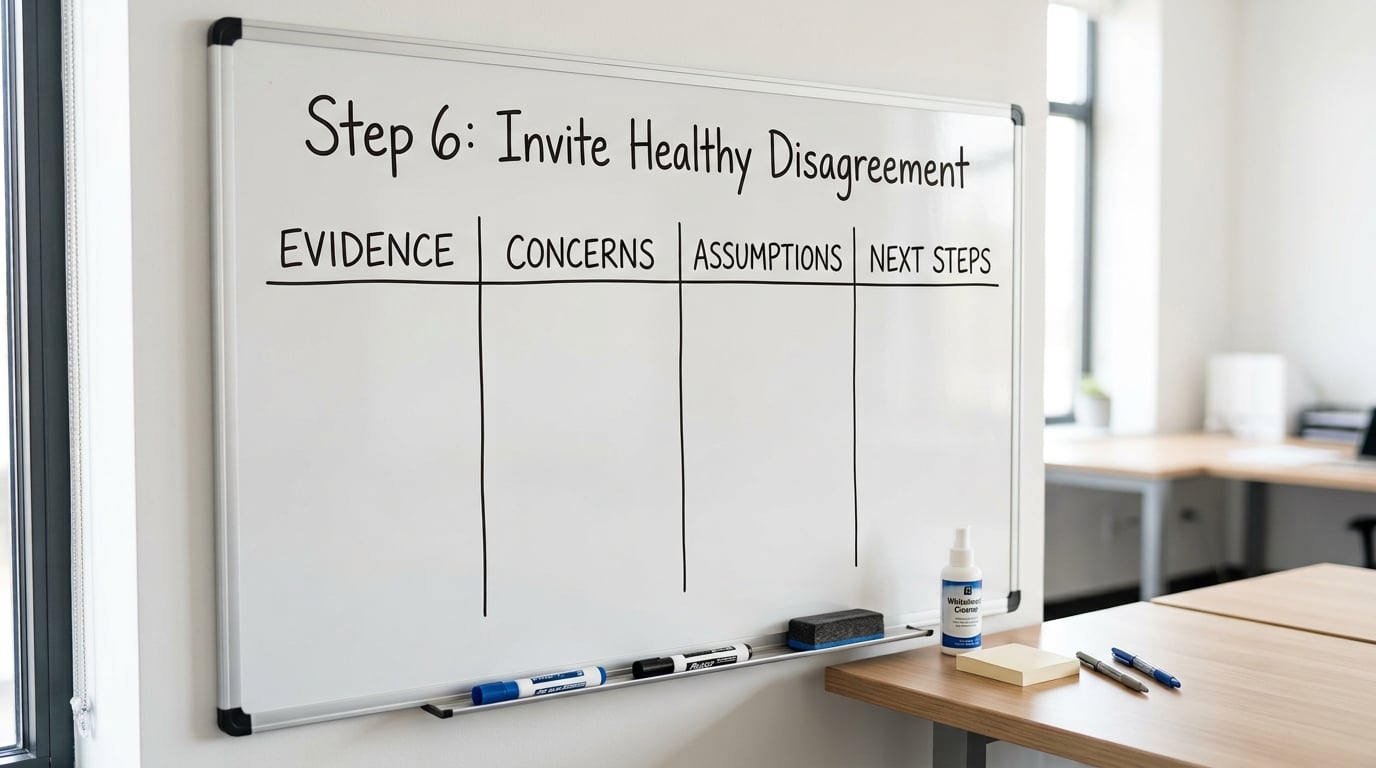
Questions that test an assumption without embarrassing anyone: “What evidence would change your mind?” “What are we assuming here that we have not checked?” “Who would disagree with this, and are they in the room?” That last one matters most on hybrid teams, where the loudest person is often not the person with the most experience.
How you know it worked: you have heard a substantive challenge directed at your own proposal, and you responded well enough that the next person tried one too.
Step 7: Measure and Improve It Regularly
You cannot feel your way to a culture, because the longer you are in it the less you notice. Ask instead, briefly and often.
A three-question pulse that fits in under a minute works well: I feel safe raising a concern on this team; my input is sought before decisions are made; I can admit a mistake here without penalty. Run it monthly, publish the results unedited, and ask one open-text question — the free-text answers tell you what the scores hide. Pair it with stay interviews, a short conversation about what is working and what is not, and one observation of a meeting for airtime and interruptions.
Interpret carefully. Scores near the top with flat response counts usually mean people have stopped trying, and a low score on one leader tells you where to start rather than something to announce. Fix one thing at a time, then re-measure. Teams that chase three changes at once change nothing.
How you know it worked: you can point to a specific behavior that changed because a number moved, and you can name the date it changed.
Common Mistakes
Mistaking low conflict for safety. A quiet team is easy to mistake for a safe one. Check the ratio: how much disagreement happened in the last month, and how much of it was about substance? If the answer is none, you have comfort rather than candor, and it will show up as a decision nobody questioned right up until it failed.
Fix: ask what the team would have pushed back on in your last major decision. Implementation tip: require one documented dissenting view on any decision above a size threshold, and read it out.
Making anonymous feedback a black box. If reports vanish into a void, the second person never files one. Anonymity is not plausible deniability for the recipient; it is a commitment to act without exposing the source.
Fix: commit to a response timeline and a visible summary. Implementation tip: publish a monthly note — what we received, what we did, what we could not act on and why.
Punishing the messenger after the fact. The “it depends on how you raise it” response is heard by every team in the organization as retaliation with extra steps. Leaders are praised in the forum posts for fixing this in the open, not quietly.
Fix: when you get it wrong, repair it in front of the team. Implementation tip: within 72 hours, name what you did, what the impact was, and what changes — and go back to the person privately rather than making them the exhibit.
Promising total confidentiality. Absolute secrecy invites staff to report things you cannot legally or ethically keep private, then betrays them later.
Fix: state the limit before the report, not after. Implementation tip: a one-line script — “I will keep this between us unless we need to involve someone else to act, and I will tell you before I do that.”
Surveying without action. An annual engagement survey with no visible follow-up trains people that opinions are collected and discarded.
Fix: fewer questions, more often, each one answered. Implementation tip: run a three-item monthly pulse, commit publicly to the single change you are making, and report the result of the next round.
Two extras that are not mistakes but accelerants. Rotating who facilitates and who presents gives junior people practice at voicing a view, and pre-mortems — a meeting where you argue against your own plan before it starts — surface objections at the cheapest possible moment. Both work because they move disagreement away from the person and onto the work.
Frequently Asked Questions
How do you build psychological safety at work?
You build it through repeated leader behavior, not announcement. Define what candor means, collect input before discussions rather than during them, thank people specifically when they report a problem, and separate the learning conversation from the accountability one. Close the loop visibly, including when you decline a suggestion, and measure with a short monthly pulse. Expect months of consistency before the behavior changes.
What is the difference between psychological safety and employee happiness?
Happiness is about how people feel about their job. Psychological safety is about what they predict will happen if they speak up, which is a belief about consequences rather than mood. A team can be cheerful and unsafe, joking through a restructure nobody is allowed to question, and a team can be serious and safe. Ask a different question of each: are people content, and would they be comfortable disagreeing with you today?
How can managers measure psychological safety in the workplace?
Use a three-item pulse monthly: I feel safe raising a concern, my input is sought before decisions are made, and I can admit a mistake without penalty. Add one open-text question, run short stay interviews, and observe meetings for airtime and interruptions. Watch response counts as closely as scores, because flat participation usually signals disengagement rather than peace. Fix one item at a time and re-measure.
Can psychological safety be developed on a remote or hybrid team?
Yes, with deliberate mechanics rather than relying on office presence. Write the prompt before the meeting and let people answer asynchronously, which removes the cost of speaking second. Rotate who presents, track who has spoken across meetings, and make chat or a shared board a real channel rather than a graveyard. Watch the risk unique to hybrid work: concerns get raised in private messages and never surface in the room where the decision is made.
What should a leader do when an employee raises a mistake or safety concern?
Thank them first, before analyzing. Ask what they noticed and when, and paraphrase it back to check you understood it. Then split the conversation in two: what conditions allowed this to happen and what changes, and what decisions were reasonable given what was known at the time. Do not diagnose the cause in the first two minutes, and never let the accountability conversation colour the gratitude for the report.
How do you encourage people to disagree respectfully at work?
Set the norm in one sentence — challenge the idea, never the person; bring evidence or admit it is a hunch — and then model the behavior yourself. Say that you disagree out loud, and say publicly when new information changed your mind. Useful questions: what evidence would change your mind, what are we assuming, and who would disagree with this and is not in the room. Safety without disagreement is dormancy.
Start With One High-Trust Conversation
If you only take one idea from this guide on how to build psychological safety at work, take this one. Do not start with the roadmap. Start with a single conversation, this week, with the people on your team: ask what concerns are hard to raise here, listen without interrupting, and thank them for every answer even the ones that sting.
Then commit to one visible follow-up before you leave the room — a single change, with a date you will report back on. Write the date down and say it out loud. That one kept promise is what the rest of the work will be judged against.