
When something traumatic happens at work, the people around it respond badly far more often than they respond wrongly. Here is the short version of how to support employees after a traumatic event at work: make sure everyone is physically safe, then give people factual information and a real choice about what happens next, protect their privacy, and connect them to professional and peer support without making them talk about what happened.
That sequence matters more than the words you choose. Trauma overrides the ordinary stress response, so an affected employee may re-experience the event, avoid any reminder of it, or react with emotion that looks out of proportion to the moment. The job of a manager in that first hour is not to counsel anyone. It is to lower the number of new stressors the person has to carry.
This guide is written for people managers, HR and occupational health staff, team leads and safety managers. It covers the first 72 hours in detail, then the weeks that follow. If you are supporting a colleague rather than a direct report, the listening scripts in step two work just as well.
It is worth knowing how common this is. US Department of Justice figures reported in workplace safety research put non-fatal workplace violence at roughly 2 million victims a year, workplace homicides at around 1,000 a year, and fatal work injuries at about 13 a day. Occupational health research on workplace violence consistently finds elevated rates of post-traumatic stress among affected workers, so what you are walking into is a known hazard rather than a personal failing. Whatever the incident, you are probably not the first manager to be standing where you are standing.
Table of Contents
- What You Need
- Step-by-Step: How to Support Employees After a Traumatic Event at Work
- What counts as a traumatic event at work
- 1. Confirm immediate safety and get emergency help when it is needed
- 2. Listen without forcing employees to talk
- 3. Clarify immediate practical support
- 4. Communicate with witnesses and the affected team
- 5. Follow up over the next several weeks
- 6. Review the event and improve prevention
- Signs a colleague is struggling after a traumatic event
- Debriefing: support without forcing disclosure
- Which support option fits
- Pacing a gradual return to work
- Where legal duties and privacy fit
- When the event is a fatality, a serious injury or an act of violence
- Remote, hybrid and multi-site teams
- When you are a peer, not a manager
- Recovery timelines and when to escalate to clinical care
- Scripts you can send today
- Caring for yourself: vicarious trauma and compassion fatigue
- When the trauma source is internal
- Common Mistakes
- Frequently Asked Questions
- When should a manager involve HR after a traumatic workplace incident?
- What should I say to an employee in the first hour after an incident?
- How do I support witnesses who were not physically hurt?
- How much time off can an employee take after a traumatic workplace event?
- Is an employee assistance programme confidential if the employer pays for it?
- Why is mandatory critical incident stress debriefing discouraged?
- Conclusion
What You Need
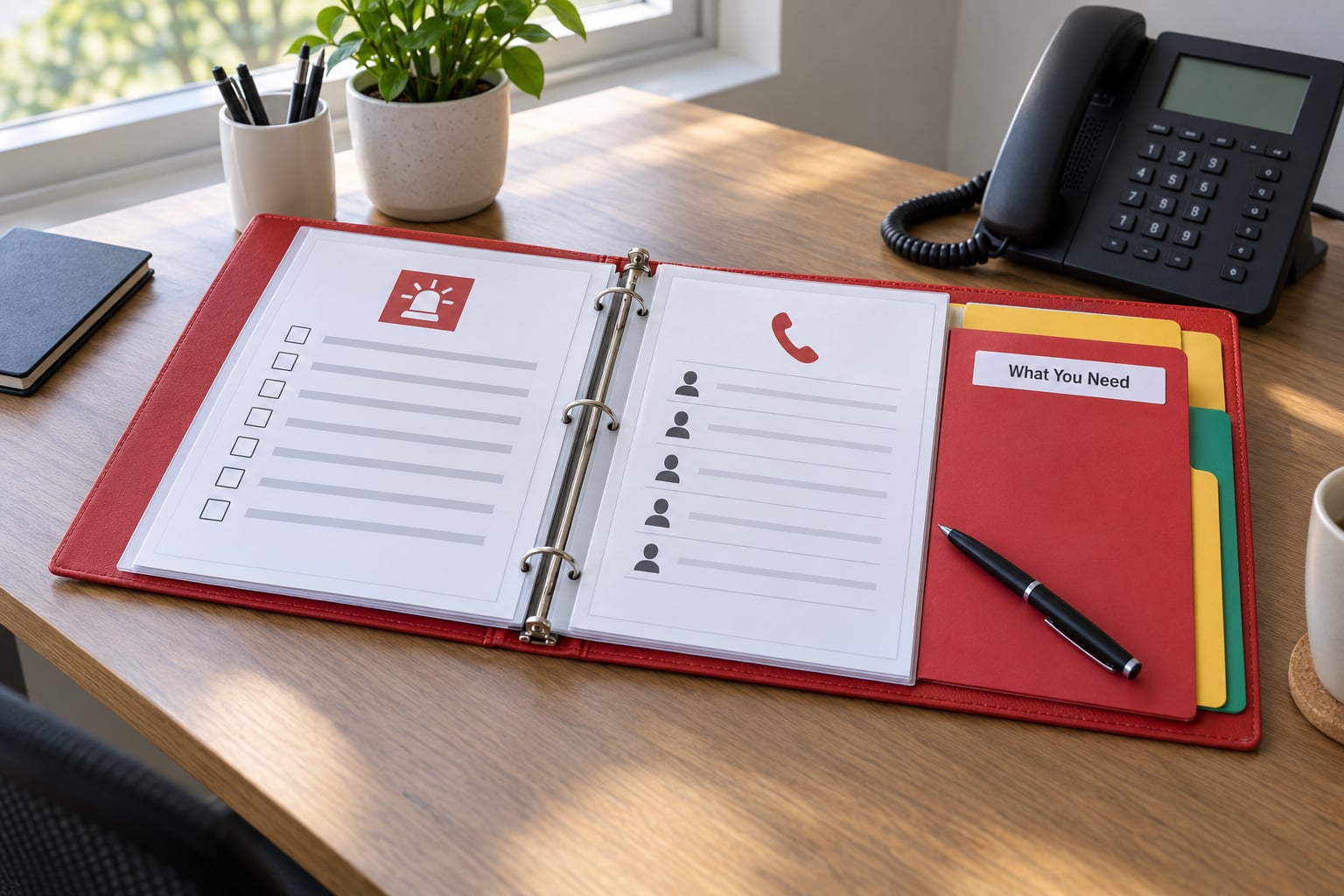
The difference between a good response and a bad one is usually preparation done months earlier. A manager who has to search a shared drive for the occupational health contact number during an incident adds ten minutes of silence to a room that already needs calm.
Keep one binder or shared folder with the following, and make sure any manager covering a shift knows where it lives:
- Emergency services and site address details, including the nearest hospital, the site muster point and who holds the floor keys for the affected area.
- HR, occupational health and safety contacts, plus an after-hours number. One named backup for each role matters more than a long list.
- Employee assistance programme details, including the phone line, the number of free counselling sessions covered, and who to tell if someone needs urgent clinical care.
- Crisis line numbers for suicide and crisis support, printed and to hand, not just bookmarked.
- Leave, workers compensation and reasonable accommodation contacts, so the paperwork conversation happens the same week rather than a month later.
- A list of who was present, updated annually, with pronouns and preferred names and the language each person speaks. Getting a name wrong in a written message is a small thing that lands badly.
- A blank incident checklist for the first hour: time, what was seen, who was contacted, decisions taken.
- Draft written statements and a team message template that can be filled in quickly, with the graphic details left out.
- A quiet room you can actually use, and permission to cancel meetings on a manager’s judgement without asking anyone.
- A manager support contact, for you. Post-incident support for the person running the response is a structural responsibility, not a personal favour.
Decide in advance, as policy, two things that get argued about mid-crisis otherwise: who speaks for the organisation, and who decides whether the site reopens. Both should sit above the level of any individual manager.
Step-by-Step: How to Support Employees After a Traumatic Event at Work
What counts as a traumatic event at work
A traumatic event is any event that overwhelms a person’s sense of safety and leaves them feeling unsafe afterwards, whether or not anyone was physically hurt. The common triggers at work fall into a few groups.
- Violence and threats, including assault, a customer or client threatening staff, a weapon being present, or a robbery.
- A death, of a colleague, a client, a family member at the workplace, or a member of the public during an interaction.
- Serious injury or a near miss, particularly where someone saw what they could not unsee.
- Sudden disaster: fire, flood, evacuation, chemical release, structural failure.
- Ongoing internal harm: bullying, harassment, a persistently abusive manager, or conduct that has been reported and ignored.
- Mass events: a violent incident at another site, a multi-site emergency, a layoff or closure announcement.
- Exposure through the work itself: ambulance crews, emergency departments, crisis lines and child protection teams seeing distressing material as ordinary work.
Note what is missing. An argument with a manager, a difficult quarter or an unpleasant customer are stressful. Most people recover from them within a day and function normally the next morning. The distinction is persistence and intrusion: does the event keep coming back uninvited, and has the person’s sense of safety in the workplace changed?
1. Confirm immediate safety and get emergency help when it is needed
Check for danger before you check for feelings. Look for injury, for a hazard still in the room, and for anyone who is in shock and physically unsteady. Call emergency services for anything serious, and do not move an injured person beyond what basic first aid requires.
Then separate the medical response from the emotional one, because they get confused easily. Someone with a sprained wrist who is also shaken is two patients, and one of them needs a clinic.
Watch for the quiet ones. People who are dazed, confused, or not answering properly within minutes of an incident need medical assessment, not a supportive conversation. Acute stress can look like shock, and shock is a medical issue.
2. Listen without forcing employees to talk
Offer calm, private support and let the employee set the pace. A short check in in a room away from the group works better than a corridor conversation in front of colleagues.
Say something close to this: “I’m glad you’re here. You don’t have to talk about what happened if you don’t want to. Would you rather talk, or would you rather I just stay here for a bit?” Then stop talking. Most managers fill that silence with reassurance, and reassurance is often the thing that gets repeated back as dismissal.
What helps: naming the reaction as common, sitting quietly, offering water or a walk outside, asking what would be useful right now, and checking whether they want company or space.
What does not help: asking what they saw, pressing for detail, comparing their reaction to someone else’s, promising that things will be back to normal, or treating visible distress as a performance problem. People on workplace trauma forums describe being pushed into emotional debriefs they did not consent to as one of the worst parts of the aftermath, and forced disclosure reliably retraumatizes rather than processing anything.
If the employee wants to tell you what happened, listen without correcting details or asking leading questions. Write down factual facts only, separately from anything personal they shared, and keep those two records apart.
3. Clarify immediate practical support
Practical help carries more weight than sympathy in the first few days. Be specific, then let the employee choose rather than assuming what they need.
Offer, in writing where possible:
- Time off now, whether or not they have decided they want it. Paid, and explicitly not contingent on a medical certificate that day.
- Transport home, or help arranging it, and a phone credit or ride voucher if they are stranded.
- Help contacting family, in whatever way they ask for. Some people want a manager to call; others would rather do it alone.
- Flexible schedule changes for the rest of the week: later start, fewer hours, remote for a day or two, a different shift.
- A workspace adjustment, such as moving their desk away from the location of the event or out of a shared open area.
- Continued access to the employee assistance programme, with the number and what it covers.
Say what is certain and what is not. “I do not know yet when the report will be finished” is far better than a confident guess that gets contradicted in two days.
4. Communicate with witnesses and the affected team
Give the wider team one clear written message and one optional in-person meeting. Repeating the story verbally to whoever walks in is how rumours and graphic detail spread through an organisation in a day.
A workable message covers: what happened in plain terms, that no blame has been assigned, what is being done, who to contact, and what support is available. Leave out speculation about cause, anything graphic, and any detail an affected person has asked you to keep private.
Run the meeting only if people can genuinely opt out without it looking like avoidance. Give the room three minutes of silence at the start, explain that anyone can step out at any point, and cover what support exists rather than inviting people to recount their own reactions in front of the group.
Watch for the team dynamic that forum posts keep describing, where people compare who is coping worse. Address it early in the meeting: distress after a shared event is normal, recovery varies, and the organisation is not ranking anyone’s response.
5. Follow up over the next several weeks
One conversation on the day of the incident is not support, it is a first contact. Set up a rhythm and then keep it, even when things appear to be back to normal.
A workable timeline:
| Timeframe | Action | Who leads |
|---|---|---|
| First 24 hours | Safety, practical help, one written team message, offer of immediate leave | Manager, with HR |
| Days 2 to 3 | Private check in with each person involved, restate available support, confirm paperwork is moving | Manager |
| First week | Optional voluntary group session, EAP reminder, review of immediate workload and schedule | HR or occupational health |
| Weeks 2 to 4 | Fortnightly check ins, return to work planning, temporary adjustments reviewed | Manager |
| Month 2 onward | Monthly check in, adjustments formalised, referral options revisited if distress continues | Manager and HR |
| Three months | Close the loop: what adjustments are ending, what continues, final wellbeing check | HR |
Keep the check ins short and predictable. Ten minutes, the same day each week, no agenda, no requirement to disclose anything. What you are watching for is functioning: sleep, attendance, errors, conflict, withdrawal, and any change from that person’s own baseline rather than from an imagined norm.
Do not end support on the basis that someone stopped mentioning the event. People describe recovery as a long, self-directed process, and visible improvement at work rarely tracks with what is happening at home.
6. Review the event and improve prevention
Document the response, not the people. A factual timeline of decisions, who was contacted and what support was offered is what protects the organisation and the employees involved if questions come later.
Run the review with the safety lead or occupational health function. Look at contributing operational factors: staffing levels, equipment, training currency, reporting systems, whether people knew how to raise a concern before the incident, and whether any warning signs were logged and dismissed.
Update what the review changes. A near miss that produces a written action nobody reads is the same as a near miss that was never reported. Assign each action an owner and a date, and tell the people involved what you are changing and why.
Signs a colleague is struggling after a traumatic event
Trauma rarely announces itself at work. It shows up as a change in pattern, and the change is easy to explain away as a bad week. Observable signs include:
- Withdrawal from the team, from lunch, or from a group they used to join without hesitation.
- Zoning out in meetings or calls, or losing track of what was just said.
- Avoiding a specific location, task, person or meeting that was connected to the event.
- Irritability, snapping, or an unexplained mood swing that peers notice before the manager does.
- Withdrawal mixed with restlessness, or the reverse: appearing flat and unfocused.
- Absenteeism, or the opposite, working longer hours and refusing to hand work over.
- Increased substance use, or a change in eating and sleep patterns.
- Errors or near misses in work they previously handled reliably.
- Hypervigilance, such as scanning doorways, sitting near exits, or reacting sharply to unexpected noise.
- Repeating the event in conversation, or distress that appears each time a particular subject comes up.
- Withdrawal from previously enjoyable activities, hobbies or relationships outside work.
Two points worth holding onto. First, someone who was not physically present can still develop trauma symptoms, which is why witnesses belong in the response plan. Second, a normal grief reaction is not the same as trauma, and grief support resources aimed at bereavement will not cover an incident-based reaction.
Debriefing: support without forcing disclosure
Single-session mandatory psychological debriefing of everyone involved in an incident is no longer recommended in most major clinical guidelines, because people who take part do not do better afterwards, and some do measurably worse when they are pushed to recount events before they are ready. That is a specific finding about compulsory, immediate, incident-by-incident debriefing, not an argument against talking at all.
If your organisation uses critical incident stress debriefing, the model most organisations actually want is critical incident stress management. CISM is a voluntary, off-site service, usually led by a trained practitioner, delivered after a delay rather than straight after the event, and focused on practical stress management rather than emotional disclosure. People on the forums that discuss this describe being made to attend a debrief as one of the most alienating parts of the aftermath, so consent and the option to decline have to be real.
The traditional critical incident stress debriefing structure runs through seven phases: introduction and instructions, facts, feelings, personal experience, coping, follow up, and team close. Recognising the phases helps you spot the version you are being offered, because the facts-and-feeling sequence is exactly what makes a mandatory session feel like cross-examination.
What most teams want instead is closer to psychological first aid: look, listen, link. Notice who is struggling. Listen without pressing for the story. Link them to practical support, their own networks, and clinical care if they want it. That is short, repeated, and something a trained manager can actually do.
If you do hold a group session, make it voluntary, hold it several days after the incident, set a clear start and end, explain that no one has to speak, and tell people beforehand what will be said about who attended. Managers should not act as therapists for their own reports; that is where boundaries get lost.
Which support option fits
Different people need different routes, and offering one thing to everyone tends to exclude exactly the people who need something else.
| Option | Confidentiality | Speed to access | Best for |
|---|---|---|---|
| Employee assistance programme | Individual contacts confidential; employers usually receive only aggregate usage data | Same day, often 24 hours a day | Early support, short-term counselling, practical problems like childcare or finances |
| Confidential counselling referral | Direct with the provider, no employer involvement | Usually within days | Ongoing or more intensive clinical care |
| Peer support | Depends entirely on how the programme is run | Fast, within the team | People who find formal services hard to access, and informal connection afterwards |
| Voluntary group session | Attendance not reported to managers | Within the first week | Teams where several people were affected and nobody wants to be singled out |
| Paid leave and phased return | Manager knows dates, not reasons | Immediate | Anyone whose functioning is affected enough to need distance from the work |
Explain the employee assistance programme before people need it, including what the employer does and does not receive. Fear of being watched is a documented reason employees avoid these services, and a single honest sentence about aggregate data resolves it.
If you are building peer support deliberately rather than informally, it is worth reading how to run a peer support program at work, including the boundaries that stop it turning into unpaid counselling.
Pacing a gradual return to work
Returning is often harder than the incident. The pattern people describe most often is under-burdening for two weeks, followed by a sudden full workload, because the manager wanted the disruption over.
Pace it deliberately. Week one is usually reduced hours, no new projects, and familiar tasks. Week two adds back routine meetings. Week three introduces anything with deadline pressure. Week four is where most of the workload should sit. Hold team-wide deadlines away from anyone returning until a month in, and tell their peers not to help by quietly taking their work back, which signals that their presence is a problem.
Adjustments should be time-limited, written down, and reviewed on a date. Informal and indefinite adjustments are how a person ends up quietly doing the work of three people while their manager believes the problem was solved.
Where legal duties and privacy fit
This is general information, not legal advice, and rules vary by state. It is worth an hour with an employment lawyer or your workers compensation administrator before an incident, not after.
Keep the investigation and the support conversations separate. An investigation into what happened and a conversation about how someone feels are different processes with different purposes, and merging them gets the investigation contaminated and the support withdrawn. Tell affected employees explicitly that they can talk to you about support without it affecting any review.
Federal recordkeeping rules for injuries and illnesses apply to what must be reported, not to how you feel about your employee. Do not treat a first-aid-only moment as a reason to skip a required entry, and do not delay reporting while you wait to understand the severity.
For leave and accommodations, most employees have a general right to request reasonable accommodation for a disability including a qualifying mental health condition, and you can request documentation you reasonably believe is needed. You cannot ask for a diagnosis where a functional limitation and its adjustment would do.
For medical information, anything a clinician gives you should go in a separate confidential file, not the personnel file. If your organisation is a covered entity under federal health privacy rules, that separation is required. If you use an employee assistance programme, understand its confidentiality terms before you rely on them, and check what your vendor reports back.
When the event is a fatality, a serious injury or an act of violence
These three situations have their own sequence, because they carry legal and safety obligations alongside the emotional ones. Get it right and the support is better; get it wrong and you create a second event.
For a fatality, the priorities in order are: the remains and the scene are handled by emergency services and the relevant authority, not by you. Notify next of kin only if you are the designated person and only per your procedure, never by a group chat message. Suspend the implicated tasks and areas rather than just the person. Delay all-hands meetings and any celebration in the same space; people find that almost unbearable. Do not hold a memorial without asking the family what they want, since some families find public mourning intrusive. And do not ask surviving staff to write a tribute, eulogy or card if they do not want to. Dozens of willing colleagues means nothing if three are forced.
For a serious injury or a near miss, complete your injury reporting obligation on the timeline your rules require. The reporting duty and your feelings about an employee are separate matters, and skipping a required entry because the injury seemed minor is the kind of thing that becomes a legal problem later. Then give the witnesses something concrete: a specific follow up date, and a clear statement about what changes as a result.
For an act of violence, treat it as a continuing risk rather than a past event. Review who has access to the area or the person involved, since perpetrators are sometimes colleagues, clients or former workers. Offer the affected employee a choice about where and when they work until the risk is resolved. Consider whether security arrangements need to change permanently, not just on the day. And if the source is internal, see the section on internal trauma sources below, because the investigation and the support have to be structurally separated from the start.
Remote, hybrid and multi-site teams
Remote employees get noticeably less informal support after an incident. They miss the hallway check-in, the coffee run that becomes a debrief, and the colleague who quietly notices something is off. If your team is distributed, you have to replace those things deliberately.
Put the team communication in writing and in the channel everyone actually reads, then follow up with a short call rather than expecting people to comment in a thread. Offer one-to-one video check ins, because a camera call catches changes in appearance that a phone call does not. If a remote employee’s home was the location of a violent incident or an intrusion, treat their workspace as unsafe regardless of whose property it is, and let them work elsewhere until it has been checked.
Multi-site teams need the same facts delivered twice. A site that gets the information late invents its own version, and that version travels when people compare notes.
When you are a peer, not a manager
Supporting a colleague limits you considerably. You cannot offer leave, adjust their workload, commission an investigation or promise anything, and pretending otherwise damages trust when you cannot deliver.
What you can do is useful: listen if they want to be listened to, without asking for detail. Mention the employee assistance programme once, plainly, and then let it go. Ask once a week for a couple of weeks whether they are okay, and take the answer at face value. Cover a small task for them without being asked, which is often the most concrete kindness available. Bring anything beyond your role to HR or to their manager, and tell them you are doing so.
Resentment builds when colleagues are quietly turned into therapists and absorb distress with no way to put it down. If you notice that happening to yourself, stop listening and start referring. That is not a failure of friendship, it is the limit of the role. If you are the one setting up a formal peer programme rather than being dragged into it by circumstance, how to run a peer support program at work covers the training and supervision that make it sustainable.
Recovery timelines and when to escalate to clinical care
There is no standard recovery window, and anyone who gives you one is guessing. What is broadly consistent is the shape. Most people function adequately within days to a few weeks, particularly where the event was frightening but no one was hurt.
Distress that is still intruding after several weeks, that is getting worse rather than settling, or that is interfering with sleep, work or relationships past the first month is a sign to move beyond informal support. The National Institute of Mental Health describes post-traumatic stress disorder as involving intrusion, avoidance, and changes in thinking and mood that persist well past the event, and diagnosis is a clinical judgement made by a qualified provider, not something a manager or an employer makes.
Refer to a clinician, and do it early rather than waiting for a threshold, when you see any of these:
- Distress continuing past a month or clearly worsening.
- No sleep, or sleep broken by nightmares or intrusive images of the event.
- Substance use increasing, or starting where there was none.
- Withdrawal from everything, including supports that used to help.
- Statements of hopelessness, or any mention of not wanting to be around other people.
- Any disclosure of self-harm or suicidal thoughts. Treat this as an immediate safety matter: stay with the person, contact emergency services or the 988 Suicide and Crisis Lifeline, and do not leave them alone.
Physical symptoms after trauma are common too, including headaches, stomach problems and unexplained exhaustion, and those belong with a doctor rather than being explained away as stress. Supporting employees after a workplace accident means the physical and the psychological are two referrals, not one.
Scripts you can send today
Most managers hesitate because they think they will say the wrong thing. Having the words written removes that problem entirely.
Team message, same day: “A serious incident happened on our floor this afternoon involving a colleague. Everyone is safe and medical support is in place. Here is what happens next, and what is available to you. If you were involved or witnessed it, [name] is available for a private check in today or tomorrow. The employee assistance line is open 24 hours on [number], free and confidential. Please do not speculate about what happened or share details outside the team. If you need time off to process this, take it and tell me, no explanation needed.”
One-to-one check in, first week: “Checking in, no agenda. How have the last few days been? Is anything making work hard right now, and can I adjust it? You do not need to talk about the incident. What would actually help this week, and would it help if I stopped checking in so often?”
Returning after leave: “Welcome back. For the first two weeks your priorities are your normal tasks at reduced hours. I have moved the deadline projects. Nobody is expecting your old pace, and if anyone gives you a hard deadline, send it to me. What would you rather not do yet?”
Employee assistance announcement, in a team channel: “Our employee assistance programme offers free, confidential counselling and practical support, available 24 hours a day including evenings and weekends. Each person contacts the provider directly. Your manager is not told who uses it, and the company receives only anonymous totals. Number: [number]. You can also speak to [name] privately if you would rather start there.”
Caring for yourself: vicarious trauma and compassion fatigue
Managers who run these responses absorb the distress of everyone around them, and the resulting exhaustion shows up as cynicism, irritability, or simply going flat. It is called vicarious trauma, and compassion fatigue is its close relative, especially in health care, emergency response and social services teams.
Treat it as a work exposure rather than a personality weakness. Ask for a manager debrief, take a day away from the follow ups if you can, and swap a check in with a colleague during the heaviest fortnight. Set a boundary on how many distressed conversations you personally take, and route the rest to HR or occupational health.
You cannot support a team well from an empty tank, and pretending otherwise tends to end in two people off sick instead of one.
When the trauma source is internal
If the traumatic event came from inside the organisation, such as harassment, an abusive manager, or a company decision like a sudden redundancy or closure, the standard manager script does not work. The person who should be offering support is the problem, or their employer is.
What changes: document in writing, move the person out of the reporting line of anyone named in the concern, tell them clearly what the process is and who owns it, and make sure the employee assistance programme is genuinely independent of the people accused. Where the source is ongoing conduct rather than a single event, focus on stopping the conduct before you focus on emotional support, because support that leaves the behaviour in place reads as complicity.
Toxic management sustained over months can produce trauma responses in the same range as a single violent incident. Treat it with the same seriousness: correct the behaviour, and offer the same support routes.
Common Mistakes
Most of these come from good intentions. Each has a simple correction.
Forcing employees to describe what they saw. Ask about support and practical needs instead. If they want to tell you, they will.
Holding a mandatory group debrief within hours of the event. Make it voluntary, delay it by several days, and offer an alternative for anyone who would rather not attend.
Promising that things will get back to normal. Say what is true instead: normal may take weeks or months, and you will keep checking in either way.
Comparing reactions between employees. Avoid it entirely, including the reassuring version. Grief and trauma compare badly and comparison reliably makes people feel dismissed.
Sharing details of one person’s account with the team. Communicate what is operationally necessary and keep everything else confidential.
Treating distress as a performance issue. A decline in functioning after a traumatic event is an expected response, and it is a reason to adjust the work, not to write it up.
Stopping the check ins once things look settled. Keep the rhythm for at least three months and let the employee end the arrangement, not your calendar.
Single person support as the whole strategy. One manager cannot be the entire support system for a team that has been through something together.
Doing nothing for witnesses. People who were not hurt can still need support, and they are the ones most often forgotten.
Letting an investigation and a support conversation happen in the same meeting. Separate the two processes and tell the employee they have both.
A few trauma-informed habits carry most of the weight: one clear communication instead of five, choice offered rather than imposed, confidentiality kept without exception, routine restored where possible, and follow up on a schedule you can defend. Managers who took those five seriously were almost always the ones employees described as having handled it well.
Managers also ask whether they need training before doing this. For the listening and signposting in this guide, no. For running a group session, supporting someone in acute distress, or handling a fatality, training is worth the day.
Frequently Asked Questions
When should a manager involve HR after a traumatic workplace incident?
Involve HR early, ideally during the first day, whenever the event involves injury, a fatality, a threat or act of violence, a regulatory or reporting question, or a team-wide effect. Also bring HR in when the affected employee is not returning to work within a few days, when a witness or peer is visibly affected, or when you are unsure what to put in writing. HR brings the reporting obligations, the leave paperwork and the option of an independent counsellor, none of which a manager should be reconstructing alone.
What should I say to an employee in the first hour after an incident?
Keep it short and practical. Something close to: I am glad you are here, you do not have to talk about what happened, and here is what I can do right now. Then offer the concrete things: time off today, help getting home, help contacting family, a quiet room, and the number of the employee assistance programme. What people remember afterwards is not a speech. It is whether someone gave them a genuine choice and then left them alone.
How do I support witnesses who were not physically hurt?
Treat witnesses as affected employees, not as bystanders. They were present for the same event and can develop trauma symptoms without injury, which is why incident debriefing models have long included them. Give them the same check in schedule, the same practical offers and the same access to counselling. Avoid pulling them into a retelling. If they want to help the person directly, tell them what is genuinely useful and what is not.
How much time off can an employee take after a traumatic workplace event?
Offer paid time off immediately and let the employee decide how much they need, rather than waiting for a medical certificate. For a serious incident, a few days away in the first week and a phased return afterwards is a common and reasonable pattern. There is no fixed figure that applies to everyone, and insisting on a return date early tends to set up the under-burdening then snap-back pattern that people describe as worse than the event itself.
Is an employee assistance programme confidential if the employer pays for it?
Usually, yes for the individual. Most programmes let an employee contact a counsellor without notifying the employer, and employers receive only aggregate utilisation data, which is what makes the numbers useful at all. Two caveats are worth checking with your vendor before you promise anything: some contracts permit disclosure where there is a risk of harm to the person or others, and some employers receive de-identified data that can still narrow down when a small team has a spike. Say plainly what your programme actually does.
Why is mandatory critical incident stress debriefing discouraged?
Because the research does not support compulsory, immediate, single-session debriefing of everyone involved. Groups that attend do not show better outcomes afterward, and some people do measurably worse when required to recount a traumatic event before they are ready, which is why the practice is now widely discouraged. What is still recommended is practical, voluntary support: psychological first aid, clear communication, optional sessions after a delay, and access to counselling.
If you want to widen this beyond the incident itself, our guide to how to support employee mental health at work covers the everyday practices that lower a team’s baseline stress, and how to prevent secondary traumatic stress at work is worth reading if your team absorbs distress as part of the job.
Conclusion
Start with safety, then give the person something they can act on. A quiet room, time off, help getting home, one honest paragraph about what happened next, and a number to call if they want to talk to someone professional.
After that, the work is repetition rather than inspiration: short private check ins on a schedule, practical support offered as a choice, adjustments written down and time-limited, and follow up that lasts months rather than days. Nothing in that sequence requires anyone to describe what they saw, and everything in it is easier to do the second time you have done it once.
Last reviewed October 2026. This is general guidance, not clinical or legal advice. For medical concerns, send employees to a qualified clinician. For legal and reporting obligations, speak to an employment lawyer or your workers compensation administrator before you act.