
Farming ranks among the most dangerous occupations in the United States for fatal injury, and the leading causes are strikingly ordinary: tractor rollovers, entanglement with moving parts, grain bin entrapment, vehicle crashes on rural roads, and animal handling. These farm safety tips cover all of them, plus chemical handling, heat, fatigue, and emergency response, in a format you can hand to a new hire or run through yourself on a slow afternoon.
One thing to clear up first: almost every serious farm accident traces back to a shortcut somebody planned to undo later. Seasonal time windows are unforgiving, and a five-minute inspection often loses to a five-hour weather window. The twelve tips below each come with a checkable action, because advice without a way to verify it does not survive a hard week.
If you are building this into an existing safety program, our guide to writing a standard operating procedure for safety is a good place to start, and a state extension service office can point you to NIOSH, OSHA, and NAGCAT resources for your state.
Table of Contents
- Farm Safety Tips at a Glance
- 1. Inspect Machinery Before Every Use
- 2. Use a Power-Takeoff Inspection Routine
- 3. Stay Clear of Grain Bins and Stored Grain
- 4. Handle Grain Wagons and Trucks in Controlled Areas
- 5. Follow Chemical Label and Storage Rules
- 6. Wear Task-Appropriate Protective Equipment
- 7. Separate Workers from Moving Equipment and Livestock
- 8. Treat Vehicles, ATVs, and UTVs as Work Equipment
- 9. Control Children, Visitors, and Untrained Workers
- 10. Plan for Heat, Cold, Storms, and Poor Visibility
- 11. Prepare an Emergency and Communications Plan
- 12. Train Everyone and Review Procedures Regularly
- Frequently Asked Questions
- What are the most important farm safety tips for small farms?
- How should workers prepare before operating a tractor or combine?
- What should never be done around a grain bin?
- Are gloves always appropriate for farm work?
- How can a small farm create an emergency action plan?
- What should a farm do after a near miss or workplace injury?
- Conclusion
Farm Safety Tips at a Glance
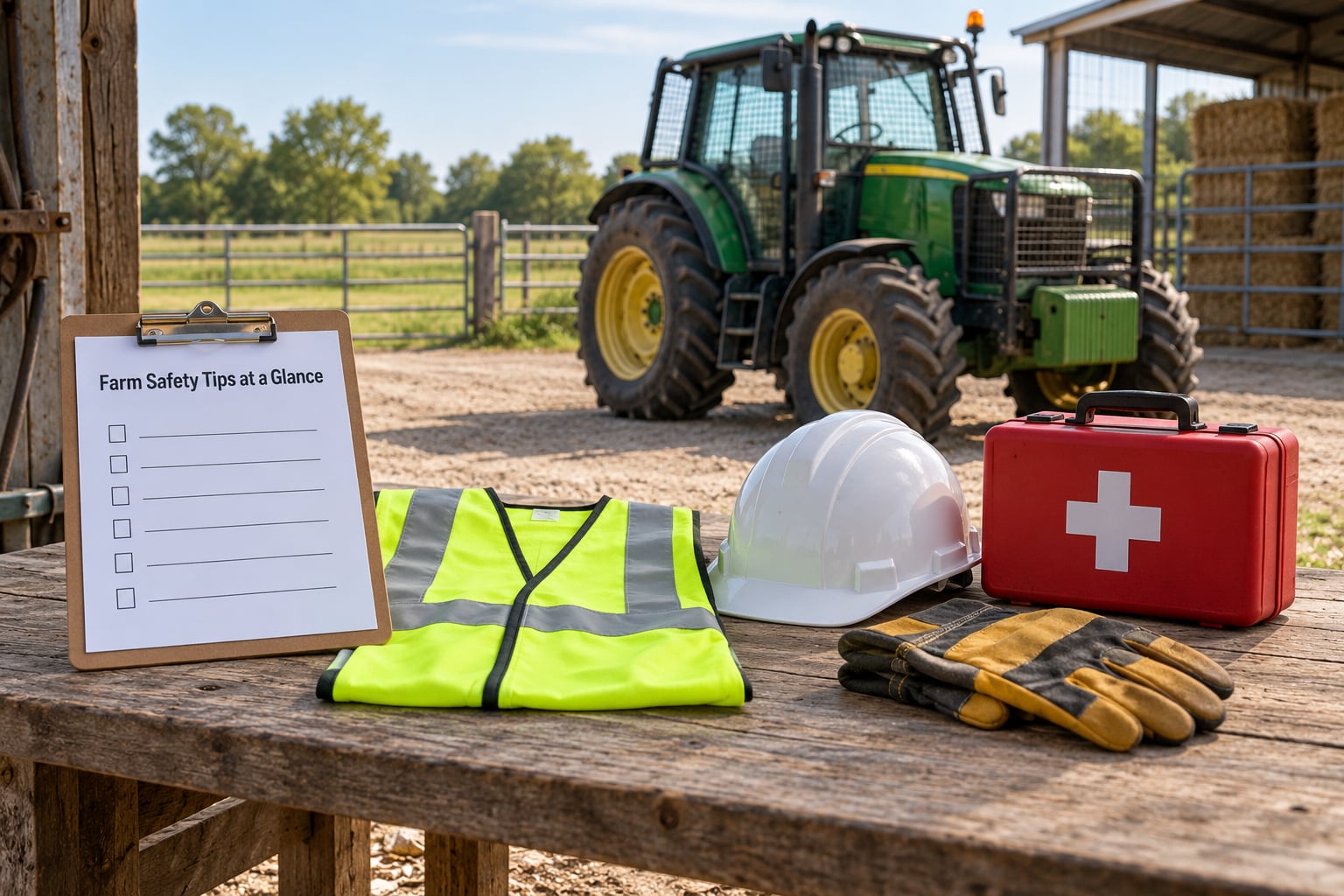
Use this table to find your most urgent risk first, not the easiest one. Work down the left column and mark anything you cannot control today.
| Hazard | Preventive action | Best time to apply it |
|---|---|---|
| Worn PTO guard or missing belt shield | Walk-around inspection, then tag and report the defect | Every time before the engine starts |
| PTO entanglement | Three-point check: before attaching, while connected, before shutting down | Every attachment change |
| Grain bin engulfment and entrapment | Lock out power, ventilate, attendant outside, harness on a secure line | Before any entry, every time |
| Wagon or truck runover during loading | Mark a no-walk zone and keep everyone out from behind | While grain is moving |
| Pesticide and fertilizer exposure | Locked storage, current label, correct PPE, restricted-entry interval | Before opening any container |
| Wrong PPE for the task | Match protection to the hazard, not to habit | At task assignment |
| People in the path of equipment or cattle | Distance, barriers, walkways, agreed hand signals | Whenever equipment is running |
| ATV and UTV rollover | Seat belt, no passengers, trained operators only | Before every ride |
| Children and visitors in work zones | Physical separation, age-appropriate tasks, orientation | Before anyone arrives |
| Heat stress and fatigue | Scheduled water, shade, and rest breaks adjusted to the work | Hourly in summer heat |
| Delayed emergency response | Printed plan, charged phone, first aid and extinguisher within reach | Reviewed at season start |
| Untrained hands on a machine | Demonstration, not just a verbal briefing, plus documentation | On hire and after any change |
1. Inspect Machinery Before Every Use
Run a walk-around before the engine starts, and write down what you find. A pre-start check takes five minutes and catches the loose shield, worn belt, slow brake, or low fluid that turns into an amputation or a rollover later.
- Guards and shields: every belt, chain, and shaft guard physically in place, not zip-tied or removed for convenience.
- Controls: steering, brakes, throttle, and emergency stop respond cleanly.
- Tires and wheels: inflation, lug bolts, and no sidewall damage from a ditch or berm.
- Fluids: engine oil, coolant, hydraulic fluid, and fuel, with no leaks underneath the machine.
- Lights and markers: work lights, reflectors, and the slow-moving vehicle emblem if the machine goes on public roads.
- Warning labels: legible and present, especially on newer attachments nobody on the farm has operated before.
When something is wrong, tag the machine and report it the same shift. An out-of-service tag only helps if everyone honors it, so make the tagging routine part of your tool and equipment inspection checklist.
A concrete example: on a morning tractor check, a hand finds the belt shield sitting loose where it had been sitting for weeks, its fasteners rusted through. The tractor was due to go into a field that afternoon with a baler attached. Tagging it meant losing an afternoon and finishing the baling the next day, which is a far better outcome than the alternative.
2. Use a Power-Takeoff Inspection Routine
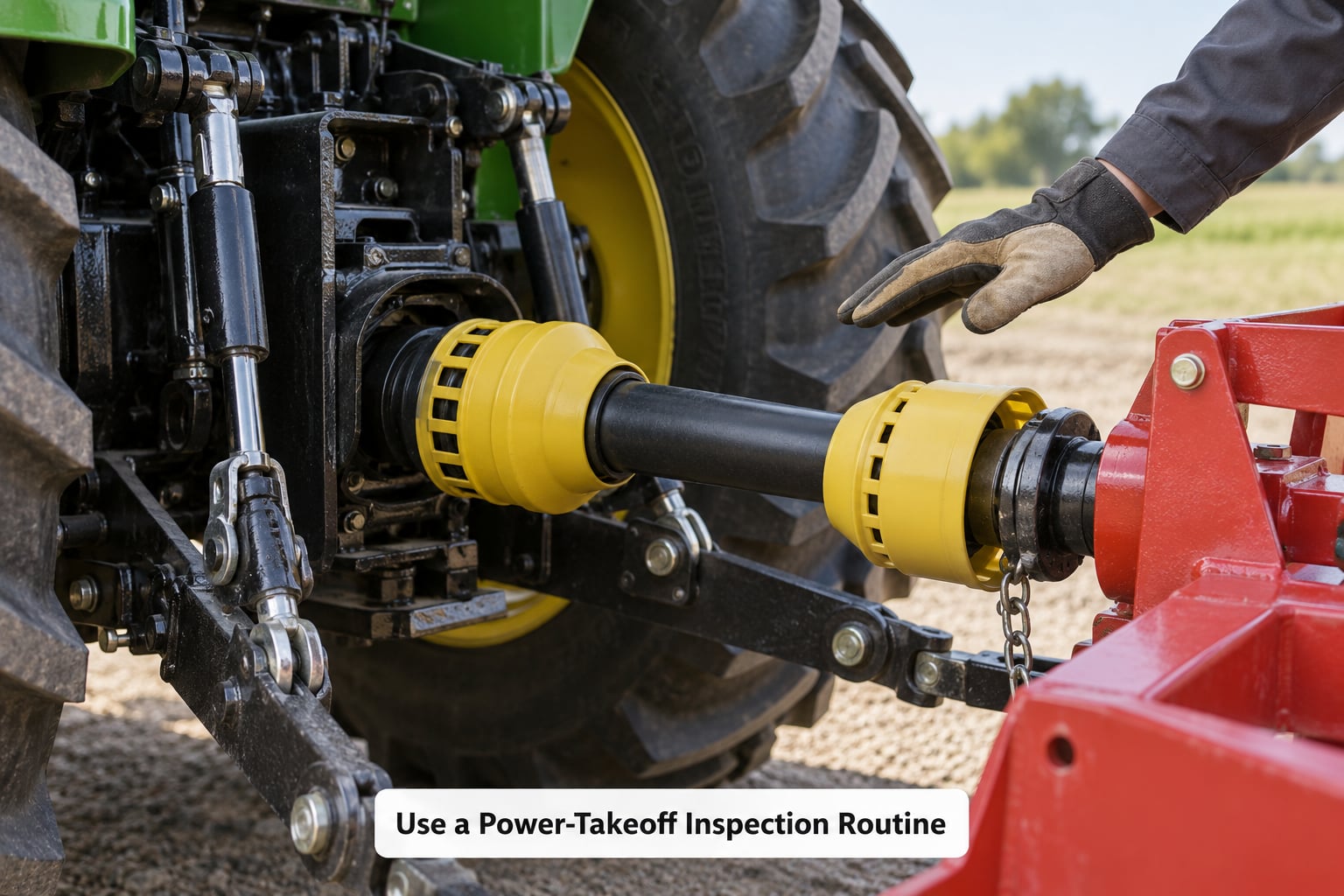
The power take-off (PTO) is the point where the tractor’s rotation meets the implement’s rotation, and a loose boot or missing shield there catches clothing, hair, and hands without warning. Treat every attachment change as a three-point check.
- Before attaching: engine off, key removed, transmission neutral, parking brake set, PTO shaft stopped. Confirm the shield and telescoping guard are intact and that shaft lengths match the implement.
- While connected: check the quick-release pin or spline coupling, the guard on the implement input shaft, and the chain or belt that drives it. Nothing should be able to spin by hand where it should be captured.
- Before shutting down: slow the engine to idle, disengage the PTO, and wait for the shaft to stop turning before anyone dismounts. A spinning shaft will still catch a sleeve or a glove long after you think you cut power.
Stop work and report it if a shield is damaged, the shaft vibrates unusually, an attachment binds, or a chain is missing its guard. A vibration you can feel through the seat is information, not background noise. A guard is a few dollars and an hour; a wrapped-around shaft is a lifetime.
Keep hair tied back, sleeves and lanyards tucked, and no loose clothing near the driveline. This includes drawstrings on hoodies and boots with untied laces, which is where a surprising share of entanglements actually start.
3. Stay Clear of Grain Bins and Stored Grain
Flowing grain can bury a person in seconds, and bridged grain that suddenly collapses will pull someone in from a walkway. Nobody enters a bin, silo, or pit without lock out/tag out, ventilation, and a trained team on the outside.
- Nobody works on stored grain while equipment is running. An auger running above the surface means no one stands on the grain, no one enters, and no one is inside the bin.
- Isolate every energy source before entry: disconnect, lock and tag switches, and verify the power is off at the panel rather than at the control.
- Ventilate and test the atmosphere before anyone enters, and treat bins and manure pits as confined spaces requiring a written permit and a trained entrant.
- Use a safety harness attached to a secure line above the grain surface, with an attendant stationed at the entry point who never enters and never leaves.
- Assume the surface is bridged if grain has been stored undisturbed. Walking on crusted grain is how people disappear and are pulled under.
Manure pits deserve the same treatment and get less of it. Toxic gases from stored manure can disable someone faster than they can reach an exit, and rescue attempts by untrained neighbors turn one fatality into several.
4. Handle Grain Wagons and Trucks in Controlled Areas
Grain movement combines an unstable load, a reversing vehicle, and people who have no reason to be close. Manage the area instead of relying on attention.
Mark a no-walk zone around any moving wagon, truck, or auger and keep it enforced, including for family. No one stands behind a reversing vehicle, between a wagon and a gate, or on the downhill side of a full wagon.
Use a spotter with agreed hand signals when visibility is limited, and stay in the cab rather than riding on the wagon. Watch axle loads, distribute weight evenly, and never exceed the rated capacity of the wagon or the vehicle. Park on level ground with the parking brake set and wheels chocked, and keep keys in the operator’s pocket so nothing moves during a pause.
Secure access during loading, check overhead power lines before raising an auger or raising a bed, and never leave a loaded truck where a passing motorist has to decide in two seconds whether to slow down.
5. Follow Chemical Label and Storage Rules
The current product label is the legal document that says how a chemical may be used, and it is more specific than any habit or shortcut. Read it before the first mix, not after a spill.
- Store pesticides, fertilizers, fuels, and veterinary products in a locked, labeled, well-ventilated area away from feed, seeds, and animals, with spill containment and no drain access.
- Keep an inventory and the current Safety Data Sheet for every chemical on the farm, including discontinued products still sitting in a shed.
- Mix where you can see what you are doing, never in an enclosed space, and never in a reused food or beverage container.
- Observe the restricted-entry interval printed on the label, and post the sign required during and after application.
- Know your spill response before it happens: what gets absorbed, what gets contained, where contaminated material goes, and who gets called.
Basic farm-use precautions and pesticide-handler requirements are different levels of training. If a family member or seasonal worker is applying restricted-use products, they need the handler certification, not a verbal heads-up.
Spray drift is a hazard to your own crew and your neighbour’s property, which is also a liability question. Read wind speed, watch for inversion conditions, and keep people and animals out of the treated area and the buffer zone.
6. Wear Task-Appropriate Protective Equipment
Personal protective equipment (PPE) is the last layer, not the first, but it still has to be right for the task. Choosing gloves by habit is how a chemical handler ends up with a pair of cotton work gloves holding herbicide in one hand and a phone in the other.
A risk assessment for each job decides the kit: ANSI-rated safety glasses for cutting, grinding, and working around chaff; steel-toed or composite-toe boots with slip-resistant soles; hearing protection near running equipment; chemical-resistant gloves selected for the specific product on the label; high-visibility clothing near roads and moving equipment; sun protection; a respirator where the task requires one; and fall protection at height.
The glove example is worth repeating. For a specific post-emergence herbicide product, the label calls for a particular glove material and a cartridge or glove configuration for handling, and a nitrile glove bought for general cleanup may not be what that label names. Check the label, then check that the glove is actually compatible with that chemical before the container is opened.
Replace PPE on its schedule and after any damage. A scratched lens, a cracked boot toe, or a stretched hearing earmuff is not equipment anymore. For heat strain and dehydration specifically, our agricultural worker heat safety guide covers the monitoring and acclimatization side that PPE cannot touch.
7. Separate Workers from Moving Equipment and Livestock
The most reliable control against runovers and kicks is distance, and the second is a barrier. Neither depends on someone paying attention at the right moment.
Set a minimum separation from tractors, combines, loaders, and augers, and designate walkways so people do not cross behind or beside equipment that is moving or idling. Agree on hand signals or radio calls before starting, and use a spotter for blind corners, gates, and tight buildings.
Stop and shut down before anyone approaches a running machine, and no exceptions for a plastic bag, a bolt, or a photo. Barricade or lock out the area whenever children, visitors, or untrained helpers are present.
Livestock needs its own plan. Work cattle from the edge of a chute rather than standing behind them, keep a solid barrier and an escape route, and remember that cattle, horses, and mules respond to movement and noise, not to what you intend. Dogs in the pen multiply the risk by a wide margin.
8. Treat Vehicles, ATVs, and UTVs as Work Equipment
ATVs and utility vehicles do the work of a small truck on most farms, and they kill as many people as the trucks do, mostly through rollover and passenger loads. Manage them like equipment, not recreation.
- Pre-use check of tires, brakes, controls, lights, and the kill switch, with defects recorded and the vehicle held out of service.
- Authorized operators only, trained and competent on that specific machine, with the rule enforced across family members too.
- Seat belt on every trip, and rollover protection intact and upright on UTVs.
- No passengers on ATVs, and no passengers in the cargo bed of any vehicle, on a lap, or standing on a platform.
- Hitching done stationary, with the parking brake set, and nobody between the truck and the implement.
Rear visibility is where a spotter earns their place. A loaded grain truck in a narrow lane, a manure spreader at a blind corner, or a pickup with a full hay rack can be reversed into a ditch or a person with no warning. Establish a designated reversing area, use a spotter with agreed signals when visibility is limited, and walk around the vehicle before moving it. Slow down near playgrounds, school buses, and oncoming traffic on rural roads, and never wave a motorist through just to move faster.
Mark slow-moving vehicles with the slow-moving vehicle (SMV) emblem, keep lights and flashers working, and make sure wide loads have the required flags and follow state rules for ag equipment road travel.
9. Control Children, Visitors, and Untrained Workers
A farm looks like the largest playground a child has ever seen, and a visiting cousin does not know which of those interesting machines are off limits. Physical separation beats a lecture every time.
Keep children out of work areas containing machinery, grain bins, chemicals, animals, and moving vehicles, and tell them plainly where they are allowed to play, not just what they must avoid. Use NAGCAT guidelines to match chores to a child’s developmental ability, since a seven-year-old and a fifteen-year-old have very different limits around equipment.
Visitors and untrained helpers get a short orientation before they set foot in a work zone: which areas are closed, where the animals are, what the emergency signal is, and who to talk to. Mark visitors with high-visibility identification so workers know who does not belong in a driving lane. Add agritourism and tour groups to this list, since the public is on the farm grounds without any farm training at all.
Set a minimum age for any powered equipment and enforce it without exception, including for the ones who are confident and careful. A farm where a rule is waived once is a farm where every rule is negotiable.
10. Plan for Heat, Cold, Storms, and Poor Visibility
Weather is a hazard you can watch for, which makes it a poor excuse for not planning. Build the adjustment into the schedule rather than into the decision at 2 p.m.
For heat: schedule water breaks on a timer, put shaded or air-conditioned rest in reach of the work, adjust work-rest cycles during the hottest hours, and build acclimatization in gradually over the first weeks of a season. Supervisors watch for the visible signs of heat strain, such as confusion, stumbling, headache, or cessation of sweating, and get the person to a cool place and medical help. They do not diagnose anything, because that is a clinician’s job.
For cold: layer clothing, keep a dry change of clothes available, and treat icy conditions as a reason to slow down, not a reason to be more careful. For storms: delay nonessential work when thunder is close enough to hear, and know where the substantial building or hard-topped vehicle is before you need it.
For high winds, stop handling lightweight materials such as tarps, net wrap, and panels that can catch and carry. For flooding, keep everyone out of moving water, because a foot of water in a channel or ditch can sweep a person away and the depth is deceptive. For dust, fog, and poor visibility, slow down, use lights, and require hand signals instead of assuming anyone saw the gesture.
Fatigue is the underrated one. Seasonal time pressure pushes people to skip rest, and tired operators make the exact decisions that lead to rollover, misjudged clearances, and skipped steps.
11. Prepare an Emergency and Communications Plan
The plan only works if the response is already decided, because the moment you need it is the worst possible time to think. Put it on paper, one page per work area, and walk the crew through it at the start of the season.
- Emergency contacts posted where they are visible, with 911, the local clinic, the poison control line, and two named people who are not on the field that day.
- First aid kits stocked and checked, with bleeding control supplies, clean water, and someone trained to use them.
- Fire extinguishers mounted and accessible, rated for the area, and checked on a schedule. Know where the fire department water supply and gate access are.
- Machinery shutdown methods written down: the engine kill, the battery disconnect, the emergency stop, and how to shut off a PTO without climbing onto a running machine.
- Evacuation routes and muster points for the field, the yard, and the shop, plus a way to account for everyone including visitors.
- A check-in protocol for lone work, with a scheduled call, a charged phone, and a named person who treats a missed check-in as an emergency.
Print one copy per work area and keep a copy in the cab of every truck. Working alone in an isolated field with no reliable cell coverage deserves a satellite messenger or a personal locator beacon, which is a small investment compared with the alternative.
After any incident, treat the first minutes as a rescue problem. Shut down the power, do not enter grain or a confined space yourself, and call for trained help. The instinct to pull a family member out of a bin is exactly how one casualty becomes four.
12. Train Everyone and Review Procedures Regularly
Instructions shouted across a yard are not training. A short demonstration of the actual task, on the actual machine, is the difference between a worker who can find the fuel shutoff and one who cannot.
On a new hire’s first day, cover the farm’s hazard map, the emergency plan, the signals, the PPE for each job, and the rule that no one operates a machine they have not been shown. Repeat the demonstration after an equipment change, since a new header or a new sprayer has hazards the old one did not.
Communicate in the language each worker reads best, and give everyone the same standard, family or hired. Document the training with the date, the task, and the trainer’s name, because that record is what an inspector, an insurer, or a court will ask for after an incident.
Run a short scenario drill once a season. A useful one: a worker is found in a grain bin, and the crew has to say out loud who shuts down the power, who calls for help, who meets the responders at the gate, and who pulls the other workers back. Then verify it by asking the crew to describe the correct action for that scenario without notes. A drill nobody can repeat is a briefing, not a drill.
Review the whole program after any injury, near miss, equipment purchase, or change in crew. Near misses are the cheapest data you will ever get, and the people reporting them are telling you what almost happened.
Frequently Asked Questions
What are the most important farm safety tips for small farms?
Start with machinery inspections, a stop-work rule for damaged guards, and separating people from running equipment and grain bins. On a small farm the biggest risks are usually the shortest routine skipped: no belt shield, no lockout before clearing a plug, or a child in the yard. Put one page of emergency contacts and one page of tasks by hazard on the fridge, and require one person to be trained on each machine.
How should workers prepare before operating a tractor or combine?
Do a full walk-around first: guards in place, tires and lug bolts sound, controls and emergency stop working, fluids checked, lights and the slow-moving vehicle emblem working, and warning labels legible. Confirm the rollover protective structure is fitted and the seat belt functions. Then check the attachment matches the machine, the PTO shaft guard is intact, and you know the emergency stop before you start the engine.
What should never be done around a grain bin?
Never enter, never stand on stored grain, and never work inside while an auger or other equipment is running. Do not walk on a crusted surface, because bridged grain can collapse without warning. Never attempt a rescue alone or enter a bin to retrieve a boot, a glove, or a person without lock out/tag out, ventilation, a harness on a secure line, and an attendant posted outside.
Are gloves always appropriate for farm work?
No. Gloves are the right protection for some chemical handling, cutting, and abrasive work, and the wrong protection around rotating machinery, where a loose glove is something to get caught in. Choose glove material based on the specific product label rather than on what is in the drawer. Near a PTO or an auger, keep hands out entirely rather than relying on a glove to help.
How can a small farm create an emergency action plan?
Write one page per work area. List emergency contacts and the gate address for responders, the location of first aid kits and fire extinguishers, how to shut down each machine and isolate its power, evacuation routes and muster points, and a check-in time for lone work. Walk the crew through it once per season and post it where it can be read from a cab.
What should a farm do after a near miss or workplace injury?
Get medical help first, then secure the scene and document what happened while details are still accurate: photos, machine condition, weather, time, and witness statements. Report the injury as required, notify the insurer or workers’ compensation carrier promptly, and record it in an injury log. Treat near misses the same way, and review what allowed the event so the cause is corrected rather than blamed.
Conclusion
Do not try to implement all twelve of these farm safety tips this week. Start by finding the single most immediate risk in your operation, whether that is a missing guard on the tractor you drive most, an unlocked chemical shed, a grain bin with no entry procedure, or a loader that reverses blind into the yard.
Assign a named person and a date to fix it, write down what changed, and then move to the next item. Safety on a farm is not a program you adopt once, it is a habit you rebuild every season, and the farms that handle it best are the ones that fix one thing at a time and keep a record of it.