
Veterinary workplace hazards are the biological, chemical, physical and psychological risks that clinic and field staff meet every shift: bites and scratches, zoonotic pathogens, needlestick injuries, disinfectants, waste anesthetic gas, ionizing radiation, lifting injuries, slips and burnout. They cannot be removed from veterinary work, only managed with layered controls.
That last point matters more than any policy document. Practicing veterinarians describe safety as minimizing exposure and staying diligent, not as eliminating risk, and anyone who promises a bite-free clinic is selling something. What a well-run practice can promise is that every hazard has a named control, a trained owner and a way to report an exposure that day.
The 12 hazards below are grouped the way exposure actually arrives: from animals, from chemicals, from equipment and from the work itself. Each one comes with the tasks that trigger it, the health effects reported in occupational health literature, and the controls that measurably reduce exposure. Read the overview table first, then dig into the sections that match your setting.
Table of Contents
- Veterinary Workplace Hazards at a Glance
- 1. Zoonotic Diseases and Animal Bites
- 2. Needles, Scalpels, and Other Sharps
- 3. Animal Handling, Restraint, and Kick or Bite Injuries
- 4. Noise and Hearing Damage
- 5. Anesthetic Gases and Veterinary Medications
- 6. Radiation, X-Rays, and Ionizing Radiation
- 7. Chemical Exposure, Cleaning Products, and Disinfectants
- 8. Biological Fluids, Waste, and Drainage Hazards
- 9. Ergonomic Strain and Repetitive Tasks
- 10. Slips, Trips, Falls, and Wet or Cluttered Floors
- 11. Fire, Electrical, and Equipment Hazards
- 12. Stress, Fatigue, and Psychological Strain
- Frequently Asked Questions
- What are the most common hazards found in a veterinary clinic?
- How do I conduct a risk assessment for veterinary workplace hazards?
- What should I do after an animal bite or needlestick at work?
- Which employees need veterinary hazard training?
- How should a clinic manage hazardous drugs and anesthetic gas?
- When should staff see a doctor after an occupational exposure?
- Where to Start: Your First Three Moves
Veterinary Workplace Hazards at a Glance
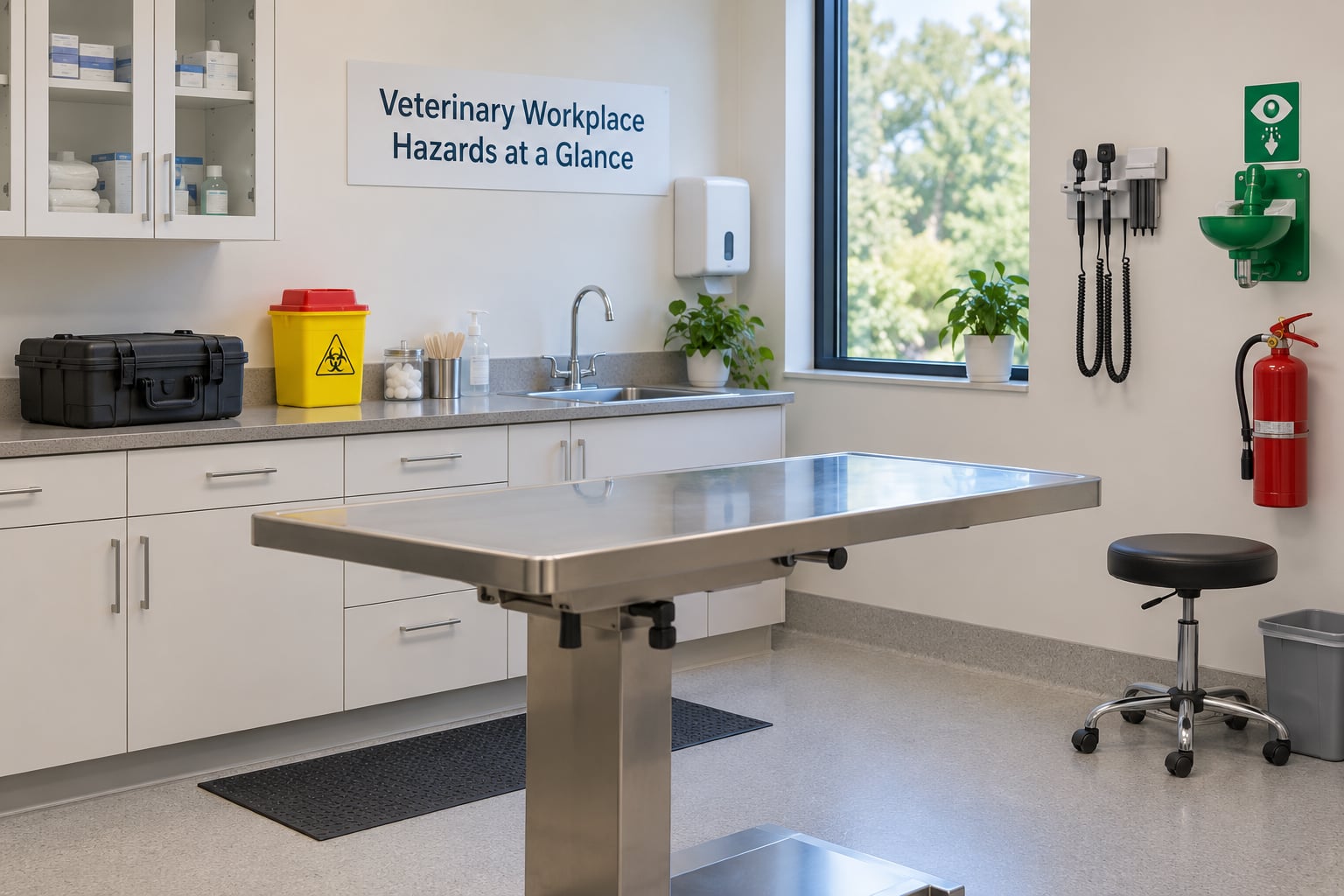
This table compares each hazard with the veterinary tasks that create it, the health effects reported in occupational health research, and the control that does the most work. Scan it before you read the detail, because most injuries trace back to a task that had no control attached to it.
| Hazard | Typical tasks or exposures | Possible effects | Main control |
|---|---|---|---|
| Zoonotic disease and bites | Restraint, wound care, dentistry, cleaning stalls, calving | Skin and soft tissue infection, respiratory illness, ringworm | Standard precautions, restraint, vaccination review |
| Sharps | Injections, catheter placement, surgery, lab sampling, wound debridement | Puncture wound, needlestick, laceration | Safety devices, no-recap practice, immediate disposal |
| Animal handling | Exams, radiographs, nail trims, moving dogs, loading horses | Bites, scratches, crush injuries, kicks, trapping | Team handling, appropriate equipment, training |
| Noise | Barking dogs, vocalizing patients, pressure washing, blasters | Permanent hearing loss, tinnitus | Equipment selection, exposure assessment, hearing protection |
| Anesthetic gas and medications | Inhaled anesthesia, chemotherapy, euthanasia agents, aerosols | Headache and nausea, reproductive effects, toxicity | Scavenging, closed transfer, labeled storage, ventilation |
| Ionizing radiation | Radiography, fluoroscopy, nuclear medicine | Cell damage, cumulative exposure risk | Restricted areas, shielding, dosimetry, ALARA |
| Chemicals | Disinfectants, solvents, histology reagents, pesticides, cleaners | Irritation, burns, respiratory sensitization | Safety Data Sheet review, dilution control, PPE |
| Biological fluids and waste | Sample handling, draining cages, kennel cleaning, euthanasia | Exposure to pathogens, skin and eye irritation | Controlled handling, hygiene, sealed disposal |
| Ergonomic strain | Lifting animals, prolonged restraint, standing, bending | Back and shoulder injury, repetitive strain | Team lifting, task variation, workstation adjustment |
| Slips, trips and falls | Wet floors, urine, vomit, hoses, cords, stacked boxes | Sprains, fractures, bruising | Prompt cleanup, signage, cable management, clear exits |
| Fire and electrical | Anesthetic machines, wet hands near equipment, overloaded outlets | Burns, electrocution, smoke inhalation | Inspection, load management, fire response planning |
| Psychological strain | Euthanasia, emergencies, client conflict, overtime, suffering animals | Compassion fatigue, burnout, depression, secondary trauma | Staffing, debriefing, recovery time, reporting systems |
What counts as a veterinary workplace hazard
A hazard is anything with the potential to cause harm, not something that has already caused harm. A sharps container sitting outside the treatment room counts even when nothing has ever been stuck in it, and the same is true of an anesthetic machine without a scavenging line.
Sources group veterinary workplace hazards into four classes, and the classes matter because each one enters the body by a different route. Biological hazards enter through bites, scratches, mucous membranes, inhalation and needlestick. Chemical hazards enter by inhalation and dermal absorption. Physical hazards are mechanical: noise, radiation, lifting, slipping, electricity. Psychological hazards come from the content and pace of the work rather than from a device.
Everything in this article fits one of those four classes. Some items, like animal allergens, sit on the boundary between biological and chemical, and that overlap is normal.
Which roles carry which exposure
Role matters more than job title. A technician who spends the morning in the dental room and the afternoon running anesthesia has a very different exposure profile from a kennel assistant mopping runs, even though both are on the same payroll chart.
| Role | Most likely exposures | Typical PPE |
|---|---|---|
| Veterinarian | Bites, zoonotic exposure, anesthetic gas, radiation, client conflict | Gloves, eye protection, lead apron and thyroid collar when imaging |
| Veterinary technician | Needlestick, restraint injury, anesthetic gas, disinfectants, radiation | Gloves, eye protection, gown or lab coat, hearing protection where assessed |
| Kennel and animal care staff | Bites, scratches, noise, wet floors, cleaning chemicals, zoonotic pathogens | Waterproof gloves, non-slip footwear, eye protection for chemical mixing |
| Front desk staff | Client conflict, infectious respiratory disease from waiting-room exposure | Standard precautions during outbreak cleaning, hand hygiene |
| Practice manager | Chemical inventory, radiation compliance, incident follow-up | Task-specific, driven by the audits the role performs |
Kennel and animal care staff carry the highest physical exposure and are the group most often left out of hazard briefings. Naming them in your training records is a small fix with an outsized effect.
1. Zoonotic Diseases and Animal Bites
Bites and scratches are the hazard veterinary staff report most often, and they carry two risks at once: the physical wound, and whatever the animal was carrying. Rabies is the one everyone rehearses, but in day-to-day practice the more common infections come from Pasteurella species, Staphylococcus, Streptococcus and Capnocytophaga, alongside fungal threats such as ringworm and sporotrichosis.
Exposure does not require a bite to be serious. Urine from infected animals, contaminated feces in a kennel run, saliva reaching a hand cut, and birth fluids during a dystocia are all transmission routes. Parasites travel too: hookworm larvae in kennel soil and roundworm eggs in contaminated bedding are ingested on unwashed hands.
Standard precautions apply to every patient regardless of what you know about its history, which is the same logic that runs through human healthcare: you treat the fluid as infectious until assessment says otherwise. Gloves go on for anything involving contact with body fluids, and a mask and eye protection go on where splashing is likely, such as draining an abscess or flushing a wound.
What to do in the first hour after a bite or scratch
- Wash the wound immediately with soap and running water for several minutes, then flush thoroughly.
- Control bleeding with clean gauze and apply direct pressure.
- Apply an antiseptic and cover with a sterile dressing if the wound is still bleeding or gaping.
- Report it the same shift to your supervisor or designated safety contact so it becomes a record.
- Ask your clinician about tetanus status and whether the wound needs evaluation, closure or antibiotics.
- Confirm whether your rabies vaccination history is current, and if the animal’s status is unknown, ask about post-exposure prophylaxis.
Start at step one every time. Delayed first aid is the part of the response that is fully in your control, and veterinary staff who treat a scratch as nothing often lose the window for useful documentation. If you want the reporting paperwork rather than the reasoning, see what to do after a workplace injury.
2. Needles, Scalpels, and Other Sharps
Sharp injury risk in veterinary practice is unusually high, because clinical staff inject, catheterize, cut, suture and debride in the same building, often in a moving patient and often at speed. Sutures are a special problem: the needle follows the suture, so it pulls out of view immediately after placement, which is exactly when hands go looking for it.
Broken glass is the other undercounted source. Sample tubes, slide holders, pipettes and culture plates break on wet racks and tile floors more often than anyone reports.
Controls start at the point of use. Use devices with safety features where they exist, activate them before you set anything down, and never recap a used needle by hand. Put sharps straight into a puncture-resistant, leak-proof container that sits at the point of use, not down the corridor where someone forgets the lid.
After a needlestick, wash the area, stop bleeding, report it the same day and get baseline bloods drawn promptly. Source-patient testing and prophylaxis decisions belong with your clinician, not with a shrug at the bench.
3. Animal Handling, Restraint, and Kick or Bite Injuries
Physical harm from the animal is the hazard that causes the most lost time. Dogs produce most bite reports, cats produce most puncture wounds, and in equine and large animal work the injury pattern shifts: kicks, crush injuries against walls and gates, ropes, and being trapped between a horse and a trailer door.
Most restraint injuries trace back to a mismatch between the equipment used and the patient’s condition. A towel no longer restrains a dog that has just had a painful injection, and a rope loop that suited a cooperative horse does nothing for a frightened one in a dark barn.
Team handling is the control that moves the needle. Two people, a plan agreed out loud, and a clear release cue reduce handling time and cut injury rates more reliably than any single device. Cover the other exit route before you bring an animal into a room, because the escape itself creates the chase, and the chase is where most people get hurt.
Mobile practice adds its own layer: no controlled environment, no second pair of hands, and a vehicle parked where you cannot reposition the animal. Plan the exit before you load.
4. Noise and Hearing Damage
Noise in clinics is underrated because it accumulates. A barking dog in a kennel run, a pressure washer against a hard wall, a dog washer, a dental scaler, an air-driven drill and a barking monitor on an alarm system all add up across a shift, and hearing damage is cumulative rather than dramatic.
Early signs are tinnitus and the sensation of hearing being blocked at the end of a shift. By the time staff report those symptoms, exposure is well established.
Start with an exposure assessment: measure levels in the kennel, treatment room and wash bay during a busy morning rather than guessing. Fix the source where you can, from quieter equipment and maintenance to layout changes that keep the kennel from sitting directly under the treatment table. Hearing protection belongs on staff who exceed the assessed action level, and fit matters more than the label.
5. Anesthetic Gases and Veterinary Medications
Wasted anesthetic gas is an invisible exposure with real effects. Staff in poorly ventilated rooms report headache, nausea, fatigue and dizziness, and reproductive concerns have been studied for decades. Leaks from anesthetic machines, uncapped vaporizers and poorly scavenged circuits add up, and small practices often have no scavenging at all.
Controls are engineering-first: a maintained scavenging or negative-pressure system, tight equipment checks before each anesthetic, and vaporizers closed and sealed when not in use. General room ventilation helps but does not substitute for scavenging.
Hazardous medications fall into a related group. Chemotherapy agents and some euthanasia drugs are cytotoxic or irritant, and oncology services need closed transfer systems, dedicated gloves, a designated preparation area and designated waste containers. Ask your occupational-health provider about an antineoplastic handling program rather than improvising one.
If a spill happens, leave the area, close the door, post a warning, and follow the safety data sheet’s spill section. Ventilation and cleanup come after you are clear of the exposure.
6. Radiation, X-Rays, and Ionizing Radiation
Diagnostic imaging exposes staff to ionizing radiation through scattered radiation and, in the case of portable equipment, through proximity to the primary beam. Veterinary practices that operate radiographs, a portable X-ray unit or nuclear medicine need a radiation safety program with a designated radiation safety officer, a controlled area, shielding, dosimetry where required, and equipment that is serviced and tested on schedule.
The everyday habits are simple and easy to skip: check the dosimeter, wear the apron and thyroid collar, keep collars and lead garments on storage hooks rather than draped over a chair, and confirm other staff are clear before an exposure. Keep pregnancy policies and declaration procedures current, and never hold a patient during a radiograph.
The ALARA principle, keeping exposure as low as reasonably achievable, works because most veterinary doses are low and most exposures are avoidable through technique.
7. Chemical Exposure, Cleaning Products, and Disinfectants
Disinfectants do not know the difference between a table and a forearm. Common clinic products, including quaternary ammonium compounds, bleach solutions, phenolics, alcohols, glutaraldehyde-based products and hydrogen peroxide compounds, can irritate skin and eyes, and several cause respiratory symptoms when mixed or sprayed. Mixing bleach with an acidic or ammonia-containing cleaner releases gas, which is a common and preventable accident.
Start every chemical decision at the safety data sheet rather than the bottle, because the same active ingredient exists in several formulations with very different requirements. Follow dilution instructions exactly, never transfer a concentrate into an unlabelled bottle, and store chemicals away from food and medications.
Control spray drift where you can, open windows or use local extraction, and keep decanted working solutions in labelled containers. When you do have a splash, flush skin and eyes with water immediately for at least 15 minutes, strip contaminated clothing, and follow the data sheet’s first-aid section.
8. Biological Fluids, Waste, and Drainage Hazards
Blood, urine, feces, vomit, saliva and contaminated bedding carry infectious material and irritate skin through repeated wet work. Drain cleaning and kennel runoff add another exposure route: aerosols lifted from a drain trap, and splashing when a blocked line is opened.
Handle fluids as if infectious, which in practice means gloves, a gown or apron for heavy soiling, closed footwear, and hand hygiene at every transition. Vacuum or use absorbent protocols rather than sweeping, and never hose floors toward an open drain without eye protection.
Shelters and humane societies run at a different intensity: high animal turnover, animals in poor condition, and drains that carry more than a clinic floor ever would. Their kennel workers absorb more of this exposure than anyone else in animal care, so they need their own assessment rather than an inherited clinic checklist.
9. Ergonomic Strain and Repetitive Tasks
Musculoskeletal injury is the quietest hazard on this list and one of the most consequential for careers. Lifting dogs onto tables, restraining patients for radiographs, holding animals during dental procedures, kneeling to drain drains, and standing for twelve hours on a surgery shift all load the same lower back, shoulders and neck.
Assistive lifting devices, adjustable-height tables and two-person lifts for anything above a set weight threshold make a measurable difference. Where the equipment is scarce, rotating tasks so nobody performs one repetitive motion for an entire shift helps more than technique coaching alone.
Treat this as an injury-prevention topic, not a comfort topic. Back injuries in veterinary staff show up years later as chronic pain and reduced capacity to work, and they are almost always traceable to a lifting pattern nobody reviewed.
10. Slips, Trips, Falls, and Wet or Cluttered Floors
Wet floors are part of the job in animal care, so the control is speed of response rather than aspiration for a dry floor. Urine, vomit, diarrhea, water from wash bays, tracked-in rain and thawed salt all end up on the same tile. Add hoses, extension cords, stacked totes and cardboard boxes, and the walking surface becomes the hazard.
Keep the response under a couple of minutes. Place wet-floor signage where staff already walk, stock mop and bucket stations close to kennel and wash areas, and make a mop a two-minute job rather than something waiting for the end of shift.
Cord management matters as much as mopping: run cables along walls or under covers, keep them out of doorways, and avoid daisy-chaining power strips. Keep exit routes and fire extinguishers unobstructed, and improve lighting in corners, under benches and in outdoor runs.
11. Fire, Electrical, and Equipment Hazards
Veterinary equipment is heavy, powered and often near water. Anesthetic machines, autoclaves, dental equipment, water baths and warming units all draw significant current, and clinics typically run several on one circuit.
Have an electrician assess outlet loads rather than adding power strips to solve a capacity problem. Inspect cords and plugs routinely, remove damaged equipment from service instead of taping it, and keep hands and wet gloves away from electrical controls during patient bathing and cleaning.
Oxygen and anesthetic gas systems raise fire risk near ignition sources, so store cylinders upright and secured, and keep combustible materials and clutter out of the surgical and anesthesia area. Every practice needs a written fire response plan, alarms that are tested, extinguishers that are inspected, and staff who know where the exits and the alarm points are.
12. Stress, Fatigue, and Psychological Strain
Psychological hazards are occupational hazards, and the field is only starting to treat them that way. Veterinary staff absorb predictable doses of suffering, euthanasia, client anger, financial conversations and emergencies in which everything depends on their speed. Compassion fatigue and burnout show up as cynicism, exhaustion, withdrawal from colleagues and errors that range from small slips to serious mistakes.
Secondary traumatic stress arrives after exposure to other people’s distress, including a client’s grief or a violent animal, and it is easy to mistake for personal failing. Sleep disruption and long shifts make everything worse.
Controls are organizational first. Adequate staffing and rest between shifts, debriefing after difficult cases, a functioning incident reporting system with no retaliation, and access to counseling or employee assistance where mental health support is offered. Managers who notice changes in behavior early do more for a struggling team than any awareness poster.
Frequently Asked Questions
What are the most common hazards found in a veterinary clinic?
The most common hazards in a veterinary clinic are animal bites and scratches, needlestick and other sharps injuries, zoonotic exposure to urine, feces and saliva, and allergen exposure. Chemical hazards follow closely: disinfectants, cleaning agents and waste anesthetic gas. Physical hazards include noise, radiation from diagnostic imaging, lifting and restraint injuries, and slips on wet floors. Psychological strain from euthanasia, emergencies and client conflict is increasingly recognised as a workplace hazard in its own right.
How do I conduct a risk assessment for veterinary workplace hazards?
Walk the practice with fresh eyes and list every hazard by location and task, including bites, sharps, chemicals, anesthetic gas, radiation, noise, lifting, floors and equipment. Rank each by how likely it is and how serious the outcome would be, then decide controls for the highest-ranked items first. Involve the people doing the work, record the findings with dates and owners, and review the assessment whenever equipment, layout or medication protocols change.
What should I do after an animal bite or needlestick at work?
Wash a bite or scratch with soap and running water, flush a needlestick site, control bleeding and apply a sterile dressing. Report the exposure to your supervisor the same shift so it is documented, and ask your clinician about tetanus status, wound assessment and rabies vaccination history. For a needlestick, arrange baseline bloods promptly so source-patient testing and any prophylaxis decision happen on a useful timeline rather than weeks later.
Which employees need veterinary hazard training?
Everyone who works in a veterinary setting needs baseline training, including veterinarians, registered technicians and nurses, veterinary assistants, kennel and animal care staff, front desk staff and practice managers. Training should be role-specific: imaging staff need radiation procedures, kennel staff need handling and drainage procedures, and anyone handling cytotoxic drugs needs drug-specific instruction. Veterinary students on clinical placement should receive the same briefing as staff.
How should a clinic manage hazardous drugs and anesthetic gas?
Install and maintain a scavenging or negative-pressure system for inhaled anesthetics, check machines for leaks before each case, and keep vaporizers closed when not in use. Handle chemotherapy and euthanasia agents with closed transfer systems, dedicated gloves, a designated preparation area and labelled waste containers. Ask your occupational-health provider to review the program rather than building controls from scratch, and follow the safety data sheet for every product.
When should staff see a doctor after an occupational exposure?
See a clinician after any bite that breaks skin, any needlestick, any chemical splash to the eyes or skin, any respiratory symptoms after a disinfectant or gas exposure, and any suspected radiation exposure above your dosimetry limits. Also seek support early when sleep, mood or concentration change after repeated distressing cases. Do not wait for symptoms to worsen; early assessment gives you more options, and vaccination status is easier to update promptly.
Where to Start: Your First Three Moves
Pick the three highest-ranked hazards from the table above and put a written control against each one this month. In most practices those are bite and scratch prevention, sharps disposal, and cleaning-chemical handling, because each one is frequent, preventable and cheap to fix.
Next, run a proper walk-through. Our eight-step guide to conducting a workplace hazard assessment gives you a structure, and kennel and care staff should walk the route with you rather than reading about it afterwards. Record what you find with names and dates.
Finally, write the controls down where people will actually see them, including what to do after an exposure. A one-page exposure response card removes the guesswork from the worst hour of someone’s month. If your practice has no written program yet, start from how to write a workplace health and safety policy and build it around the hazards you actually have.