

Truck driver health problems and prevention come down to the same handful of work conditions: hours of sitting in a vibrating cab, irregular sleep, truck stop food, noise, sun and isolation. Research from NIOSH and Safe Work Australia points to the same cluster of conditions in drivers everywhere, and each one has a matching workplace fix.
The prevalence numbers are not subtle. NIOSH has found truck drivers roughly twice as likely to be obese and about twice as likely to smoke as other workers, with around 26 percent reporting hypertension and 14 percent reporting a diabetes diagnosis. The Centers for Disease Control and Prevention notes that six in ten US adults live with a chronic disease and four in ten live with two or more, which makes chronic illness the normal operating background of any adult workforce in 2026.
Outside the US, Safe Work Australia’s Comcare truck driver health research project found back problems, high blood pressure and mental health problems to be the most common conditions among Australian drivers, with more than half classified as obese. The picture holds across countries even when the truck, the shift pattern and the food are completely different.
This is general occupational health information, not medical advice. If you have symptoms, a diagnosis or a decision to make about your commercial driver’s licence, talk to a doctor or another qualified clinician rather than relying on a web page.
Table of Contents
What Health Problems Do Truck Drivers Face?
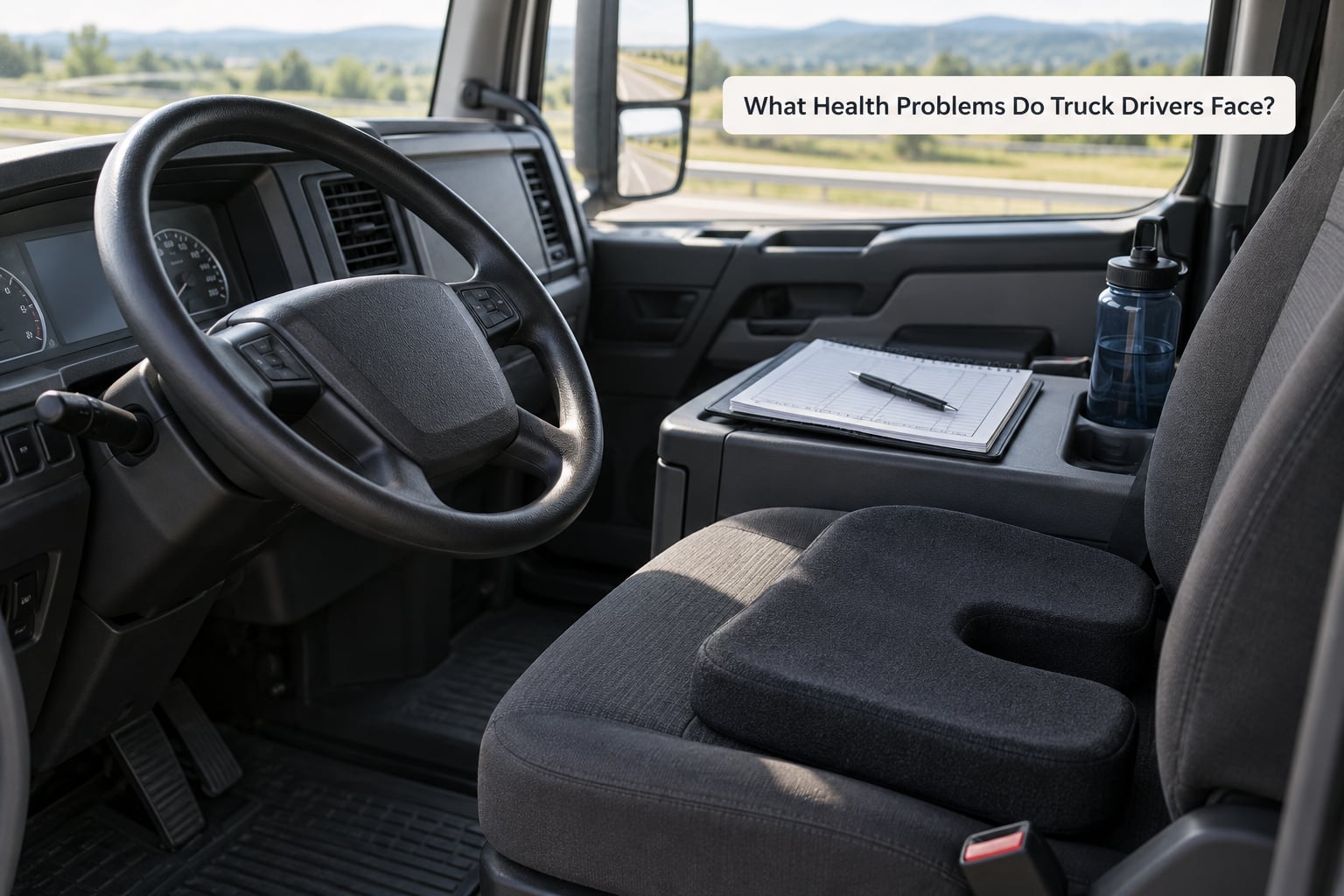
The most common health problems truck drivers face are back and neck pain, obstructive sleep apnea and chronic fatigue, hypertension and cardiovascular disease, type 2 diabetes and obesity, smoking-related illness, and depression or social isolation. Long-haul drivers also report leg swelling, varicose veins, vitamin D deficiency, skin damage from sun exposure, and dental and digestive complaints that start with dehydration and a high-sodium diet.
Here is the full list, with the driver-specific cause behind each one.
- Lower back and neck pain — prolonged sitting, whole-body vibration from the seat and steering wheel, and loading trailers by hand.
- Obstructive sleep apnea and chronic fatigue — short and fragmented sleep windows, sleeping in a moving or poorly ventilated cab, and circadian disruption from night shifts and early starts.
- Hypertension and cardiovascular disease — sodium-heavy truck stop food, inactivity, chronic stress and poor sleep quality.
- Obesity and type 2 diabetes — long hours seated, erratic meal timing, sugary drinks and calorie-dense food available on route.
- Depression, anxiety and social isolation — days away from family, limited conversation, constant decision pressure and no separation between work and rest.
- Smoking-related illness — nicotine dependence is more common among drivers than among other workers, which raises cardiovascular and respiratory risk.
- Leg edema and varicose veins — hours of seated driving with the legs still, which slows venous return from the lower limbs.
- Vitamin D deficiency — years of windshield-filtered sun with little skin exposure, alongside diets without fortified dairy or supplements.
- Skin cancer and sun damage — cumulative ultraviolet exposure through side windows on the driving side, where most of the damage happens.
- Dental decay and digestive complaints — dehydration, frequent sweetened coffee and energy drinks, and irregular meals.
- Occupational injury — slips and falls getting in and out of the cab, and handling equipment that was never designed to be lifted two hundred times a day.
Worth separating clearly: injury hazards and disease are different categories. Crashes, falls and equipment strains are events. The eleven items above are mostly conditions that build quietly over years, which is exactly why they get missed until a medical exam forces the conversation.
Risk accumulates with tenure. A driver in their first year has a different exposure profile from one twenty years in, mostly because metabolic and musculoskeletal damage has had time to compound.
What Factors Increase Truck Driver Health Risks?
The health risks come from a short list of workplace exposures, and they stack on each other. A driver who has all eight of them is not unlucky, they are working the way the industry is built.
| Workplace exposure | Possible health effect | Prevention priority |
|---|---|---|
| Hours of service and tight delivery windows | Sleep loss, drowsy driving, circadian disruption | High |
| Prolonged seated sitting | Back and neck pain, leg edema, metabolic decline | High |
| Irregular shifts and time-zone crossings | Obstructive sleep apnea risk, daytime sleepiness | High |
| Truck stop food high in sodium and sugar | Hypertension, weight gain, type 2 diabetes | High |
| Whole-body and hand-arm vibration | Musculoskeletal disorders, cumulative trauma | Medium |
| Cab noise and diesel exhaust | Elevated cardiovascular strain, hearing loss, respiratory irritation | Medium |
| Ultraviolet exposure through windows | Skin cancer and cumulative sun damage | Medium |
| Isolation and constant decision pressure | Depression, anxiety, burnout | Medium |
The high-priority rows share one feature: the driver cannot remove them on their own. A seat cushion is a twenty dollar decision, a realistic delivery schedule is a management decision.
How Can Truck Driver Health Problems and Prevention Be Improved?
The workable approach treats the cab, the schedule and the diet as workplace equipment rather than personal failings. Prevention here means changing what the job exposes you to, with the employer carrying most of it.
How Do Fatigue and Sleep Problems Affect Drivers?
Fatigue reduces attention, slows reaction time and blurs judgement, and a driver who is short of sleep does not reliably notice how impaired they are. Sleep loss in trucking is rarely one bad night; it is a structural result of shift patterns that leave six or seven hours of clock time for a body that needs closer to eight, in a space that is not dark, not quiet and not level.
The exposure is well documented. Our guide to drowsy driving prevention for commercial drivers covers the warning signs worth acting on, and preventing driver fatigue on long hauls covers the scheduling changes that remove the cause rather than the symptom.
What helps most is unglamorous: a consistent sleep window even when the route changes, blocking out light and keeping the cab dark and cool, a scheduled short nap rather than pushing through, and screens avoided in the hour before sleep. Fatigue reporting needs a policy behind it. A driver who says they are too tired to drive should get the same response as one who reports a mechanical fault, not a reputation for being unwilling.
How Can Drivers Prevent Musculoskeletal Problems?
Back and neck pain in a truck is usually a setup problem before it is a fitness problem, and the fix that works most often is geometric. One driver posted on r/Truckers in their first year that sitting upright as long as they could did nothing for neck pain; what resolved it was adjusting the seat so their thighs sat parallel to the floor and their shins at ninety degrees. That kind of specific, checkable adjustment beats general advice about posture every time.
Concretely, drivers can work through a first-week checklist: set the seat so feet rest flat and knees sit slightly below hip height, adjust lumbar support until the lower back keeps its natural curve rather than arching forward, check that the steering wheel is not angled sharply up, and make sure the wheel doesn’t sit so close that the shoulders are raised. Add ten minutes of walking and a few minutes of movement between loads, keep loads that require twisting close to the body, and report pain that lasts more than a week instead of working around it.
Hands and shoulders take a beating too, particularly with manual transmissions and gate-mounted equipment. Anything that has to be gripped hard, high or overhead for hours at a time is a candidate for a maintenance request.
Nutrition and hydration sit in the same category. A truck stop diet is the practical problem, so the practical answer is stocking the sleeper cab with food that does not need a microwave, reading labels rather than guessing, and keeping a filled water bottle within reach instead of buying sweetened drinks by the gallon. Pair that with UV-blocking sunglasses, sunscreen on exposed skin, and some form of confidential mental health support, because the isolation half of the problem does not respond to a water bottle either.
What Workplace Policies Support Prevention?
Prevention only works if it is written down, which makes it a management task. Carrier policies that reduce health problems tend to share a few features.
- Realistic delivery planning — schedules built around hours of service and realistic drive times, without the kind of margin pressure that pushes drivers past their limits.
- Protected rest and break opportunity — breaks drivers actually take, at places where parking and food make them manageable.
- Vehicle maintenance standards — seats, steering columns and suspension treated as health equipment, not just comfort items.
- Confidential health support — access to clinicians who understand the trucking lifestyle, including telehealth, plus screening drivers can book themselves.
- Non-retaliation for reporting — a driver who reports fatigue, pain or a mental health struggle keeps the job.
The Total Worker Health approach gives carriers a framework for this: programs that treat safety, schedules and health as one problem rather than three separate ones.
There is a business case underneath. US truck driving fatalities peaked at 843 in 2019, and industry driver turnover is estimated above 90 percent in some segments. A driver who leaves costs far more than a program that keeps them healthy and driving.
How Should Employers Respond When a Driver Has Warning Signs?
Stop the work, make the situation safe, and get the person to a clinician. That sequence matters more than the paperwork that follows.
- Sudden or severe symptoms — chest discomfort, difficulty breathing, severe headache, fainting, one-sided weakness, or any symptom that does not feel normal. Stop safely, call emergency services, do not let the driver continue to the next stop.
- Drowsiness while driving — pulling over immediately at the nearest safe location is not negotiable, and it needs to be treated as a safety event rather than a performance issue.
- Persistent or worsening symptoms — arrange a medical appointment and, where the driver’s role requires it, follow the process for medical certification through the driver’s own clinician and a certified medical examiner.
- Return to work — agree a written plan with the driver and, where reasonable, the driver’s own clinician, including any restrictions on hours, lifting or equipment. Review it rather than assuming it still fits.
Individual assessment belongs with a doctor. A carrier can control the schedule, the vehicle and the reporting culture, but it cannot diagnose anyone.
Frequently Asked Questions
What are the common health problems truck drivers face?
The most common are back and neck pain, obstructive sleep apnea and chronic fatigue, hypertension and cardiovascular disease, obesity and type 2 diabetes, smoking-related illness, and depression or social isolation. Long-haul drivers also report leg swelling, varicose veins, vitamin D deficiency, skin damage from sun exposure and digestive complaints. Almost all of these trace back to the same work conditions: prolonged sitting, irregular sleep, truck stop food, vibration and isolation.
Can you lose your CDL if you have sleep apnea?
A sleep apnea diagnosis does not automatically end a commercial driving career, but untreated severe sleep apnea is a condition a certified medical examiner can act on because it affects daytime alertness. Treatment is the usual route to qualification, and many drivers pass once treated and compliant. Rules vary by jurisdiction and by how the condition affects you day to day, so the person to ask is a certified medical examiner and your own clinician, not a forum.
How much sleep do truck drivers need?
Most adults need seven to nine hours of sleep, and drivers need it as much as anyone else. The problem is rarely the requirement but the window available for it. Shift changes, early starts and daytime interruptions compress that window, and sleep in a cab is often shorter and poorer quality than sleep at home. Protecting a consistent sleep window usually does more than trying to sleep harder within whatever time is left.
Does anyone ever pass a sleep apnea test?
Yes. Plenty of drivers get a mild result, and many who are diagnosed go on to pass once the condition is treated and they are using the equipment as prescribed. Testing is meant to identify a treatable sleep problem, not to catch people out. Driver anxiety about the process is common and worth raising directly with the sleep clinic doing the test rather than speculating online.
What is trucker syndrome?
Trucker syndrome is the informal name drivers use for the cluster of back, neck, shoulder, hip and leg problems that come with hours of seated driving and whole-body vibration. It is not a formal medical diagnosis. Symptoms usually build slowly, and seat geometry, lumbar support, movement breaks and safer loading habits can reduce the load. Persistent pain deserves an assessment from a clinician rather than another seat cushion.
What is the average life expectancy for a truck driver?
There is no single figure, and the numbers vary a lot by country, segment and how they are measured. What the research does show consistently is that drivers carry more chronic disease than the general working population, with NIOSH data showing higher rates of obesity, smoking, hypertension and diabetes. Shorter life expectancy figures you see quoted usually trace back to those conditions and to crash risk, not to driving itself.
Conclusion
Start by naming the exposures you already know about: the schedule, the seat, the vibration, the food. Employers can review hours of service against realistic drive times, set maintenance standards for seats and steering columns, publish a fatigue reporting policy with no retaliation attached, and book confidential screening drivers will actually use.
Drivers can adjust the seat geometry this week, add a walk between loads, and stock the cab with food that is not from a vending machine. None of it replaces a clinician, and anyone with symptoms should get assessed properly rather than waiting for a medical exam to force the issue.