
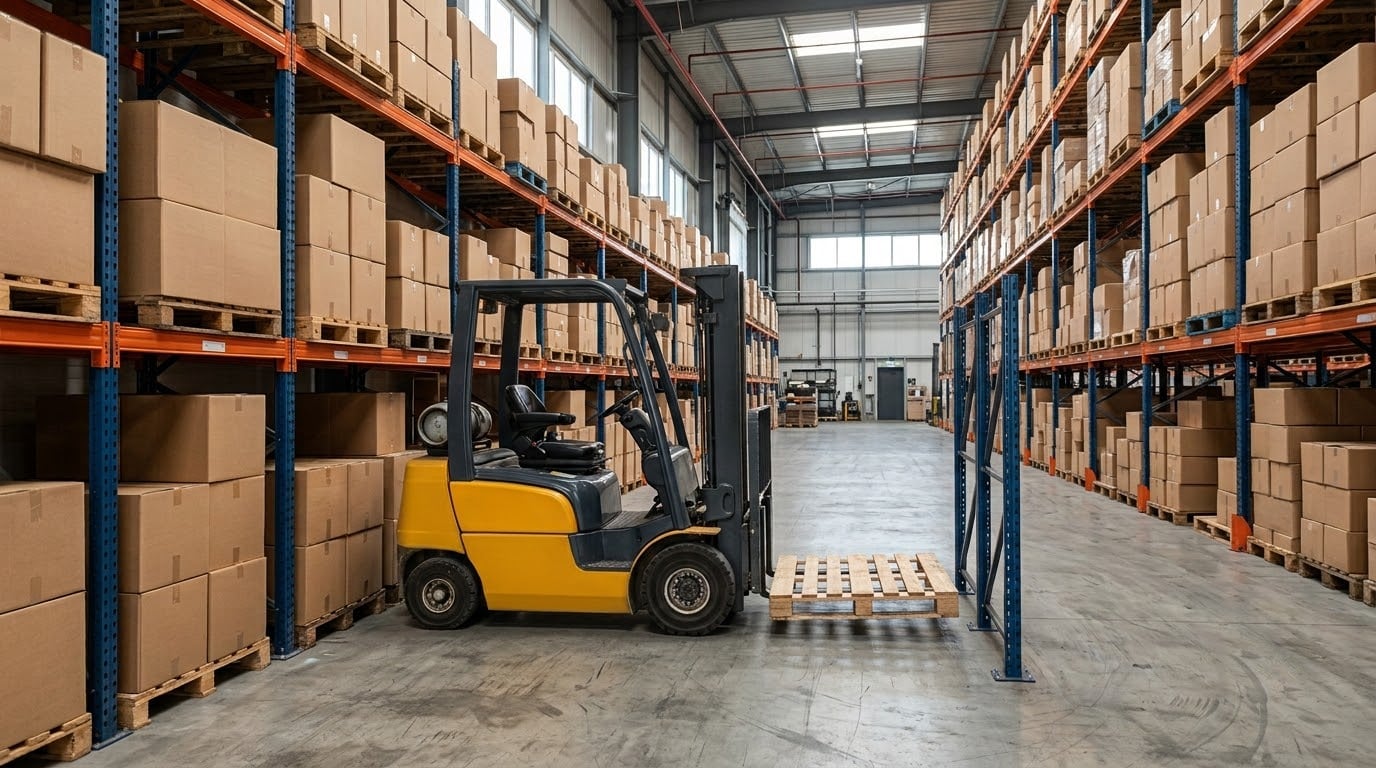
Caught in between hazards examples come up in every OSHA 10 class because the mechanism is so ordinary: a worker steps into a gap to do a job, then something moves. OSHA groups these injuries as ones where a person is squeezed, crushed, pinched or compressed between two or more objects, or is buried or entangled by machinery and other materials.
The 12 examples below span loading bays, machine shops, excavations, warehouses, recycling yards and grain bins. Each one names the specific compression or entrapment point, then the control that removes it, because a general rule against being caught will not keep anyone out of a nip point.
Table of Contents
- Caught in Between Hazards Examples at a Glance
- 1. Caught Between a Vehicle and a Fixed Object
- 2. Caught Between Movable Machine Parts
- 3. Caught Between Excavation Equipment and a Trench Wall
- 4. Caught Under a Falling or Unstable Load
- 5. Caught Between a Forklift and Pallet Racking
- 6. Caught in a Conveyor’s Return Path
- 7. Caught Between a Machine and a Wall
- 8. Caught Between Containers During Material Handling
- 9. Caught Between a Gate and a Fixed Structure
- 10. Caught Between Equipment and a Workbench or Cart
- 11. Caught in a Compressed-Air or Hydraulic Cylinder Failure Zone
- 12. Caught Between Falling Materials and a Confined Space
- Frequently Asked Questions
- What is considered a caught between hazard in OSHA 10 training?
- What are the major types of caught-in and caught-between hazards?
- How do you prevent caught-in/between injuries on a work site?
- Can you give me some examples of struck-by hazards?
- What are five examples of workplace hazards?
- What should you do if a co-worker is caught in or between something?
- Conclusion
Caught in Between Hazards Examples at a Glance
| Hazard scenario | Source of crush or entrapment | Workers most at risk | Most important immediate control |
|---|---|---|---|
| Worker between trailer and dock wall | Reversing vehicle plus fixed structure | Dock hands, pedestrians | Barrier-guarded exclusion zone plus spotter rules |
| Hand in a guillotine shear | Two converging machine surfaces | Machine operators, helpers | Fixed guard and lockout before any adjustment |
| Buried by trench wall | Unprotected excavation face | Diggers, utility crews | Sloping, shoring or shielding by a competent person |
| Pinned under stacked pallets | Unstable stored material | Warehouse pickers | Load ratings, stacking limits and inspection |
| Trapped between forklift and rack | Mobile equipment plus rack upright | Pedestrians, operators | Aisle clearance and separation from pedestrians |
| Arm in a conveyor return | Belt and return rollers | Jam clearers | Lockout and stored-energy release before clearing |
| Worker between baler and wall | Machinery plus inadequate clearance | Plant operators | Relocate the machine or restrict access while running |
| Crushed between bulk bags | Moving containers | Recycling and yard staff | Spacing, wheel locks and an exclusion area |
| Caught at a sliding gate | Powered gate and post | Pedestrians, drivers | Edge sensors, interlocks and a clear walkway |
| Pinned between cart and bench | Mobile equipment plus fixed object | Workshop staff | Parked-position procedures and wheel chocks |
| Struck by a failed hydraulic part | Stored pressure and flying parts | Maintenance, press operators | Bleed, block and shield before opening |
| Overwhelmed by grain in a bin | Flowing stored material | Grain handling staff | Entry controls, isolation and a rescue plan |
1. Caught Between a Vehicle and a Fixed Object
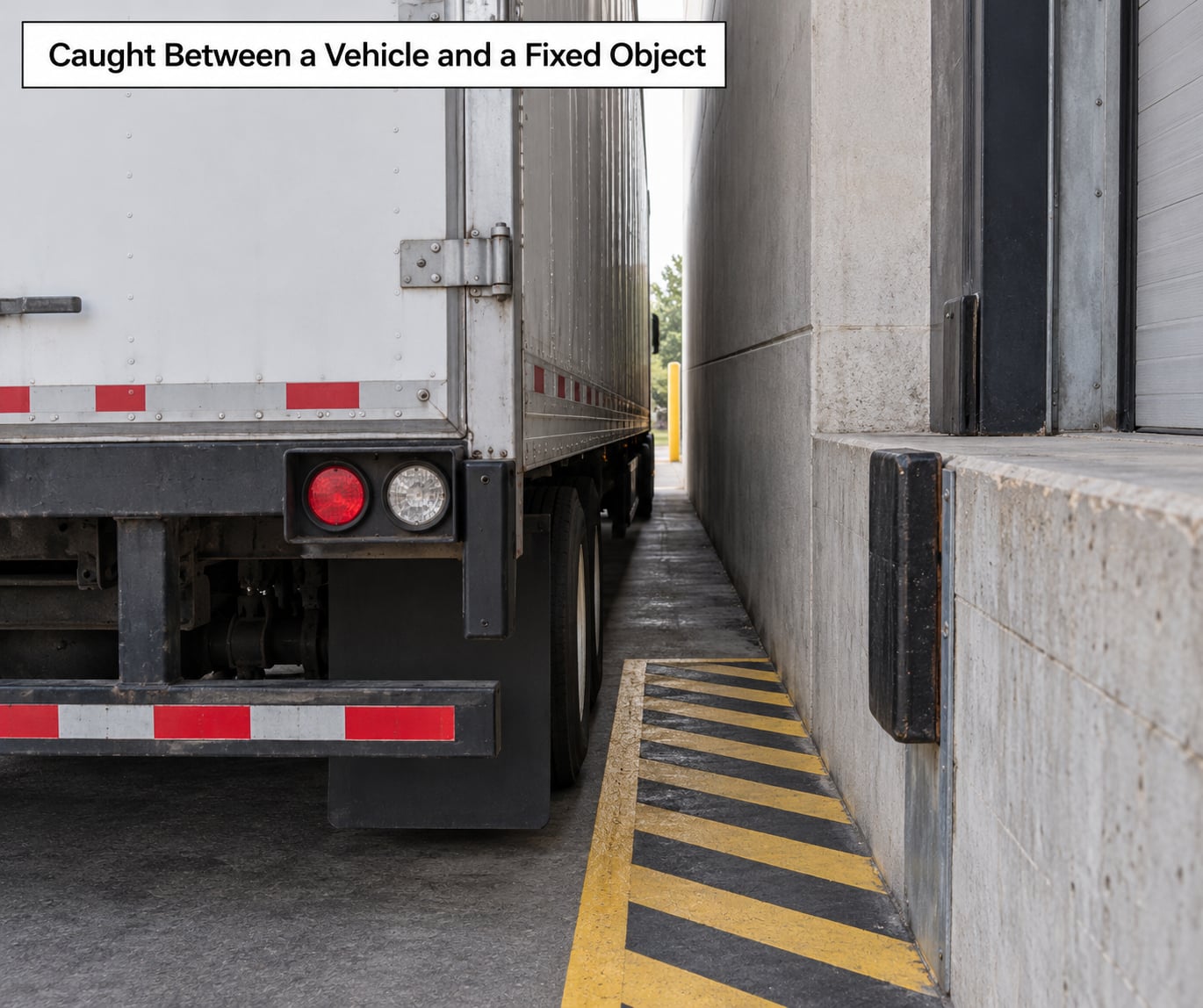
The classic example is a truck reversing toward a dock while a hand reaches into the gap to check the trailer position. There is no room to move, and the trailer’s rear swing takes the space a person needs to escape.
It also happens on the other side of the fence. A track loader backing on a narrow site pins a spotter between the machine and a jersey barrier, exactly the situation that turns a routine cut-through into a fatality.
Controls that work: barrier-guarded exclusion zones around docks, physical separation between pedestrian walkways and vehicle routes, and written spotter procedures with agreed hand signals. Reversing alarms help only if nobody is standing inside the swing radius. Dock guidance systems and interlocks that cut reverse and neutral out of movement into a dock should be serviced, not bypassed.
How Caught in Between Hazards Differ from Entanglement Risks
Caught between hazards usually mean compression between two objects or forced enclosure, while entanglement means catching around a moving part, a sleeve, a lanyard or a drawstring. One closes a gap; the other snags.
Where a scene lands on an OSHA citation can depend on what is actually pinning the worker. A sleeve pulled into a roller might be cited under the specific machine standard, the general machine guarding rule, or the lockout rule, depending on whether guarding was missing or an energy isolation was skipped. The written exposure assessment you do on site is what decides which control belongs in your program.
2. Caught Between Movable Machine Parts
Guards get removed “temporarily” for a size change, the line restarts, and a helper reaches across the infeed to clear a misfeed. The gap between the two moving surfaces closes on the hand or forearm.
On a packaging line, that gap is usually a nip point at the infeed and a shear point at the discharge, plus rotating shafts and chain drives underneath the guard that nobody can see.
Put the guard back on and keep it there. Where a guard cannot stay permanently, use a fixed barrier with a feed chute that keeps hands outside the hazard zone. For any adjustment or clearing, apply lockout, isolate the electrical, pneumatic and hydraulic sources, release stored energy, and verify zero energy at the point of work rather than trusting the stop button.
3. Caught Between Excavation Equipment and a Trench Wall
A trench face that looks solid at eight in the morning can slump by lunch, and the soil weight is enough to trap a person who cannot dig themselves out. Equipment parked inches from the edge adds a second crushing source.
On a utility job, a spotter standing at the top of the trench to guide the excavator bucket is often closer to the edge than anyone realises, with the machine right beside them.
Every excavation needs a protective system chosen by a competent person: sloping, benching, shoring or shielding, matched to the soil and the depth. Keep spoil piles and equipment back from the edge by the distance your assessment specifies, inspect the excavation after rain, a freeze-thaw cycle or any change in conditions, and control access with barricades and ladders set inside the protected zone.
4. Caught Under a Falling or Unstable Load
Nothing is moving quickly and nobody is operating a machine. A pallet that was stacked slightly proud gets nudged by a passerby, and a load of carton after carton comes down on the person picking at the bottom.
In a warehouse, this usually traces back to a rack that was loaded above its rating, damaged uprights left in service, or a stack built higher than the sprinkler clearance. Suspended loads on a hoist and panels stacked on a cart fail the same way.
Post the load rating for every rack and shelf, enforce the stacking limit, and train staff to report damaged uprights instead of using them until a repair order is closed. Rack inspections at a documented interval, restraint systems on pallets, and a marked exclusion zone under any suspended load will keep the floor clear.
5. Caught Between a Forklift and Pallet Racking
Aisle width decides how much room a pedestrian has when a forklift is coming through at speed. In a narrow pick aisle, there may be less than a foot of clearance once the pallet is raised.
The crush point is the gap between the mast or load and the rack upright, and the person who ends up in it is usually not the operator. It is a co-worker reaching for a label, a visitor walking the aisle, or a picker standing where the forklift needs to turn.
Set aisle widths so a loaded truck and a person cannot occupy the same space, keep pedestrian routes painted and physically separated, install mirrors or remote sensors where sight lines are poor, cap travel speed, and make lighting a controlled maintenance item. Operator training on right-of-way and on refusing to move a blocked pedestrian belongs in the same file as the truck’s daily inspection checklist.
6. Caught in a Conveyor’s Return Path
Sorting facilities run belts day and night, so jams get cleared on the fly. A product riding the tail pulley is visible from above; the two workers’ hands reaching under the belt are not.
The space between the carrying belt and the return rollers is a nip point, and running a hand along it to find the product pulls the arm in before anyone reacts.
Pull cords along the walk side that stop the belt in an emergency are a minimum. Jam clearing is a shutdown task: isolate the source, release stored energy so the belt cannot creep, and apply lockout with a personal lock and verification before anything goes under the frame. Fixed guards around the nip points matter more than the belt’s cover, because most of the injuries happen where a hand can reach the gap.
7. Caught Between a Machine and a Wall
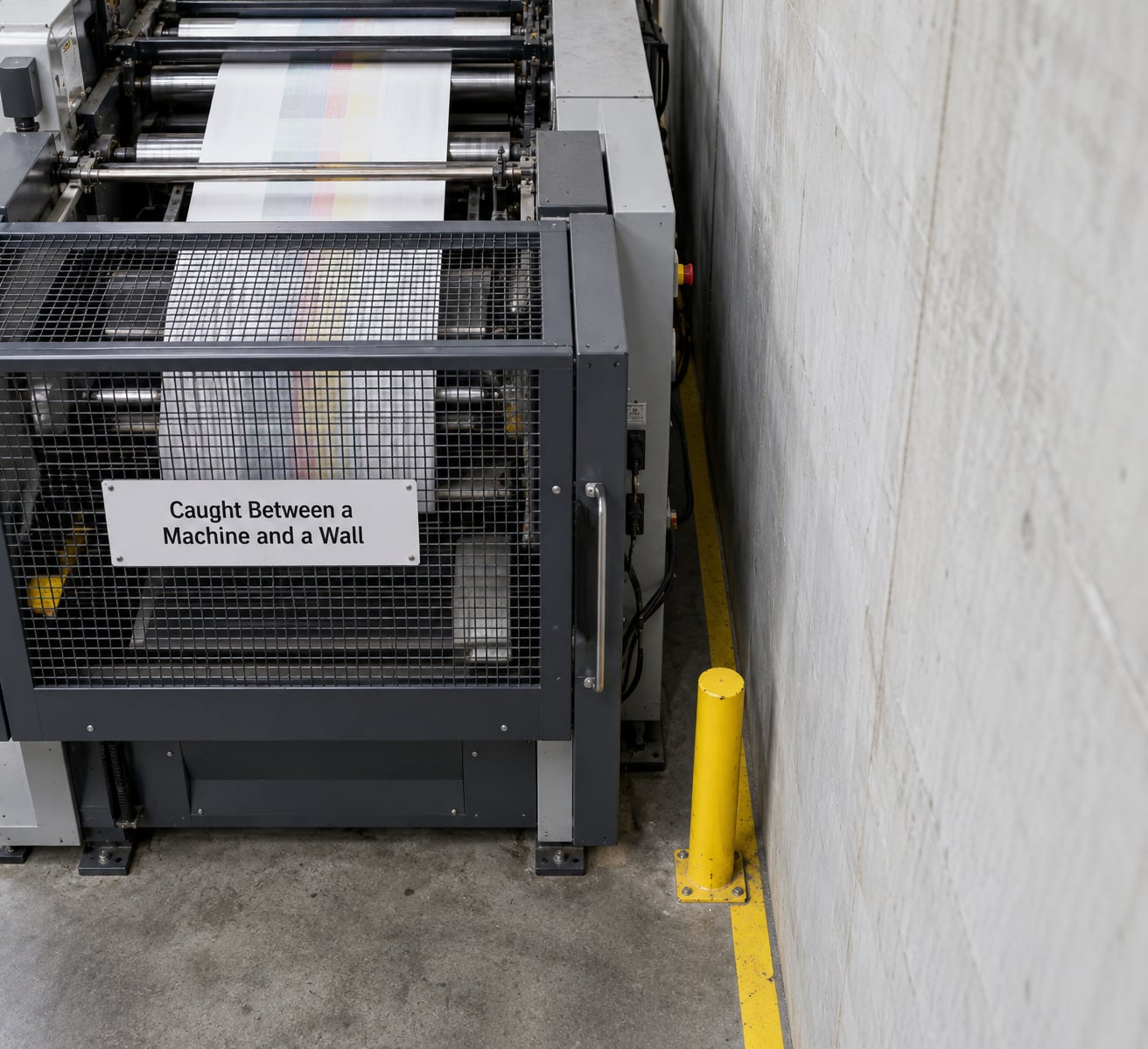
When a baler, compactor or press is installed against a wall, one side becomes a slot that nobody sees from the aisle. Operators step into it to check a fault, and the next stroke closes the gap.
In a printing facility, the press line was reconfigured twice, and each move pushed equipment closer to the structure behind it. Nobody measured the operating clearance after the second change, so the residual gap was small enough to trap a person and hidden from the walkway.
Measure the clearance your machine needs for access, cleaning and egress, then relocate the unit or install a barrier that makes the gap physically unusable. Relocate anything closer than the manufacturer’s service requirement. Until then, treat that side as a no-access zone, stop the machine before anyone enters it, and record the measurement in the layout drawing so the next remodel does not repeat the problem.
8. Caught Between Containers During Material Handling
Two bulk bags leaning toward each other after one settles unevenly will not stand back up on their own. A worker reaching into the gap takes the full load.
On a recycling yard, the same pattern appears with dumpsters, wheeled bins and mobile containers being moved while someone is inside the pickup zone. A vehicle returning to the hitch pins a hand against the frame.
Place containers on level ground, space them so nothing settles into contact, and lock the wheels before anyone works at the opening. Agree a single signal for the driver to stop, keep the approach path clear, and mark the exclusion area around any moving container. Nobody reaches between two units to reposition one; they separate them first.
9. Caught Between a Gate and a Fixed Structure
A powered sliding gate looks harmless when it is stopped, which is exactly when people step into its closing gap to pass a bicycle or a pallet jack. Gate posts and fence terminals do not move, so the pinch point is easy to miss on a walk-through.
The failure pattern is usually the same: a photo eye gets bridged with tape, a safety edge is wired out during a repair, and the gate runs on without a working presence or edge detection.
Use photo eyes or safety edges rated for the gate’s speed and mass, wire them into the control so the drive actually stops, and interlock the gate so it cannot run with a defeated device. Keep a protected walkway clear of the gate path, provide a separate emergency access point, and test the stop and the reverse function on a documented schedule rather than assuming they still work.
10. Caught Between Equipment and a Workbench or Cart
Workshop floors get crowded fast. A mobile platform gets parked where it was last needed instead of where it belongs, and the next person walking past with a tray of parts is the one who gets squeezed.
The crush point is the gap between a parked unit and a fixed bench, and it forms in seconds. Catching a hand between the bench and the handle of a rolling cart causes the same injury in a much smaller package.
Choose equipment sized for the work rather than the largest available, define docking and parking positions and mark them, and use wheel chocks or brake engagement on anything that sits near a walkway. Keep a clear route for pedestrians, and give operators a line of sight to the floor level before they move. Resetting the room at the end of a shift is what keeps these gaps from forming in the first place.
11. Caught in a Compressed-Air or Hydraulic Cylinder Failure Zone
Nothing has to move a machine into a person for a press to cause a caught-between injury. A failed hose at a hydraulic press can release a load, throw a fitting across the room and remove a cover in a single second.
Reports of hydraulic component failures on presses and lifts describe the same ingredients: high pressure, a moving part with stored energy behind it, and operators standing inside the line of fire.
Isolate the pressure source, block the cylinder against movement, bleed the system down and verify at the gauge before any cover comes off. Inspect hoses and fittings on a schedule, replace components past their service limit, and mount a shield where a fitting or rod end could travel. Mark the exclusion zone around the press so no one stands in the path of a moving part during a stroke or a test. Energy isolation is only half the job; our guide to preventing electrical hazards at work covers the electrical side of the same pre-task check.
12. Caught Between Falling Materials and a Confined Space
Grain in a bin flows once the material above it moves, and a worker buried to the chest cannot free themselves. The flow can pull a person under a surface that looks firm from the walkway.
Grain handling deaths usually involve the same chain: entry without the required controls, material moving while someone is inside, and a bridge of grain forming above them. Hoppers and vaults in foundries, asphalt plants and bulk-bag filling lines behave the same way, whatever the material is called.
Treat the bin as a confined space with a written permit, attendant and retrieval plan. Lock out the conveyors, augers and gravity feeds, and confirm the stored material cannot move before anyone enters. Never enter flowing or bridged material, and never work above it without engineering controls that physically stop the flow. Before entry, confirm the rescue plan is workable with the equipment on site, because a bucket and a rope are not a recovery plan when the grain is 1,200 pounds per cubic yard.
Frequently Asked Questions
What is considered a caught between hazard in OSHA 10 training?
OSHA considers it a caught-in or caught-between hazard when a worker is squeezed, crushed, pinched or compressed between two or more objects, or is buried or entangled by machinery and other materials. In OSHA 10 construction training it is one of the Fatal Four. Grading questions usually describe a worker pinned between a truck and a wall, a hand in unguarded rollers, or a person buried by a trench collapse, and all three count.
What are the major types of caught-in and caught-between hazards?
OSHA splits them into two mechanisms. Caught in means entanglement in or between moving parts such as rotating shafts, rollers, chains or presses. Caught between means compression between two converging objects, whether both are mobile or one is fixed, such as a forklift and a rack or a baler and a wall. Burial by soil, grain or stored material is usually treated as a separate sub-type of the between mechanism.
How do you prevent caught-in/between injuries on a work site?
Start by finding every crush, pinch and entanglement point in the equipment you use, then control them in this order: eliminate the reach, add fixed guarding or barriers, separate people from moving equipment physically, and apply lockout with verified zero energy before any task inside a hazard zone. Then control the organisational side with traffic routes, spotter procedures, exclusion zones and training. PPE is the last layer, not the plan.
Can you give me some examples of struck-by hazards?
Struck-by means an object hits a person, and the person does not get pinched. Examples include a swinging pipe wrench, a falling bundle of rebar, a nail ejected from a pneumatic tool, a reversing truck, a dropped load on a crane hook, and material kicked out of a cutting or chipping operation. The difference is the direction of force: a struck-by injury arrives from an outside object, while a caught-in/between injury comes from compression or entanglement.
What are five examples of workplace hazards?
Beyond caught-in/between, the common ones are falls from height and ladders, struck-by from vehicles and swinging or falling objects, electrocution from energised equipment and damaged cords, chemical exposure from cleaning agents, solvents and dusts, and noise exposure in production, warehousing and food processing. Repetitive strain from repetitive lifting or awkward postures is another common category, particularly in warehousing and assembly work.
What should you do if a co-worker is caught in or between something?
Stop the machine, vehicle or gravity feed first, and call emergency services. Do not pull on the person unless the energy source is isolated and a competent person directs it, because stored hydraulic and pneumatic pressure can move a load again. Keep everyone else out of the crush zone, and have a trained rescue plan with the right equipment ready rather than sending untrained co-workers in. Account for every person on site before restarting anything.
Conclusion
Start by finding the compression and entrapment points on your site and writing them down: every gap between a moving and a fixed object, every nip point within reach, every place where stored material can shift. Then keep people out of those zones with barriers, guardrails and marked routes rather than instructions alone.
Verify energy isolation before anyone works inside one, and have a qualified safety professional evaluate the site-specific risk before you rely on this list alone.