
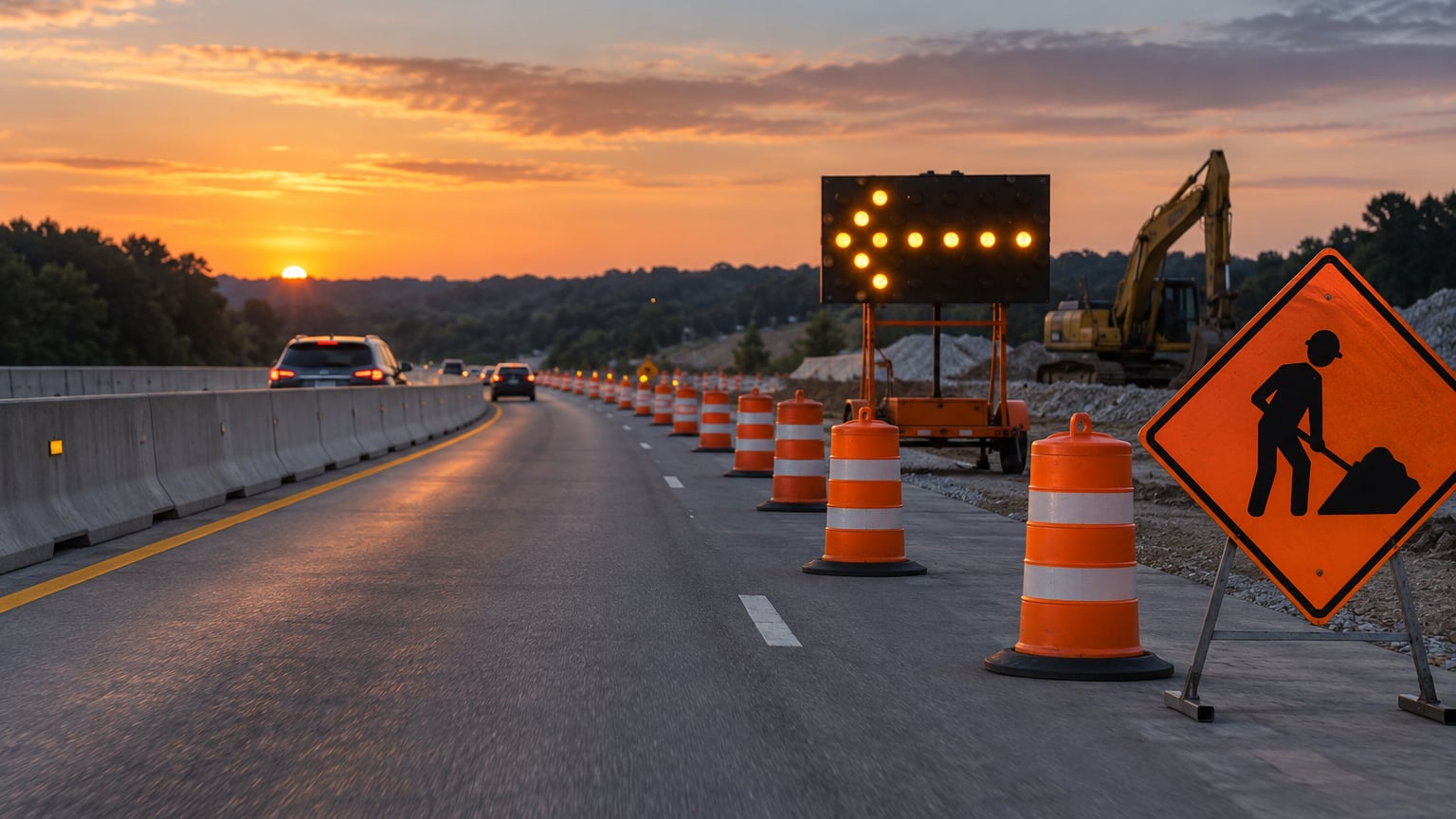
Work zone safety for road crews is the whole system that keeps a worker out of the path of moving traffic: a traffic control plan that separates people from vehicles, personal protective equipment that makes a worker visible in any light, equipment placed to create buffer space, and a crew that knows how to stop work when conditions change. Most incidents I look at come down to one of those four things being skipped for ten minutes on a Tuesday morning.
What follows is a field guide rather than a regulation summary. It is built around the questions a supervisor actually asks before a crew rolls: what is out there, what could hit us, what separates us from it, and who verifies that the separation still exists at two in the afternoon.
Table of Contents
- Work Zone Safety for Road Crews: Quick Guide
- What Are the Main Hazards in Road Work Zones?
- How Should a Crew Assess the Work Area?
- How Do Traffic-Control Plans Protect Road Crews?
- What Personal Protective Equipment Do Road Crews Need?
- How Do Crews Communicate Safely in Moving Traffic?
- How Should Vehicles and Equipment Be Positioned?
- What Should Crews Do When Conditions Change?
- How Can Road Crews Prepare for Emergencies?
- What Training and Daily Checks Reduce Road-Crew Risk?
- How Do Supervisors Verify That Controls Are Working?
- Frequently Asked Questions
- How should road crews prepare a work zone for changing traffic conditions?
- What training should a new flagger receive before working alone?
- Is high-visibility clothing enough to protect road crew members?
- When should a supervisor stop road work for unsafe conditions?
- How do crews improve visibility during nighttime or foggy work?
- What should be included in a road-work-zone emergency plan?
- Conclusion
Work Zone Safety for Road Crews: Quick Guide
Six controls cover most road work zone risk, and each one has a way to verify it is actually working in the field rather than on paper.
| Hazard category | Primary control | How you verify it |
|---|---|---|
| Vehicle entering the work space | Traffic control plan with channelizing devices and buffer space | Walk the taper and count devices against the plan; check spacing and alignment |
| Worker struck while crossing a live lane | Positive protection, spotter, planned escape route | Brief each crossing; confirm no one crosses alone or behind a device line |
| Worker invisible to drivers | High-visibility apparel inspected at shift start | Check retro-reflective banding in low light or with a flashlight |
| Backing equipment into a crew member | Camera or alarm plus a designated spotter with a defined position | Confirm the spotter is visible to the operator before movement begins |
| Equipment failure or vehicle intrusion | Crash truck or attenuator positioned on the exposed side | Verify position, clearance and that the driver knows the escape path |
| Heat, noise and fatigue | Scheduled breaks, water, shade and rotation | Check that breaks are actually taken and that nobody is working alone in distress |
The daily rhythm matters more than any single piece of gear. Assess before you set up, verify after the traffic control devices go in, re-check at midday, and reassess whenever traffic volume, weather or the work itself changes.
What Are the Main Hazards in Road Work Zones?
Road work zones are dangerous because two incompatible things occupy the same space: heavy equipment operating at walking pace, and drivers moving at highway speed. The hazards fall into two groups, and crews need to control both.
Hazards the work itself creates
Struck-by and backing incidents sit at the top of that list. A paver, striper or excavator swinging wide can put a worker in a blind spot within seconds, and reverse alarms fail or go unheard on a loud site.
Unstable surfaces come next. Fresh asphalt, gravel, open utility trenches, broken concrete and sloped embankments all turn a normal step into a trip or a roll. Equipment left in the buffer space or parked in a live lane creates a collision target that moving traffic will find.
Hazards the site brings with it
Speed differentials are the quiet killer. Where a posted limit drops from 55 to 35 inside a work zone, drivers arrive at the slow zone before they have adjusted, and that mismatch shows up in rear-end crashes that then become worker strikes.
Weather, noise and vibration follow. Rain makes taper reflectivity useless and asphalt slick. Fog and darkness cut detection distance. Continuous equipment noise blocks alarms and radio calls, and whole-body vibration behind a paver or compactor raises fatigue on a long shift.
Visibility problems hide the rest. Sun glare at low angles, dust, and unlit equipment silhouettes at dawn and dusk all reduce the time a driver has to react. Underground and overhead hazards sit under this too: unmarked dig locations, unmarked services, and contact with power lines during lifting or boom work.
How Should a Crew Assess the Work Area?
A repeatable assessment beats a thorough one that happens only at the start of a project. Run the same pass before setup, again after traffic control devices are placed, and once more mid-shift.
Start with the roadway itself. Look at the posted speed, the actual measured speed when drivers pass, the lane count, and where vehicles are already slowing or swerving. That last one tells you where the taper is too short.
Then work outward: shoulder width and condition, drop-offs, slope stability, the access route the crew will use on foot, where equipment will stage, and whether a resident, business, school crossing or transit stop sits within the influence area. Pedestrians ignore cones the way drivers do.
Finish with conditions. Weather and forecast, lighting for the hours on site, radio coverage in the work area, and whether anyone on the crew has not slept or is taking medication that affects alertness.
What crews should document
Date, time, location, who assessed, traffic volume and speed, device count and spacing, unusual hazards found, and the controls chosen. Keep it short enough that someone actually fills it in at 5 a.m.
When work should pause
Pause when the taper or buffer has been struck, when visibility drops below the level assumed in the plan, when a device run is no longer continuous, when an unapproved pedestrian route opens up, or when a crew member reports feeling unwell. Reassess, then restart with a documented decision rather than a shrug.
How Do Traffic-Control Plans Protect Road Crews?
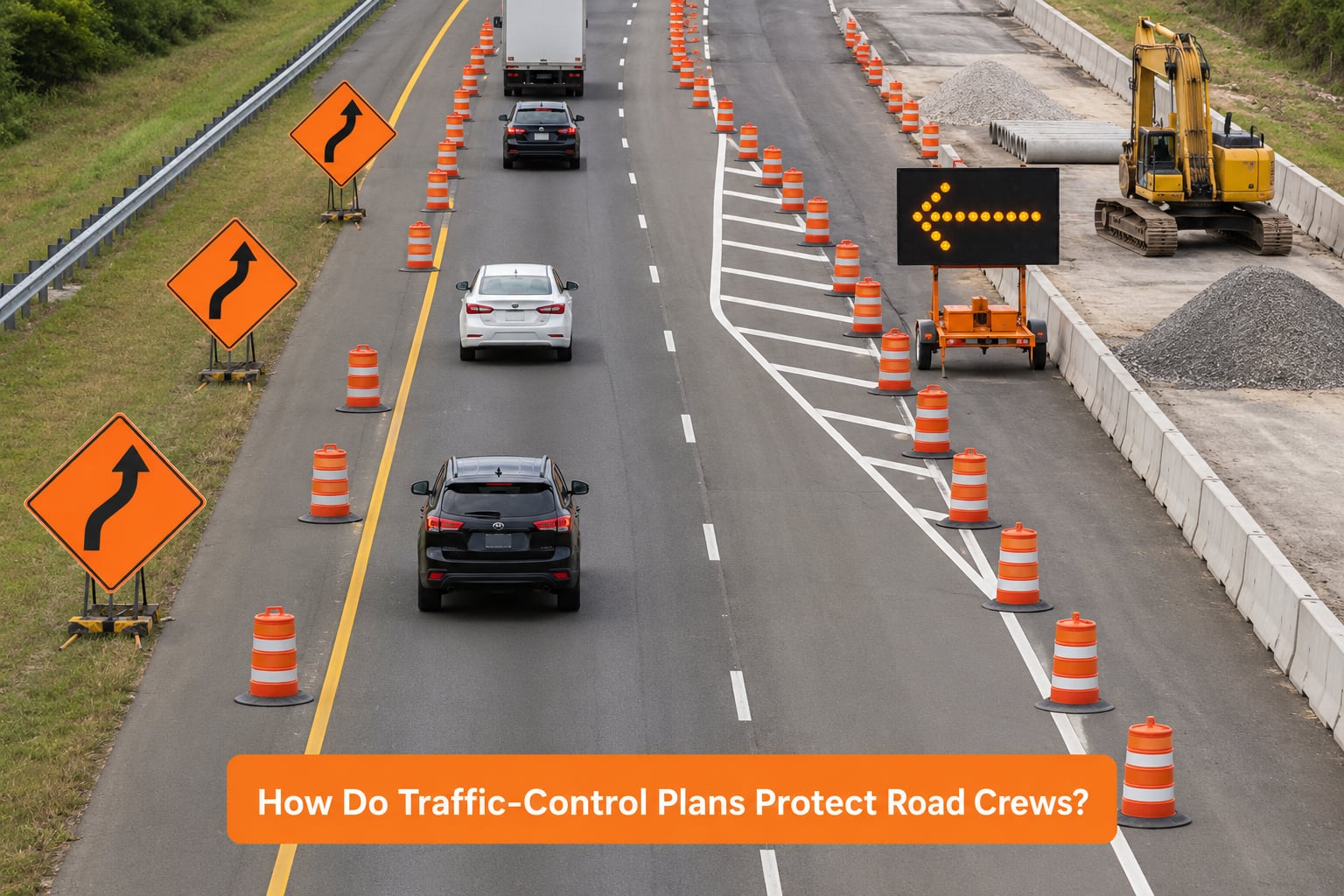
A traffic control plan protects the crew by building distance and time between the driver and the worker, one zone at a time.
Every temporary traffic control zone has four parts working in sequence. The advance warning area uses signs and arrow boards to give drivers distance to slow and shift lanes. The transition area is the taper, where channelizing devices guide the merge. The activity area holds the buffer space plus the work space where crew and equipment sit. The termination area gives drivers a clear path back into the open lane.
Buffer space is the part crews care about most, because it is where a driver who misjudges the taper ends up. The plan sets its length from the posted speed and the device type, and it is empty on purpose. Nothing parks there, nothing stages there, and no one takes a shortcut across it.
Mobile and rolling operations need a different plan shape. Rather than a fixed zone, the cone truck or pickup moves with the work, so advance warning comes from the vehicle placement itself and the buffer is the distance the crew keeps from the traffic side of the truck. Striping, shoulder work and maintenance patrol work all fall here.
Night work tightens the requirements. Lighting has to illuminate the work space without glaring back into approaching drivers, device spacing often increases, and advance warning signs need to be either lit or placed where headlights catch them.
The plan is a starting document, not a field truth. When traffic patterns, speeds or the work itself change, the supervisor revises the setup on the ground rather than arguing with the paperwork version.
What Personal Protective Equipment Do Road Crews Need?
PPE is the last layer, not the first. It protects a worker when the traffic control plan, the buffer and the positive protection have all failed, which is exactly the situation it was bought for.
High-visibility apparel is the core item. A hard hat protects from overhead and dropped-object hazards, safety footwear with toe protection and slip resistance handles dropped tools and unstable ground, and eye protection guards against dust, chips and fuel.
Gloves matter more than crews expect: cut-resistant gloves for handling wire, rebar, saw blades and sharp sign panels, plus chemical-resistant gloves for fuel and caulk. Hearing protection is essential on paving, milling and demolition sites, where exposure can damage hearing over a single season.
Add task-specific protection on assessment, not by habit. Respiratory protection is needed for silica dust during cutting or grinding, for asphalt fumes during paving, and for lead paint on older structures. Fall protection applies to bridge work above the deck level, and reflective clothing is not a substitute for it.
Choosing Class 2 or Class 3 high-visibility apparel
Class 2 apparel is designed for jobs where the worker is visible against a background of other vehicles, equipment and clutter. Class 3 is for jobs where the worker is the only visible object against dark or low-contrast backgrounds, which describes night lane shifts, rural shoulder work and work in heavy fog.
A useful field test: if the crew would not see themselves standing still in the work space under the planned lighting, the class is too low. Higher classes also carry more retro-reflective area, which matters more at dawn and dusk than at midday.
Fit and condition decide whether any of it works. Check that bands are not peeled, cracked or faded, that garments are the right size for layering, and that nothing sits on top of the retro-reflective surface. Soot, dust and repeated washing degrade banding faster than most crews assume, so replace on a schedule rather than on appearance.
Finally, PPE never substitutes for engineering controls. A vest does not create buffer space, and it will not stop a truck that never saw you.
How Do Crews Communicate Safely in Moving Traffic?
Most communication failures I have reviewed were not equipment failures. They were assumptions: one person moving something, another person certain they had been told.
A pre-task briefing solves most of them. Before traffic control devices go out, the supervisor states who is flagger, who is spotter, where the escape route is, what hand signals will be used, and what triggers a stop. Five minutes on the shoulder prevents an hour of confusion in a live lane.
Use one agreed signal system and stick to it. The STOP and SLOW paddle gives a flagger authority that a waving arm does not, and drivers respond to it. Radios fail constantly, so a flag pole with a red flag remains a required backup for daytime flagging in many specifications.
Spotters have rules. One designated spotter per moving vehicle, positioned where the operator can see them continuously and never behind the equipment itself, never between the machine and the hazard. If visual contact is lost, the movement stops.
Establish communication with everyone who is not in the work zone: the dispatcher, the supervisor at the next job, law enforcement during peak hours, and emergency services. Write down the numbers that apply to the site rather than relying on a phone contact list that lives on one person.
Common work zone safety failures worth correcting
- Radio traffic on a shared channel with no call signs, so instructions go to the wrong person.
- A spotter who doubles as a laborer and gets pulled into another task mid-manoeuvre.
- Flaggers on opposite ends of a long taper using paddles but no agreed timing, leaving a gap.
- Equipment movement started on assumption that everyone had seen the hand signal.
How Should Vehicles and Equipment Be Positioned?
Position is the control that does the most work. Where the truck sits decides how much room the crew has and how likely an intrusion is to become a fatality.
| Position risk | Safer practice |
|---|---|
| Support vehicle parked inside the buffer space | Stage outside the buffer or behind positive protection, never between traffic and the crew |
| Truck parked facing away from traffic on approach | Angle so the crew looks toward approaching drivers and the attenuator faces the incoming lane |
| Tailgate down in a live lane with no positive protection | Load and unload inside the work space or behind a barrier |
| Reversing into a work area with crew nearby | Use a spotter or camera, spotter gives the all-clear before movement |
| Equipment left overnight near the carriageway | Relocate to a protected staging area or shield it with barrier and devices |
| Cone truck stopping suddenly in a live lane | Decelerate early, signal well in advance, and place the truck where it will not hide crew behind it |
Support vehicles work best when they act as a barrier. Where a truck must sit on the traffic side of the crew, it should carry an attenuator, sit at the position planned in the traffic control plan, and leave the driver with a clear path out. Crews report those drivers feeling most exposed at the head of a taper, where intrusion risk and visibility are both worst.
Loading practices belong on the list too. An open tailgate in a live lane, a pallet resting on a shoulder with no cones, or a toolbox that has slid to the edge are all collision targets in a way that stacked material is not.
What Should Crews Do When Conditions Change?
Change is normal on a road job, so the response has to be a procedure rather than an improvisation. The sequence is stop, reassess, notify, re-enter.
Stop means ending the specific activity that has become unsafe, not necessarily the whole job. A paving pass can pause while setup continues elsewhere, which keeps production from becoming the reason nobody calls it.
Reassess what changed and what it affects. Fog changes lighting and stopping distance. Rain changes surface conditions, reflectivity and how quickly devices get knocked over. Darkness changes device spacing and visibility. High wind moves signs and changes how equipment must be secured. Heat changes how long the crew can safely work before rest breaks.
Notify the supervisor and the dispatcher, and warn any other contractor working in the same zone. Road work zones often have two crews, a maintenance team and a utility crew sharing one plan, and one team changing conditions affects all of them.
Re-enter only after the revised control is in place, everyone has been briefed, and someone has verified it. A restart without that step is how a mid-shift adjustment quietly removes the buffer that was doing the work.
How Can Road Crews Prepare for Emergencies?
An emergency plan for a work zone has to work before anyone needs it, which means it is written for the specific site rather than copied from a binder.
Keep emergency contacts and the site address at the exact location, not just the nearest intersection. That sounds basic and it is still the detail that costs minutes when it is missing.
Know who is trained in first aid and where the kit and an AED are located. On a remote or long-duration project, this can mean one designated person per shift and a documented arrangement with a local clinic.
Plan rescue access. Ambulances and fire apparatus need a path through the traffic control zone, so the plan should identify which lane stays clear and who removes devices on command. Put a fire extinguisher within reach of fuel transfer points and hot work, and know where the nearest fire department hydrant is.
After a crash or a serious incident, the work zone itself becomes dangerous. Traffic that was already slowing now has nowhere to go, so the plan should say who sets up crash protection, who calls it in and who notifies the crew.
Define evacuation points for the normal case and for the case where the zone is the emergency. Long-duration projects with on-site facilities need a rally point away from the roadway. Every plan also needs a clear reporting path, because supervisors are required to record injuries, near misses and vehicle incursions and notify the authority where required.
What Training and Daily Checks Reduce Road-Crew Risk?
Training is layered, and each layer has a point where you can see whether it stuck.
New workers get site orientation before they take a position: the traffic control plan, the escape route, the site address for emergency calls, and who to ask. Task-specific training follows, including flagging procedures where the role applies.
Short toolbox talks before shifts cover what is different today: a new taper length, a weather hold, a changed access route, or a piece of equipment that behaved differently yesterday. Five focused minutes beat an hour of generic content.
Observable evidence that a check happened
- A dated inspection record with the device count and taper length, not just a signature.
- A traffic control diagram on the tailgate showing the setup used that day.
- Photographs of the installed taper taken from the driver approach at the posted speed.
- Named spotter assignments in the daily briefing record.
- PPE inspection notes showing replacement requests, which proves someone looked rather than ticked a box.
- Equipment pre-start checks with defects logged and either fixed or the unit removed from service.
Note the evidence pattern: each of those produces something a third party could check later. That is what distinguishes a real check from a signature.
How Do Supervisors Verify That Controls Are Working?
Paperwork proves an activity was recorded. It does not prove the work zone is safe, so verification has to happen in the field.
Drive the approach at the posted speed before the crew starts. That view is the one drivers get, and it exposes problems that a standing inspection cannot, such as signs lost against a visual background or glare from a lighting tower aimed at the roadway.
Walk the full zone with someone from the crew who was not involved in setup. Crews notice a device that shadows another at a certain sun angle, or a spotter position that puts them out of the operator view, in ways a supervisor stepping through for the first time will miss.
Use near-miss reports as the main signal rather than the exception. A near miss, a driver intrusion or a struck device means the control failed even though nobody was hurt, and the response is to find which part of the plan did not hold. Treat near misses as useful information and they get reported; treat them as blame and they stop.
Re-verify after every change: a moved taper, a new device type, a shift handover, an equipment swap, a weather event. A control that was verified at 7 a.m. is an assumption by noon.
Broader programs measure the same way. Where a site tracks near misses, inspections and repeat defect rates over time, it can see whether the system is working or just whether the paperwork is.
Frequently Asked Questions
How should road crews prepare a work zone for changing traffic conditions?
Treat the traffic control plan as a starting document and revise it in the field whenever traffic volume, speeds, or the work itself change. Walk the taper again after any adjustment, brief the crew on what moved and why, and have someone other than the installer verify spacing and buffer length. A change in device position, weather or crew task should trigger a documented re-check before work resumes.
What training should a new flagger receive before working alone?
A new flagger should not work alone until trained and observed in the specific duties they will perform. That usually means the signals and paddle standard in use on the job, positioning relative to the taper, when to step into the roadway and when to step back, communication with the crew and supervisor, and emergency procedures. Competency is confirmed by direct observation on a live site, not by finishing a course.
Is high-visibility clothing enough to protect road crew members?
No. High-visibility apparel raises the odds a driver sees you in time, but it does not create distance, stop a vehicle or replace a traffic control plan. It sits at the end of a protection system that runs positive protection, buffer space, planning and communication. Treat it as the last layer, inspect it every shift, and replace faded or damaged banding rather than waiting for it to fail visibly.
When should a supervisor stop road work for unsafe conditions?
Stop when a control that the plan depends on is missing or broken: the taper has been struck, devices are no longer continuous, a support vehicle has moved into the buffer, visibility has dropped below what the plan assumed, or a crew member reports symptoms of heat illness. Stop the affected activity, reassess what changed, notify the dispatcher and other crews in the zone, and re-enter only after the revised control is in place and verified.
How do crews improve visibility during nighttime or foggy work?
Improve visibility by matching lighting, device placement and clothing to the conditions. Illuminate the work space without aiming glare back at drivers, increase device spacing at night, make sure advance warning signs are lit or positioned where headlights catch them, and require the higher high-visibility apparel class for the shift. Verify the setup by driving the approach at the posted speed before the crew starts work.
What should be included in a road-work-zone emergency plan?
Include the site address at the exact work location, emergency contacts for the shift, who is trained in first aid and where the kit and defibrillator are, a clear access route for emergency vehicles with someone assigned to remove devices, evacuation points, and fire protection at fuel and hot work areas. Add the procedure for controlling traffic after a crash or equipment failure, plus the injury and near-miss reporting path.
Conclusion
Five actions decide most work zone outcomes, and all five happen before the first cone goes out. Assess the site and the surrounding conditions. Separate people from traffic with a traffic control plan that matches the work. Verify the setup from the driver’s approach rather than from the shoulder. Check the crew and the equipment, including PPE condition and machine defects. Confirm who is flagging, who is spotting and who can stop the job.
After that, keep doing the small things. Walk the zone at midday, take the breaks when the heat rises, and treat every near miss as information about the system rather than as bad luck. That is what makes work zone safety for road crews a habit instead of a briefing that gets skipped.