

Building a fleet safety program means turning safety expectations into written, enforced procedures: define who may drive and under what standards, inspect vehicles before and after every trip, train and retrain on a schedule, investigate every incident to root cause, and keep records you can produce on demand. Whether you run four vans or four hundred trucks, the build follows the same seven steps, and you can complete a working first draft in a week.
That last part is where most small fleets get stuck. They assume a fleet safety program belongs to large carriers with a USDOT number and a compliance department. It does not. OSHA’s General Duty Clause applies the moment you put a company vehicle in an employee’s hands, no matter how few vehicles you own.
Plenty of small operations have cleared an OSHA inspection on documentation alone, and plenty of large carriers have lost a crash case because their pre-trip forms never made it out of the glovebox. Process is what separates the two. Below is the build, step by step, with the evidence each step produces.
Table of Contents
- What You Need Before You Write the Program
- Step-by-Step: How to Build a Fleet Safety Program
- Step 1: Define the Scope and the Business Case
- Step 2: Conduct a Fleet Risk Assessment
- Step 3: Set Goals, Roles, and Accountability
- Step 4: Establish Driver Qualification and Training
- Step 5: Build Vehicle and Equipment Controls
- Step 6: Create Policies, Procedures, and Reporting Systems
- Step 7: Measure, Review, and Improve
- Common Mistakes That Undermine a Fleet Safety Program
- Frequently Asked Questions
- How do I start a fleet safety program for a small company?
- What should a fleet safety program include?
- How often should fleet vehicles and drivers be reviewed?
- What fleet safety metrics should employers track?
- How should a company handle a driver who violates fleet safety rules?
- Can telematics technology replace driver training and safety procedures?
- Conclusion
What You Need Before You Write the Program
You need six things before drafting a single page: a clear scope, a named owner, accurate vehicle data, whatever records already exist, training resources, and a clear read on which regulations apply to you. Gathering those first keeps the program short enough that people actually read it.
Scope: which vehicles and which drivers
Write down every vehicle the company owns, leases, or assigns, including the cars field technicians take home and the pickup a supervisor uses on weekends. List every person who may drive one, whether or not driving is in their job title. Personal use of a company vehicle is a policy decision you make in writing, not an assumption you leave open.
The owner and the budget
One named person has to be accountable for the program. On a small fleet that is often the owner. Decide who performs MVR checks, who reviews inspection forms, who signs off training records, and who runs the post-crash investigation. Then decide what you will actually spend: typically 4 to 8 hours of writing time for the first draft and a few hours per month keeping it current.
The records you already have
Gather three years of incident reports, insurance loss runs, maintenance invoices, and driver files. This is the raw material for your risk assessment, and it is also the honest test of where your real problems sit. Fleets often find that one route, one shift, or one vehicle type drives a disproportionate share of incidents.
Vehicle data
Collect gross vehicle weight rating, age, mileage, and maintenance schedule for each unit. The GVWR number matters legally because it decides which rules apply. Note which vehicles carry placarded hazardous materials and which cross state lines.
Training resources
Budget time, not just money. A new-hire orientation, an annual refresher, and short coaching sessions after flagged events are the minimum viable training program. Decide where sessions happen: paid time at the yard beats a self-paced module nobody opens.
A clear read on which rules apply
This is where most small fleets guess wrong, and guessing wrong is expensive. Federal motor carrier rules under 49 CFR Parts 390 through 396 attach when your operation falls inside the commercial motor vehicle definition in 49 CFR 390.5 and is engaged in interstate commerce. Whether your fleet is covered depends on weight and commerce, not on how professional your drivers are.
| Your fleet | What generally applies | Where it comes from |
|---|---|---|
| Company cars and light vans under 10,001 lb GVWR, intrastate only, no placarded hazmat | OSHA General Duty Clause, state plan rules, workers’ comp, insurance terms. OSHA recordkeeping under 29 CFR 1904 applies if you are covered. | OSH Act Section 5(a)(1); 29 CFR 1904 |
| Vehicles at or above 10,001 lb GVWR operating in interstate commerce | FMCSA safety and maintenance rules, driver qualification files, hours of service, inspections, CDL requirements where applicable | 49 CFR Parts 390-396 |
| Placarded hazardous materials in bulk | Additional hazmat-specific rules layered on top of the carrier rules above | 49 CFR Part 177 and related |
| Powered industrial trucks and yard equipment | Separate powered industrial truck standard, operator training and certification | 29 CFR 1910.178 |
This table is a starting point for scoping your research, not legal advice. Rules vary by state and by operation, and intrastate-only carriers can still be pulled into federal rules in some circumstances. When your fleet sits near a threshold, talk to an insurance agent and a safety consultant rather than guessing.
Step-by-Step: How to Build a Fleet Safety Program
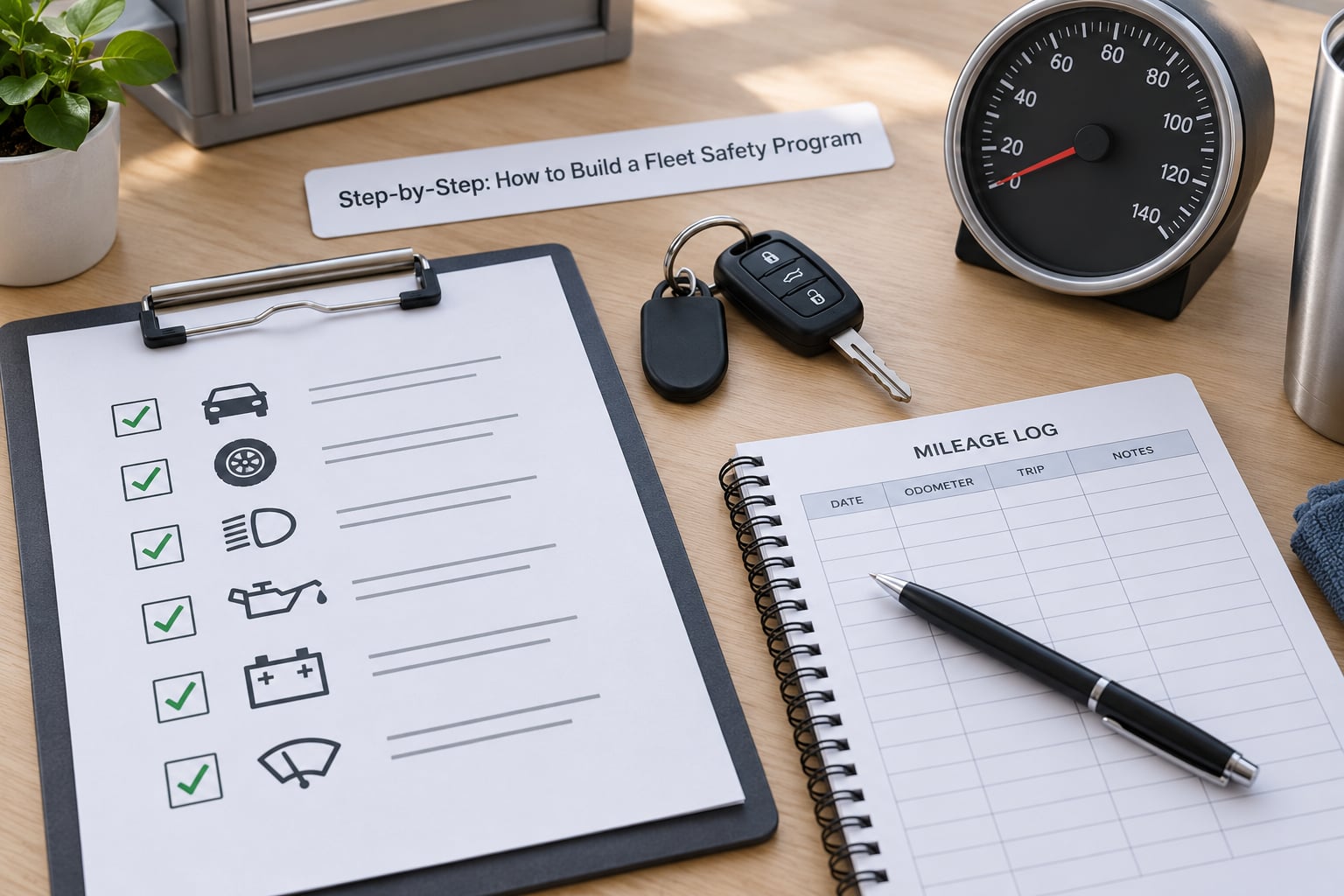
A fleet safety program builds in seven steps, and each one ends with evidence you can hand to an inspector, an insurer or a claims attorney. Skip the evidence and you have a binder nobody can use. Work through them in order; later steps depend on what the earlier ones produce.
Step 1: Define the Scope and the Business Case
Start by writing a one-page scope and commitment statement. It names the covered vehicles and drivers, the locations covered, the person accountable, and the review cadence. It also states what the program does not cover, and that clarity prevents arguments later.
The business case should use your own numbers. Total vehicle miles, crash count over three years, insurance premium, and lost-time claims give you a baseline. Frame safety as uptime and cost avoidance rather than a cost center, because that is the language that gets budget. Fleet managers who lead with collision rates get ignored; the ones who lead with days the truck stayed in service usually get the tracking hardware approved.
Owner: fleet manager or owner. Evidence: signed commitment statement with a date. Working means: a driver can name who runs fleet safety without asking.
Step 2: Conduct a Fleet Risk Assessment
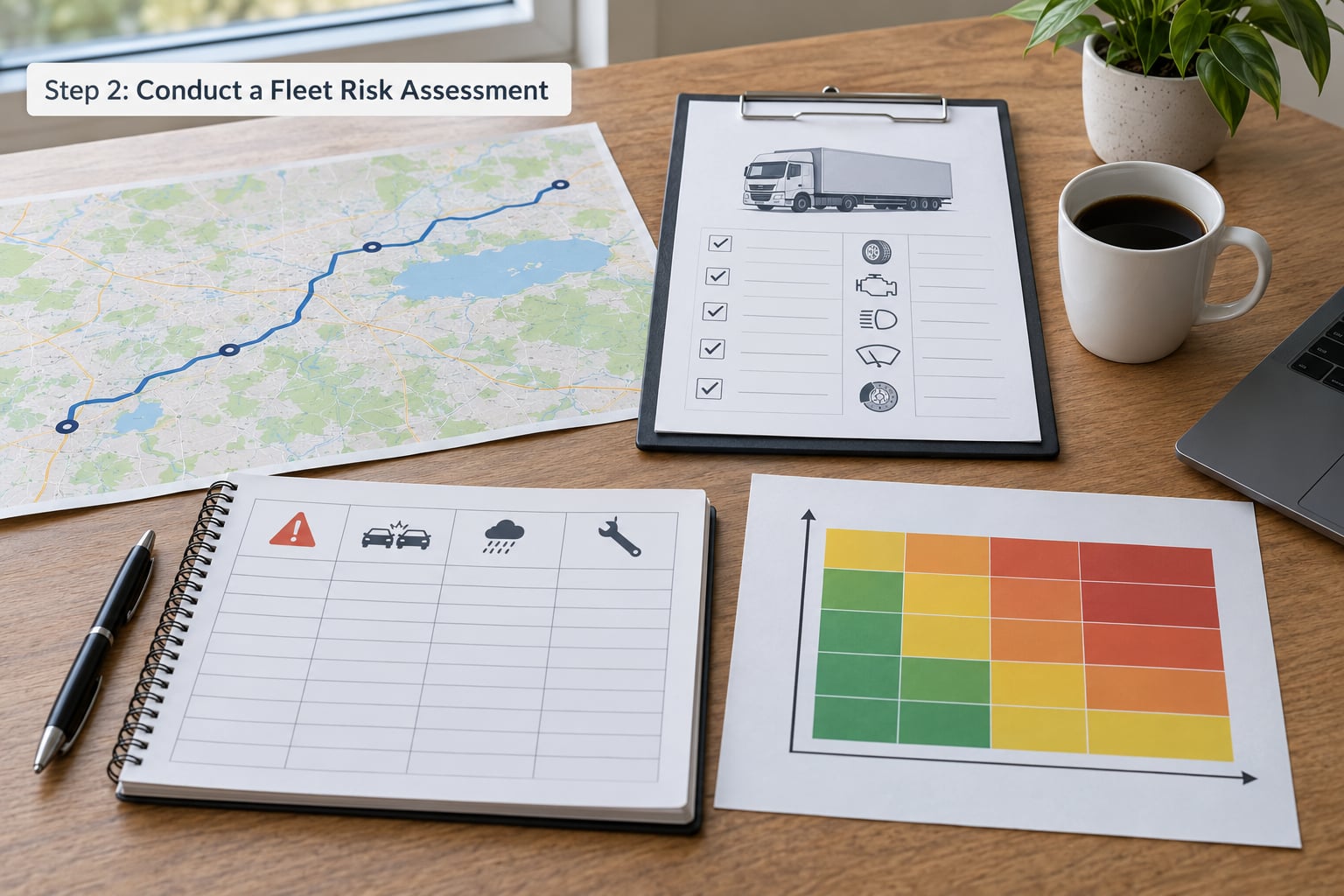
Rank your hazards by severity and frequency using three years of crash data, near misses, and route information. Look at where vehicles operate: urban density, school zones, highway speeds, unlit roads, construction zones, steep grades, and weather exposure. Then look at people: hours of service, sleep, new hires, and any driver whose behavior data looks different from the rest.
Score each hazard high, medium, or low and attach a control to each one. A risk assessment with no assigned control is just a list of worries. The most common finding in small fleets is that two or three specific risks drive most of the loss, and fixing those alone moves the numbers.
Owner: safety lead with driver input. Evidence: dated risk register with assigned controls. Working means: every high hazard has a named control and an owner.
Step 3: Set Goals, Roles, and Accountability
Write goals that can be measured and reviewed monthly. Collision rate per million miles is the baseline measure. Pair it with leading indicators, because lagging measures tell you what already happened: harsh braking events, speeding violations, following-distance alerts, and near-miss closure rate.
Assign roles in writing. Leadership commits budget and reviews the dashboard. The fleet manager runs inspections and coaching. Supervisors handle daily dispatch decisions. Drivers report defects and hazards. Maintenance signs off on repairs. When a supervisor hesitates to discipline a driver who broke a rule, the cause is usually missing documentation; if you want to document the conversation, see how to track safety metrics in a small company for the reporting habits that make it stick.
Evidence: goals signed by leadership, a responsibility matrix, and a meeting cadence on the calendar. Working means: the review meeting happens whether or not there is bad news.
Step 4: Establish Driver Qualification and Training
Set the hiring standard first: license verification, a motor vehicle record check, a minimum driving history, and a medical certification where required. For covered carriers, the annual MVR check cadence comes from 49 CFR 391.25 and the driver qualification file contents come from 49 CFR 391.51.
Write your disqualification criteria before the first check, not after the first problem. Criteria that appear only when a driver is already in trouble read as pretext, and applying them unevenly is exactly how a fair policy turns into a discrimination claim.
Then build training: new-hire orientation covering your policies and vehicle specifics, defensive driving, hazard perception, hours of service and fatigue, cargo and passenger rules, and incident reporting. Then an annual refresher and event-driven retraining after any serious near miss or crash. Fatigue is the cause most consistently missed by fleets that treat training as a single orientation day; fatigue risk management program basics covers that layer in more detail.
One caution on training hours: no specific number satisfies every fleet, and anyone promising a fixed figure is overselling. What matters is that training is documented, repeated, and matched to the risks in your register.
Evidence: driver qualification file per driver, signed policy acknowledgements, dated training records, MVR printouts. Working means: you can produce any one driver’s complete file within an hour.
Step 5: Build Vehicle and Equipment Controls
Write pre-trip and post-trip inspection procedures. Under 49 CFR 396.11, a driver vehicle inspection report covers the vehicle at the start and end of each trip, and the report has to be retained per 49 CFR 396.21. Periodic inspections under 49 CFR 396.17 and preventive maintenance should follow manufacturer schedules, with the more demanding of the two governing.
The inspection list should be short enough to be completed every single day. Lights and signals, tires and tread, brakes, mirrors, wipers, fluids, secure cargo, horn, seat belts, and any warning indicators. Add the items specific to your operation: liftgate function, refrigerated unit, aerial lift, trailer coupling, or load securement for roof racks.
Then define the defect path. The driver reports, the vehicle is taken out of service or repaired, and someone confirms it happened. A defect report with no documented repair is a defect report that will produce a roadside failure next month.
Evidence: retained inspection reports, maintenance records, defect-to-repair log, out-of-service records. Working means: you can pull a single vehicle’s last twelve months of records in one call.
Step 6: Create Policies, Procedures, and Reporting Systems
Now write the rules your drivers will be held to. Cover seat belts, distracted driving including phone use under 49 CFR 392.82 where it applies, impaired and fatigued driving, substance testing, speeding, following distance, route selection, weather decisions, hours of service, passengers, cargo securement, and personal use of company vehicles.
Write an accident response procedure that covers the scene and the days after. At the scene: injuries first, then the scene itself, notification of management, no admission of fault, and evidence preservation including dash cam and telematics downloads. In the 24 to 48 hours after: written driver statement, supervisor report, insurance notification, and a scheduled investigation.
Investigate every crash and every serious near miss for root cause. Then decide whether the crash was preventable or non-preventable, using written criteria. That determination drives discipline, insurance conversation, and retraining, and it is far easier to defend when the criteria were published before the event. Never let a driver self-report fault and never let a supervisor decide in the moment without the written standard.
Finally, set up near-miss reporting and reward it. A near miss reported by a driver should never become a performance problem. If you do not see near misses, you are not hearing about them, and the next event you hear about will be the bad one.
Evidence: dated policy manual with version history, signed acknowledgements, crash packets, near-miss log. Working means: every rule someone was disciplined under exists in writing and predates the incident.
Step 7: Measure, Review, and Improve
Set a monthly review and a quarterly program review. At the monthly meeting look at collisions per million miles, harsh events, speeding, near misses reported and closed, inspection completion rate, and MVR incidents. At the quarterly review ask which controls did not work and why.
The part most fleets skip is closing the loop. Every corrective action gets an owner, a due date, and a verification step. A program where findings sit open for a year teaches everyone that findings do not matter. If you want a simple scoring model for small operations, safety training that employees actually remember covers how to keep the human half engaged once the rules exist.
Drivers notice two things about measurement: whether the numbers are used to coach or to punish, and whether leadership follows the same rules. A manager speeding to a meeting destroys the program faster than a policy sentence ever could.
Evidence: meeting minutes with data, corrective action log with closure dates, annual program review. Working means: at least one control changed because a measurement said to change it.
Common Mistakes That Undermine a Fleet Safety Program
Treating safety as paperwork. The manual gets written, bound, and forgotten. The fix is to cut the document to the length people will actually read, usually under 15 pages, and make every section answer a question a driver actually asks. A short manual that is quoted beats a long one that is stored.
Leaving drivers out of the build. Policies written by someone who has never made a delivery in the rain get ignored in the rain. Ask two or three drivers to review the draft and change what they would not follow.
Framing monitoring as surveillance. Dash cams and scorecards installed without explanation produce turnover, not compliance. Tell drivers they are monitored, tell them why, and give them a documented path to question how data is used. Vendors that skip disclosure generate conflict instead of results.
Measuring only crash counts. With a small fleet, crash counts move so slowly that you learn nothing for a year. Pair lagging measures with leading indicators like harsh braking and near-miss closure rate so you get signal while it still matters.
Not closing corrective actions. Findings get logged and never finished, which quietly trains everyone to ignore the log. Assign an owner and a due date to every finding, and review open items by name at each meeting.
Applying rules inconsistently. Two similar drivers, two different outcomes, and you have a discrimination exposure that costs more than the crash. Publish criteria in advance and apply them the same way every time, documenting each decision.
Filling out inspection forms and losing the paper. Paper forms completed in the cab and left in a glovebox are worthless after a crash. Move to digital inspection forms if you can; that single change creates the accountability trail and speeds up defect reporting more than any other upgrade.
Buying technology before defining the problem. Small operators get buried in vendor pitches, and most hardware is unnecessary at small fleet sizes. Decide which specific risk each tool addresses, buy against that list, and keep the hardware count low enough that you can still supervise it.
Frequently Asked Questions
How do I start a fleet safety program for a small company?
Start with the scope statement and a risk assessment, not a policy manual. List every vehicle and every person who may drive one, review three years of crashes and near misses, identify your top three hazards, and write one control for each. Assign a named owner, then build out driver qualification, inspections, training, and reporting. A working first version takes most small fleets a week.
What should a fleet safety program include?
A scope and commitment statement, a risk assessment with assigned controls, measurable goals and named responsibilities, driver qualification and MVR criteria, a training and refresher schedule, pre-trip and post-trip inspection procedures, preventive maintenance records, written policies on distracted and impaired driving, an accident response and investigation process, and a measurement cadence with corrective actions.
How often should fleet vehicles and drivers be reviewed?
Inspect vehicles before and after every trip, which is the baseline for both OSHA expectations and 49 CFR 396.11 driver vehicle inspection reports. Run motor vehicle record checks annually at minimum, or at the cadence 49 CFR 391.25 requires for covered carriers. Review driver performance monthly and run a full program review quarterly so controls actually change.
What fleet safety metrics should employers track?
Start with collisions per million miles as the outcome measure. Add leading indicators: harsh braking and acceleration events, speeding violations, following-distance and lane departure alerts, distraction alerts, near-miss reports and near-miss closure rate, inspection completion rate, defect repair turnaround, and MVR incidents. Track at least one driver-level and one vehicle-level metric so coaching is specific.
How should a company handle a driver who violates fleet safety rules?
Use written criteria that were published before the violation, document the facts, and apply the same steps you use for everyone else. Investigate root cause, which is often hours of service, schedule pressure, or an unaddressed vehicle defect. Then decide preventability, retrain, and coach. Consistency across similar cases is what keeps a policy defensible.
Can telematics technology replace driver training and safety procedures?
No. Telematics and dash cams tell you what already happened in the cab and catch a fraction of behaviors, but they cannot qualify a driver, teach hazard perception, or stand in for a written policy. They work best as a coaching input layered on top of qualification, training, inspections, and reporting, and only when drivers know they are monitored and why.
Conclusion
Here is where to start this week. Name one person accountable for fleet safety and tell your team who it is. Pull three years of crash and near-miss records and rank your top three hazards. Run one unannounced pre-trip inspection round and one MVR check. Write three measurable goals with a monthly review on the calendar. Then book the first quarterly review before you leave the building.
That sequence takes about a day of work and gives you the skeleton of a fleet safety program that satisfies OSHA expectations, meets FMCSA requirements where they apply, and survives the next insurance conversation. Keep it short, keep it in writing, and keep closing the actions it generates.