

A distracted driving policy for employees is a written workplace rule that bans employees from using phones and other attention-dividing activities while driving for work, whether they are in a company vehicle or their own, and that explains how the rule gets communicated, monitored and enforced. Most employers can draft one in an afternoon and revise it once a year.
The reason to write it down is that the exposure follows the trip, not the vehicle. An employee texting a dispatcher from a personal car on a sales call creates the same liability question as one doing it behind the wheel of a fleet van, and a verbal “drive safe” reminder from a manager does not survive a crash investigation.
This guide covers US employers. State texting and hands-free laws differ, and the rules change; check the law where your employees drive and have counsel review anything unusual before you publish.
Table of Contents
- What should a distracted driving policy for employees include?
- What activities should employees avoid while driving?
- How should employers communicate and enforce the policy?
- How can employers reduce distracted driving without creating privacy problems?
- What exceptions and special situations should the policy address?
- How should managers respond when an employee reports distracted driving?
- How can employers measure whether the policy is working?
- How do you write a distracted driving policy for employees step by step?
- How do you train employees to follow the distracted driving policy?
- What are common mistakes when creating a distracted driving policy?
- Frequently Asked Questions
- Does a distracted driving policy cover employees driving their own personal vehicles?
- Can an employer discipline an employee for texting while driving on personal time?
- Is hands-free phone use safer while driving?
- What are the three types of distracted driving?
- What is the Anti-Distracted Driving Act?
- What happens to a CMV driver who violates the federal distracted driving rule?
- What do we do when an employee refuses to sign the acknowledgment?
- How do we roll out the policy to employees who are already driving?
- Conclusion
What should a distracted driving policy for employees include?
Include five things: who it covers, what is prohibited, how employees handle urgent messages, how they report violations, and what happens when they break the rule. That sounds obvious, but most weak policies cover only the first two and leave the rest to case-by-case judgment.
Scope needs the most thought. The usual reach covers every employee who drives for work: full time, part time, temporary and seasonal staff, anyone driving a company-owned or leased vehicle, and anyone using a company-issued phone in a personal vehicle while on company business. For CDL and other commercial motor vehicle drivers, federal rules add their own layer on top.
Be careful about the boundary between your safety duty and an employee’s private life. You can set behavior rules for company vehicles and for work trips. Extending those rules to commuting in a personal car is legally murkier and can invite complaints from employees who rightly see it as overreach, so state that line explicitly rather than leaving it vague.
If you are building a broader safety program, our guide on how to write a workplace health and safety policy covers the same drafting discipline applied to hazards beyond vehicles.
What activities should employees avoid while driving?
Ban the behavior, not the device. A rule phrased around “no phones” gets argued with; a rule phrased around “no activity that takes eyes off the road, hands off the wheel, or attention off driving” is harder to bend.
- Texting, email and messaging apps. Manual and visual at once, and the only distraction most state laws target by name.
- Scrolling, browsing and social media. The “just a quick check” pattern that turns a three-second glance into a full pass through an inbox.
- Reading email or working documents aloud. The cognitive load is the problem here, not the eyes.
- Any use of a handheld device. Reaching for a phone at a red light is still reaching.
- Programming the infotainment or navigation system while moving. Set the route before you pull out.
- Video calls and extended personal calls. Even hands-free, these occupy the same attention slot as driving.
- Non-device distractions. Eating, drinking, grooming, reading paperwork, arguing with back-seat passengers, hunting for a rest stop.
That last group is where experienced drivers say the real risk sits. Safety professionals who drive high mileage every year point to hot coffee, sheet music on the steering wheel and children in the back seat as routine hazards, not edge cases.
How should employers communicate and enforce the policy?
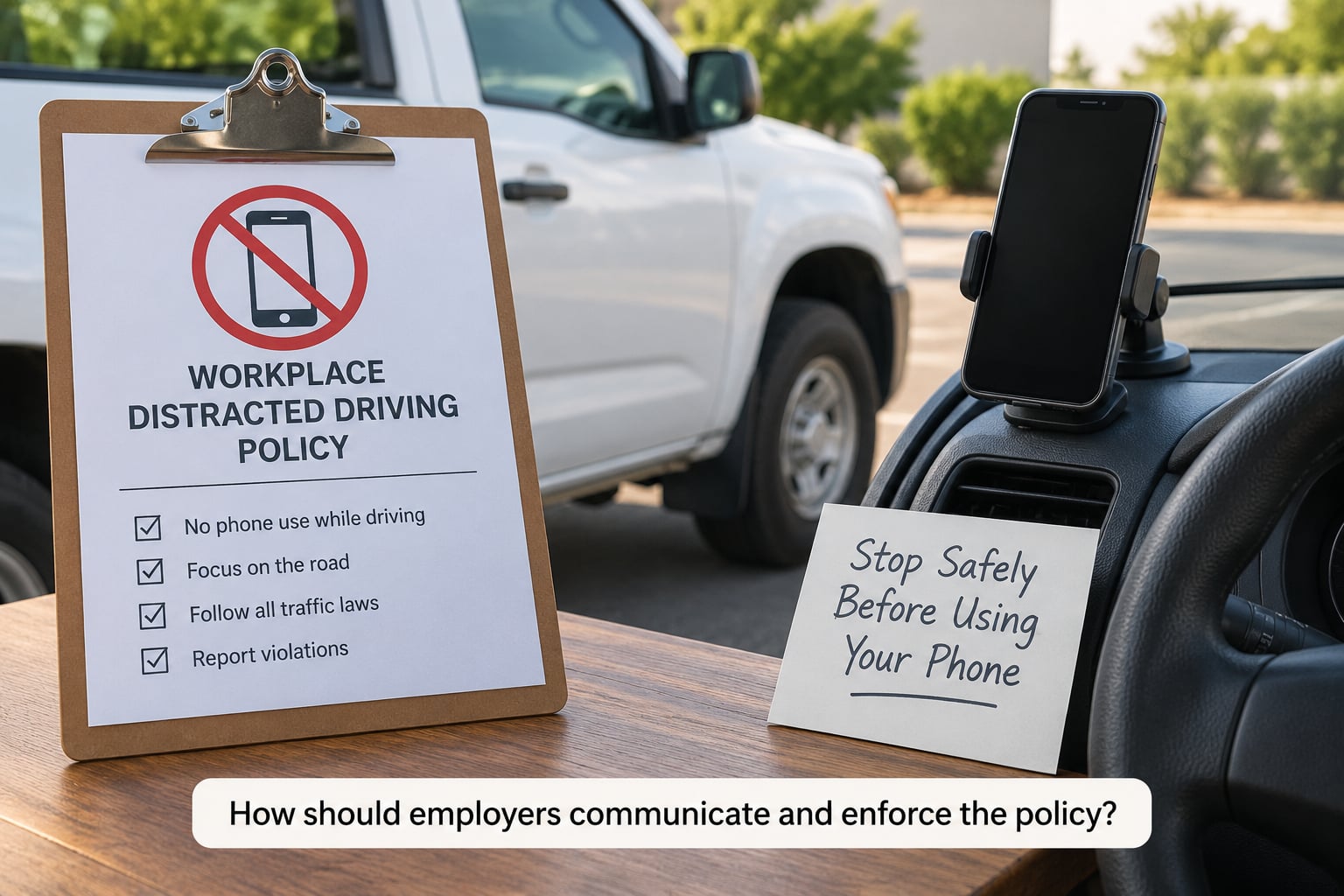
Communicate in writing, in training, and in acknowledgment. A policy that lives only in a handbook section nobody opens will not help you later.
- Distribute it at onboarding and whenever it changes. Put it in the handbook, attach it to the onboarding packet, and require a dated read-and-sign acknowledgment.
- Train managers separately. A supervisor who calls a driver twice an hour because “it is urgent” is undermining the policy in real time. Write manager rules too: no calls or texts to someone known to be driving unless there is a genuine emergency, and schedule check-in windows instead.
- Build in operational support. Drivers break the rules when the schedule gives them no place to eat, no place to park, and no gap in the day to answer a message.
- Give one reporting channel and make it safe. A manager, an HR inbox or a safety form — whichever one people actually use. Ask reporters to note what they saw, not what they assume.
- Apply consequences consistently. Progressive discipline, documented every time, usually beats a zero-tolerance clause you never use.
- Name an owner and a review date. Put both on the policy page itself.
On enforcement specifically, legal commentary in the HR world has long argued that “terminate immediately” clauses are impractical: they are hard to apply fairly, they push managers to avoid reporting anything at all, and they tend to collect in court. Write the ladder instead, and mean it.
How can employers reduce distracted driving without creating privacy problems?
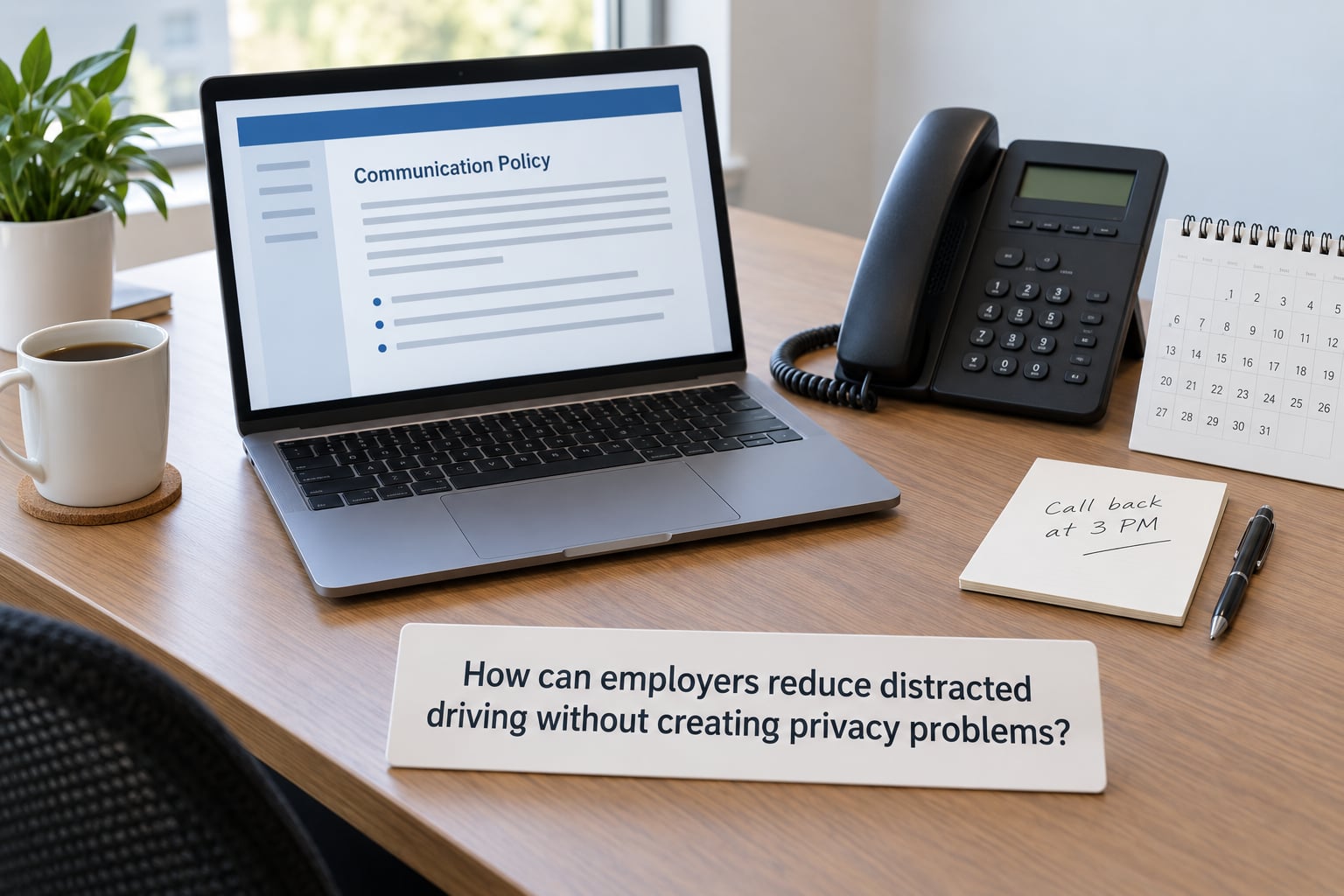
Start with communication design rather than surveillance. Most distracted driving at work is caused by the message pattern, not by employee character: everything is urgent, everyone can reach you, and nobody has told anyone to wait.
- Set expectations that nonurgent messages get answered within a stated window, and hold your own managers to it.
- Schedule check-in points for field staff and drivers instead of demanding constant availability.
- Use scheduled Do Not Disturb windows and a voicemail greeting that says when the employee will return a call.
- Give drivers a defined stopping point — a lot, a yard, a safe shoulder — as part of the route, not as an improvisation.
Where you do use monitoring, tie it to a stated purpose. An in-cab camera or telematics feed should exist to investigate a specific event, and the policy should say who reviews it, what they may look at, and how long the data is kept. General-purpose tracking of personal devices invites privacy complaints and, in some states, requires notice or consent.
Tell employees what you monitor before you start, not after you find something. Nothing corrodes trust faster than an employee learning about in-cab video from a coworker.
What exceptions and special situations should the policy address?
Write the exceptions out. Policies that assume a perfect scenario get bypassed in exactly the situations where they matter.
- Emergency calls. Use a device to reach emergency services or to prevent immediate harm. Reasonable, and worth stating plainly so nobody is afraid to call for help.
- Authorized hands-free systems. Some organizations allow them for short, scheduled calls. Say which devices count and that the employee still pulls over when the conversation is not urgent.
- Commercial motor vehicle drivers. Federal rules under 49 CFR 392.2e restrict a CMV driver from reaching for or holding a mobile phone to conduct a voice communication, and from dialing by pressing more than one button. Violations bring fines, crash exposure and driver disqualification — safety bonuses are not on that list.
- Company-assigned driving and delivery routes. These need scheduled breaks and fatigue limits, not just a phone rule. Our piece on drowsy driving prevention for commercial drivers goes deeper on that.
- Personal vehicles on company business. Covered, with the reimbursement and mileage context spelled out so nobody is guessing.
- Accessibility needs. A hearing-impaired employee’s route differs from a desk worker’s. Note that accommodations are handled individually through HR.
How should managers respond when an employee reports distracted driving?
Treat the report as safety information, not as a complaint to be dismissed. The sequence matters more than the outcome.
- Thank the person by name in the moment. If reports get punished socially, they stop.
- Write down what was observed. Date, time, route, what was seen. Keep observation separate from conclusion.
- Check the immediate risk. Is this driver on the road right now? If so, contact them through the safe channel and confirm they are parked.
- Investigate the same way every time. Same questions, same evidence, same person reviewing, regardless of seniority or how well the driver is liked.
- Decide on the response ladder and record it. Coaching, documented warning, further training, suspension, termination — with the facts that justified the step.
- Check back with the reporter. Reporters want to know the outcome, not to run the investigation.
- Never retaliate against the reporter. Say that in the policy in plain words.
One more thing: the manager who received the report should not be the manager the driver reports to, if you have anyone else available. People discount reports that route to the person being judged.
How can employers measure whether the policy is working?
Measure leading and lagging indicators separately. Lagging indicators — crash counts, insurance claims — move slowly and are noisy. Leading indicators tell you whether the policy is alive.
- Acknowledgment completion. What share of drivers have signed the current version, dated today.
- Training completion. Onboarding and annual refresher rates, by team.
- Near-miss reports. The count usually rises in the first months after a launch, which usually means trust has improved rather than safety has worsened.
- Pull-over and stop events. If you use telematics, hard braking and speeding cluster around distraction and are a useful early signal.
- Repeat violations by team. A pattern in one depot or route usually points to a scheduling problem, not a personnel problem.
- Anonymous feedback. Ask drivers directly whether they can realistically stop when they need to.
- Policy review on a fixed cadence. Annually, and immediately after any serious incident.
No metric here will eliminate distracted driving. Treat them as feedback on the policy’s design, not as a scorecard for the safety department.
How do you write a distracted driving policy for employees step by step?
Work through it in this order. It takes about a day the first time and an hour on each annual revision.
- List every role that drives for work. Not just fleet drivers — couriers, field service, sales reps, executives, anyone with a company vehicle for home use.
- Map the legal floor. Note each state where employees drive, its texting ban and hands-free requirements, and the FMCSA rules if you run CMVs. Write to exceed the minimums.
- Define the prohibited behaviors. Use the three-distraction framework below so the list covers eyes, hands and attention.
- Write the safe-stopping rule. Where employees are expected to stop, what counts as a safe location, and who they call when they do.
- Add communication limits and monitoring scope. What the company monitors, why, who reviews it, and how long records are kept.
- Write the reporting and enforcement sections. One reporting channel, a progressive ladder, and a no-retaliation line.
- Build in the exceptions. Emergencies, hands-free, accessibility, commercial drivers.
- Attach the acknowledgment form. Name, signature, date, policy version number.
- Get legal review. Especially on scope over personal vehicles and on anything touching monitoring.
- Launch with training, not a memo. Short session, real scenarios, signatures collected on the spot.
If you want the framework in one page, the same structure applies to writing a workplace health and safety policy for the rest of your program.
Underneath every rule in the template is one of three kinds of distraction. Visual distraction takes your eyes off the road. Manual distraction takes your hands off the wheel. Cognitive distraction takes your mind off driving while your eyes and hands stay put — which is why a hands-free conversation still costs you.
How do you train employees to follow the distracted driving policy?
Training is where policies actually take hold, and it is where most employers stop too early. Ten minutes at onboarding and nothing after is a compliance exercise, not preparation.
- Use real scenarios from your own routes. A dispatcher calling at a red light in your own town beats a stock video.
- Teach the safe alternatives. Scheduled check-ins, callback windows, a designated stopping point. Training that offers no alternative teaches people that the rule is unenforceable.
- Give managers talking points. Three sentences on why the call matters, one on what to do instead, one on what happens after an incident.
- Refresh annually and after any serious event. Short, specific, and pointed at what the data shows, not a generic deck.
- Use recurring safety meeting topics. Three types of distraction, hands-free limits, infotainment setup, fatigue and breaks, in-cab decorum and passengers, safe following distances, what to do after a crash, reporting near misses, reviewing the year’s own incident data.
- Consider a defensive driving course. Employers report that completion sometimes earns a discount on business auto coverage and can help employees on personal policies too.
Our notes on safety training that employees actually remember go deeper on the format side of this.
What are common mistakes when creating a distracted driving policy?
- Vague wording. “Drive responsibly” is unenforceable because nobody can say what compliance looks like.
- Texting only. A texting-only rule leaves video calls, scrolling, email and every non-device distraction wide open.
- Fleet drivers only. Most workplace trips happen in personal vehicles, and that is exactly where the scope gap hurts.
- Confusing personal phone use with work communication. Employees notice the difference. Say plainly that personal use on personal time is not covered, so the rule reads as reasonable rather than invasive.
- No acknowledgment and no training records. Without dated signatures you have a document, not evidence.
- Unenforceable enforcement. A termination clause nobody applies is worse than a documented ladder everybody follows.
- Monitoring with no stated purpose. If nobody can say why the data exists and who reads it, expect a privacy complaint.
- Managers who break the rules. Urgent calls to drivers at all hours undermine the policy faster than anything on the road.
- Schedules that force violations. No breaks, no place to park, no gap to reply, and people will find a shoulder to stop on.
- Skipping legal review. State law varies, monitoring law varies, and the rules change.
Frequently Asked Questions
Does a distracted driving policy cover employees driving their own personal vehicles?
It should, at least when they are on company business. An employee using a company-issued phone in a personal car while working is the most commonly missed case. Rules about the rest of their personal commute are murkier, and many employers state plainly that personal-time driving is not covered. Drawing that line in writing prevents both the coverage gap and employee resentment.
Can an employer discipline an employee for texting while driving on personal time?
Generally not, and trying to creates real exposure. Employers can set behavior rules for company vehicles and for work trips. Reaching into an employee’s commute is hard to justify and may conflict with state privacy or labor law. Say the limit explicitly in the policy so the boundary is understood rather than implied.
Is hands-free phone use safer while driving?
It removes the manual and visual distraction of holding a device, which is a real gain. It does not remove cognitive distraction, and attention still leaves the road. Treat hands-free as a limited permission for brief, scheduled calls rather than a general allowance, and require employees to pull over when a conversation is not urgent.
What are the three types of distracted driving?
Visual, manual and cognitive. Visual takes your eyes off the road, as with a phone screen or a passenger. Manual takes your hands off the wheel, as with reaching for a phone or a coffee cup. Cognitive takes your attention off driving while your eyes and hands stay in place, which is the hidden one, because a conversation looks and feels safe.
What is the Anti-Distracted Driving Act?
It is proposed federal legislation intended to pressure states to adopt uniform texting and hands-free driving bans, along with stronger penalties. It has been introduced repeatedly and has not become permanent federal law. The practical takeaway is that your policy should be written to the strictest state rule your drivers encounter, not to the weakest one.
What happens to a CMV driver who violates the federal distracted driving rule?
Under 49 CFR 392.2e, a commercial motor vehicle driver may not reach for or hold a mobile phone to conduct a voice communication or dial by pressing more than one button. Enforcement can bring fines, crash exposure and driver disqualification. Safety bonuses are not a consequence of the violation. Employers also carry their own exposure as motor carriers under FMCSA rules.
What do we do when an employee refuses to sign the acknowledgment?
Ask why first. Some refusals are about the personal-vehicle scope or about monitoring language, and you may be able to resolve the concern with a clarification. If the refusal stands after that, document it and follow your ordinary progressive discipline process, treating the signature as a condition of driving for work. Get HR involved before the meeting.
How do we roll out the policy to employees who are already driving?
Announce it with a start date far enough out that everyone can see it coming, use it as the trigger to add a voicemail greeting and Do Not Disturb schedule, and run training before the effective date rather than after the first incident. Employees who are on the road the day it takes effect deserve a heads-up, not a surprise.
Conclusion
Write the policy, get the signatures, and fix the schedule. That last part is the one most employers skip, and it is usually the reason a well-written rule gets broken anyway.
If you do one thing this month, list every role that drives for work, draft the prohibited-behavior list using the three distraction types, and schedule a fifteen-minute session where people sign on the spot. Then set a calendar reminder for the annual review.