
Lone worker safety tips matter because the accident itself is often survivable while the delay in getting help is not. A technician who slips on a rooftop stair, a home health aide in an unfamiliar living room, or a delivery driver stalled on a rural road may need assistance within a couple of minutes. This guide gives employers, supervisors and the workers themselves ten concrete steps: assess the risk, check in on a schedule, carry the right communication tools, train for hazards, plan for emergencies, match supervision to risk, protect well-being, plan for travel and weather, learn from near misses, and build a culture where anyone can stop work.
Across the US, roughly 15 percent of the workforce — more than 25 million people — work alone, and about 70 percent of organizations reported a lone worker safety incident in the three years before those figures were compiled. Lone workers in high-risk industries face two to three times the risk of serious injury or death. Those numbers come from SAIF citing a Verdantix report and a National Safety Council white paper, and they are the reason an honest lone worker program is a management responsibility rather than a device purchase.
Table of Contents
- Lone Worker Safety Tips at a Glance
- 1. Complete a Lone Worker Risk Assessment
- 2. Set Clear Check-In and Contact Procedures
- 3. Use Reliable Location and Communication Tools
- 4. Train Workers to Recognize and Report Hazards
- 5. Create an Emergency Response Plan
- 6. Match Supervision and Support to the Risk
- 7. Protect Mental Health and Workload Well-Being
- 8. Plan for Travel, Remote Locations, and Changing Conditions
- 9. Review the Safety System After Incidents and Near Misses
- 10. Build a Culture of Speak-Up and Continuous Improvement
- Frequently Asked Questions
- What are the OSHA rules for working alone?
- What are the most common hazards for lone workers?
- How often should a lone worker check in?
- Does a check-in system alone make lone working safe?
- What should an employer do if a lone worker misses a check-in?
- Are remote and home-based employees covered as lone workers?
- Where to Start This Month
Lone Worker Safety Tips at a Glance
| Tip | Who acts | Most useful when | Safety benefit |
|---|---|---|---|
| 1. Complete a lone worker risk assessment | Employer and worker together | Before solo work starts at a new site | Shows whether the job can safely be solo |
| 2. Set check-in and contact procedures | Employer, with worker input | Every shift, every site | Cuts the time before a search starts |
| 3. Use reliable location and communication tools | Employer supplies, worker uses | Low-signal basements, roofs, rural routes | Keeps a real connection when a call would fail |
| 4. Train workers to recognize and report hazards | Employer delivers, supervisor refreshes | Onboarding and each new hazard | Catches problems before the shift goes wrong |
| 5. Create an emergency response plan | Employer writes, whole team rehearses | Before deployment, after any change | Tells everyone who calls whom, and when |
| 6. Match supervision to the risk | Employer and supervisor | High-risk and lower-risk tasks differ | Puts eyes on the riskiest work |
| 7. Protect mental health and workload well-being | Manager | Long solo stretches, night and weekend work | Reduces fatigue errors and isolation |
| 8. Plan for travel and changing conditions | Worker with employer sign-off | Long drives, remote sites, weather | Prevents the stranded-solo scenario |
| 9. Review after incidents and near misses | Employer leads, worker involved | After every event, small or large | Turns one bad shift into a better process |
| 10. Build a speak-up culture | Leadership | Continuously, not annually | Makes the safety system actually used |
One caveat worth stating up front: there is no single US federal standard called the lone worker standard. The duty sits under OSHA’s General Duty Clause, Section 5(a)(1), which requires an employer to provide a workplace free from recognized hazards likely to cause death or serious harm, plus specific rules such as the emergency action plan standard at 29 CFR 1910.38 and lockout/tagout at 29 CFR 1910.147. No buddy system is universally mandated for lone work.
1. Complete a Lone Worker Risk Assessment
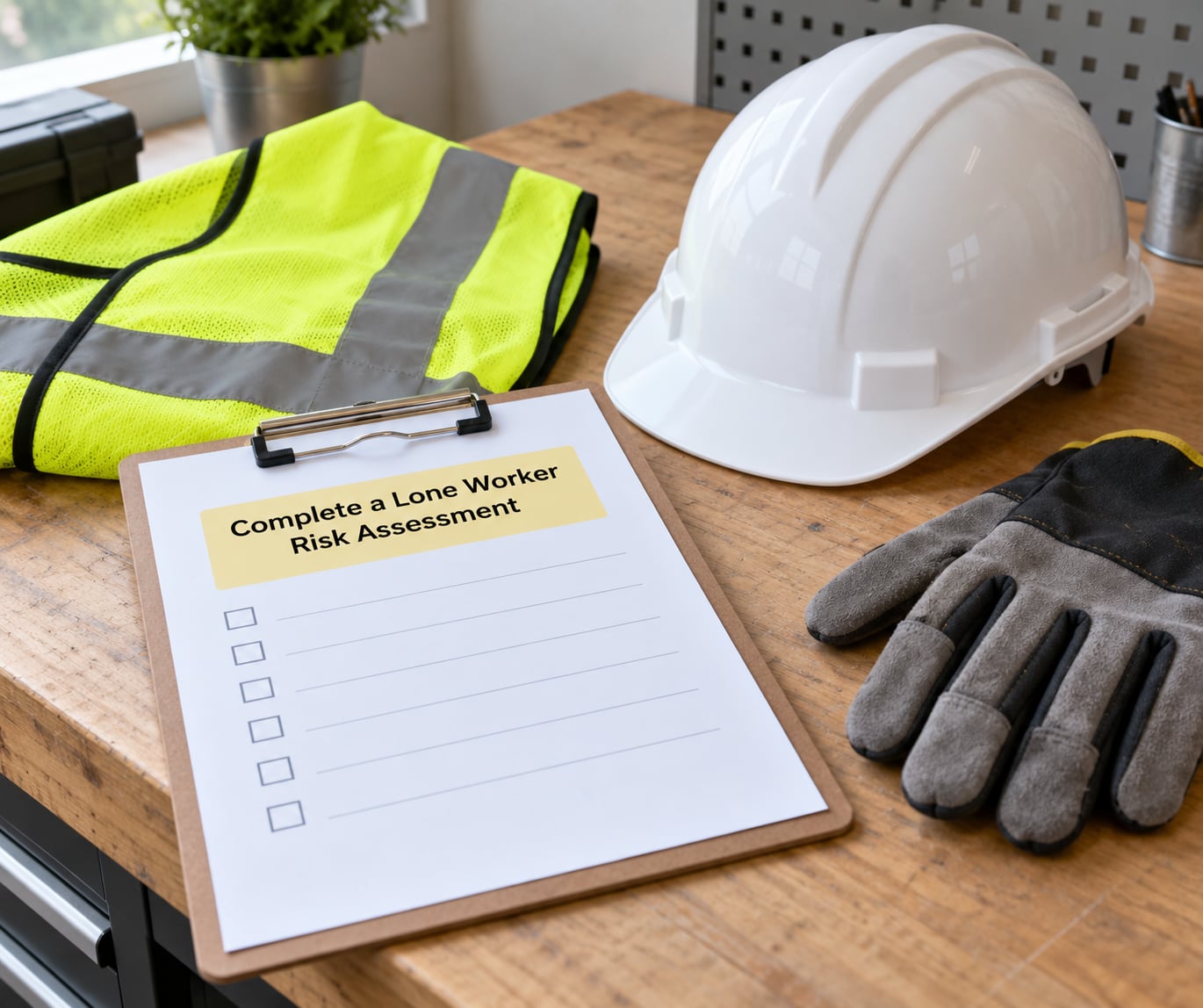
A risk assessment is the foundation of every other tip. Without it, check-in intervals and devices are guesses.
Work through five questions, ideally on site and with the person who will do the job: What is the task, and what can go wrong during it? Where does the work happen, including entry routes, stairs, roofs, basements, traffic and blind spots? What is the work pattern — how long, how far, at what time of day? What individual circumstances apply, such as training level, medical restrictions, pregnancy or fatigue? And what help is available, given that the nearest person may be 20 minutes away?
Here is a concrete example. A remote maintenance technician is sent alone to a suburban office building to replace a rooftop air handler unit. The assessment shows a steep internal stair, a locked roof hatch with no second exit, no nearby staff, and a job that needs two people to lift the 200-pound unit. The outcome is not a better gadget, it is a two-person crew or a smaller replacement job. That decision is the safety control.
Write the assessment down and revisit it when the job, site or worker changes. A job hazard analysis that lives in a filing cabinet protects nobody.
2. Set Clear Check-In and Contact Procedures
A check-in procedure is the difference between an incident found in eight minutes and one found in two hours. It needs a scheduled check-in time, a named person who watches for it, and a written escalation step for when it is missed.
Set the interval from risk, not habit. Short, frequent check-ins suit lone work in basements, on ladders or at unoccupied homes. Longer intervals suit a technician parked at a fixed worksite with predictable breaks. Task-based check-ins work well too: check in on arrival, before starting a risky step, and on completion.
Tell the worker exactly what happens when they miss one. Nobody takes a system seriously until they know whether a missed check-in means a phone call from a supervisor or a welfare check by emergency services. Then decide how that response escalates, and put the timeline in writing so the supervisor receiving it does not have to guess. Safety professionals describe forgotten check-ins as one of the three hardest problems in lone work, which is why the routine has to fit the real shift pattern rather than an ideal one.
3. Use Reliable Location and Communication Tools
A phone is a starting point, not a plan. Basements, mechanical rooms, rooftops, rural routes and some utility infrastructure have no usable signal, and a dead phone is the exact moment you need it.
How to choose a device that works where your workers actually are
Match the tool to the gap. Timed check-in apps handle routine accountability and location history for office-adjacent field work. Panic buttons and personal alarm devices suit physical assault risk in home care, security and night cleaning. Man-down and fall detection suit lone work at height or in remote locations where a motionless worker cannot trigger anything. Two-way radios suit crews working within radio range of each other or a depot. Satellite messengers suit routes with no cell coverage, where a check-in stores and sends when a signal appears.
What to look for in a check-in tool
Four things matter most: does it work without cell signal, does it escalate automatically when a check-in is missed, does it confirm to the worker that the check-in registered, and does the receiving supervisor get a clear view of who is overdue and since when. Ask what happens when the device itself fails, whether alerts are acknowledged or silently dropped, and whether the record can be exported for an investigation afterwards. Reviewers on the r/SafetyProfessionals forum make a related point often: supervision and escalation discipline matter more than the hardware you buy.
Privacy deserves a paragraph of its own. Share location during the working window, say so plainly in the policy, and stop it when the shift ends. Continuous tracking that workers cannot switch off builds resentment and, in a safety argument, gives you less cooperation rather than more.
4. Train Workers to Recognize and Report Hazards
Generic annual training does not survive contact with a Tuesday night in a customer basement. Role-specific training does.
Cover the hazards that actually show up in that role: slips and falls on stairs, lone work at height, vehicle movement on site, electrical exposure, confined spaces, aggressive behaviour from clients or customers, and the fatigue and isolation issues that come with long solo stretches. Then cover the decisions: when to leave a scene that feels wrong, how to make a call with no signal, what to do in the first sixty seconds after a fall, and how to file a near-miss report that does not feel pointless.
Stop-work authority has to be written into the lone worker policy and demonstrated by leadership, or workers treat it as theoretical, especially on night shifts when a customer is waiting. If you want the training to stick, our guide to safety training that employees actually remember goes into the parts adults retain and the parts they forget by Friday.
5. Create an Emergency Response Plan
Write the plan so a frightened person at 2 a.m. in a dark utility room can follow it without thinking. Every worker needs: who to call first and the second number if that fails, what details to give (exact location including floor, unit or mile marker, nature of the problem, callback number), who gets escalated to next, what first aid they are expected to give, and what happens if the phone or radio does not work at all.
Put the site address and access instructions in the plan. Dispatchers cannot find a worker on a multi-building campus or a rural site described only as north end of the property. Keep ICE contacts on the lock screen and one printed card in the first aid kit for the case where the phone is locked, cracked or dead.
A written plan only works if someone has drilled it. Scenario drills beat policy reviews here: you slip and cannot stand, your phone is on the roof deck ten feet away, and the nearest colleague is 25 minutes out. The parts of the response that feel obvious on paper often collapse under that kind of pressure. When the plan is stable enough to print, our guide to writing a standard operating procedure for safety walks through turning it into a document people actually follow.
6. Match Supervision and Support to the Risk
Treating every lone task the same wastes resources and protects the wrong people. Some solo work is genuinely low risk, and forcing a buddy onto it adds cost without adding safety. Some tasks are high risk and should not be solo at all.
Use a simple tiering. Low-risk solo work: routine site visits, inspections, deliveries with a scheduled stop, remote administrative work. Medium risk: work in unoccupied buildings, after-hours cleaning, home visits, home care. High risk: work at height, energized electrical work, confined space entry, lone work at night in unfamiliar places, and any job where violence or aggression is plausible.
Then attach controls to each tier. Low risk gets a check-in schedule. Medium risk gets check-ins plus a monitored device, restricted after-hours access and a supervisor contact who knows the location. High risk gets a second person, a restriction on when it may be done, or a remote supervisor with a live response commitment.
Remote employees are lone workers too, and the risk profile is different: isolation, workload creep and blurred boundaries rather than physical hazards. Give remote staff the same escalation path, a named person responsible for their welfare, and a way to report a concern that does not route through their own manager.
7. Protect Mental Health and Workload Well-Being
Fatigue and psychological strain rank among the most common lone working hazards, and they show up as mistakes before they show up as complaints. Long solo stretches, night work, back-to-back video calls and no informal contact all degrade judgement and situational awareness.
Managers can do a lot without turning supervision into surveillance. Hold a short human check-in on a set rhythm rather than only when something is wrong. Watch for workload creep, where solo staff never get a boundary because no colleague is present to see it. Offer confidential support that does not route back through the worker’s own manager, and make it clear that mental health support does not affect performance reviews. Set expectations that nobody works solo through illness, however the schedule looks, and cover for them when they call out.
The point is meaningful contact without intrusive monitoring. Workers who feel watched switch off the very reporting behaviour that makes a lone worker system work.
8. Plan for Travel, Remote Locations, and Changing Conditions
Long distances create the version of lone work most likely to end badly, because the failure modes stack: a breakdown, then no signal, then cold, then nightfall.
Before departure, check the route and weather, confirm the destination address and access, and tell someone the planned arrival and return times. Carry a charged phone, a power bank, water, warmth for the season and a first aid kit. If the route has no coverage, carry a satellite messenger or a personal locator beacon, and know how to use it before you need it. Agree a check-in window for the return journey so someone knows when to look.
Safe accommodation matters too. A hotel with a staffed desk and a working phone in the room is a different risk profile from a roadside rest stop at 4 a.m. If conditions deteriorate, the rule should be that stopping and reporting beats pushing on alone.
9. Review the Safety System After Incidents and Near Misses
A near miss is a free lesson. A slipped ladder that nobody was under is exactly the data you want, and most organizations throw it away because nothing broke.
After any incident or near miss, ask what happened, what made it possible, and what would have stopped it. Involve the worker who was there; they know where the plan touched reality. Then look for the small failures too: an alert nobody acknowledged, a battery that was flat, a check-in that went out two hours late and nobody noticed, a device left in the truck instead of on the person. Workers in field service forums say plainly that the device is the easy part and wearing it is the hard part.
Assign corrective actions with a name and a date, then verify they were completed. If you want the numbers to mean something, tracking safety metrics in a small company covers the handful of measures that actually predict whether your program is working: check-in compliance rate, alert acknowledgement time, mean time from missed check-in to contact, near-miss reporting volume and device uptime.
10. Build a Culture of Speak-Up and Continuous Improvement
Every tip above fails if the culture punishes the person who uses it. A worker who calls in a stop-work pause and gets an earful for missing a job never does it again, and you have lost your early warning system permanently.
Leaders set this by example in small ways. Ask what nearly went wrong last week and thank the person who brought it up. Never treat a false alarm as a failure, because the alternative is a device nobody trusts. Report back on what changed after a worker raised something, which is the single fastest way to prove reporting is worth something. Give supervisors authority to reschedule solo work without needing permission from above, and make it easy for a worker to request a second person without having to justify it in the moment.
The forum conversations on lone worker safety describe this as a culture problem rather than a technology problem, and that is right. Ask workers which part of the system they would drop first; the answers are usually more useful than any vendor demo.
Frequently Asked Questions
What are the OSHA rules for working alone?
There is no single US federal lone worker standard. The duty comes from OSHA’s General Duty Clause, Section 5(a)(1), which requires an employer to keep the workplace free from recognized hazards likely to cause death or serious harm. Specific rules apply on top of that, including the emergency action plan standard at 29 CFR 1910.38 and lockout/tagout at 29 CFR 1910.147. State plans can be stricter, so check your state agency rules too.
What are the most common hazards for lone workers?
The hazards that recur most are slips, trips and falls, medical emergencies such as heart attack or seizure, workplace violence and aggression, vehicle movement and roadside incidents, equipment or tool accidents, and environmental exposure such as heat, cold or poor air. Fatigue and mental health strain also appear consistently in incident data. The controlling factor across all of them is the same: how long it takes for help to arrive.
How often should a lone worker check in?
Set the interval from risk rather than a fixed rule. Short intervals of 15 to 30 minutes suit work at height, in confined spaces or in unfamiliar locations. Longer intervals suit low-risk work at a fixed site with predictable breaks. Task-based check-ins work well too: check in on arrival, before a risky step and on completion. Whatever interval you choose, record who watches for the check-in and what happens when it is missed.
Does a check-in system alone make lone working safe?
No. A check-in system tells you something is wrong; it does not get help to the worker. You still need a risk assessment, rules about which tasks are never done alone, a device that works where the worker actually is, a written escalation plan with names and phone numbers, and a supervisor who knows exactly what to do when an alert arrives. Technology is the last layer, not the first.
What should an employer do if a lone worker misses a check-in?
Work down a fixed escalation timeline rather than improvising. First attempt: call the worker and leave a message. Second: contact the second named contact or the site contact. Third: notify the supervisor responsible for that location. Fourth: if no response within the agreed window, contact emergency services with the last known location, site access details and job hazard information. Record the timeline afterwards and review why the check-in was missed.
Are remote and home-based employees covered as lone workers?
Usually yes, at least for welfare purposes. A remote employee working alone at home may face isolation, workload creep, blurred boundaries and no one aware they have become unwell, even though the physical hazard list is shorter. Apply the same structure: a risk assessment covering home working conditions, a check-in routine for wellbeing, a named person responsible for escalating a concern, and confidential support that does not route through the employee’s own manager.
Where to Start This Month
If you do one thing, list every job your people do without a colleague within a fifteen-minute walk, and mark each one that has a check-in today. That single list usually shows you which lone worker safety tips you already have and which are aspirational. Then write the escalation timeline for one high-risk role, put it in the hands of the supervisor who would receive the call, and rehearse it once. A documented check-in procedure with a named responder beats an expensive device nobody has tested.