

A 5 minute safety talk is a short, structured pre-start discussion — also called a toolbox talk or a safety moment — held daily or weekly to cover one hazard, one safe method and one action. These 5 minute safety talk ideas give supervisors, safety officers and team leads 15 ready-to-run topics with an opening question, a delivery sequence and a follow-up task, for construction sites, warehouses, plants, offices, clinics and fleet operations.
Five minutes is short enough that nobody skips it and long enough to change a habit. That is the whole promise: one hazard named clearly, one method described plainly, one action assigned before people walk away.
The hardest part is not the delivery. It is picking what to say on a Tuesday morning when nothing has gone wrong yet. Topics run dry because leaders default to the same three subjects or because every hazard on the list is written for a construction site and nobody translated it to an office or a warehouse.
The 15 topics below are grouped by hazard rather than by industry, so you can pull the one that matches your shift, then adapt the example in about a minute. If your team has drifted back to nodding along without hearing anything, the material on safety training that employees actually remember is worth reading alongside this list.
Table of Contents
- 5 Minute Safety Talk Ideas at a Glance
- 1. Housekeeping Trip Hazards and Good Housekeeping
- 2. Safe Manual Handling Without Straining Your Back
- 3. Ladder Safety: Before You Climb
- 4. Forklift and Vehicle Interaction Zones
- 5. Choosing and Using the Right PPE
- 6. Chemical Labels, SDSs and Safe Work Practices
- 7. Heat Stress and Hydration
- 8. Computer Ergonomics and Small Workstation Changes
- 9. Near Misses: What They Can Teach Your Team
- 10. Emergency Exits and Evacuation Routes
- 11. Fatigue and Alertness on the Job
- 12. Incident Reporting Without Delay
- 13. Tool and Equipment Inspection
- 14. Safe Work Practices for New and Temporary Workers
- 15. Building a Strong Reporting Culture
- Frequently Asked Questions
- Conclusion
5 Minute Safety Talk Ideas at a Glance
This matrix gives you the topic, the hazard it addresses, where it lands best, an opening prompt and the follow-up action, so you can scan the whole bank in under a minute.
| Topic | Hazard addressed | Best setting | Opening prompt | Follow-up action |
|---|---|---|---|---|
| 1. Housekeeping | Slips, trips, falls | Anywhere, any shift | What did you nearly trip on this week? | Ten-minute floor sweep of walkways |
| 2. Manual handling | Strains and back injuries | Warehouse, plant, delivery | What makes a load feel heavier than it looks? | Flag awkward loads for two-person lifts |
| 3. Ladder safety | Falls from height | Site, warehouse, retail stockroom | When did you last check the feet? | Remove damaged ladders from service |
| 4. Forklift zones | Vehicle and pedestrian contact | Warehouse, dock, yard | Where do you stand when a truck is moving? | Walk the crossing points and repaint faded markings |
| 5. PPE selection | Eye, hand, hearing, foot injury | Manufacturing, construction, labs | Does your PPE match today’s task or habit? | Check PPE stock and replacement dates |
| 6. Chemical labels and SDSs | Chemical exposure | Facilities, cleaning, maintenance | When did you last read the label before pouring? | Confirm SDS binders are current at every station |
| 7. Heat stress | Heat exhaustion and heat stroke | Outdoor work, kitchens, yards | When was the last water break today? | Set shade and water points before the shift |
| 8. Workstation ergonomics | Strain and repetitive injury | Office, admin, hybrid | Where are your wrists when you type? | Adjust one desk per person this week |
| 9. Near misses | Repeat incidents | Any setting | What nearly happened to you this week? | Log one near miss with a named owner |
| 10. Exits and evacuation | Delayed escape | Multi-occupancy buildings | Can you name your two nearest exits? | Clear and unblock one route per floor |
| 11. Fatigue and alertness | Error rate and reaction time | Night shift, drivers, long shifts | How many hours have you been awake? | Review shift length and break coverage |
| 12. Incident reporting | Delay in getting help | Any setting | What do we report, and when? | Walk through the reporting form together |
| 13. Tool inspection | Equipment failure and laceration | Maintenance, workshop, site | What tells you a tool is finished? | Red-tag anything doubtful and replace it |
| 14. New and temporary workers | Unsupervised unfamiliar work | Any hiring site | What did we show them on day one? | Assign a named supervisor for first week |
| 15. Reporting culture | Silence about hazards | Any setting | When did someone last stop an unsafe job? | Thank that person publicly and act on the report |
1. Housekeeping Trip Hazards and Good Housekeeping
Clutter, wet floors, obstructed paths and poor storage cause more lost-time injuries on most sites than the dramatic hazards do. This talk works because everyone in the room has seen the problem and probably stepped around it.
Cover three things in order: what counts as a trip hazard, why a spill left for ten minutes becomes a slip hazard, and what good storage actually looks like on your floor.
Open with: “What did you nearly trip on this week?” You will get an answer from someone within seconds, and that answer becomes your example — a trailing cable behind a desk, a pallet overhanging a walkway, a cardboard box left in a fire route.
Finish with a task, not a promise. Ask for a ten-minute floor sweep of the main walkway before people get to their benches, and note what turns up so you can fix it the same week.
2. Safe Manual Handling Without Straining Your Back
Most manual handling injuries are not dramatic lifts. They are the same box moved twenty times a day, each one slightly awkward, each one done with a bent back and a twist.
Build the talk around five points: judge the load before you touch it, keep it close to your body, bend at the knees with a neutral spine, move your feet instead of twisting, and ask for help before the lift rather than after the strain.
Open with: “What makes a load feel heavier than it actually is?” The answer — a bad grip, an awkward distance, an unstable stack — sets up the whole method neatly.
Use your own case as the example: a 20 kg carton of fittings from the pallet to the mezzanine, three times a shift. End by flagging the loads your team always struggles with and marking those for a two-person lift or a mechanical aid.
3. Ladder Safety: Before You Climb
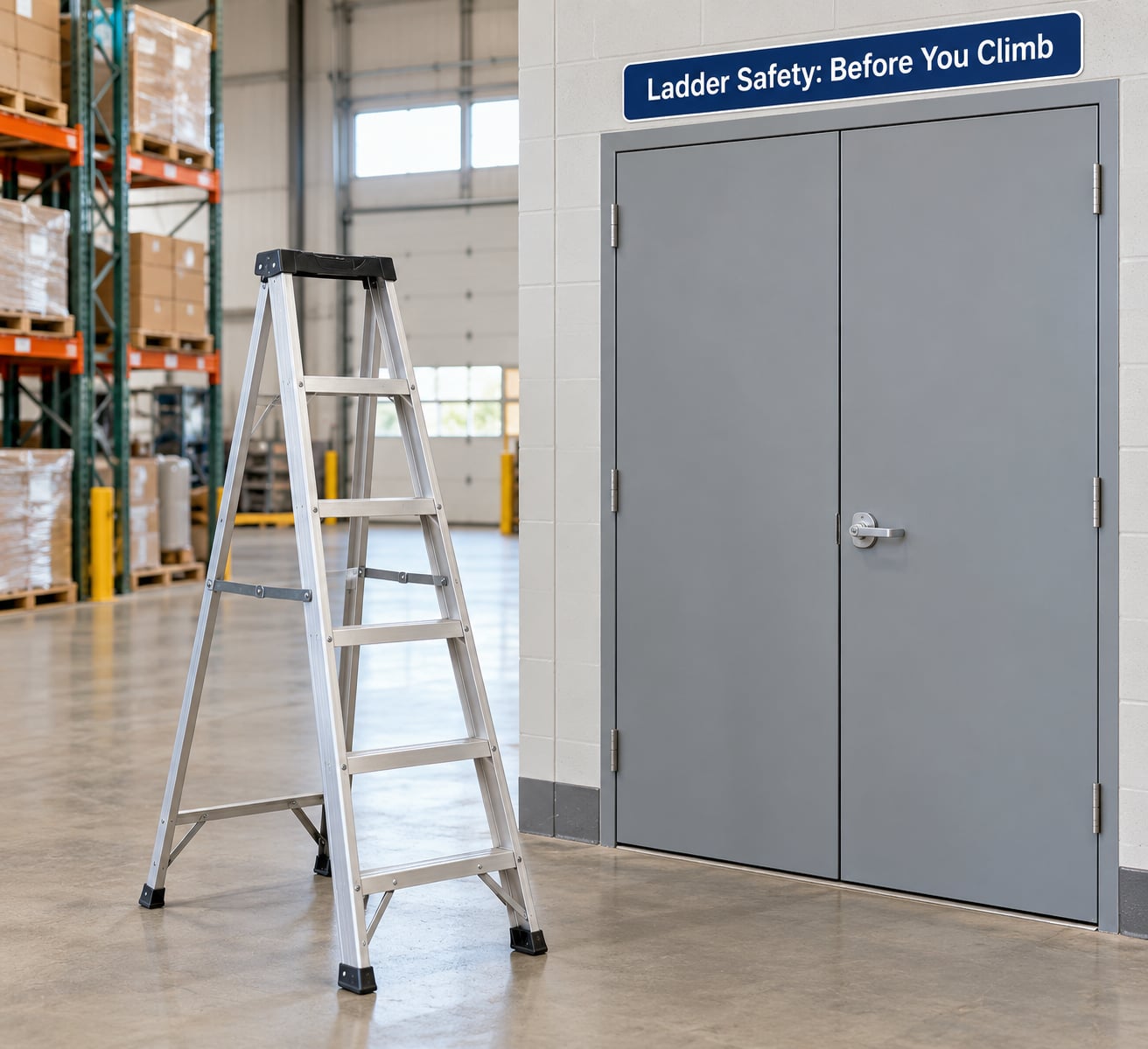
Ladder falls climb the list every year, and almost all of them trace back to a pre-use check that got skipped.
Run through the inspection in five beats: feet solid and clean of oil or debris, rails and steps free of splits or missing parts, the ladder the right type for the job, three points of contact maintained while climbing, and no standing on the top step or the top cap.
Open with: “When did you last check the feet before you climbed?” Then ask what they would do with a ladder missing one rubber foot — the answer should be tag it, take it out of service, tell the supervisor.
The classic example is the worker who climbs fine, reaches sideways to a high shelf and shifts a hand. Talk about moving the ladder instead, or using a proper platform step unit for anything above reach. Finish by walking the room and pulling any damaged ladder from service today.
4. Forklift and Vehicle Interaction Zones
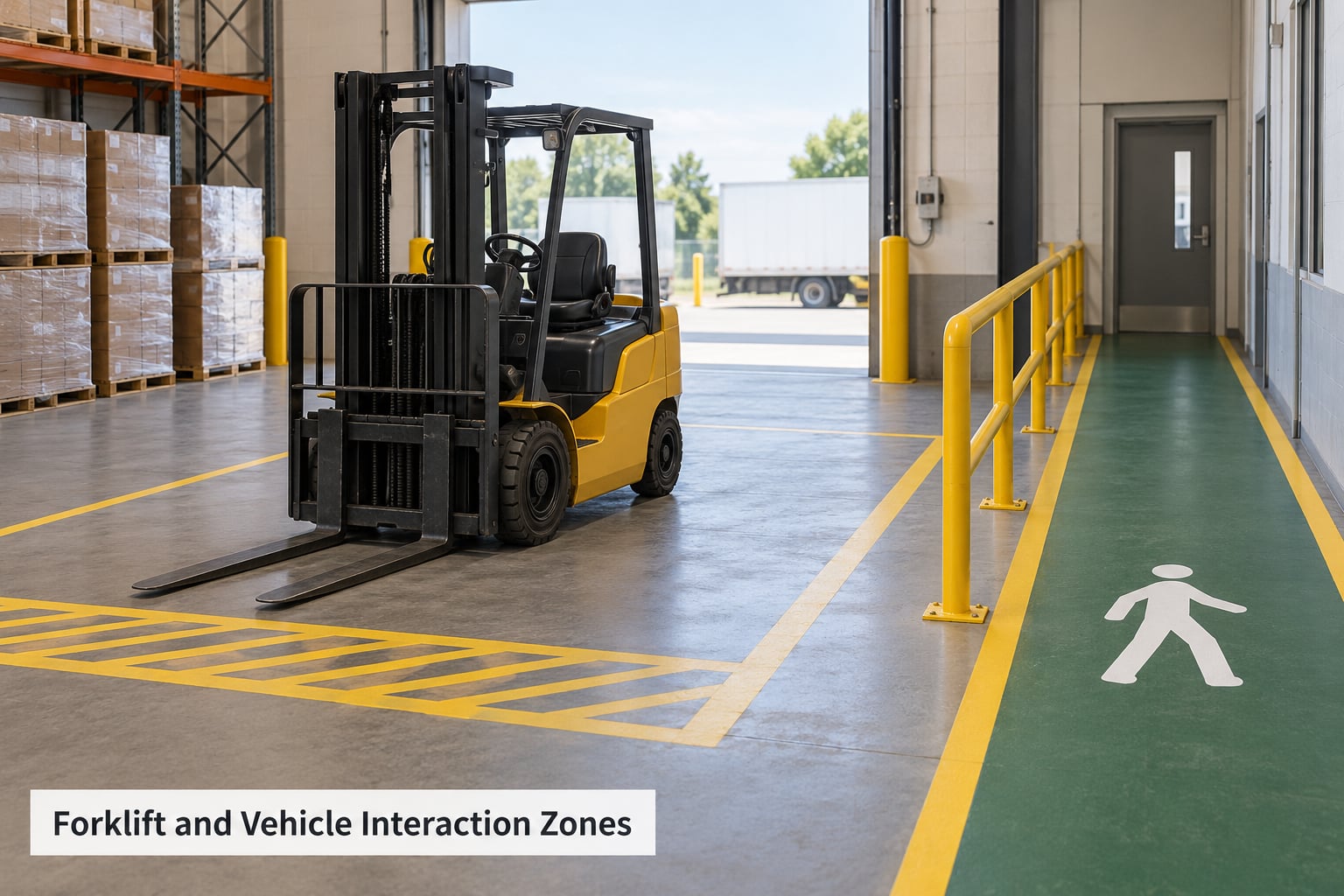
Roughly a quarter of forklift deaths involve someone standing or walking on foot, and almost all of those happen inside the vehicle’s blind spot.
Cover the blind spots first — behind, in front, and both sides where the mast blocks the view — then the controls that matter: designated crossings, marked walkways, eye contact with the driver before any crossing, sounding the horn at junctions, and never stepping over, under or around a raised guard or mast.
Open with: “Where do you stand when a forklift is moving toward you?” A loading dock is the best example. Ask what happens when the driver cannot see the pedestrian and the pedestrian cannot see the driver.
End with a walk of the actual crossing points at your site and repaint or re-tape any faded markings before the next shift.
5. Choosing and Using the Right PPE
PPE is the last line of defence, not the first. Controls on the hazard come before a piece of equipment on the body, and a talk that starts with gloves ends with a preventable hand injury.
Explain what each item is actually for: safety glasses for flying debris, goggles for chemical splash, a face shield for grinding and cutting, cut-resistant gloves for sheet metal, hearing protection where noise levels are high.
Open with: “Does your PPE match today’s task, or does it just match what you grabbed this morning?” That question usually gets an honest laugh and an honest answer.
Finish with a practical action: check the PPE store for gaps, check whether eye protection is scratched, and check whether any glove is being worn on a rotating machine where gloves get caught. When you are building your own set of 5 minute safety talk ideas, this one is worth running monthly because the task, not the person, keeps changing what the correct equipment is.
6. Chemical Labels, SDSs and Safe Work Practices
HazCom only works if people read the label before the product leaves the shelf. Most exposure incidents start with a shortcut that felt obvious in the moment.
Cover the label contents — product name, hazard pictograms, signal word and the hazard statements — then how to find the safety data sheet, and why sections 2, 4, 7 and 8 matter: hazards, first aid, handling and storage, exposure controls.
Open with: “When did you last read the label before you poured?” Use the janitorial example: a sanitiser concentrate used undiluted because the bottle was already open, with no goggles on and no ventilation in the small room.
Close with the reporting rule rather than a cleanup procedure. Ask where spills get reported and who responds; untrained cleanup attempts cause second injuries every year.
7. Heat Stress and Hydration
Heat illness builds quietly and then arrives fast. Workers keep working through early signs because the symptoms feel like ordinary tiredness.
Name the warning signs plainly: heavy sweating, headache, dizziness, nausea, cramps and fatigue point to heat exhaustion; confusion, fainting, seizures and very hot skin point to heat stroke and are an emergency.
Cover the controls: water on the job, shade or air conditioning nearby, scheduled rest breaks rather than optional ones, shorter shifts and more frequent breaks during a heat wave, and gradual acclimatisation for new and returning workers.
Open with: “When was the last water break today?” End with a setup task — position water and shade before the shift starts, not once someone is already overheating. Anyone showing confusion, fainting or seizures needs emergency services called straight away, not a drive home and a rest.
8. Computer Ergonomics and Small Workstation Changes
Office injuries develop slowly and rarely get reported, which is exactly why a five-minute talk works well here. Nobody feels hurt, so nobody mentions it.
Cover the four adjustments with the biggest return: screen height near eye level with the top of the display at or just below eye level, lumbar support in the chair, forearms roughly level with wrists in a neutral position, and lighting placed so screens do not reflect windows.
Open with: “Where are your wrists when you type?” Then add the movement break question: when did you last stand up in the last two hours?
Use the shared hot-desk example, where a person adjusts one chair in the morning and everything else is wrong. Close with one change each person makes this week, and a clear referral route to occupational health or a qualified ergonomic assessor if discomfort persists.
9. Near Misses: What They Can Teach Your Team
A near miss is a free lesson. Nobody was hurt, the event happened anyway, and the data is still sitting in the room.
Frame it in three questions: what nearly happened, why did it nearly happen, and what control would have stopped it. Nothing else is needed for a five-minute version.
Open with: “What nearly happened to you this week?” Tell the story yourself too — a tool fell from a workbench and landed in an empty spot on the floor where someone had been standing a minute earlier.
Work the room to find the root cause rather than the person, then pick one control: a tether on overhead tools, a marked exclusion zone, a raised shelf line. Close by logging it with a named owner so the fix is not left in the air.
10. Emergency Exits and Evacuation Routes
Almost everyone knows where the fire door is. Far fewer know whether it opens from their side, and whether anything is stacked against it.
Cover three habits: identifying your two nearest exits from wherever you work, keeping routes and doorways clear at all times, and recognising the alarm without waiting for confirmation from a colleague.
Open with: “Can you name your two nearest exits from where you are standing right now?” Make people point, out loud. Then ask whether the route stays clear all the way to the assembly point.
Use the floor-plan example: a stockroom exit that looked fine on the plan but was blocked by a pallet every afternoon. Close by asking for one route per floor to be walked and cleared this week, and by reminding everyone that nobody re-enters until the all-clear is given. Route checks are one line item in most safety audit checklists for small businesses, so they tend to survive the busy weeks better than a memory does.
11. Fatigue and Alertness on the Job
Tired people make ordinary mistakes at a higher rate, and most of them do not notice they are impaired. That makes fatigue a management problem, not a character problem.
Talk about insufficient sleep, long or rotating shifts, repetitive work with no task variation, and breaks that get skipped whenever the line is behind.
Open with: “How many hours have you been awake?” Then ask what a job feels like at hour eleven that felt easy at hour three.
Give managers concrete moves in the same five minutes: review shift length, rotate repetitive tasks, protect break coverage rather than treating it as slack, and make it easy to report fatigue without embarrassment.
12. Incident Reporting Without Delay
Reporting exists so the next person does not repeat the injury. Delayed reports are the most expensive kind, because by then the cause has usually moved on and the detail is gone.
Be precise about the distinction: an incident is an event that caused harm or damage, however small. A near miss is an event that could have caused harm but did not. Both get reported, and the near miss usually gets reported first.
Open with: “What do we report, and when?” Answer plainly — injuries, damaged equipment, damaged property, and near misses, immediately, through the site’s reporting process, before the end of shift.
Use the minor cut example: a hand grazed on a sheet-metal edge, no lost time, nobody mentioned it, and the same edge cut someone properly a fortnight later. Close by walking through the actual reporting form with the team so nobody has to ask later.
13. Tool and Equipment Inspection
Most damaged tools give a warning before they fail. Skipping the pre-use check throws that warning away.
Point out the common damage indicators: a cracked or nicked power cord, a missing guard, a loose handle, a dull or chipped blade, a missing guard screw, a battery that will not hold a charge.
Open with: “What tells you a tool is finished?” Then set the rule simply: damaged tools get removed from service immediately, tagged and reported, never repaired on the spot and never quietly borrowed from another crew.
Use the guard example, where a missing guard exposed a spinning blade on a bench grinder. Close with a physical removal of anything doubtful today, then hand out your tool safety inspection checklist so the same five beats happen at the start of every shift.
14. Safe Work Practices for New and Temporary Workers
The newest person on site carries the least experience and the least permission to speak up. That combination is where most early-career injuries happen.
Cover what proper induction means: site hazards, emergency arrangements, the tasks they are allowed to do, and the tasks they are not, plus who to ask when something is not clear.
Open with: “What did we actually show them on day one?” The honest answer is usually a tour and a set of instructions to observe.
Use the first-day scenario: a new operator asked to run a machine alone on day three because the trainer was covering another line. Close on task-specific instruction, supervised practice before independence, and the same reporting expectations for a temporary worker as for everyone else.
15. Building a Strong Reporting Culture
People keep quiet about hazards when stopping work feels like a career problem. That silence is the most expensive condition on any site, and five-minute talks are one of the best ways to break it.
Describe what the leader does, not what the worker should. Thank the person who stopped an unsafe lift in front of the team, ask what prompted it, and act on the report visibly. Nothing teaches faster than seeing a suggestion turn into a fix.
Open with: “When did someone last stop an unsafe job, and what happened next?” Tell the story yourself if nobody raises a hand.
Name the specific channel before people leave — the suggestion box location, the form, the person, and the response time. Then close with the one rule worth repeating: no blame for reports, ever, including your own. Teams that treat a report as useful feedback, rather than a confession, keep the conversation going week after week.
Frequently Asked Questions
How often should a workplace hold five-minute safety talks?
Most sites that keep them useful deliver them daily at shift start, or weekly when a daily cadence is not realistic. Daily works best for plant, warehouse and site teams where conditions change hour to hour. Weekly suits offices and administration teams. The frequency matters less than the consistency, and these 5 minute safety talk ideas are designed so you can run one without preparation.
Who should deliver a short workplace safety talk?
The person who owns the task is usually the right speaker, not a safety officer flown in for the day. Supervisors, team leads and experienced operators carry authority the room already respects. Rotate speakers so the person who notices a hazard most often is also the person standing at the front when it gets discussed.
How do I keep safety talks from becoming repetitive?
Track what has been covered and pull from a different category each week: one physical hazard, one administrative control, one wellbeing topic, one near miss. Anchor talks to real events on your own floor rather than generic material, and rotate who delivers. A twelve-topic bank covers most sites for a full quarter without repeating.
Do five-minute safety talks replace required employee training?
No. Short talks reinforce awareness and surface hazards between formal sessions. They do not satisfy training requirements for tasks that need certification, such as working at height, operating powered equipment, hazardous chemicals or first aid. Use them to prepare people for training and to follow up afterwards, not instead of it.
What makes workers remember a short safety talk?
A specific event from your own workplace beats any statistic, a single action they can repeat today beats a list of rules, and a question they answer out loud beats a monologue. Keep it to one hazard and one action so the message survives the walk back to the workstation. Send people out with something to do, not just something to have heard.
Conclusion
Pick the one hazard your team struggled with most recently, find the matching topic above, and schedule it in the next five minutes you have with the crew.
The talks that work are short, specific and tied to something that actually happened on your floor. One hazard, one method, one action assigned before anyone walks away.