
Sick building syndrome symptoms and causes point to one thing above all else: the same non-specific health complaints appear while you are inside a particular building and fade when you leave it. There is no single test and no single disease behind it, which is exactly why it gets brushed off for so long.
Sick building syndrome (SBS) is the pattern of headache, fatigue, eye, nose and throat irritation, cough and poor concentration that develops in the occupants of a building, where no specific illness or single cause can be pinned down. In practice the building is almost always sealed, energy-efficient and mechanically ventilated, so outdoor air barely moves through it.
Below is what the symptoms look like, what tends to trigger them, how to work out whether a building really is the common factor, and what an employee or a facilities team can actually do about it.
Table of Contents
- What Is Sick Building Syndrome?
- Sick Building Syndrome Symptoms and Causes
- How to Tell Whether a Building Is the Common Factor
- What to Do If Symptoms Appear at Work
- How Employers and Building Managers Can Investigate
- When to Seek Medical or Professional Help
- Frequently Asked Questions
- How long do sick building syndrome symptoms usually last?
- Can sick building syndrome symptoms happen at home as well as at work?
- Is sick building syndrome contagious?
- How can an employer test a building for causes of employee symptoms?
- What should I do if multiple coworkers develop headaches at the same workplace?
- Can sick building syndrome symptoms be serious?
- What to Do First
What Is Sick Building Syndrome?
Sick building syndrome is a recognised description of a symptom pattern, not a diagnosis. The US Environmental Protection Agency describes it as situations in which building occupants experience acute health and comfort effects that appear linked to time spent in a building, but where no specific illness or cause can be identified.
That last clause is what makes SBS awkward. The symptoms are real and measurable by the people experiencing them, but because there is no pathogen to swab for and no lab value to point at, it sits between a medical problem and a building problem. Occupational health teams usually treat it as a diagnosis of exclusion, meaning other explanations get ruled out first.
The workplace connection matters because the exposure is repeated and involuntary. Someone who spends eight hours a day in the same air for months cannot simply avoid the source, and the health consequences reach beyond the individual worker: absence, reduced concentration, turnover, and in some cases aggravation of asthma or allergies that were already there.
Sick Building Syndrome Symptoms and Causes
The symptoms of SBS are non-specific by definition, and the causes are usually a combination rather than one trigger. The most frequent cause is inadequate ventilation, which lets everything else accumulate indoors for longer than it should.
Common Symptoms People May Notice
Symptoms usually build through the morning or afternoon and ease in the evening, at weekends, or on days spent at home. Because none of these signs point at one organ system, people often describe them as feeling vaguely unwell rather than naming a symptom.
| Symptom | Body system | Typical onset | How commonly reported |
|---|---|---|---|
| Headache, sometimes with pressure behind the eyes | Neurological | Mid-morning to mid-afternoon | Very common |
| Fatigue that lifts the moment you leave | General | Late in the working day | Very common |
| Burning or watering eyes, nose and throat irritation | Eye, nose and throat | Within an hour of arrival | Common |
| Dry cough, stuffy or runny nose | Respiratory | Mid-shift | Common |
| Dizziness and nausea | Neurological | On arrival or after a busy period | Reported often |
| Difficulty concentrating, memory lapses, feeling fuzzy | Cognitive | Afternoon | Common |
| Dry or itchy skin, eczema-type rashes | Skin | Hours to days of exposure | Less common |
| Chest tightness in people with existing asthma | Respiratory | Variable | Reported by at-risk groups |
None of these is unique to SBS. Allergies, a viral infection, migraine, dehydration, poor sleep and plain stress produce overlapping pictures, which is why a clinician will want to rule those out before anyone attributes symptoms to the building.
Common Causes and Workplace Triggers
The dominant cause is ventilation rate. A sealed building running on minimum outdoor air for energy saving accumulates carbon dioxide, heat, humidity, dust and dander from its occupants with nothing to flush them out.
- Ventilation and airflow faults. Undersized or misbalanced ductwork, stuck dampers, blocked grilles, filters past their service life, or fresh-air intakes pulling in exhaust from a loading bay or car park.
- Carbon dioxide build-up. A rough proxy for whether enough outdoor air is reaching a space. A room sitting well over 1,000 ppm through a working day is a strong hint that it is not.
- Cleaning chemicals and odors. Bleach, ammonia, degreasers, fragranced products and aerosol disinfectants sprayed while people are in the room, then held in the air by low air changes.
- Volatile organic compounds from new materials. Adhesives, paints, flooring, new furniture, photocopiers and laser printers off-gas formaldehyde and styrene. This is why so many people date their symptoms to a refit or a move-in.
- Dust and particulates. Paper, toner, fibrous office textiles and construction dust circulating through the return air.
- Damp and mould growth. Water ingress, leaking pipes, a failed roof or a persistently wet carpet tile produces mould spores and musty odor, and the damp itself affects people even before any growth appears.
- Temperature and humidity. Overheating pushes discomfort and complaints, while very dry air from air conditioning or forced heating irritates eyes, nose and throat and worsens eczema.
- Tobacco smoke and other inhaled irritants. Environmental tobacco smoke drifting in from outside, or workplace smoking in some jurisdictions.
- Pests and their droppings. Rodents and insects leave allergen residues that are stirred into the air.
- Human factors. Overcrowding, no control over temperature or windows, high stress and fluorescent lighting frequently amplify symptoms in the same space. They rarely explain them alone, but they reliably make them worse.
How to Tell Whether a Building Is the Common Factor
You cannot confirm SBS from symptoms alone, but you can test whether a pattern exists. The strongest evidence is a repeated in-and-out pattern: symptoms start at the building and clear away from it.
Start by mapping location. Do they appear at one desk, one floor, one end of an open-plan space, or everywhere? Then map timing. Note the hour symptoms begin, and whether Monday mornings are worse than Friday afternoons. Duration matters too: a problem that started after a refit, a new HVAC setpoint or a move into a different building points at a change rather than at a slow deterioration.
Improvement away from the building is the single most useful observation most people can make. If you feel fine at home, fine at weekends and unwell in the office, the building is doing something to you that your body does not like. Add co-worker reports to the picture: a shared pattern across several people in the same zone is far more persuasive than one person’s account, and short surveys of your team or floor will usually establish it quickly.
Be honest about the limits here. Anecdote is not proof, tests coming back normal do not disprove anything, and some symptoms have causes you cannot see from your desk. What this process establishes is whether the building is common to the symptoms, which is the question an employer or an occupational health referral needs answered first.
If you are the only one affected, that is worth raising carefully rather than dropping. Some people react noticeably to low levels of VOCs or to dryness while colleagues report nothing, and being told to relax because nobody else feels it is a poor experience. Write down what you notice, keep your own records, and ask for a documented review rather than a conversation that ends with a shrug.
What to Do If Symptoms Appear at Work
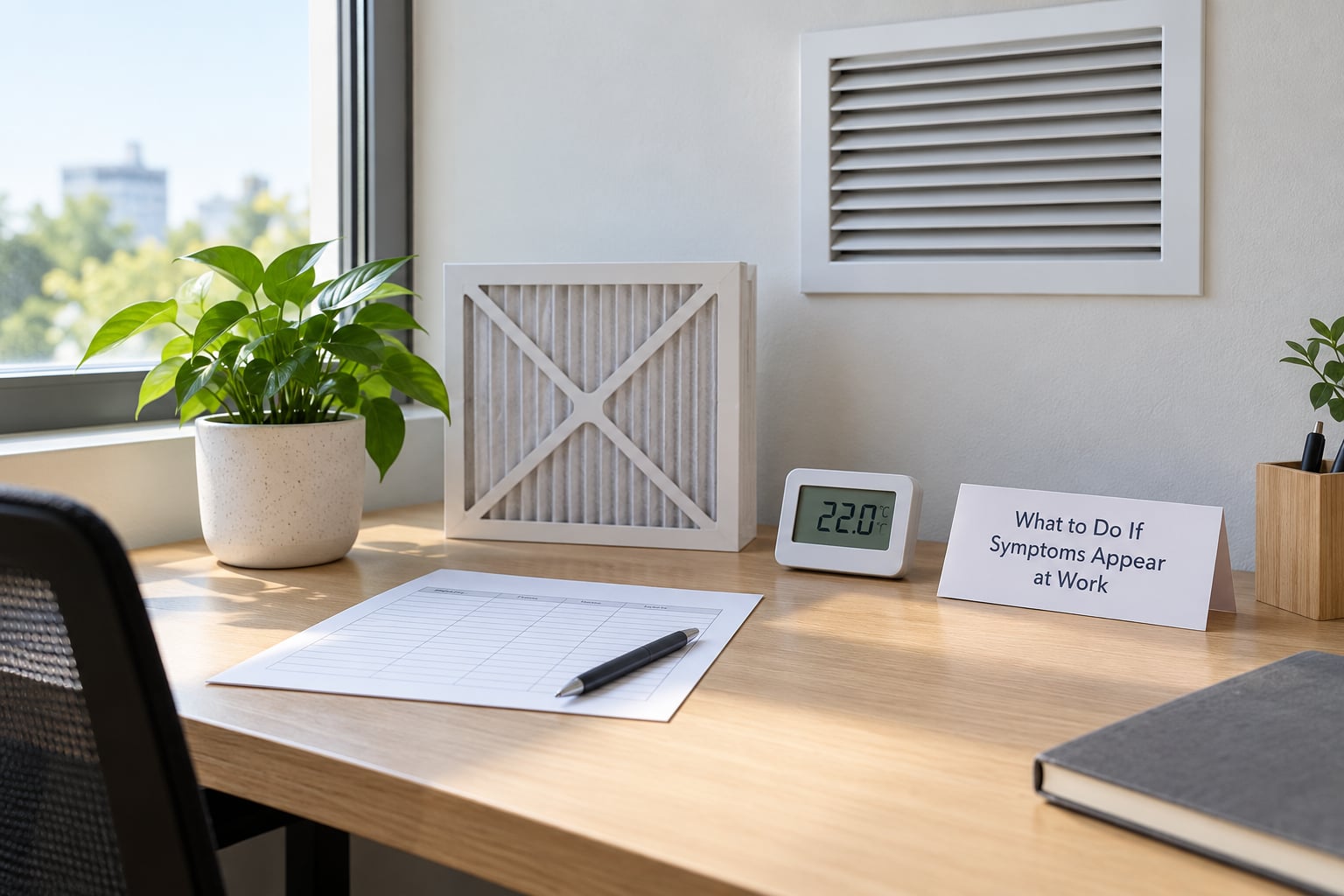
Move to fresh air, start a written record, and report it before you go looking for a diagnosis. Those three things cost nothing and they are what makes any later claim or claim for adjustments workable.
- Step away from the source. Step outside for a few minutes when symptoms start and note what happens. If a workspace move or a day working from home resolves it, that is useful information.
- Keep a dated symptom log. Record the date, time, location in the building, what you were doing, the symptoms, and the outdoor weather and air quality that day.
- Note triggers. Any refit, new furniture, new printer, cleaning product, temperature change or occupancy spike in the days before symptoms started.
- Report it in writing. Use email or your HR system rather than verbal only, so there is a dated record. Ask for a response.
- Survey co-workers. A simple question about who has felt unwell in the building, and when, turns an individual complaint into a pattern. Forum discussions on this topic reach the same conclusion consistently: group data moves faster than a lone report.
- Ask for an occupational health referral. If symptoms keep recurring, this puts the assessment with someone independent of the facilities team.
Avoid unnecessary exposure in the meantime. Open a window when outdoor air quality is good, take breaks away from the densest work area, and if you are an asthmatic or have a known chemical sensitivity, ask how your medication plan works if symptoms recur at work. Personal measures such as a portable HEPA unit in your work area can help with particles and dust, though none of them replaces fixing the ventilation.
If your employer offers remote or hybrid working, that is a legitimate adjustment to raise when symptoms are documented and recur. Ask about it as a temporary measure while the building is investigated, rather than as an exit route.
How Employers and Building Managers Can Investigate
A serious investigation treats the building as a system and measures it, rather than relying on whether anyone in the room feels fine. Any single person reacting in a shared space proves very little.
- Review the ventilation system. Check outdoor air delivery rates against occupancy, inspect dampers and grilles for blockage, confirm filters are within their service life, and look at whether fresh-air intakes sit near exhausts or traffic.
- Measure the space. Log carbon dioxide, temperature and relative humidity in occupied zones across a working day. CO2 is the easiest signal that a room is under-ventilated for how many people are in it.
- Review occupancy and timing. Map which zones and which hours show the highest readings, especially after occupancy spikes or seasonal changes to the air conditioning setpoint.
- Audit sources. Walk the space for cleaning chemicals in use, storage of solvents and adhesives, recent refits, new equipment, damp patches, water-stained ceiling tiles, visible mould and pest activity.
- Check maintenance records. Filter changes, duct servicing, water-leak history, humidifier and cooling-coil condition, and any seasonal setpoint changes.
- Involve a qualified indoor air quality professional. Independent testing is justified when symptoms persist, when mould or a chemical source is suspected, or when measurements confirm a problem.
- Communicate the findings. Tell occupants what was measured, what was found and what is being changed. People who can see the response tend to report less scepticism than people who only hear silence.
Several employer duties sit underneath this. US employers have a general duty to provide a workplace free from recognized hazards under the Occupational Safety and Health Act’s general duty clause, and reasonable accommodation may apply where symptoms meet the definition of a disability. In the UK, the Health and Safety at Work Act 1974 and the Workplace (Health, Safety and Welfare) Regulations 1992 require employers to maintain ventilation systems and to ensure a safe working environment. Rules and requirements vary by country and state, so get advice for your specific situation rather than relying on a general summary.
When to Seek Medical or Professional Help
See a clinician for symptoms that persist, worsen, or follow a pattern you cannot explain, and treat any of this article as general information rather than a diagnosis.
Prompt medical attention is warranted for severe or sudden symptoms such as breathlessness at rest, chest pain, wheezing, a fever with a productive cough, or confusion. Do not assume those are building-related until a clinician has assessed them.
Seek professional building or environmental assessment when there is suspected mould or damp, known or suspected asbestos, chemical exposure, standing water, a ventilation system that is not working, visible fumes, or symptoms affecting multiple people at once. These fall outside the definition of SBS and need qualified specialists: an industrial hygienist, a ventilation engineer, a damp-and-mould surveyor, or a relevant authority such as a local environmental health department or the Health and Safety Executive.
Two things are worth being clear about. Prolonged exposure to poor indoor air quality can aggravate asthma and allergies even where there is no single diagnosis, so existing conditions should be reviewed. And if you are in the UK, a doctor can request a statement of fitness for work or refer you under the fit note process if symptoms affect your attendance.
Frequently Asked Questions
How long do sick building syndrome symptoms usually last?
Symptoms typically ease within hours to a few days of leaving the building, and they resolve fully once the underlying air quality problem is corrected. There is no set recovery period because SBS is not a single disease. Some people notice lingering sensitivity to odors or chemicals for longer after prolonged exposure, so persistent symptoms after you have left the environment are worth raising with a clinician.
Can sick building syndrome symptoms happen at home as well as at work?
Yes. The pattern applies to any building, so the same symptom sequence can follow time spent in a home, school, care home or retail space. What matters is whether symptoms appear there and clear when you leave. If they show up in several unrelated buildings, the cause may be personal sensitivity, an allergy, or a medical condition rather than one specific property.
Is sick building syndrome contagious?
No. SBS is not an infection and it does not spread from person to person. Headache, fatigue, eye irritation and poor concentration have nothing to do with transmission between colleagues. Outbreaks of symptoms in a workplace usually reflect a shared environmental trigger such as ventilation, a chemical release or damp, which is why several people can be affected in the same space at the same time.
How can an employer test a building for causes of employee symptoms?
Start with measurements and records: outdoor air delivery rates, filter condition, and carbon dioxide, temperature and humidity logged in occupied zones over a working day. Then audit sources such as cleaning chemicals, new materials after a refit, damp and mould, and pests. If the data confirms a problem, or symptoms persist, commission an independent indoor air quality survey by a qualified professional.
What should I do if multiple coworkers develop headaches at the same workplace?
Collect the evidence together rather than separately. Run a short survey asking who has felt unwell, what symptoms, in which part of the building and on which dates, then present it to management as a group pattern with dates. Ask for a documented indoor air quality investigation and an occupational health referral for affected staff. Keep copies of every request and reply you send.
Can sick building syndrome symptoms be serious?
SBS itself is not a disease and is not usually dangerous, but the poor air quality behind it can be. Long-term exposure may aggravate asthma, allergies and eczema, and specific causes found during investigation can be serious, including Legionnaires’ disease from water systems, occupational asthma, hypersensitivity pneumonitis and asbestos exposure. Get medical assessment for symptoms that persist or worsen, and treat sudden breathlessness or chest pain as urgent.
What to Do First
If this describes you, start with three things: write down the pattern, report it in writing, and step out of the space when symptoms start. Documenting dates, locations and hours is what turns a feeling into something an employer or an occupational health professional can actually investigate, and it is far easier to build that record now than to reconstruct it later.
Then ask for the building to be measured rather than discussed. Carbon dioxide, temperature, humidity and filter condition in the zones people use will tell you more than any walk-round opinion. Related reading on this site covers asbestos awareness for building maintenance workers, which matters during any refit or refurbishment, and how to design a paid sick leave policy for the absence side of the problem.
And get the symptoms medically assessed rather than self-diagnosed. SBS settles when the air changes, but persistent or worsening symptoms deserve a clinician who can rule out the things that genuinely need treatment. This article is general information and not medical advice.