
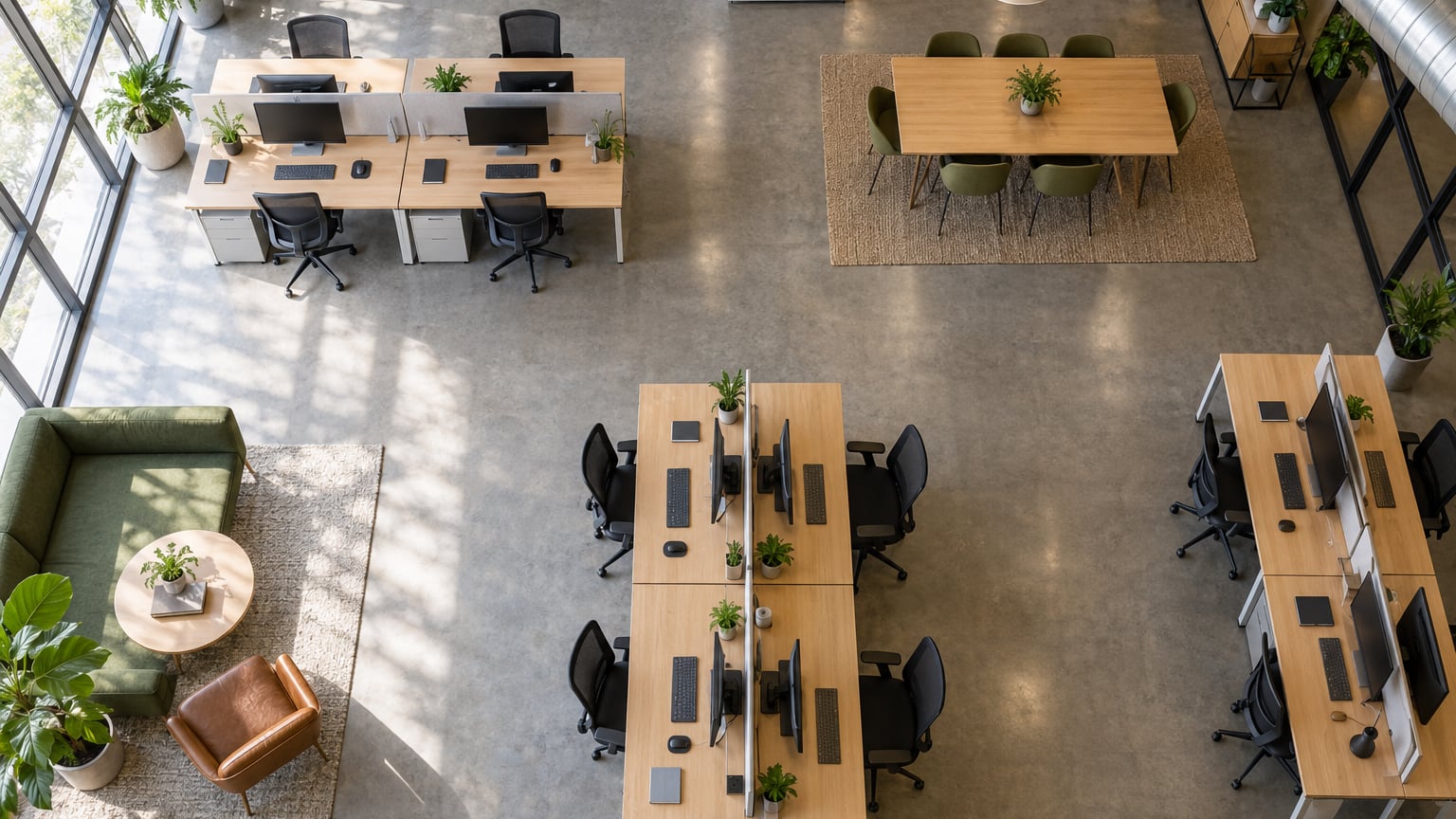
Open office health effects are the documented physical and psychological consequences of sharing one large room without private walls: more illness and more sick days, harder concentration, higher occupational stress, and a daily loss of control over noise, temperature, movement and privacy. Not every open office is harmful. The effect depends far more on how the room is run than on whether it has walls.
That distinction matters because the most-cited statistics in this debate are frequently quoted without their methods attached. Below is what the research actually supports, which claims deserve scepticism, and what employers and employees can realistically change in 2026.
Table of Contents
- Open Office Health Effects: What the Evidence Shows
- What workplace conditions may influence health?
- What are the most common physical and mental health concerns?
- How can an employer assess its own open office?
- Which changes can reduce open office health effects?
- What should employees do if they notice symptoms?
- Frequently Asked Questions
- Do open offices cause health problems?
- What is the most common open office health problem?
- Can noise and interruptions affect employee stress?
- Does an open office have worse air quality than a private office?
- Are open-plan offices better or worse for productivity?
- What can employers do to make an open office healthier?
- Conclusion
Open Office Health Effects: What the Evidence Shows
An open-plan office is a single shared space with few or no full-height partitions, so a worker is typically within sight and earshot of many colleagues. The layout spread from a 1970s Australian design idea called community osmosis, which argued that removing barriers would trigger useful spontaneous conversation. That was the theory. The measured reality was more complicated.
Bernstein and Turban, writing in Harvard Business Review, tracked employees before and after their firm converted to open plan and found face-to-face interaction fell by roughly 70 percent, with the reduction concentrated in the exchanges the layout was meant to encourage. So the core assumption behind most open offices was not supported by the data gathered after the move.
On the health side, the strongest recurring finding comes from sickness absence records. A study published in the Scandinavian Journal of Work, Environment and Health reported sickness absence around 62 percent higher for employees in open-plan offices. The important caveat is how that data was collected: participants self-reported how long they had been ill, which means the number is not a clinical measurement and not proof that the floor plan caused the illness.
Most of this literature is cross-sectional field study. It captures associations at one point in time, it leans on self-reported complaints, and it struggles to separate the layout from culture, management style, team size and how long people had worked in the space. If you want to know how to weigh a study before you act on it, our guide on how to read an occupational health study walks through the design types and what each one can and cannot show.
How open office health effects vary by worker
Two people at adjacent desks can describe completely different offices. What varies is the set of exposures each person is sitting inside: how much audible speech there is, how stale the air feels, how many visual triggers sit in the edge of vision, whether they can stand or move, how crowded the desk is, and whether confidential conversations are overheard.
Short-term and longer-term effects also need separating. A headache by 3pm from glare, or a lost afternoon to a loud phone call, is discomfort and recovery. Fatigue that never lifts, rising blood pressure readings, or a stretch of sick days is a different order of problem. Only the second group of patterns justifies a formal workplace health review, and even then an individual case needs a clinician, not a blog.
Susceptibility varies too. Some employees regulate themselves well in busy rooms and lose nothing. Others, particularly those who are introverted, autistic or otherwise neurodivergent, report that the same conditions cost them disproportionately. Employee adjustment for disability is a legal matter as well as a health one, and it does not reset just because a company moved desks around.
What workplace conditions may influence health?
Read the open office health effects as a set of conditions rather than a single outcome. The table below maps the conditions most often studied to what workers report and where the research is weakest.
| Workplace condition | What employees report | Strength and limits of the evidence |
|---|---|---|
| Noise and irrelevant speech | Harder concentration, irritation, raised stress | Consistently the most reported complaint. Veitch’s work at the National Research Council of Canada and Haapakangas’s studies of open-plan offices both point to intelligible speech, not loudness, as the problem. Mostly self-report and laboratory tasks. |
| Visual distraction | Attention pulled to movement in peripheral vision | Consistent in laboratory and field studies. Hard to isolate from noise because both occur together. |
| Ventilation and air quality | Stale air, afternoon sleepiness, complaints about odour | Direct CO2 and ventilation-rate measurement is uncommon in the popular literature. Occupancy density and fresh-air supply are measurable and worth checking. |
| Thermal comfort | Too warm, too cold, no ability to adjust locally | A Hong Kong Polytechnic University survey of 259 office workers found noise and temperature among the top sources of dissatisfaction. Self-reported, single workplace. |
| Movement opportunity | Long unbroken sitting, stiffness, restlessness | Prolonged sitting is well established as a risk factor. Linkage to a specific office layout is weaker than general guidance about sedentary work would suggest. |
| Social interaction | More incidental contact, but more overheard conversations | Bernstein and Turban found the extra contact did not appear. Several workers also report stress from overhearing colleagues’ medical, HR or disciplinary matters. |
| Workstation design | Neck, shoulder and wrist discomfort after a move | Related to desk, chair and monitor setup, which often changes at the same time as the layout. Engelen and colleagues’ active-design work links movement and light exposure to wellbeing measures. |
Illness transmission sits across all of these. Shared desks, keyboards, phones and break areas increase contact opportunities, and the research published since the pandemic makes the airborne route harder to dismiss than it was before. A widely repeated figure of 86 minutes a day lost to distraction, originally reported by the Canada Life Group, shows how the category is commonly used: it is a self-reported estimate, not a stopwatch study of open-plan floors.
What are the most common physical and mental health concerns?
Headaches and eye strain come up first in employee surveys, usually tied to glare, screen position and long uninterrupted focus blocks. They are common in any sedentary job and the open plan can make them worse, but they are not diagnostic of anything on their own.
Fatigue and reduced concentration are the complaints people describe most vividly. The mechanism researchers usually point to is that unattended speech captures attention without being consciously chosen, so the listener pays a small switching cost dozens of times an hour. Whether that shows up as reduced output depends on the task: it hurts work that needs 90 minutes of unbroken concentration more than it hurts a phone-based role.
Occupational stress follows from losing control of the environment. People in open plan describe the loss of choice over noise, temperature and social exposure as the core problem, more than any single irritant. Perceived lack of privacy is part of the same picture, and it is the piece most often left out of productivity conversations.
Illness and sickness absence round out the list. Higher self-reported sickness absence in open-plan offices is the most quoted finding in the field, and the recent framing of presenteeism, working while unwell because the office is shared, has attracted more attention since the pandemic.
For a wider view of how workplace exposures map onto symptoms, read Office Worker Health Risks Explained: Signs and Prevention. It is general information, not an assessment of any one person, and individual symptoms need a qualified health professional.
How can an employer assess its own open office?
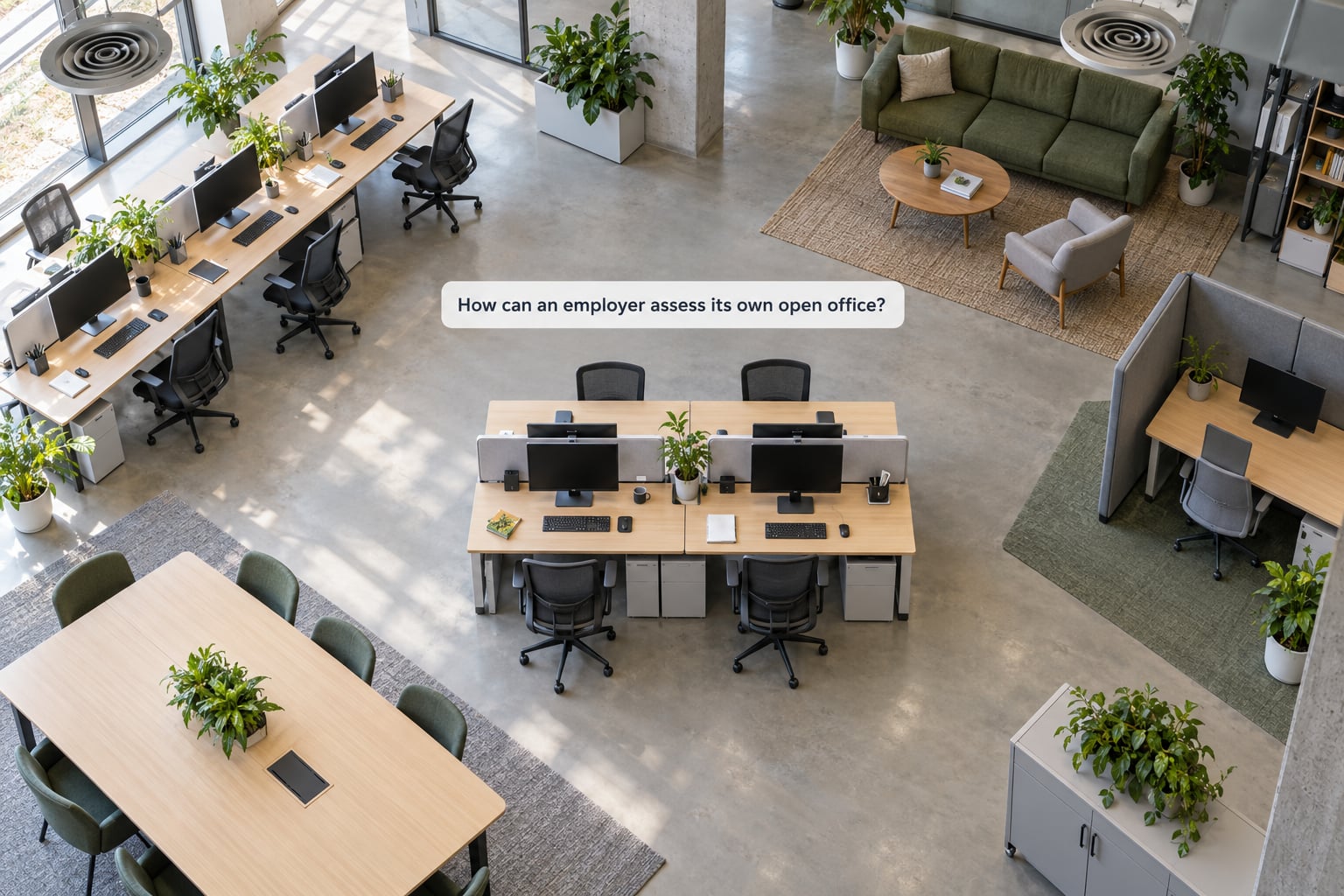
You do not need a consultant to get a useful read on the space. Six steps cover most of what matters, and the point is to run the same measurement before and after any change so you can tell whether the change worked.
1. Run an anonymous survey with one open question. Ask employees which specific conditions interfere with their health and focus, and let them rank three. Anonymous detail beats a generic satisfaction score every time.
2. Check occupancy and density. Count people per usable floor area and compare it with the space per employee the design assumed. Cramped floors concentrate every other exposure on this list.
3. Measure ventilation rather than assuming it. Log outdoor air supply per person, and sample CO2 in the afternoon at desk height in the densest zone. Elevated afternoon readings usually point to an undersized system rather than bad intentions.
4. Observe noise for a day. Log dB(A) and, more usefully, how often intelligible speech falls within earshot of a workstation. That count is what workers actually complain about.
5. Audit movement. Count how many desks have sit-stand capability, whether a quiet room exists and how often it is booked, and how long people can sit without getting up.
6. Repeat the survey and the measurements after changes land. Report the before-and-after numbers internally, including the ones that did not improve.
Which changes can reduce open office health effects?
Prioritise by exposure size. Sound travels further and annoys more people than almost anything else on the list, so acoustics usually come first.
Noise control: put absorptive material on the ceiling plane and on hard surfaces rather than only in the ceiling tile, set up a genuine quiet zone with a booking rule, and agree a team norm for holding calls away from desks. Measure it with the same speech-count and dB(A) log you used before.
Ventilation: raise outdoor air per person and fix diffuser placement so supply reaches occupied zones. Measure the afternoon CO2 reading in the same spot as your baseline.
Flexible seating and activity-based zones: give employees a choice of zone by task, including solo focus work, rather than a default assigned desk. Measure booking distribution by zone type. A space nobody books was not designed for the right task.
Movement: make sit-stand desks the default where possible, and protect short movement breaks from meeting culture. Measure the proportion of desks with sit-stand capability and track reported musculoskeletal complaints through your existing reporting route.
Meeting practice: put agendas and a clear finish time on invitations, and keep the room count in line with how many people are actually in the office that day. Fewer, shorter meetings cut both the noise and the sitting.
Privacy options: provide bookable rooms for confidential calls and for HR or medical conversations, and stop treating a full desk row as private. Measure how long a confidential call can be held before someone gives up and takes it outside.
Participation: involve employees in the diagnosis rather than announcing fixes. The 2026 return-to-office and hybrid debates consistently show that what people ask for is choice about where they work, not a better version of the same floor.
Workstation design is part of the same project. Our office ergonomics checklist for desk workers covers the desk, chair and screen setup that tends to shift during a move.
What should employees do if they notice symptoms?
Start by writing down what you notice and when. A short record of headaches, fatigue or focus trouble alongside the day’s conditions is far more useful later than a memory of a bad month, and it is the starting point most occupational health processes expect.
Next, adjust what you control. Reposition your monitor to cut glare, use noise-cancelling or masking headphones if speech is your problem, take movement breaks, and use any focus space the office offers. Workstation setup is worth getting properly assessed rather than guessed at.
Then raise it through your employer, with specifics. Name the condition, the date and the location. Ask for a quiet space, a change of zone, or an occupational health referral. Under disability accommodation duties, neurodivergent employees can ask for adjustments to be reviewed after an office change rather than treated as a one-off.
Speak to a qualified health professional about persistent or concerning symptoms. Nothing in this article is a diagnosis, and a doctor, nurse or occupational health clinician is the right route for anything that keeps recurring or affects your daily functioning.
Do not wait on urgent warning signs. Chest pain, severe shortness of breath, fainting or similar acute symptoms need immediate medical attention, and any suspected workplace cause should be raised with your employer and, where relevant, your safety representative afterwards.
Frequently Asked Questions
Do open offices cause health problems?
The research shows a consistent association, not proven causation. Employees in open-plan offices report more illness, more sick days, more noise complaints and more stress than those in private offices, but most studies are cross-sectional and rely on self-reported symptoms. Occupancy, ventilation, acoustics and management culture all shape the result, so a well-run open plan and a badly run one produce very different experiences.
What is the most common open office health problem?
Noise-driven loss of concentration is the complaint reported most often across the research and in employee forums. The specific problem is intelligible speech rather than loud volume, because the brain tracks and processes language it can partly hear. Head and eye strain follow, usually tied to glare and long unbroken stretches of screen work rather than to the shared floor itself.
Can noise and interruptions affect employee stress?
Yes. Environmental psychologists including Veitch and Haapakangas have linked irrelevant speech to physiological stress responses in open offices, and workers routinely describe fatigue, irritation and a sense of not being able to switch off. Cost matters too: an interruption is cheap to give and expensive to recover from, so frequent small interruptions add up across a working day.
Does an open office have worse air quality than a private office?
It often does, mainly because more people share the same outdoor air supply and the same volume of air, so CO2 and other indoor pollutants build up faster. Density is the deciding variable, not the desk style. This is also the easiest factor for an employer to check and fix, since outdoor air per person and afternoon CO2 readings can be measured directly.
Are open-plan offices better or worse for productivity?
The balance depends on the work. Studies from Virginia Tech and North Carolina State, and work reported by Michigan State’s Center for the Study of Inequality in Higher Education, found lower satisfaction and performance in open settings. Against that, recent global survey data finds a majority of employees feel more productive in the office than at home, so the case is not one-sided.
What can employers do to make an open office healthier?
Start with the biggest exposures: acoustic treatment, a genuinely bookable quiet zone, and higher outdoor air supply per person. Then give employees choice of zone by task, protect movement breaks, and stop treating an open desk as a private space. Measure the same noise, air and survey numbers before and after, and publish the results, including the changes that did not work.
Conclusion
Ask employees which specific open office conditions interfere with their health and focus, then pick the two or three that come up most and fix those first. Noise and ventilation usually lead, and both can be measured before and after so the result is evidence rather than opinion.
Open offices are a set of conditions, not a verdict. A floor with acoustic treatment, adequate fresh air, real choice of space and someone actually measuring the conditions is a different workplace from a packed, echoing, all-desks-identical one.