
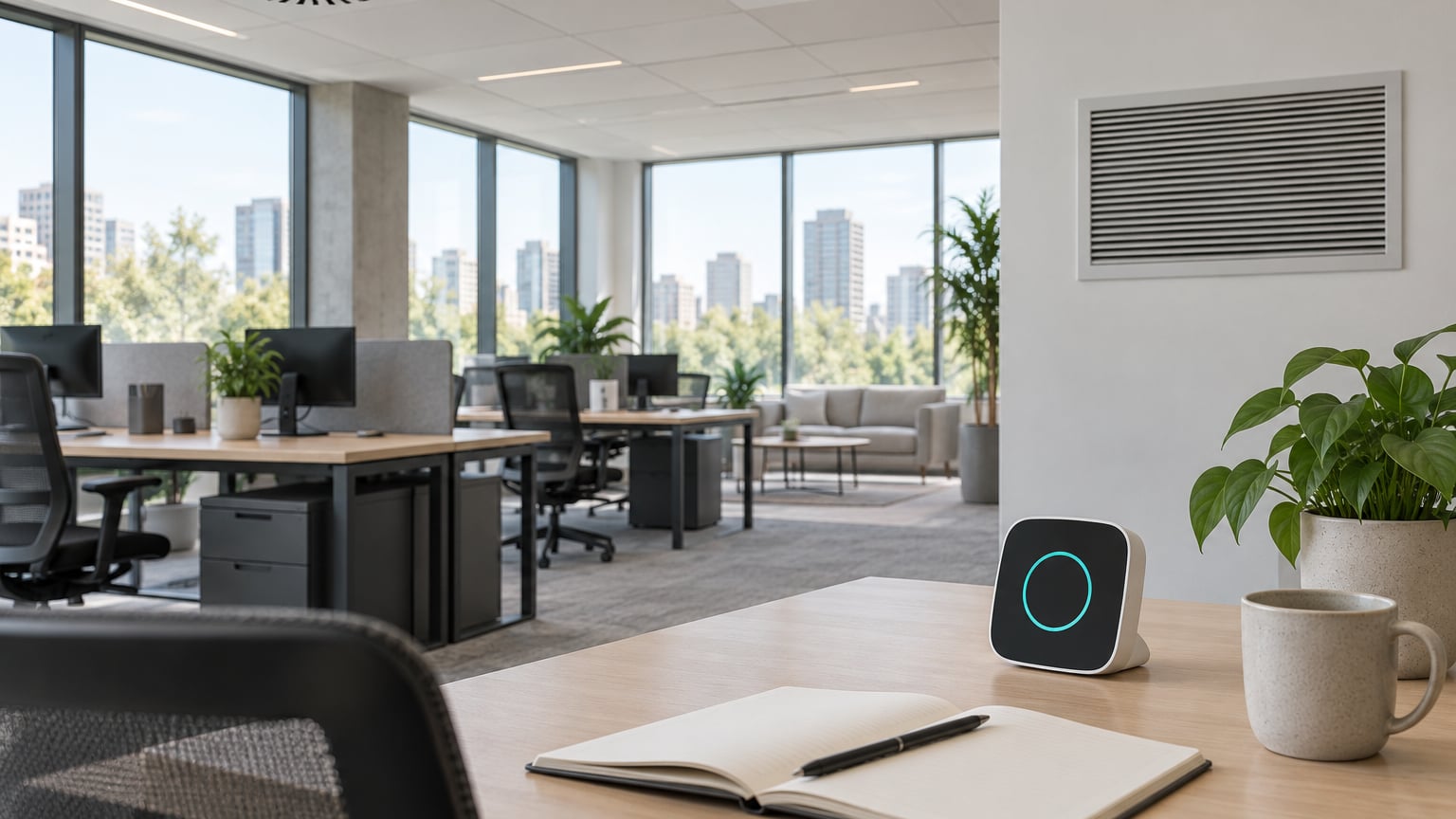
To improve ventilation in an office, work in this order: find where air is blocked, get a carbon dioxide baseline, fix the airflow paths, upgrade filtration to match the system, remove pollution sources, improve circulation, keep the system maintained, then verify with measurements. Most offices are not short of equipment. They are short of air getting from somewhere to somewhere.
Do it over a few days rather than in an afternoon. Steps one and two are free and tell you where the problem actually is, and every later step is cheaper when you know whether the issue is air volume, air quality or a source you can remove. Updated for October 2026.
Table of Contents
- What You Need
- Step-by-Step
- 1. Identify Airflow Problems and Pollution Sources
- 2. Measure Occupancy and Existing Ventilation Performance
- 3. Keep Supply Vents and Return Paths Clear
- 4. Upgrade HVAC Filtration Responsibly
- 5. Reduce Pollution Sources at the Source
- 6. Improve Air Distribution and Circulation
- 7. Maintain the System and Set Review Intervals
- 8. Verify That the Office Is Better Ventilated
- Common Mistakes
- Frequently Asked Questions
- Conclusion
What You Need
Before touching a setting or ordering anything, gather five things. Most are free and take an afternoon.
- Occupancy and layout notes. Head count per room, hours of use, where desks and partitions sit, and any recent reconfiguration. Moving partitions changes airflow patterns, which is why the original design assumptions stop holding.
- Baseline observations. A walk-through at three points in the day: mid-morning, early afternoon and late afternoon. Note odours, dust, temperature differences between zones and which areas feel stuffy.
- Carbon dioxide monitoring where appropriate, either a personal monitor you can relocate or a low-cost fixed unit for the room you suspect.
- Filter and HVAC records. The filter specification for the unit, the last change date, the run schedule and any maintenance log the building keeps.
- Access to the right professional. A qualified HVAC technician for mechanical work, and an industrial hygienist or ventilation consultant if people report symptoms that cluster in one room.
If you are an employee rather than the person who controls the building, that last item is the honest limit of your role. You can document conditions and raise a written request. You cannot change filters or dampers.
Step-by-Step
1. Identify Airflow Problems and Pollution Sources
Start by standing in the room for five minutes and looking for the obvious. Supply diffusers blocked by stacked boxes or a cabinet. Return grilles hidden behind a partition or a reconfigured desk bank. These are common in offices that were reorganised over a few years without anyone rechecking the airflow design.
Then look for pollution sources. Printers and copiers in a small room, cleaning chemicals stored in a closet without ventilation, an upholstered seating area off-gassing after a refurbishment, dust from construction nearby, and vaping or smoking on a balcony door that stays propped open. Fragrance diffusers and scented candles add their own VOC load and are worth removing as a first experiment, since people often assume a room smells worse because it is dirtier when the odour is manufactured.
Success check: you can name the specific locations where air enters, the specific locations where it leaves, and at least two pollution sources with locations.
2. Measure Occupancy and Existing Ventilation Performance
Record how the room is actually used, not how it was designed to be used. A six-person meeting room booked for twelve people at four in the afternoon is a ventilation design problem expressed as a booking problem.
Compare occupied and unoccupied conditions. If you can, take a reading with the room empty and sealed early in the morning and another after two hours with people in it. The gap tells you how much fresh air is arriving, and it needs no expensive equipment to reveal.
These are the numbers most useful when you are arguing for a change or briefing a contractor.
| Measure | Good | Acceptable | Poor or very poor | Source |
|---|---|---|---|---|
| Carbon dioxide (CO2) | Below 600 ppm | 600 to 1,000 ppm | Above 1,000 ppm; above 1,500 ppm is very poor | CIBSE guidance |
| Outdoor air supply | 20 CFM per person | 10 to 20 CFM per person | Below 10 CFM per person | ASHRAE Standard 62.1 |
| Fresh air per person (UK practice) | 10 litres per second per person | 5 to 8 litres per second per person | Below 5 litres per second per person | HSE and Building Regulations |
| Relative humidity | 40 to 50 percent | 30 to 60 percent | Below 30 or above 60 percent | ASHRAE Standard 55 |
| Temperature | 68 to 76 degrees F | Below 76 degrees F | Above 78 degrees F, with complaints | ASHRAE Standard 55 |
| Air changes per hour for offices | 6 to 8 ACH for general office space | 4 to 6 ACH | Below 4 ACH | Common design practice |
CO2 is a proxy, not a pollutant. It matters because it rises in proportion to how little outdoor air reaches the space, so it is the most reliable single indicator of ventilation adequacy in an occupied room. It does not tell you about dust, chemicals or gases, which is why it cannot be your only check.
Success check: you have a written baseline with a date, a room, an occupancy count and a reading.
3. Keep Supply Vents and Return Paths Clear
This is the cheapest improvement available and it is regularly undone by an office move. Walk every supply diffuser and return grille. Furniture, tall partitions, filing cabinets, whiteboards and stacked archive boxes all restrict airflow, and a blocked return is worse than a blocked supply because the air has nowhere to go.
Two checks worth doing by hand: hold a strip of tissue near a supply diffuser and watch whether it moves steadily rather than weakly, and check whether you can feel air at a return grille. Neither is a substitute for testing, but both catch a blocked path immediately.
Move the obstruction, not the ductwork. If clearing the path requires shifting heavy equipment, moving a partition or touching ductwork, involve facilities staff first.
Success check: every diffuser and grille visible and clear, with airflow at each one that feels steady.
4. Upgrade HVAC Filtration Responsibly
Check what filter the unit takes before ordering anything. The specification is usually on the unit label, in the maintenance log or in the building’s O&M manual, and it may include a maximum MERV or FEV rating that the fan is not designed to pull against. A denser filter raises the pressure drop across the filter bank and can reduce the total outdoor air delivered.
A MERV 13 filter captures fine particles well. HEPA filtration is used in portable cleaners and in higher-grade units. Both catch particles. Neither brings in fresh air, neither removes CO2, and neither touches most gases or VOCs, which is why a filter upgrade is a genuine improvement and still an incomplete answer to a ventilation deficit.
Skip filters that collect dust but have not been changed for months, since airflow drops long before anyone notices the filter.
Success check: filters match the manufacturer’s specification and the change date is on record.
5. Reduce Pollution Sources at the Source
Ventilation dilutes pollution. Source control removes it, and it is usually the better return per pound.
- Move printers and copiers into a ventilated room or to a supplier-managed print hub, rather than a small enclosed copy room.
- Choose cleaning products with low or no VOC content, and keep them closed when not in use.
- Ban scented candles and plug-in fragrance diffusers in shared spaces.
- Keep smoking and vaping entirely outside the building envelope, including at doors and loading areas.
- Use dust control during construction and fit-out: seal off the work area and run the space for several days before occupancy.
- Ventilate after a refurbishment far longer than feels necessary. Off-gassing from new carpet, paint and adhesives can persist for months, and occupants stop noticing before the source stops emitting.
Post these as workplace policy rather than personal preference, so cleaning contractors and new starters follow the same rule.
Success check: the same pollutant source is no longer present in the space, and the odour or dust complaint attached to it has stopped.
6. Improve Air Distribution and Circulation
Where windows open, cross-ventilation is the cheapest real ventilation there is. Open openings on opposite sides of the room so air has a path through it rather than a dead pocket. The technique that works best is a narrow inlet and a wider outlet: a small opening on the windward side draws air in, and a wide opening on the leeward side lets it leave. Openings on adjacent walls create a corner recirculation instead of a flow.
Short and often beats long and rare. Two five-minute airings each hour clear a room far better than one ten-minute airing, because CO2 accumulates continuously with occupancy and only clears when air moves.
Inside, ceiling fans and air circulators move air around a room, which improves comfort and evens out temperature. They do not add a single cubic foot of outdoor air. Treat them as comfort tools, not ventilation tools, and never rely on a circulator in place of fixing a supply path. If you are chasing the comfort side of the problem, our guide to an office ergonomics checklist for desk workers covers the workstation adjustments that cost nothing, starting with how to adjust an office chair correctly, step by step.
Airflow balancing, damper adjustment, duct modifications and anything that changes the system design belong to a qualified HVAC professional. So does diagnosing a room that is over-pressurised, which often means another exhaust system is overpowering the supply and pulling air, and moisture, in from outside.
Success check: the CO2 reading drops during occupied hours, and the difference between the stuffiest corner and the freshest corner of the room narrows.
7. Maintain the System and Set Review Intervals
Improvements decay without a routine. Put this on a shared checklist with an owner against each line.
- Monthly: check filters visually, confirm the schedule ran, look for blocked diffusers and grilles after any office move.
- Every one to three months: change filters on the interval the manufacturer specifies, and clean coils and drain pans as part of a service visit.
- Twice a year: have the outdoor air intake, economiser dampers and run schedule checked by the technician, and confirm the unit is actually delivering outdoor air rather than only recirculating.
- On any layout change: re-check airflow paths and the affected room’s CO2 reading.
- Annually: repeat the measurements in step two and compare against the baseline.
Rotate responsibility rather than appointing one enthusiast. Cleaning staff and anyone doing evening office moves can check a diffuser in ten seconds.
Success check: the checklist has a date on it and the last completed entry is within the interval.
8. Verify That the Office Is Better Ventilated
Repeat the measurements from step two in the same rooms, at the same times, with a similar number of people in them. A monitor placed on a desk near a window measures that desk, not the room, so keep the position consistent between baseline and follow-up.
Look at the shape of the daily curve rather than a single number. Good ventilation shows a rise in CO2 during occupancy and a fall shortly after the room empties. A flat high line that never falls points to a delivery problem. A curve that climbs steadily all day points to insufficient outdoor air for the head count.
Watch for the qualitative changes too: fewer odour complaints, less dust on surfaces near the diffusers, fewer afternoon headaches reported in one room but not another.
Ask staff what changed, in writing, and keep the readings beside the complaints. Documented data is what turns a dismissed complaint into a facilities ticket. If symptoms continue after the air reads well, escalate to an industrial hygienist, because at that point the problem may be a source that CO2 cannot see. Office worker health risks explained: signs and prevention sets out which symptoms are worth taking seriously and which of them belong in a facilities ticket rather than a medical note.
Success check: the follow-up readings sit in the good or acceptable column of the table, and the complaints have dropped or shifted.
Common Mistakes
Changing filters without checking the specification
A denser filter than the unit is designed for can reduce airflow and may damage the system. Check the rating on the unit and match it, and note that filtration removes particles rather than supplying fresh air.
Pushing equipment up against a vent
Furniture against a supply diffuser or a return grille is one of the most common causes of a poorly ventilated office, and it usually arrives with a reconfiguration nobody re-checked. Walk the vents after every move.
Assuming more fans mean cleaner air
Circulators and ceiling fans redistribute air already in the room. They do not remove CO2, dust or VOCs, and they can push air from one person’s desk across the whole floor.
Masking an odour with fragrance
A scented diffuser covers a ventilation or source problem while adding VOC load. Remove it and let the room smell like the room.
Making do-it-yourself duct changes
Adjusting dampers, removing duct sections or adding a fan to a duct can unbalance the system and affect other tenants in a shared building. This is licensed work in many jurisdictions and skilled work in all of them.
Assuming it is always a ventilation problem
Stale air after a refurbishment is often off-gassing, not under-ventilation. A blocked return grille looks like a ventilation problem. Exhaust fans from a kitchen or copy room can depressurise an office and pull humidity into the building fabric. Diagnose before you spend.
Ignoring occupancy changes
Four people in a room designed for eight need half the air. If head count doubled when the floor was reconfigured, the ventilation rate needs revisiting, and a room booking policy is often the cheapest fix available.
Frequently Asked Questions
How do I fix poor ventilation in an office?
Start by identifying where supply and return vents are and whether anything blocks them, then take a carbon dioxide baseline in the room during normal occupancy. Clear obstructions, open opposite windows for cross-flow where possible, extend the HVAC run schedule, and match filters to the manufacturer’s specification. Cut dust, cleaning chemicals and equipment emissions at the source. Repeat the readings afterwards to confirm improvement rather than assuming it.
Is there a way to test air quality in an office?
Yes. Carbon dioxide monitors give the clearest picture of ventilation adequacy because CO2 rises in proportion to the amount of outdoor air reaching a room. Place one at seated head height, away from a supply diffuser, a door opening or a direct breath, and take readings at the same times on the same days. Add a temperature and humidity reading, and consider particulate monitoring where dust or construction is nearby.
What CO2 level is acceptable in an office?
CIBSE guidance puts a well-ventilated room below roughly 600 ppm, with readings up to 1,000 ppm still broadly acceptable and anything above 1,500 ppm considered poor. Ventilation assessment benchmarks generally aim to keep CO2 below about 1,000 ppm in occupied space. A single reading means little; the pattern across a working day tells you far more about how much outdoor air is actually arriving.
Do air purifiers improve ventilation?
No. Purifiers and upgraded filters capture particles, and HEPA units capture fine particulate well, but they do not supply outdoor air and they do not remove CO2. They are a useful supplement in a dusty or filtration-constrained room, yet they cannot fix a ventilation deficit. If CO2 readings stay high, the answer is more outdoor air or fewer occupants in the room, not a cleaner filter.
How many air changes per hour should an office have?
General office space is commonly designed for roughly 6 to 8 air changes per hour, with 4 to 6 ACH acceptable where occupancy varies. ACH describes how many room volumes of air are replaced in an hour, counting both outdoor air and filtered recirculation, which is why it can look adequate on paper while CO2 readings climb. Check the outdoor air rate per person as well, since that is what actually dilutes occupancy.
How do I get more airflow into a room with no windows?
You need mechanical supply air, and that means the HVAC system, a transfer grille from an adjacent space, or a ducted fresh-air unit serving that room. Work out how much outdoor air is already arriving by checking the outdoor air rate per person against the head count. If the system cannot deliver more, reducing occupancy in the room or using it for tasks that need less air are the options that cost nothing.
Conclusion
The first move costs nothing: walk the room, find the supply and return paths, write down the head count, and take a carbon dioxide reading during a normal working afternoon. That baseline tells you whether you have an air volume problem, a source problem or a system fault, and it decides which of the remaining seven steps you actually need. Buy equipment only after you know which one.