
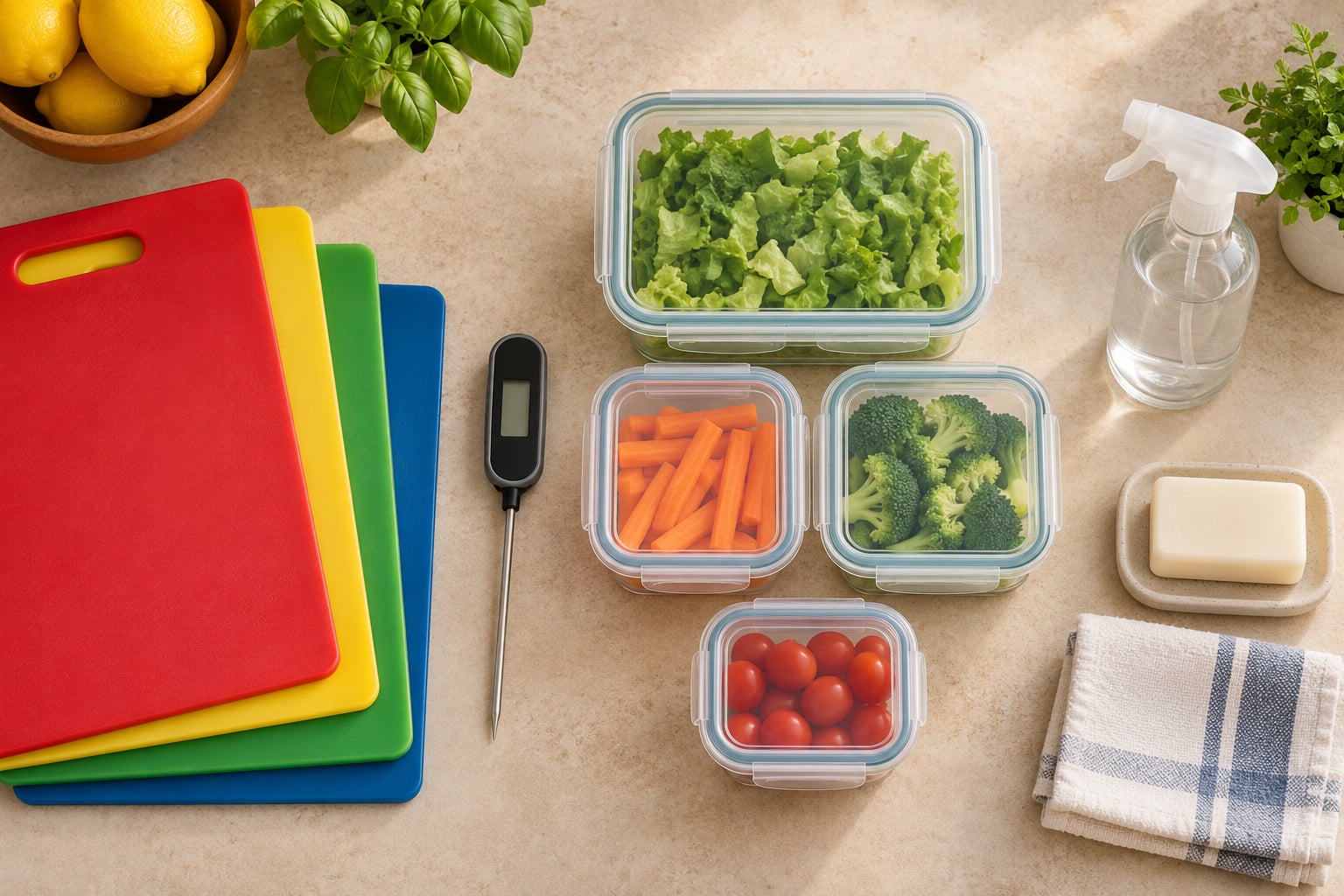
Cross-contamination happens when bacteria, viruses, chemicals or allergens move onto food that will not be cooked again, and the fix is mostly about three habits: wash hands with soap for 20 seconds, keep raw meat and its juices away from ready-to-eat food, and clean and sanitize the tools and surfaces in between. Most home kitchens already have what they need to do this well. The setup takes about ten minutes once, and the routine after that is a couple of minutes a day.
It is worth being honest about what actually causes foodborne illness at home. Surfaces do not have to be sterile. The risk concentrates where raw protein touches food that will be eaten straight away, because cooking kills bacteria on a steak but will not remove toxins already formed in a salad bowl.
If you only change three things this month, change these:
- Use a separate cutting board, knife and utensils for raw meat, poultry and seafood, and a different set for bread, salad, fruit and other ready-to-eat food.
- Wash your hands with soap and water for at least 20 seconds before and after handling raw protein, and again after the phone, the pet, the bin or a child.
- Store raw meat sealed in a leak-proof container on the lowest fridge shelf, below anything you plan to eat uncooked.
The nine steps below walk the whole workflow, from the shopping bag to the moment you reopen the kitchen for the next meal.
Table of Contents
- What You Need
- Step-by-Step
- 1. Wash Your Hands Before Handling Food
- 2. Separate Raw and Ready-to-Eat Foods
- 3. Use Separate or Sanitized Equipment
- 4. Clean and Sanitize Surfaces Between Tasks
- 5. Store Ingredients in Covered, Labeled Containers
- 6. Prevent Raw Juices from Leaking
- 7. Cook Foods to Safe Internal Temperatures
- 8. Clean Up Immediately After Raw-Food Handling
- 9. Reopen the Kitchen Only After Cleanup
- Common Mistakes: Where Cross Contamination in the Kitchen Comes From
- Frequently Asked Questions
- Do I really need separate cutting boards, or is washing in between enough?
- Should I wash raw chicken before cooking it?
- What is the difference between cleaning and sanitizing a kitchen surface?
- How far should raw meat be from ready-to-eat food in the fridge?
- Do gloves prevent cross-contamination in the kitchen?
- How can I keep cross-contamination under control in a small or shared kitchen?
- Conclusion: Start With Separation and Clean Hands
What You Need
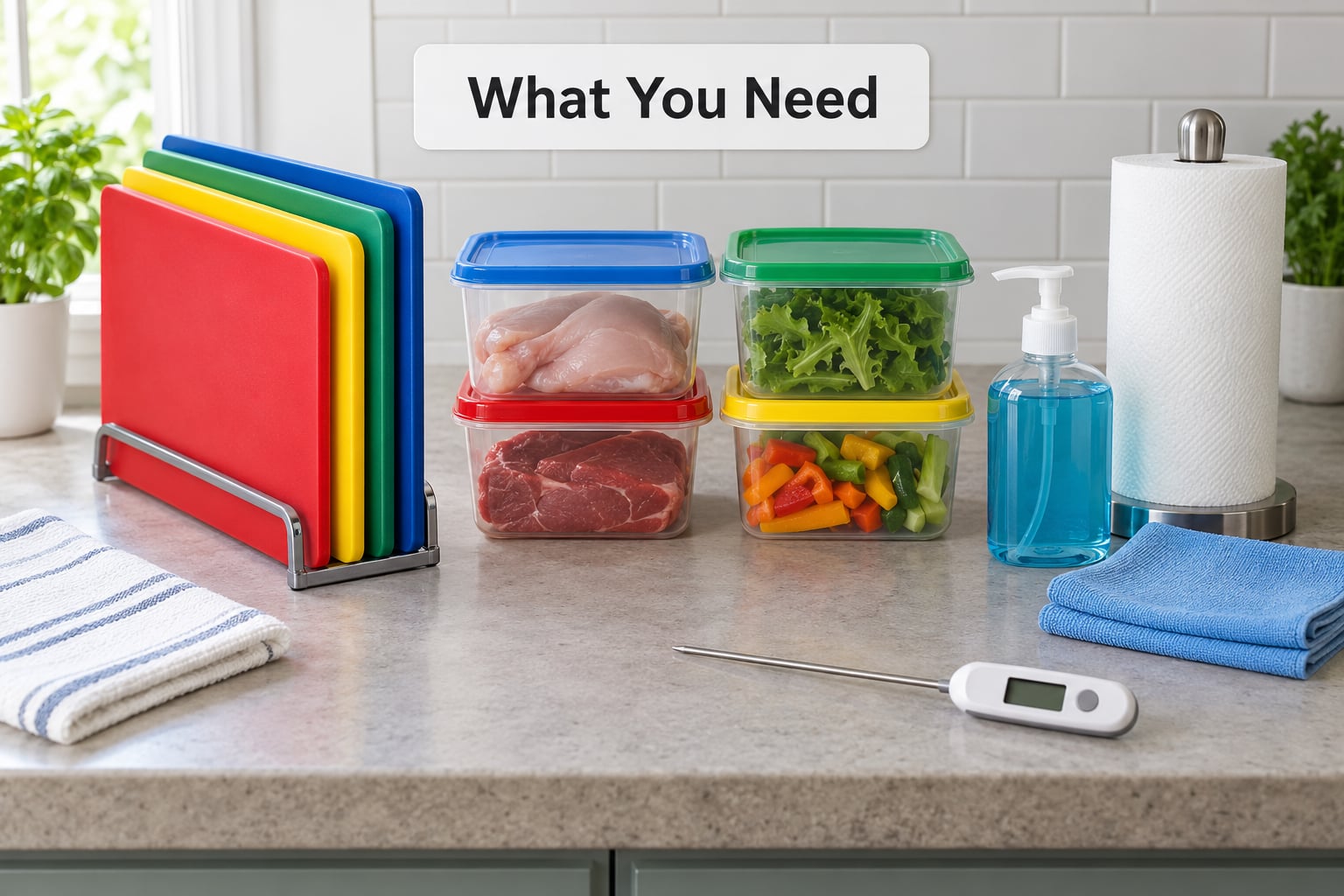
You do not need a commercial kitchen to get this right. You need a small number of dedicated tools and one habit that is hard to skip.
- At least two cutting boards. One for raw meat, poultry and seafood, one for produce, bread and ready-to-eat food. If you also cook for someone with coeliac disease or a serious allergy, a third board makes life easier.
- Dedicated knives and utensils. Keep the raw-protein knife and tongs in the same drawer or block as the raw board so the pairing is obvious.
- Leak-proof storage containers and a rimmed tray. Both are worth having; the tray catches drips even when the packaging splits.
- An instant-read thermometer. This is the single tool that turns a guess into a reading, and it is the one most home kitchens skip.
- Hot, soapy water, a clean cloth or paper towel, and a sanitizer with a printed contact time. Wiping with a damp cloth is cleaning. A sanitizer needs to stay wet on the surface for the time printed on the label to work.
- Liquid soap and a hand towel that gets laundered. A towel used to dry raw hands and then to dry a clean plate defeats the whole routine.
- A damaged-food bin and a fridge thermometer. Swollen or dented cans, split packages and leaking containers go out, not back on the shelf.
Color-coding is optional but it works, because the cue does the remembering for you. Red for raw meat, yellow for poultry, blue for seafood, green for produce, white for dairy and bakery. Households that switch to this system report fewer mix-ups than households that rely on remembering.
Step-by-Step
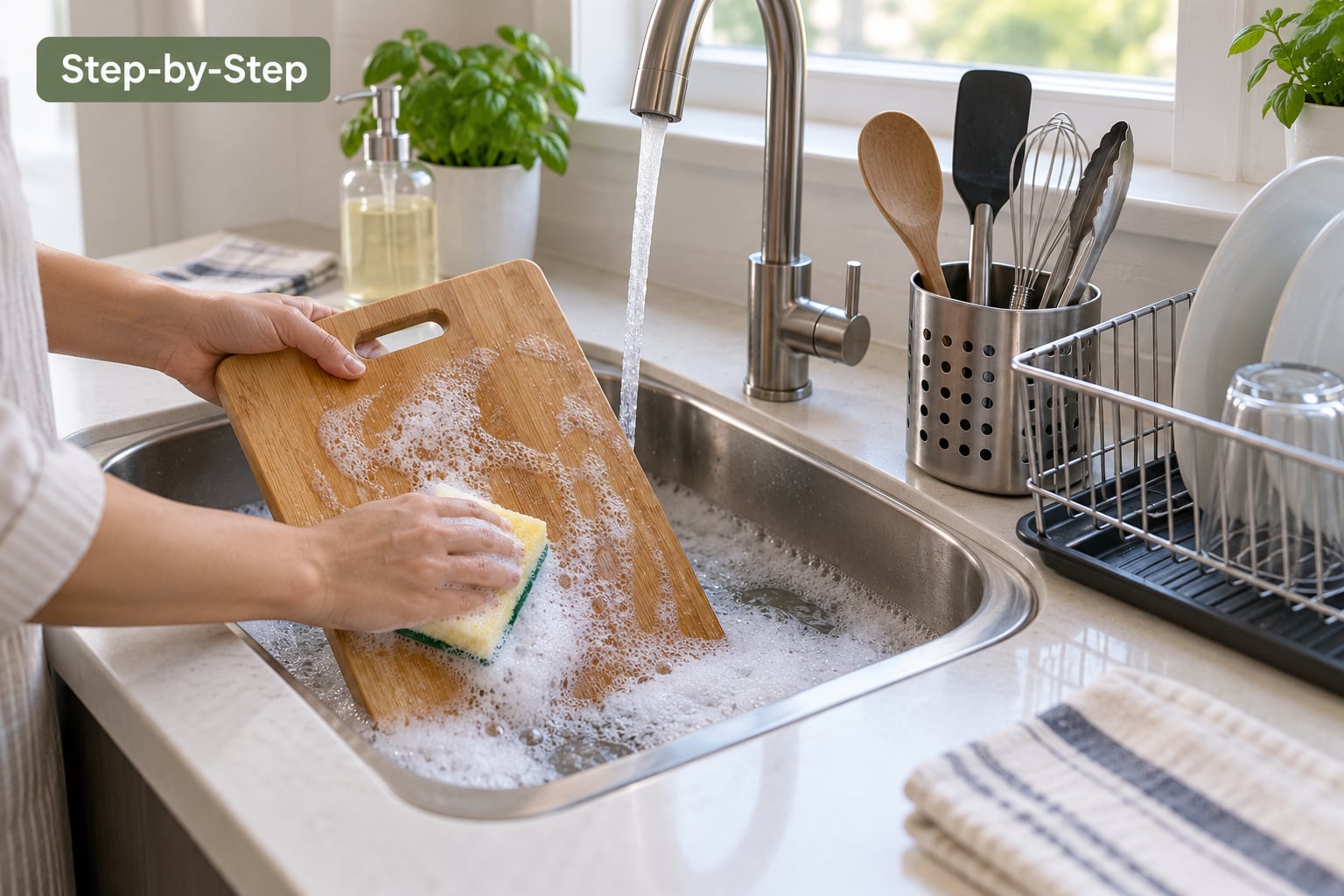
Work through these in order. The order matters as much as the steps themselves.
1. Wash Your Hands Before Handling Food
Wet hands, lather with soap, scrub palms, backs of hands, between fingers and under nails for at least 20 seconds, then rinse and dry. The CDC puts the 20-second figure on every handwashing instruction, and it is the number to build the habit around.
Wash before you start, and wash again after the restroom, after raw meat, poultry, seafood or eggs, after handling dirty dishes or the bin, after money or the dishwasher door, after a break, and any time a phone, a pet or a child enters the prep zone. Sanitizer is for when there is no sink. It is not a substitute for soap and water after raw protein.
You know it worked when your hands are slippery from the scrubbing time, not just wet.
2. Separate Raw and Ready-to-Eat Foods
Ready-to-eat foods are the ones eaten with no further cooking: salad, cut fruit, bread, cooked rice, cheese, cold dips and anything a guest handles. Give them their own zone, physically as far from the raw-protein area as the kitchen allows.
In the fridge, raw meat sits on the lowest shelf in a sealed container. Cooked foods and ready-to-eat items go above. In a small kitchen where the lowest shelf is also where the crisper sits, a sealed tray inside the fridge still beats an open package on a middle shelf.
3. Use Separate or Sanitized Equipment
Separate is cleaner than sanitized, because it removes the decision. If you do share, the swap has to be deliberate: wash the board, knife and tongs with hot soapy water, rinse, sanitize, and let the contact time on the label run out before the next food goes on.
A knife that cut raw chicken and then goes straight into a tomato is the classic case. Washing it under the tap for a few seconds is not the same thing.
4. Clean and Sanitize Surfaces Between Tasks
The order is fixed. Scrape or wipe away debris, wash the surface with hot soapy water and a cloth, rinse with clean water, then apply sanitizer and leave it wet for the full contact time printed on the label. Wipe dry with a clean paper towel or a laundered cloth.
Target the areas people forget: cutting board grooves, knife handles, the underside of the sink rim, faucet handles, the refrigerator door gasket, can openers and the small gap behind the stove.
5. Store Ingredients in Covered, Labeled Containers
Cover everything. Moisture and drips are how raw juices travel to produce and cooked food, so a covered container ends the route before it starts.
Label with what it is and the date it was opened or prepared. Dating also answers the use-by question later, since a package you cannot identify gets thrown out and a package you can identify often still has a few safe days left. Follow best-before dates for quality and use-by dates for safety, and check the package instructions for the food you have.
6. Prevent Raw Juices from Leaking
Put raw meat and poultry in a leak-proof container, then set that container on a rimmed tray or in a second bowl. Seal the package with clips if the tray does not close.
When a package splits in the fridge or on the counter, deal with it right away: discard the food if it has contacted the shelf liner or other items, remove and clean or discard the packaging, and clean and sanitize the shelf and anything that sat near it. Refrigerator shelves are porous enough that a wiped stain is not the same as a cleaned surface.
7. Cook Foods to Safe Internal Temperatures
Cooking is the final barrier, and it only works if the food actually reaches temperature. Check in the thickest part, away from the bone, and for ground meat avoid the surface, where a probe reads the outside.
- Poultry, stuffed or not, and leftovers: 165°F / 74°C
- Ground meats: 160°F / 71°C
- Whole cuts of beef, pork, lamb and veal, and fish and shellfish: 145°F / 63°C with a three-minute rest
Between about 41°F and 135°F (5°C to 57°C), bacteria multiply fast. That range is the temperature danger zone, and the practical rule is to refrigerate perishable food within two hours, or within one hour when the air temperature is above 90°F / 32°C.
8. Clean Up Immediately After Raw-Food Handling
Do not let raw-food mess sit while you finish cooking. Clear the packaging, wipe or discard spills, wash the board, knife and tongs, then wash your hands again before you touch anything that is finished or ready to eat.
Run cloths and towels on a hot laundry cycle rather than a cold one, and use paper towels for spills you would never want to wash. Air-dry boards and knives on a rack instead of a damp towel, since a wet board invites bacteria to grow in the groove.
9. Reopen the Kitchen Only After Cleanup
Before you start the next food, check that surfaces are dry and sanitized, tools are back in their assigned places, the fridge order is restored, and anything damaged or split has been thrown out.
In a shared or workplace kitchen this last step is the one that gets skipped, because somebody else is waiting. Replace damaged boards, split containers and frayed towels with items approved for food contact, and log the check if your site requires a written record. A kitchen that reopens only when it is clean is a kitchen where the routine holds.
Common Mistakes: Where Cross Contamination in the Kitchen Comes From
A few mistakes account for most of the risk, and each has a simple correction.
Rinsing raw meat or poultry. USDA FSIS guidance is not to wash raw meat, poultry or eggs before cooking. Rinsing does not remove bacteria and it splashes raw microbes across the sink, the wall and the front of your clothes. Washing produce under running water is a different instruction and still worth doing.
Storing raw food above ready-to-eat food. Order is the whole fix: lowest shelf for raw, sealed and contained; everything you eat without cooking goes above it.
Reusing a board without cleaning it. Washing in a rush with cold water leaves the groove wet and dirty. If a board is deeply scored, split or soft, replace it rather than trying to scrub it back into service.
Treating gloves as protection. Gloves spread contamination just as easily as bare hands when they are changed badly or used across tasks. They are useful for handling ready-to-eat food, and they still need handwashing underneath and frequent changes.
Reusing the same spoon or towel. A condiment spoon that has been in a bowl of raw chicken and back into the jar is a direct transfer. Decant condiments into squeeze bottles or use separate utensils, and keep one towel for hands and another for dishes.
Ignoring sponges, cloths and the sink splash zone. Sponge and cloth-based cross-contamination is common and almost invisible. Replace sponges often, run them through the dishwasher if they can survive it, keep separate cloths per zone, and treat the sink rim and splash zone as contaminated whenever raw protein passes nearby.
Skipping the thermometer. Colour and timing are unreliable indicators. One reading in the thickest part settles it.
The stakes are not equal for everyone. Pregnant people, infants and young children, adults over 65, and anyone who is immunocompromised or managing diabetes, coeliac disease or a serious food allergy can be affected by contamination that would not trouble a healthy adult. Their households should treat the handwash, the fridge order and the separate boards as non-negotiable.
Frequently Asked Questions
Do I really need separate cutting boards, or is washing in between enough?
For most home kitchens, washing and sanitizing in between is workable, but only if you give it real time. Wash the board with hot soapy water, rinse, sanitize, and leave it wet for the contact time printed on the label. Separate boards are simpler and safer because they remove the decision entirely. If anyone in the household has coeliac disease or a serious allergy, separate boards stop being optional, since trace crumbs survive ordinary washing.
Should I wash raw chicken before cooking it?
No. USDA Food Safety and Inspection Service guidance is to cook poultry as purchased and not to rinse it first. Rinsing does not remove bacteria, and the splashing spreads raw juices across the sink, the counter and your clothing. Patting the meat dry before seasoning works fine if you want the skin to crisp, and it does not involve rinsing.
What is the difference between cleaning and sanitizing a kitchen surface?
Cleaning removes dirt, grease and food residue with soap and water. Sanitizing then reduces the bacteria and viruses left on the surface. Wiping a counter with a damp cloth is cleaning only, even if the counter looks clean. To sanitize, apply the product and keep it wet on the surface for the full contact time printed on the label, which is often 30 seconds to a minute, then air-dry.
How far should raw meat be from ready-to-eat food in the fridge?
Different shelf. Raw meat, poultry and seafood belong on the lowest shelf, sealed in a leak-proof container and ideally set on a rimmed tray so a split package cannot drip onto anything below. Cooked foods and anything you plan to eat without further cooking go above them. If your fridge is too small to stack that way, use a sealed tray and keep raw items at the back of the lowest shelf.
Do gloves prevent cross-contamination in the kitchen?
Not on their own. Gloves help when you handle ready-to-eat food, but a glove that was used on raw protein and then on salad carries the contamination across. Gloves also hide the problem, because a used pair looks clean. Wash and dry hands before putting gloves on, change them between tasks and after touching anything raw or dirty, and treat them as an addition to handwashing rather than a replacement.
How can I keep cross-contamination under control in a small or shared kitchen?
Work with the space you have. Keep one raw board and one ready-to-eat board, store raw packages sealed on the lowest shelf, and assign one cloth per zone. In a shared or workplace kitchen, label boards and containers with the cooker’s name and the date, because training fades with staff turnover and written labels survive it. If a board or container is split, stained or soft, replace it rather than trying to clean it back into use.
Conclusion: Start With Separation and Clean Hands
If you do nothing else, do these two things tonight. Move the raw meat and poultry to the lowest shelf of the fridge in a sealed container, and give yourself two cutting boards instead of one.
The rest of the nine steps is repetition rather than talent. Wash hands for 20 seconds, sequence the prep so ready-to-eat food goes first and raw protein goes last, clean and sanitize between tasks, and check the thermometer in the thickest part. That is a repeatable system, and a system holds up on the days when you are cooking with kids, feeding guests, or too tired to think about it.
That is how to prevent cross contamination in a kitchen: separation first, clean hands second, and everything else built on those two habits.