
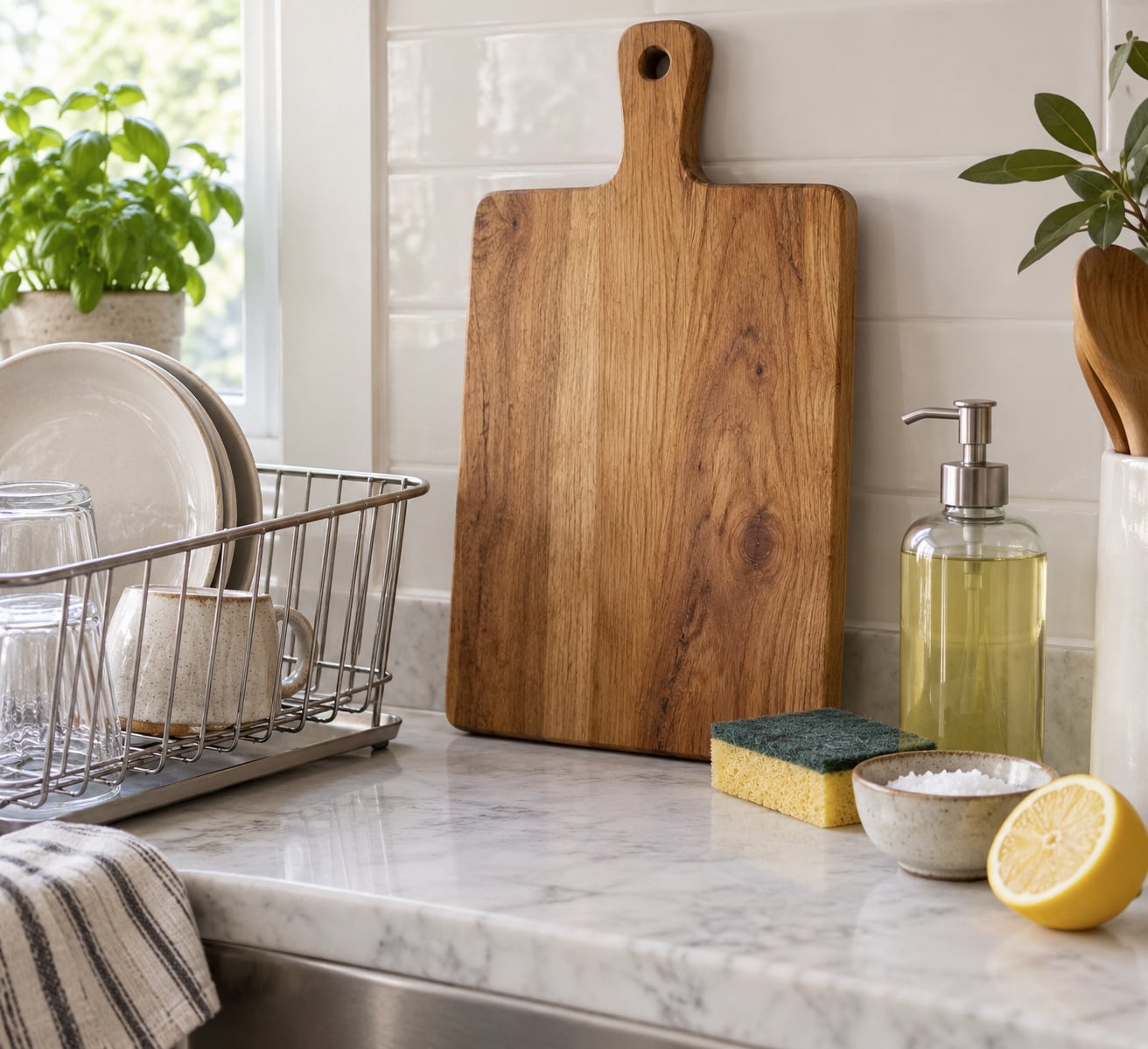
Knowing how to clean a cutting board properly takes about five minutes: scrape off the food, wash both faces with hot soapy water, rinse, sanitize if you handled raw meat, and stand the board upright until it is completely dry. The whole job takes less time than boiling a kettle.
A cutting board is one of the few kitchen tools that touches raw chicken, salad leaves and a toddler’s afternoon snack in the same week. Food film plus moisture is a perfect home for Salmonella, E. coli and Listeria, and those three cause most food poisoning cases that start at home.
Table of Contents
- What You Need
- Step-by-Step: How to Clean a Cutting Board Properly
- 1. Identify the Board Material and Follow Its Care Instructions
- 2. Scrape Away Food and Wash the Board Immediately
- 3. Rinse and Dry the Cutting Board Thoroughly
- 4. Sanitize the Surface When Extra Protection Matters
- 5. Treat Stains and Odors, Then Inspect for Damage
- 6. Store the Board Clean, Dry, and Upright
- Cleaning Methods by Cutting Board Material
- Common Mistakes
- Tips for Keeping a Cutting Board Clean Longer
- Frequently Asked Questions
- Conclusion
What You Need
For the routine wash after every use you need very little: hot water, dish soap, a non-abrasive sponge or nylon brush, and a place to stand the board upright.
A bench scraper or the back of a knife helps lift stuck-on food before water goes near the surface. Keep one by the sink and it takes two seconds.
Optional extras, only for problem boards
Coarse salt and a halved lemon scrub discoloration out of wood. Baking soda handles odors and light stains on any material.
Unscented liquid chlorine bleach is the sanitizer most people already have under the sink, and a dropper or measuring spoon keeps the dilution honest. Food-grade mineral oil is only needed for wood and bamboo, and only monthly.
Sandpaper from around 80 grit through 220 grit is a repair kit, not a cleaning supply. Reach for it when knife marks have gone deeper than a scrub can fix.
Step-by-Step: How to Clean a Cutting Board Properly
1. Identify the Board Material and Follow Its Care Instructions
Wood, bamboo, plastic, glass and composite surfaces do not accept the same treatment. Identify the material first, then read whatever care card came with the board.
Wood and bamboo look like grain and have visible pores or a laminated edge stripe. Plastic is smooth, moulded and usually lighter in colour, often with a rubber foot underneath. Glass is transparent or frosted and heavy for its size. Composite boards show resin or stone particles suspended in a dark binder.
The manufacturer’s instructions override anything on this page. A few bamboo boards are labelled dishwasher safe, and running one under the wrong care rules is how you crack it.
You can tell the method worked at this stage because you know which bucket the board belongs in for the rest of the process.
2. Scrape Away Food and Wash the Board Immediately
Do not let food dry on the surface. Carry the board to the sink, scrape leftovers into the bin with the bench scraper or a knife edge, and wash it straight away.
Fill the sink with hot water and a drop of dish soap, then scrub every surface: the face you cut on, the reverse, all four edges, any handle or thumb hole, and the juice grooves on a carved board. A sponge only touches the top unless you turn it over and work the other side.
Check for the sticky patch under the handle. That corner is where the raw chicken juices run, and it is where most boards quietly stay dirty.
You know the wash worked when the surface feels slimy nowhere and the sponge comes away without a film of fat on it.
3. Rinse and Dry the Cutting Board Thoroughly
Rinse under running hot water so the soapy film and loosened debris go down the drain. Rinse both faces and the edges.
Then dry. Pat it with a clean towel to remove the bulk of the water, and finish standing it upright on a dish rack or against the backsplash with the two faces not touching each other. Air drying flat and face down traps water against the board and against the counter.
Wood and bamboo take on water faster than you expect, and the grain swells unevenly. Standing moisture is what turns a board into a shallow bath for microbes, and repeated soaking is what opens the cracks bacteria settle into.
The check is simple: the board should feel dry and room temperature, not cool and damp, on both faces before you put it away.
4. Sanitize the Surface When Extra Protection Matters
Washing removes the food film. Sanitizing kills what washing leaves behind, and it matters most after raw poultry, raw fish, ground meat or after someone with a stomach illness has handled food on the board.
For plastic, glass and composite boards, mix about 1 tablespoon of unscented liquid chlorine bleach into 1 gallon of water. Pour it over the surface, let it sit for a few minutes, rinse with clean water and air dry. A weaker dilution of roughly 1 teaspoon per quart works for a small board if that is all you need to cover it.
Wood and bamboo are more forgiving in use and more sensitive in chemistry. A light once-a-week bleach wipe, well rinsed and dried, is what regular home cooks on AskCulinary describe; heavy soaking is what splits boards. Vinegar at a 1:4 vinegar-to-water ratio is a reasonable odor treatment but a weak substitute for bleach on a raw-meat surface.
Spray or pour the solution onto the board only. Never splash it into a sink full of dishes, a stainless basin, or a countertop where someone else is working.
You know the sanitize step worked because the board smells faintly of nothing at all and is dry to the touch before storage.
5. Treat Stains and Odors, Then Inspect for Damage
Stains and smells are a separate problem from dirt. A board can be perfectly sanitized and still smell like last night’s garlic, because the odor sits in the surface rather than on it.
For a light stain on wood, bamboo or plastic, work a paste of baking soda and water over the area with the sponge and leave it a few minutes before rinsing. Garlic and onion smell often come out with a raw potato or apple rubbed across the surface, then rinsed, because the enzymes bind the sulfur compounds.
For a darker discoloration on wood or bamboo, scrub coarse salt across the board in circular motions with the cut side of a lemon, let it sit for 5 to 15 minutes, then scrape off the pulp, then rinse and dry. The action is doing the work, not the lemon.
For mold and black speckles, dilute white vinegar at 1:4 with water, apply it, leave it a few minutes, then scrub. If dark specks sit inside deep grooves and do not come out, the board has moved past cleaning.
Inspect before you put it back. Deep grooves you cannot scrub clean, cracks or splits, a permanent warp, or odor that returns within hours of washing are replacement signs. Grooves alone are not a death sentence if you sand them flat, but odor embedded in a groove is.
6. Store the Board Clean, Dry, and Upright
Storage is where most boards get ruined. A board put away damp in a drawer or leaning against a soiled stack of baking sheets will come out musty, spotted or warped.
Stand clean, fully dry boards upright in a rack or on the counter. Give each one air space rather than stacking them face to face, and keep them away from the sink splash zone.
Store plastic boards separately from the wood ones if you have the room, because a damp plastic lid pressed against a wooden board keeps that wood wet longer than it needs to be.
When boards come out of storage, they should smell neutral and feel dry on both sides. That is the whole standard for clean.
Cleaning Methods by Cutting Board Material
| Material | Routine cleaning | Deep cleaning | Sanitizing | Drying | Replace when |
|---|---|---|---|---|---|
| Wood | Hot water and dish soap, non-abrasive sponge | Baking soda paste or salt and lemon scrub, 5 to 15 minutes | Diluted bleach wipe occasionally, well rinsed; separate raw-meat board preferred | Upright, faces apart, then mineral oil when water no longer beads | Split, cracked, permanently warped, or odor that survives washing |
| Bamboo | Hot soapy water by hand; check the label, a few are dishwasher safe | Baking soda or diluted vinegar, then rinse | Diluted bleach, about 1 tablespoon per gallon, or vinegar at 1:4 | Upright and fully dry before storing | Glue lines separating, deep blackened grooves, or a soft surface |
| Plastic | Hot soapy water; dishwasher only if labelled safe | Baking soda paste, or diluted bleach for stubborn staining | Diluted bleach, about 1 tablespoon per gallon, a few minutes’ contact | Any position, including the dishwasher, once it is clean | Grooves too deep to scrub, or a surface that stays rough after cleaning |
| Glass | Hot soapy water; dishwasher safe on most boards | Baking soda paste; bleach is safe on the surface | Diluted bleach or a food-contact surface sanitizer | Any position | Chipped or cracked edges, which create sharp fragments |
| Composite | Hot soapy water and a soft sponge, no steel wool | Baking soda paste; avoid harsh abrasives on the resin | Diluted unscented bleach, following the maker’s contact time | Upright until fully dry | Surface roughening or delamination around the edges |
Two rules cross every row of that table. Never put wood or bamboo in the dishwasher unless the maker says so, and never combine bleach with vinegar, ammonia or any other cleaner.
Common Mistakes
Rinsing with water only
Water moves food around and rinses it away. Soap is what loosens the grease film that bacteria cling to.
Fix: use hot water with a drop of dish soap every single time, not just when the board looks dirty.
Soaking wood or bamboo
Standing water saturates the grain, and as the board dries it swells unevenly. That is where warping, cracking and splits come from.
Fix: wash under running water or in a basin, never submerged, and dry it immediately.
Running the dishwasher on wood
Heat, steam and standing moisture cycle through the board for an hour or more. That combination also weakens the glue in end-grain boards.
Fix: hand wash wood and bamboo every time. Reserve the dishwasher for plastic and glass labelled for it.
Mixing bleach with another cleaner
Bleach and vinegar together give off chlorine gas, which is genuinely dangerous. It also destroys the board while you are trying to protect it.
Fix: one sanitizer per session, dilute it, and apply it to the board rather than the sink.
Cleaning only the top face
Raw meat juices run under the handle, along the edges and into the juice groove. Those areas stay wet and warm.
Fix: flip the board mid-wash and scrub all four edges and the handle.
Drying face down on the counter
The bottom face sits in a puddle while the top air dries, and the counter underneath is not clean either.
Fix: towel off, then stand upright with the faces separated.
Keeping a ruined board
A warped board tilts under the knife, which makes your prep slower and wrecks your knife edge faster.
Fix: a light warp can be flattened with a damp cloth and a warm iron, then weighted while drying. Deep splits, embedded mold or permanent odor mean the board goes in the bin.
Tips for Keeping a Cutting Board Clean Longer
Wash after every use, not every few days. A wiped-down board that sat for two hours is harder to clean than one washed right away, because the moisture has already let the residue set.
A damp wipe-down is fine between uses for produce, bread and cheese. It is not fine after raw meat. Produce has low moisture and few nutrients for bacteria, while raw poultry and ground meat have both.
Use separate boards, and colour-code them if you work in a shared kitchen. One board for raw poultry and ground meat, one for vegetables and fruit, one for bread and ready-to-eat food. Boards get swapped by accident more often than anyone admits.
Oil wood and bamboo with food-grade mineral oil about once a month, or whenever water stops beading on the surface. Skip olive oil and other kitchen oils; they are not fully drying, they go rancid, and the smell is hard to remove from a board.
Keep boards out of the dishwasher and away from the stove, and replace them on a rhythm rather than waiting for a smell. Deep grooves and a permanent warp are a scheduled replacement, not a repair project.
Frequently Asked Questions
Can I use soap to clean a cutting board?
Yes. Hot water plus dish soap is the standard way to clean a cutting board, and it is the only step you need after most vegetable prep. The soap loosens the grease film that bacteria attach to, something plain water cannot do on its own. Rinse thoroughly afterwards, dry upright, and reserve sanitizing for after raw meat or poultry.
Does white vinegar kill germs on a cutting board?
Partly, and it is not the same as disinfecting. Vinegar diluted at about 1:4 with water helps neutralize odors and works against a range of bacteria and yeast on a surface, but it is a weak substitute for a proper sanitizer. After raw chicken or ground meat, use diluted unscented chlorine bleach instead, then rinse and dry.
How should I clean a wooden cutting board after use?
Scrape the food off, wash with hot water and dish soap on both faces and all the edges, then rinse and dry it standing upright with the faces apart. Never soak wood and never run it through the dishwasher. Once a month, or when water stops beading on the surface, wipe on food-grade mineral oil and let it soak in.
Can I put a cutting board in the dishwasher?
Only if it is plastic or glass and the maker says it is dishwasher safe. Heat, steam and standing moisture will warp, crack or split a wooden or bamboo board, and they can weaken the glue in an end-grain board. Check the care instructions that came with the board, because a small number of bamboo boards are rated for the dishwasher.
When should I throw away a cutting board?
Throw it out when the damage is structural or embedded, not merely cosmetic. Replace a board with splits or cracks, a permanent warp, mold that will not scrub out, or odors that return within hours of washing. Deep knife grooves are acceptable on wood if you sand them flat, but grooves you cannot clean and odor you cannot remove are a reason to bin the board.
Conclusion
Start tonight, with the board that is already in your sink: scrape it, wash both faces and the edges with hot soapy water, rinse, and sanitize it if it touched raw meat. Stand it upright until it is completely dry, then put it away.
That five-minute routine is what keeps a cutting board safe, and it is quicker than the time you already spend unwinding after a stomach bug.