

To report an unsafe workplace to OSHA, you file a safety complaint on OSHA’s online complaint form at OSHA.gov, call the hotline at 1-800-321-OSHA (6742), or send it in writing by mail or fax. You can also ask OSHA to keep your name confidential, or file the entire complaint with no name on it at all. The whole thing takes about ten minutes if you have your facts straight.
Most people who never file do it for one of two reasons: they assume nobody will do anything, or they assume reporting will get them fired. Both assumptions are worth examining before you decide.
This guide walks through the process step by step, what to document first, and what to do if the workplace punishes you for speaking up. Rules differ by state and change over time, so treat this as a practical orientation rather than legal advice.
Table of Contents
- What You Need Before You File
- Step-by-Step: How to Report an Unsafe Workplace to OSHA
- Step 1: Make the Area Safe and Check for Immediate Danger
- Step 2: Decide What Happened and Who Is Affected
- Step 3: Document the Hazard With Specific Facts
- Step 4: Report the Concern Through the Appropriate OSHA Channel
- Step 5: Submit a Clear and Complete Report
- Step 6: Follow Up and Protect Against Retaliation
- Common Mistakes
- Frequently Asked Questions
- Can I report an unsafe workplace to OSHA anonymously or confidentially?
- Can my employer fire me for filing an OSHA complaint?
- How long do I have to file an OSHA complaint?
- How long does an OSHA investigation take after I file?
- Do I have to be an employee to file an OSHA complaint?
- Should I file with OSHA or take my employer to court?
- Conclusion
What You Need Before You File
A complaint is a short factual description of a hazard: where it is, what it is, and why it can hurt someone. Having the following ready turns a vague worry into a report an inspector can act on.
- Specific facts. Date, time, exact location, the machine or area involved, the task being performed, and the specific standard or hazard you believe is being violated.
- Potential harm. What could happen to a person. Amputation, chemical exposure, fall from height, electrocution, respiratory illness.
- Your job. Title, shift, how long you have worked there, and what your employer told you to do about the hazard.
- Names. Who else saw it, who supervises the area, and who made the decision to leave it as is.
- Photos and documents. Timestamped photos, safety data sheets, training records, past incident forms.
- Your employer details. Legal name, address, and the site where the work happens.
Two records are underrated. The OSHA 300 log, the annual injury and illness log many employers must keep, tells you how many injuries already happened in that department. And your own written record of every time you raised the hazard internally, with dates, shows a pattern rather than a one-off complaint. Our guide to how to conduct a workplace hazard assessment walks through that first pass if the problem feels bigger than a single machine.
You do not have to be an employee to file. Former employees, temporary and contract workers, unpaid trainees, and family members of an exposed worker can all complain. So can someone reporting a hazard at a site they visit.
Step-by-Step: How to Report an Unsafe Workplace to OSHA
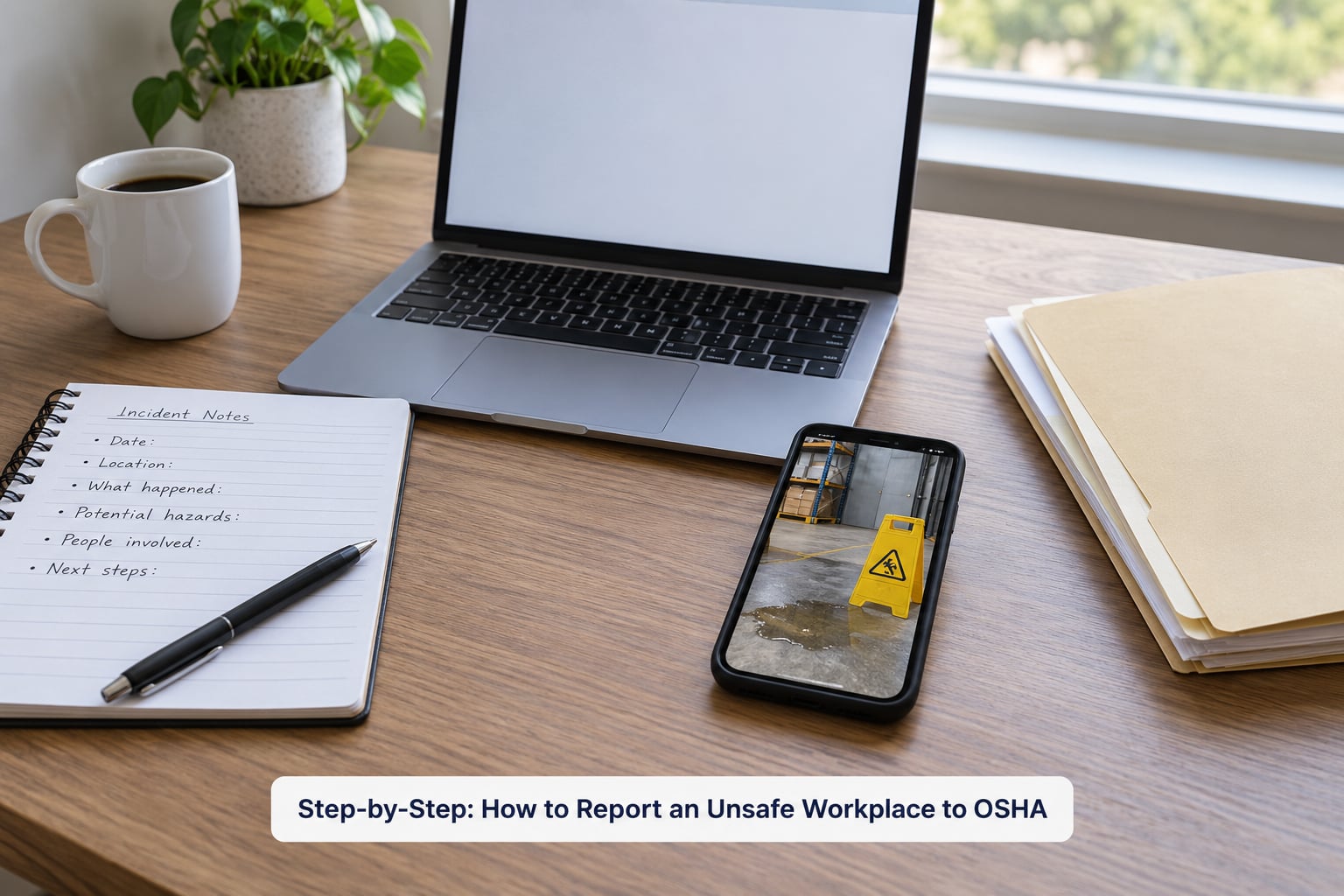
Step 1: Make the Area Safe and Check for Immediate Danger
Get yourself out of danger first, then report. Nothing about a complaint is worth becoming a second injury statistic.
If someone is hurt right now, call emergency services. If a death has occurred at work, or three or more employees are hospitalized in one event, or someone has lost an eye or had an amputation, the employer is required to notify OSHA within eight hours for a fatality and within 24 hours for those other events. Bring that up if management seems unaware of the clock.
If the danger is imminent but nobody is hurt, remove yourself from the area, tell a supervisor in writing, and keep a copy. For injuries that already happened, work through what to do after a workplace injury before you reach for the phone.
You know this step worked when you can point to a timestamp showing you raised it: an email you sent, a text message, a written note you kept.
Step 2: Decide What Happened and Who Is Affected
Not every workplace frustration is an OSHA matter. Pay disputes, scheduling, personality conflicts, and broken promises are usually handled by your employer, a union, or a labor board rather than a safety agency.
It crosses into OSHA territory when a specific safety standard applies, or when the General Duty Clause does, which requires employers to provide a workplace free from recognized hazards likely to cause death or serious physical harm. Blocked or locked emergency exits, unguarded machine parts and pinch points, missing fall protection on a scaffold, chemical exposure without hazard communication, unsanitary conditions with vermin, and heat stress all fit that description.
You do not need proof anyone has been hurt. Hazards are reportable before the injury happens, which is the point.
Step 3: Document the Hazard With Specific Facts
This is the step that decides whether your report does anything. Document the hazard in plain, dated, specific language before you file, not after.
Write down what you saw, not what you concluded. “The guard on the panel saw was removed on the second shift on Tuesday, March 4, and operators reach into the blade area without a lockout” is useful. “Management does not care about safety” is not.
Photograph from a safe position and without interrupting work. Timestamped photos of the machine, the missing guard, the blocked exit, the unlabeled container, the wet floor with no sign. Record what witnesses saw and get their contact details. Save the safety data sheet, the training roster, and any prior incident report with the same hazard in it.
Keep the originals somewhere outside the employer’s systems. Personal email, a personal cloud folder, a written notebook at home. Once you leave a company, its email and its file server are gone.
Step 4: Report the Concern Through the Appropriate OSHA Channel
How to report an unsafe workplace to OSHA comes down to where you work and how urgent it is. There are five routes, and they are not equal.
The fastest option is the online complaint form at OSHA.gov. It reaches any area office, works 24 hours, and produces a confirmation number you can save. The hotline, 1-800-321-OSHA (6742), is staffed during business hours and is the better choice when you want to explain something complicated out loud, ideally in a language you are comfortable speaking.
For severe injuries, the single fatality line at 1-800-321-OSHA (6742) extension 1 accepts reports after hours. Mail and fax remain valid channels, and you can walk into an OSHA area office. Written complaints signed by the worker carry more weight than anonymous ones, but any of these routes reaches the same intake process.
Then check your state. About half of US states, including California, Michigan, and Washington, run their own OSHA-approved state plan with its own enforcement. For an on-site hazard, file with your state agency. OSHA still handles retaliation complaints in state plan states, and it retains authority over federal government employees and maritime matters.
There is one more channel worth knowing. OSHA’s On-Site Consultation Program sends a consultant to your workplace at no cost, identifies hazards, and issues no citation and no penalty. It works well for a first-time employer that genuinely wants a fix. It does not work if you think the employer will punish whoever speaks up.
Step 5: Submit a Clear and Complete Report
The online form asks for a few plain things: how you want to be contacted, whether you want your name treated as confidential, where the hazard is, what the hazard is, and whether you believe there is an imminent danger.
Answer those in complete sentences. Keep each report focused on the site and the hazard rather than turning it into a list of everything wrong with the company. Attach documents if the form allows it, and describe in the body what you are attaching, because attachments sometimes get separated from the file.
Before you hit submit, read it back as if you were the inspector. Could someone who has never seen your workplace picture the hazard from your words? Save the confirmation number, the date, and a copy of everything you submitted. When in doubt, say “I do not know” rather than guessing at a cause.
Step 6: Follow Up and Protect Against Retaliation
Sections 11(c) of the OSH Act makes it unlawful for an employer to fire, demote, cut hours, cut pay, threaten, or otherwise discriminate against anyone who files a complaint, participates in an inspection, or reports an injury or illness. Constructive discharge counts, so being pushed out counts too.
OSHA screens and prioritises complaints, and for hazards involving a fatality, imminent danger, or exposure to something like lead, asbestos, silica, or confined spaces, an inspection can happen quickly. Otherwise an on-site inspection is not guaranteed, which is the honest answer to the belief that reporting does nothing. What your complaint reliably produces is a record with your name and your description of the hazard attached to it.
Keep a log of every change after you file: shift changes, schedule cuts, reassignments, sudden write-ups, a performance improvement plan that did not exist before, reduced hours, a layoff. Note the date, who did it, and what changed compared to the weeks before. That log is the evidence in a retaliation case.
Here is the deadline that gets missed. A safety complaint has no filing deadline. A retaliation complaint under Section 11(c) must be filed with OSHA within 30 days of the retaliatory action. Some states allow a little longer under state plan rules, but 30 days is the federal baseline and it passes quickly.
To file a retaliation complaint, use the Whistleblower.gov process or the same online form and the same hotline, and select the discrimination or retaliation option. You can also file a charge with the U.S. Department of Labor’s Unlawful Employment Practice program, and separate discrimination complaints may go to the EEOC or the NLRB. A retaliation complaint is the one with the shortest fuse, so file it first.
Common Mistakes
Six patterns come up again and again in real complaints. Each has a straightforward correction.
- Waiting until after you are fired. Once you are gone, you lose access to witnesses, systems, and the daily view of the hazard. Document first, file second, even if you are still deciding whether to file.
- Conflating the two deadlines. Safety complaints carry no deadline. Retaliation complaints must be filed within 30 days. Treating both as “whenever I get around to it” can cost you the retaliation protection entirely.
- Writing an opinion instead of an observation. Replace “they don’t care about safety” with the missing guard, the date, and the task being performed at the time.
- Filing a complaint when you wanted an inspection you control. On-site consultation is free and penalty-free. A complaint triggers enforcement. Know which one you are choosing.
- Skipping the internal record. If you raised the hazard with your supervisor and nothing changed, write down when you said it and to whom. Our step-by-step on filling out an incident report at work gives you a format for that.
- Expecting OSHA to sue for you. OSHA cites and penalises the employer. It does not bring your personal injury claim, your unpaid wages, or your discrimination case. That is a different route with a different deadline.
Two more practical notes. Workers who do not speak English as a first language can request an interpreter, and a union representative, worker centre, or legal aid society can help file the complaint with you. And if you are worried about immigration status, that fear is common and well documented; getting help from a worker centre before you file is a reasonable precaution.
Frequently Asked Questions
Can I report an unsafe workplace to OSHA anonymously or confidentially?
Yes, both. You can file without giving your name at all, or file a signed complaint and check the box asking OSHA to keep your name confidential. OSHA will tell your employer it received a complaint, but confidential complainants get a specific assurance that their identity is protected from the employer, and trade secret and witness information is treated separately. Anonymous complaints are still investigated, though a signed complaint usually moves faster.
Can my employer fire me for filing an OSHA complaint?
No, and Section 11(c) of the OSH Act makes that illegal. Firing, demoting, cutting hours or pay, reassigning you to worse work, threatening you, writing you up, or pushing you out the door all count as retaliation. Proof is harder than people expect, which is why the day-by-day log of schedule and treatment changes matters. If retaliation happens, you have 30 days to file an OSHA discrimination complaint.
How long do I have to file an OSHA complaint?
A safety complaint has no deadline, so you can report a hazard at any time, including long after the fact. Retaliation is different: a Section 11(c) discrimination complaint must be filed with OSHA within 30 days of the adverse action. State plan states may allow a slightly longer window. Separate employment discrimination claims have their own deadlines, usually 180 days or more with a charge filed with the EEOC or NLRB.
How long does an OSHA investigation take after I file?
It varies widely. OSHA screens every complaint for jurisdiction and severity, and complaints involving a fatality, an imminent danger, or exposure to lead, asbestos, or silica move to the top of the list. For other hazards, an on-site inspection is a possibility rather than a guarantee, and no published timeline promises an inspection date. What you can rely on is a complaint record with your description of the hazard and the date attached to it.
Do I have to be an employee to file an OSHA complaint?
No. Current employees can file, and so can former employees, temporary and contract workers, unpaid trainees, and workers employed by a temporary staffing agency. A family member of an exposed worker can file on their behalf, and anyone can report a hazard they have observed at a workplace they visit. Confidentiality requests and anonymous filings are available to every complainant, employee or not.
Should I file with OSHA or take my employer to court?
They solve different problems. An OSHA safety complaint pushes for an inspection, a citation, and correction of the hazard. OSHA does not bring your personal lawsuit, and penalties it assesses go to the government, not to you. A private lawsuit, usually through a personal injury or employment attorney, is the route for compensation. Many people do both: file the safety complaint quickly, then talk to a lawyer about your own claim.
Conclusion
Start with the first action: get out of the danger, then write down what you saw, where, when, and what could happen to somebody. That record is the foundation of everything that follows, and it is easier to build today than to reconstruct in a month.
If someone is hurt now or the danger is imminent, use the emergency line and the severe injury route rather than the standard form. If you are in a state plan state, the state agency handles the safety complaint. If nothing has happened to you yet but the condition is clearly unsafe, file the safety complaint with no deadline hanging over you, and ask for confidentiality if it makes the difference between filing and staying silent.
And if the workplace responds to your report with fewer hours, a worse shift, or a termination, that is a second clock starting. You have 30 days to file a Section 11(c) retaliation complaint with OSHA. Keep the log the day it happens, because that log is what the filing is built on.
Reviewed against current 2026 guidance from OSHA and the NIOSH worker safety resources. Laws, deadlines, and state agency rules vary and change, so check the specifics for your state before you rely on them.