

To deal with a difficult coworker, do five things in order: confirm the pattern, stay calm and neutral, set one clear boundary, document what happens, and escalate to your manager or HR with facts if nothing changes. Most people get this wrong in the first two minutes, by reacting instead of preparing.
It rarely needs to be a confrontation. A short private conversation that names a specific behavior and one change you want is usually enough, and takes about fifteen minutes. The part people skip is the record, and the record is what makes an escalation land in a formal process instead of turning into a he-said-she-said argument.
This guide covers the awkward middle case, the coworker who is not abusive and not your friend but makes your week measurably harder. It also covers the cases that are not awkward at all, like threats or discrimination, where the correct move is to stop managing the relationship and start reporting it.
Table of Contents
- What You Need
- Step-by-Step: How to Deal with a Difficult Coworker
- 1. Confirm the problem and identify the pattern
- 2. Check for organizational or personal factors
- 3. Choose a private, neutral time to talk
- 4. Describe the behavior and set clear expectations
- 5. Respond consistently in the moment
- 6. Document, follow up, and use support
- 7. Escalate when the behavior continues or becomes unsafe
- What to do when the difficult coworker is you
- When it is time to look for another job
- Common Mistakes
- Frequently Asked Questions
- How do I document a coworker’s behavior?
- When should I talk to HR about a coworker?
- How do I set boundaries with a coworker without creating tension?
- How do I tell the difference between a difficult coworker and workplace bullying?
- What if my boss is friends with the coworker I have a problem with?
- Is it my own fault if I am finding a coworker difficult?
- Conclusion
What You Need

You need four things before you speak, and none of them require anyone’s permission.
A record of what happened. Write down dates, times, what was said, who was present, and what work was affected. Keep it factual and neutral. People who go to HR with a pattern of specifics get a response; people who go with “she is horrible” get a suggestion to have a chat.
A clear ask. One behavior, one change. “I need you to stop answering my messages with sarcasm in the team channel” is workable. “I need you to respect my role” is not something anyone can act on.
Support contacts. Know your manager’s name, your HR or people partner, and whether your organization has an employee assistance program. Check if you have a coworker or a trade union representative who can come with you or sit in on the conversation. Finding these out during a crisis is worse than having them written down.
A way to switch off afterwards. Plan the thirty minutes after. That is the part almost nobody plans, and it is the part that decides whether you are still angry at dinner. A walk, ten minutes of notes to close the loop, and a definite end to work for the day does more for you than rehashing the conversation in your head.
One boundary worth setting now: you are preparing a work conversation, not building a legal case. If any part of the list starts to look like evidence of harassment, discrimination or threats, stop preparing and go straight to step 7.
Step-by-Step: How to Deal with a Difficult Coworker
1. Confirm the problem and identify the pattern
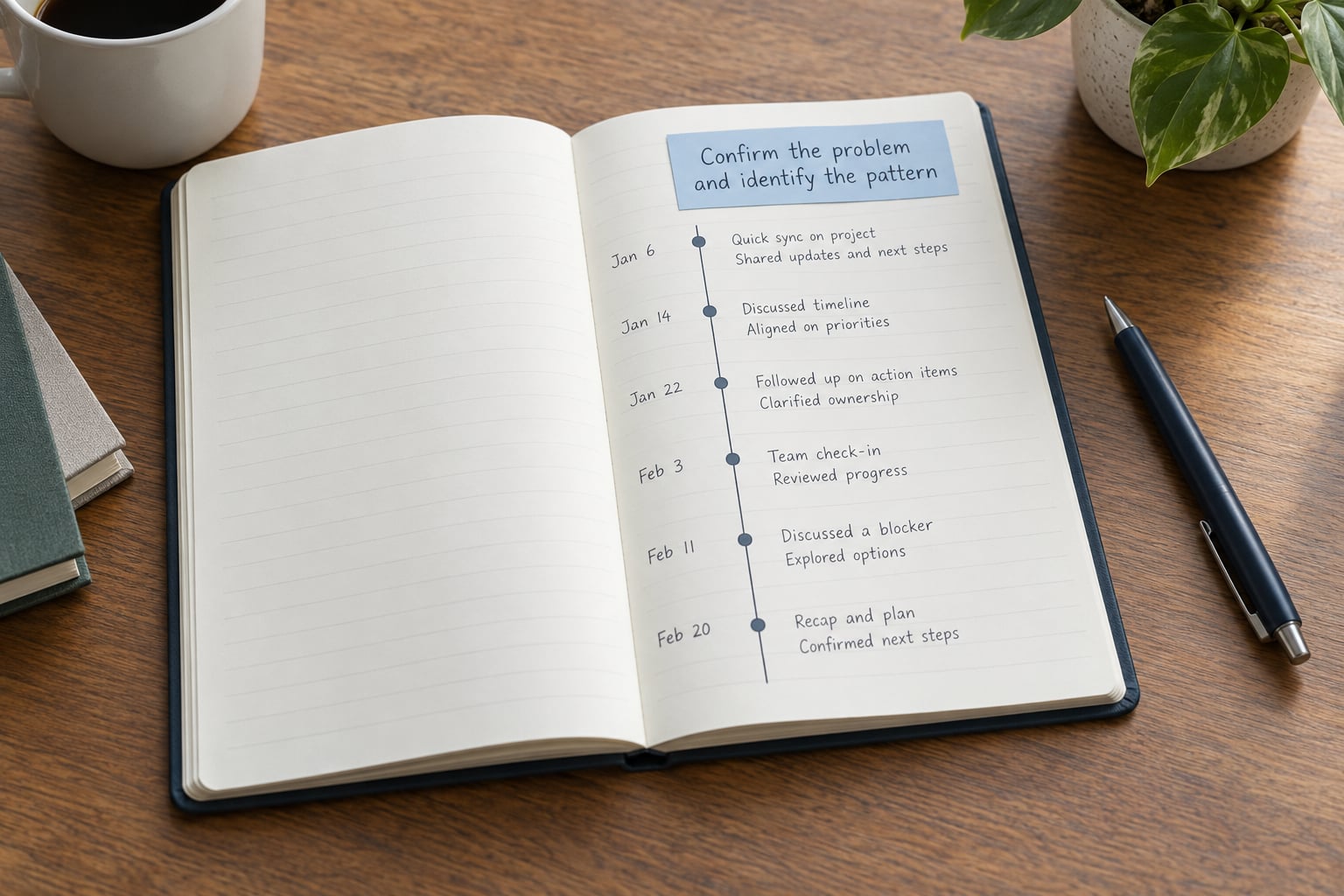
Write down three or four specific incidents before you conclude anything. One bad Tuesday is weather. A pattern over six weeks is a problem you can act on.
Separate what you observed from what you concluded. “She said in the 10 a.m. standup that the report was finished when it was not” is an observation. “She sabotages me” is a conclusion, and conclusions are impossible to discuss or escalate.
Then name the workplace impact, because impact is what makes a conversation legitimate. Deadlines missed, a client called for information you had already sent, two team members avoiding a meeting. If the honest answer is that the conflict is annoying but nothing is actually affected, that is a different conversation and a smaller one.
2. Check for organizational or personal factors
Aim for a difficult coworker and you will get a difficult coworker. Aim for a fix and you may find something else entirely.
Look at the conditions around them first. An unclear role description, a workload that changed three managers ago, a policy they have never seen, or a deadline that was always unrealistic all produce the same visible behavior. So does an unmet adjustment, a language barrier, or a manager who never tells them they are doing fine. If you manage people yourself, our guide to accommodating workers with disabilities at work covers the adjustments that most often get missed.
Notice your own contribution too. Forum advice from r/careerguidance is unusually practical on this: people who understood the other person’s work and goals before reacting had better outcomes than people who went straight to a script. Not because the behavior is acceptable, but because you respond differently once you know whether you are dealing with a person who is stuck or a person who is choosing this.
Do not diagnose. You are looking for causes that change how you should handle it, not for a label to file.
3. Choose a private, neutral time to talk
Private means a room with a door, not a corner of the kitchen. Never in front of the team, never in a group chat, never as the last thing before a meeting where the person will be present.
Timing matters more than most people expect. End of the day is usually better than the middle of a deadline, and after a calm stretch rather than during a heated one. Ask for a short slot rather than an ambush: “Do you have twenty minutes tomorrow afternoon to talk about how the handover is going?” That phrasing is neutral, and it is very hard for the other person to say no to without looking like they are avoiding something.
Open with purpose, not accusation. “I want to talk about the client calls, because I think we’re duplicating each other” lands completely differently from “we need to talk about you.”
4. Describe the behavior and set clear expectations
The structure that works is fact, impact, request, and it takes about thirty seconds to say.
“Three times this month the client has asked me for figures I sent to Sam before the call. That’s roughly four hours of rework for me, and it makes the client think we are not talking to each other. From now on, when you have context I don’t, can you message me at least a day before the client does?”
That version gives the other person something to do. Compare it with the versions that fail.
“You always do this.” Always is the word that ends the conversation, because it is a claim about a character rather than an event. “You undermined me in front of the client.” Undermine is a label, and the other person will now argue about the label instead of fixing the handover. “You’re so passive-aggressive.” That is an interpretation of intent, and intent is the one thing you cannot observe.
Keep the rest of the conversation on the work. Ask a question, then listen longer than feels comfortable. The goal is not a confession or an apology. The goal is an agreement about what happens next, so finish by asking: “Does that work for you?”
5. Respond consistently in the moment
One good conversation does not repair a habit. Behavior that was rewarded yesterday tends to return today, and consistency is what finally shifts it.
When you get interrupted in a meeting, stop talking and wait. The silence is uncomfortable for about three seconds and then the floor is yours. Or name the pattern lightly and move on: “Let me finish this point, then I want to hear your read on it.” Both work, and doing the same thing every time matters more than doing it perfectly.
For the passive-aggressive email, the best reply is often a boring one. Answer the question asked, restate the deadline, and do not match the tone. If a message is ambiguous, reply with a short factual clarification: “Just to confirm, are we signing off on the draft today?”
Do not retaliate in kind. Escalating the tone, forwarding the thread, or making a joke about them at your desk all escalate, and the story you tell afterwards becomes the story about you. The calm version is slower and it wins.
6. Document, follow up, and use support
If you took notes before the conversation, the format is simple: date, time, people present, what was said, what changed as a result. Use plain language, no adjectives about their personality, and no speculation about their motives.
Send yourself a copy the same day while it is fresh. Keep it private, and store it where your work email and calendar already live, not somewhere a departing coworker could see it. This is not ammunition to hold over them. It is about being able to say “this happened on the 4th, then again on the 11th” instead of “it is always like this.”
Give it two to three weeks. If the behavior changes, you have your answer and the file goes quiet. If it does not, send a short written follow-up to the same person: “Thanks for the conversation on the 9th. I wanted to note that the duplicate client asks are still happening, on the 13th and the 18th.” Written, calm, and boring on purpose.
Then use the support that exists. A manager who already knows the pattern can change a deadline or a shift assignment. HR can look at whether something is a policy problem. Occupational health, if your organization has it, can advise on adjustments or on workload, and an unmet adjustment is one of the reasons a coworker starts behaving this way in the first place; if the problem is a health condition rather than a personality clash, start with our overview of supporting employees with chronic conditions. An employee assistance program offers confidential short-term counselling, which is genuinely useful when the stress has already reached your sleep.
Note the documentation tip that comes up repeatedly in forum threads: people who keep a private log describe it as the thing that made them calm, not just the thing that won the argument. r/CAStateWorkers and r/cscareerquestions both recommend the same plain record, and Kitchen Confidential threads add a practical version of it, a personal log with dates and details nobody else can see.
7. Escalate when the behavior continues or becomes unsafe
Escalation is the right professional move, not tattling. It is how the organization learns what you could not fix on your own.
Escalate immediately, without a private conversation first, when there is discrimination based on a protected characteristic, harassment, threats or intimidation, retaliation against you for raising an issue, or sustained disruption of your work. Also escalate when you are excluded from decisions, meetings or information that your role requires, and when you feel unsafe, with reasonable fear for your wellbeing.
Take it up the chain of command: your manager first, HR or people partner if your manager is involved or does not respond, and the written grievance or conflict-resolution process that most organizations have. If it is a large employer in the US, the Employee Relations or Employee Assistance line and the written policy are usually on the intranet. Know the difference between a concern and a formal complaint, because filing one starts a process with a timeline.
What to include: the record from step 1, the conversation you had, what changed and what did not, and the specific remedy you want. “I would like the client handover reassigned” is actionable. “I want her to be nicer to me” is not.
Ask for the outcome in writing, keep copies of everything you send, and note any retaliation the moment it happens. If you are a trade union member, tell your representative before you file. If you are in a state that protects employees who report, that protection is real, but it only covers you if you were the one raising the concern, which is another argument for raising it early rather than enduring it for months.
What to do when the difficult coworker is you
Half the hardest part of this topic is the suspicion that the problem is your own. That suspicion is worth taking seriously, because the same behavior is invisible to the person causing it.
Five signs you may be the difficult one: you raise problems by complaining rather than asking for a change, you bring the same grievance to more than one person, you interrupt or answer for people in meetings, you withhold information as a tactic, or you are the only person in the team describing the office as toxic. Forum threads on difficult colleagues return to this often, and the honest version is that a pattern of conflict with everyone you work with is usually information about your own approach rather than a conspiracy.
The fix is unglamorous. Bring one specific request, once, in the right format, then check whether the work actually got easier. Most of the time it does.
When it is time to look for another job
Some situations are not a management problem, they are a workplace problem. If you have documented a pattern, asked directly once or twice, and used support, and the answer is still that your quality of life depends on one person’s mood, the market is open. Updating your CV and quietly talking to people costs nothing and keeps options real.
Watch for a signal most people ignore: your health. Trouble sleeping, dread on Sunday night, or physical symptoms that started when this began are a legitimate reason to leave a job, not a character flaw. The stress is measurable, and pretending otherwise is expensive.
Before you resign, do one practical thing. Ask for the pattern in writing, even in a neutral form, so that a future employer’s reference call goes well and so that you know the record exists. It also helps to hear more than one view before you decide, and if you manage a team and want wider feedback without a formal review, our walkthrough of how to run focus groups with employees is built for exactly that.
Common Mistakes
Reacting in the first five minutes. The fastest version of this is a sharp reply in the team channel that you cannot unsend. The fix is a delay rule: nothing goes out for at least an hour, and never while you are still angry.
Confronting them publicly. A public callout wins a short-term point and costs a long-term relationship, and it gives them the grievance. Correcting in the moment, quietly and immediately, is the professional version.
Describing personality instead of behavior. “You’re so negative” cannot be fixed. “Three times this week you have said the project was doomed before we had presented it” can.
Talking to everyone about it. Gossip spreads and it grows in the retelling, and it turns you into the office problem. One person, the right one, with facts.
Skipping the record. If you cannot say when it started, how often it happened and who saw it, an escalation is just a story. A plain log takes five minutes per incident.
Expecting one conversation to fix a pattern. A boundary that is never tested is not a boundary. The follow-up message after two or three weeks is where most people quit, and it is where the change actually happens.
Doing nothing and hoping it fades. Untreated conflict is the main reason people leave, and it usually costs them more than the conversation they avoided.
Ignoring a safety signal. If something felt unsafe, the handling method above is not the right method. Report it and use whatever formal process your organization has.
Three habits keep all of this in place: keep the record habit weekly, decide the one behavior you are actually asking to change, and give yourself a firm end to the workday after difficult conversations. That last one is not soft. It is what keeps a professional problem from turning into a health problem.
Frequently Asked Questions
How do I document a coworker’s behavior?
Keep a private written log with five fields: date, time, who was present, what was actually said or done, and what work was affected. Describe only what you observed, and skip anything about their motives or character. Email a copy to yourself the same day so it is dated and searchable, and store it with your work records. The purpose is to be able to say when things started and how often they recur, not to build ammunition.
When should I talk to HR about a coworker?
Talk to HR right away if there is discrimination, harassment, threats, retaliation, or sustained exclusion from work your role requires. Otherwise start with a direct conversation, then your manager, and move up to HR if the pattern continues after a couple of weeks. Bring your record rather than a description of their personality. In most organizations a concern starts an informal process and a formal grievance starts a documented one with a timeline, so it helps to know which you are filing.
How do I set boundaries with a coworker without creating tension?
Ask for one specific change, say what you will do if it does not happen, and then test whether the boundary held. Keep it to observable work behavior and deliver it calmly, without an audience. Tension usually comes from asking for a change in tone rather than in conduct, and from repeating the request instead of following through quietly. Give it two to three weeks, then say plainly in writing what has and has not changed.
How do I tell the difference between a difficult coworker and workplace bullying?
Difficult behavior is unpleasant and disruptive: constant criticism, gossip, negativity, or undermining without a threat. Bullying is repeated, and it involves power, either formal or social, plus harm to a person rather than a disagreement about work. The practical test is repetition and power. If the behavior has happened many times, targets your weaknesses, and you feel unable to push back safely, treat it as bullying and use the formal reporting process rather than a private conversation.
What if my boss is friends with the coworker I have a problem with?
This is the situation people worry about most, and it is more common than HR departments admit. Do not put the complaint in that channel alone. Write down your facts, raise it with your manager in a neutral framing about the work, and use the written conflict or grievance process, which exists partly for this reason. If your manager is the person involved, go to HR or people partner directly. Ask that concerns be handled by someone outside the friendship group, and keep a copy of everything you send.
Is it my own fault if I am finding a coworker difficult?
Not necessarily, and the question is worth asking anyway. Personality clashes are real, and a conflict you have with everyone on a team is usually information about your own approach rather than about them. Check whether you raise problems as requests or as complaints, whether you talk to more than one person about the same grievance, and whether you interrupt or answer for others. Then run one test: make a single specific request, in a calm private conversation, and see whether the work improves. Most of the time it does.
Conclusion
Start tonight, not tomorrow. Open a note, write down three dated incidents with what each one cost in time or rework, and decide which single behavior you are going to ask about. Book fifteen minutes with that person this week, open with purpose rather than accusation, name the behavior and one change, and then write down what they said.
Give it two to three weeks. If nothing moves, send a short factual follow-up and take it to your manager or HR, with the record attached and one clear request for what you want to happen. If at any point it is discrimination, harassment, threats or retaliation, skip straight to the formal process, and if it keeps going after that, start looking, because a job that costs you sleep is worth leaving.