
Heat exhaustion and heat stroke are two points on the same escalating illness, and the difference between them is your brain. Heat exhaustion means the body is dehydrated and overheating but still thinking clearly. Heat stroke means thermoregulation has failed, core body temperature has passed roughly 104°F (40°C), and the central nervous system is starting to fail. Cooling and observation handle the first one. A call to emergency services and aggressive whole-body cooling handle the second.
This article is general health information, not medical advice, and it does not replace training from a recognized provider such as the American Red Cross or your employer’s safety program. If you suspect heat stroke in anyone, call emergency services immediately.
Our team pulled the guidance from the CDC, NIOSH and OSHA resources on heat illness, then laid it out in the order you would actually use it: spot it, cool it, escalate it. Reviewed for 2026.
Table of Contents
- Heat Exhaustion vs Heat Stroke Differences and First Aid at a Glance
- What Is the Difference Between Heat Exhaustion and Heat Stroke?
- Symptoms and Warning Signs
- How Heat Exhaustion and Heat Stroke Affect the Body
- First Aid for Heat Exhaustion
- First Aid for Heat Stroke
- When to Call Emergency Services
- How Employers and Workers Can Prevent Heat Emergencies
- Which Should You Choose?
- Frequently Asked Questions
- Conclusion: Act Fast as the Condition Escalates
Heat Exhaustion vs Heat Stroke Differences and First Aid at a Glance
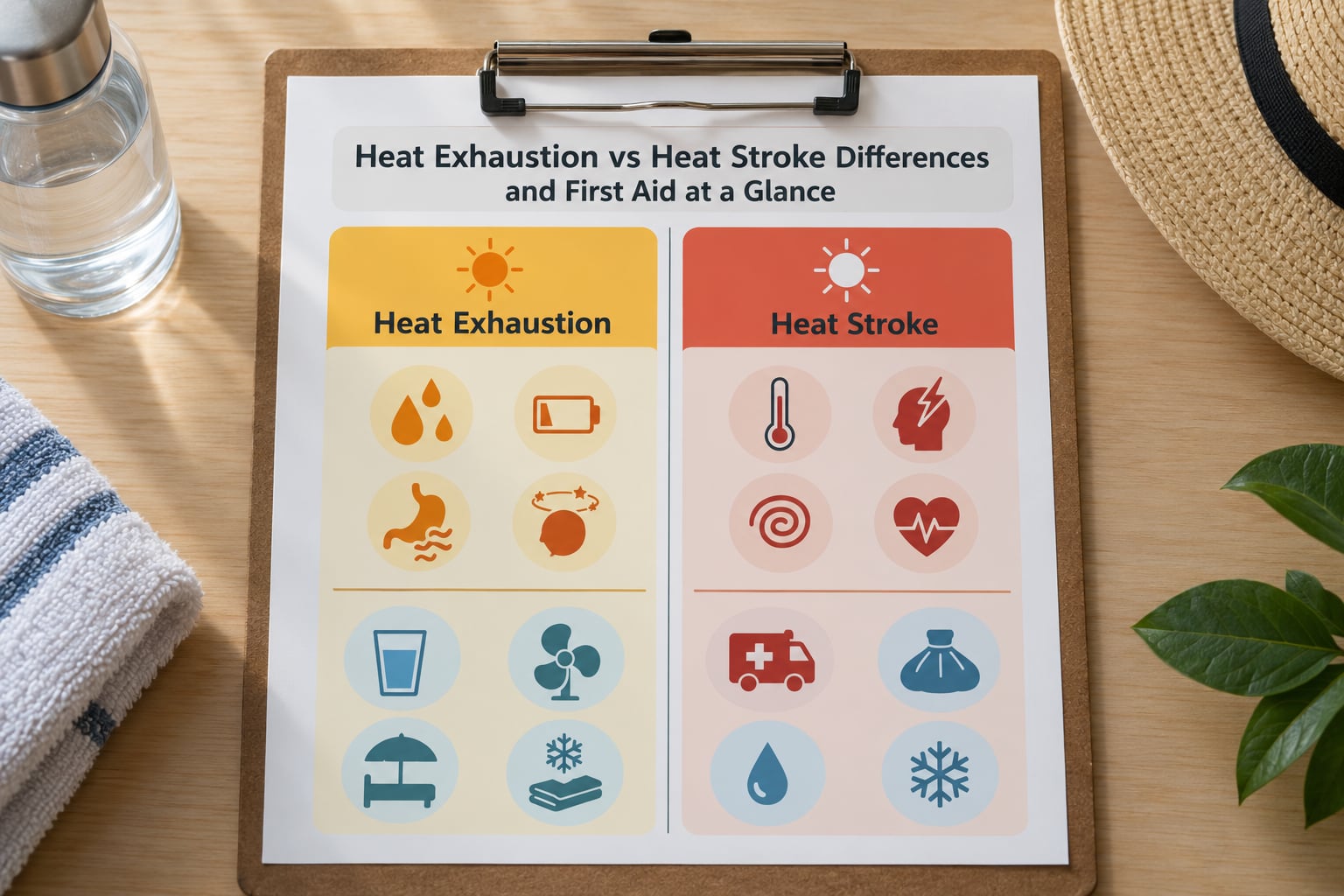
If you only have thirty seconds, this table is the whole comparison. Scan the mental status row first, because that single line decides whether you are monitoring or calling 911.
| Factor | Heat exhaustion | Heat stroke |
|---|---|---|
| Severity | Serious, but usually reversible with prompt cooling | Life-threatening emergency |
| Core body temperature | Elevated, generally below 104°F (40°C) | 104°F (40°C) or above |
| Mental status | Alert, oriented, able to answer questions clearly | Confused, slurred speech, aggressive, unusual behavior, seizures, unconscious |
| Sweating | Heavy sweating, cool clammy pale skin | May stop entirely, or may continue heavily in exertional cases |
| Pulse | Fast and weak | Fast and strong, then weak as the person collapses |
| Breathing | Normal or slightly shallow | Shallow and rapid |
| Onset | Hours of feeling off, headache, dizziness, nausea | Can follow heat exhaustion within minutes, or arrive with no warning |
| First-aid priority | Cool environment, water if fully alert, close monitoring | Call emergency services first, then cool aggressively while waiting |
| Do not | Leave the person alone, or let them resume strenuous work the same day | Give fluids to someone confused or unconscious, or delay the call to see if cooling alone works |
One row deserves special attention. Altered mental status turns a heat illness from a treat-at-the-scene problem into a transport problem.
What Is the Difference Between Heat Exhaustion and Heat Stroke?
Heat exhaustion is a moderate heat illness in which the body loses excess water and salt through heavy sweating. Heat stroke is a life-threatening emergency in which the body’s thermoregulation fails and core temperature climbs above 104°F (40°C).
That single sentence is the definition, but the mechanism explains the symptoms better. During heat exhaustion, sweating works and blood flow is adequate, so the body can still shed heat as long as the person rests and drinks. The shortfall is fluid and electrolyte loss, which is why the signature symptoms are thirst, headache, dizziness, nausea and heavy sweat.
In heat stroke, the cooling system itself breaks down. The brain’s thermoregulatory center stops functioning, sweating may shut off, and heat accumulates faster than the body can release it. Core temperature keeps climbing past the point where enzymes, cell membranes and proteins begin to fail. The NIOSH and CDC guidance treat 104°F (40°C) as the practical threshold because neurological injury and organ damage accelerate sharply above it.
The practical difference is response time. Heat exhaustion often improves within 30 minutes of proper cooling. Published figures put heat stroke fatality rates in the range of roughly 10 to 50 percent, and survivors can carry permanent neurological damage. Treat the first one with care. Call for help on the second.
Symptoms and Warning Signs
The seven signs of heat exhaustion
These are the signs people report and supervisors look for most often, in roughly the order they tend to appear.
- Heavy sweating, often soaked through clothing, with cool, pale, clammy skin.
- Heavy fatigue or weakness, including a feeling of being physically drained after very little effort.
- Dizziness or lightheadedness, especially when standing up quickly.
- Cool, moist skin and a fast, weak pulse.
- A throbbing headache, usually at the front of the head.
- Nausea or vomiting, sometimes with loss of appetite.
- Muscle cramps, and thirst with noticeably less urine than usual.
The slowed pace is the clue that catches people out. Forestry workers in online discussions describe hours of feeling fine-but-slower as the first sign they noticed, long before anyone admitted something was wrong. On a job site, a supervisor who sees pace drop and a worker who stops talking normally has early warning well before collapse.
Heat stroke signs: what changed
The shift into heat stroke usually shows up first in behavior, not in a thermometer reading. Watch for confusion, slurred speech, stumbling or an unsteady gait, aggressive or bizarre behavior that is out of character, and rapid shallow breathing. Seizures and loss of consciousness mean heat stroke is well underway.
Skin findings vary. Classic, non-exertional heat stroke often shows hot, red, dry flushed skin with sweating stopped. Exertional heat stroke, which hits workers, athletes and cyclists, very often happens while the person is still sweating heavily, because their muscles are generating heat faster than evaporation can remove it. Cyclists in cycling forums and mountain bike riders describe exactly this, and it is the most common misconception people hold.
If sweating is present, do not use it to rule heat stroke out. The question is never “are they sweating,” it is always “are they thinking normally.”
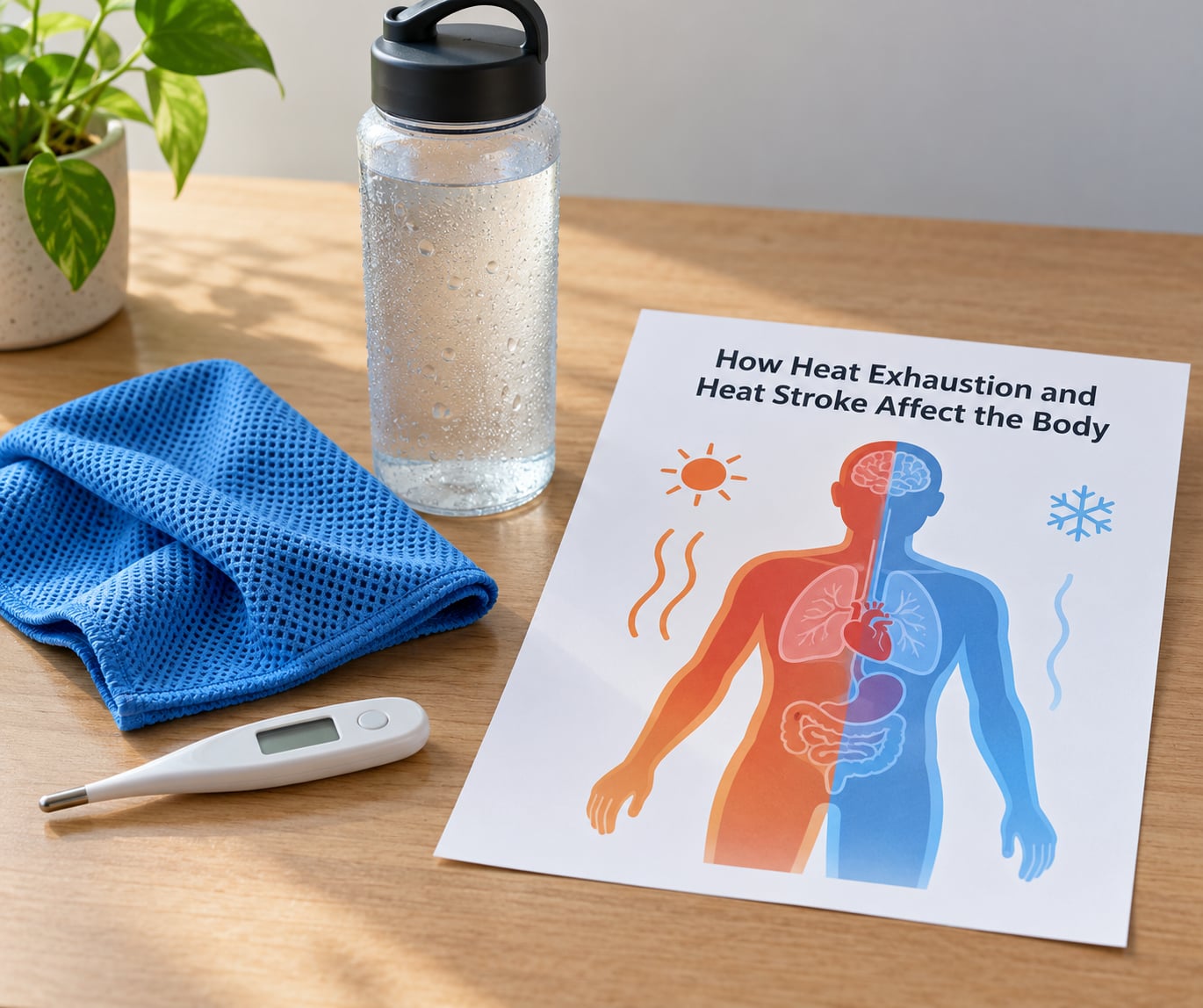
How Heat Exhaustion and Heat Stroke Affect the Body
Heat Exhaustion vs Heat Stroke Differences and First Aid: What to Check For
Work through this list in order. It is the fastest field check there is, and it needs no equipment beyond a watch and a shaded spot.
- Mental status first. Ask their name, where they are, and what day it is. Any wrong answer or slurred reply is heat stroke until proven otherwise.
- Core body temperature. A rectal reading above 104°F (40°C) confirms heat stroke. Oral and forehead readings run low, so treat them as a floor, not a verdict.
- Sweat. Heavy clammy sweat points to heat exhaustion. No sweat points to classic heat stroke. Heavy sweat during hard work points to possible exertional heat stroke.
- Skin and pulse. Cool, pale, clammy skin with a fast weak pulse is heat exhaustion. Hot, flushed skin with a bounding pulse that turns weak is heat stroke.
- Ability to swallow. Only a fully alert person who swallows on command can safely be given fluids.
- Trajectory. Track whether symptoms are improving after ten minutes of cooling. Not improving is itself a red flag.
How fast each cooling method works
Cooling speed is the single most important factor in survival from heat stroke, and the methods are not equal.
| Method | Relative speed | Best used when |
|---|---|---|
| Cold water immersion | Fastest available | A second rescuer is present, drowning risk is controlled, and the person can be held safely |
| Ice sheets or bagged ice over the neck, armpits and groin | Fast | The default field method, works in a vehicle, on a job site or at a track |
| Continuous evaporative cooling | Moderate to fast | No immersion setup available; wet the skin, fan continuously and keep airflow going |
| Shade, air conditioning and cold wet cloths | Slowest of the emergency methods | Heat exhaustion, and as a bridge while waiting for help during heat stroke |
Two warnings on fans. Fans do not help above roughly a 95°F heat index, because they add heat instead of removing it, which is a caution the CDC repeats. And a fan aimed at someone whose core temperature is already very high is fine only as part of active cooling with wet skin, not as a substitute for it.
Two kinds of heat stroke also matter. Classic heat stroke comes from environmental exposure, typically in older adults during a hot spell, in people with chronic illness, or in anyone on medications that impair sweating, including diuretics, blood thinners and some antihistamines. Exertional heat stroke comes from the body’s own heat production in work or sport. Both end at the same threshold, and both need the same response.
First Aid for Heat Exhaustion
Work fast, and you will usually see improvement inside half an hour.
- Move the person out of the heat. Get them into shade, an air-conditioned vehicle or a cool room. Stop all physical work immediately.
- Loosen and remove outer clothing. Take off heavy workwear, boots and anything trapping heat. Keep breathable layers if the skin is sunburned.
- Cool actively. Apply cold wet cloths to the neck, armpits and groin. Use a fan if the heat index is below about 95°F, and keep air moving across damp skin.
- Offer water if the person is fully alert and swallowing normally. Sip slowly, about half a cup every 15 to 20 minutes. An oral rehydration solution or a drink with electrolytes and sugar is better after prolonged heavy sweating, because plain water alone does not replace salts.
- Stay with them and monitor. Check mental status every few minutes. If symptoms worsen, stop improving, or the person becomes confused at any point, treat it as heat stroke and call emergency services.
Do not give alcohol, caffeinated drinks, or sugary drinks such as energy drinks. Do not give aspirin or acetaminophen; they do not treat the problem and can mislead you about the person’s condition. Do not leave the person alone, even briefly, and do not let them get back to strenuous work the same day.
First Aid for Heat Stroke
Heat stroke is not a scene you manage. It is a call you make and then cool while you wait. Delay is the main reason people die unnecessarily.
- Call emergency services right away. Say “suspected heat stroke” and give your exact location. Do not wait to see whether cooling alone fixes it.
- Move the person into shade or air conditioning and remove outer clothing and heavy equipment.
- Cool the body aggressively and continuously. Apply ice or cold wet packs to the neck, armpits and groin, wet the skin and fan it hard, and keep cooling until help arrives or the person is clearly responding.
- Immerse in cold water if you can do it safely and someone is holding them. This is the fastest method, but never leave a confused or seizing person unattended in water.
- Give nothing by mouth if the person is confused, drowsy, having a seizure or unconscious. Do not force water into someone who cannot swallow on command, because it can go into the lungs.
- Stay with them until help takes over. If they vomit, turn them onto their side. If they stop breathing normally, begin CPR and follow the dispatcher’s instructions.
People ask why they should not give water to someone with heat stroke. The answer is that a confused or drowsy person has a weak gag reflex, and swallowed water can go into the airway instead of the stomach. Choking makes the emergency worse. There is also no time to waste on oral fluids when immersion cooling works faster.
EMTs and emergency departments treat confirmed heat stroke with rapid whole-body cooling, intravenous fluids, and monitoring for seizures, clotting problems and kidney or liver injury. The window that decides survival is the one before the ambulance arrives, and that window belongs to whoever is standing next to the person.
When to Call Emergency Services
Call immediately if any of these are present. You do not need to confirm a temperature first.
- Confusion, slurred speech, or not making sense.
- Fainting, collapse, or loss of consciousness, even briefly.
- Seizures.
- Aggressive, erratic or completely out-of-character behavior.
- Very hot skin, especially with a fast strong pulse that later weakens.
- Vomiting that will not stop, or an inability to keep fluids down.
- A person who cannot drink, or who is too drowsy to swallow.
Heat exhaustion crosses into emergency territory on a simple rule. If symptoms are not clearly improving within 30 minutes of proper cooling, or if the person was working hard in heat and their thinking changes at all, call. Riders on mountain bike forums put it more bluntly: stopping early is the whole prevention strategy, because the escalation is often fast and there is no warning.
Call sooner if you are unsure. Nobody has ever been harmed by an unnecessary ambulance at a construction site.
How Employers and Workers Can Prevent Heat Emergencies
Most of this article is about the fifteen minutes after something goes wrong. Prevention is where the real gains are, and OSHA treats heat illness prevention as a required program rather than a courtesy.
- Acclimatize gradually. New and returning workers should build up over about a week. NIOSH’s guidance is roughly a 20 percent increase in workload duration per day for the first several days, with extra rest and water breaks, for people not used to the heat.
- Use water, rest and shade. Provide cool drinking water close enough that nobody has to walk far for it, schedule rest periods in shade or air conditioning, and rotate crews so no one carries the heaviest load in peak hours.
- Adjust the schedule to the heat index or wet bulb globe temperature, not to the calendar. Move strenuous work to early morning and evening during severe heat.
- Use a buddy system. Heat exhaustion is easy to miss in yourself and easy to hide at work. Pair workers so someone else watches for slowed pace, headache, irritability and uncharacteristic silence.
- Train everyone, not just supervisors, in recognizing symptoms and calling for help. Workers should know they will not be punished for stopping work when they feel unwell.
- Write an emergency action plan that names who calls, who meets the ambulance, where the nearest cooling point and first-aid kit are, and how the site communicates an emergency by radio.
For crews working outdoors on farms, orchards and fields, our Agricultural Worker Heat Safety: A Practical Guide covers the specific hazards of that work, including limited shade and long transport distances to help.
If someone does go down, the incident does not end when they leave the site. Our guide to what to do after a workplace injury walks through documentation, reporting and the follow-up that keeps a heat incident from becoming a recurring one.
Do not rush a return. A person who had heat exhaustion should be assessed before returning to strenuous work, and anyone who had heat stroke needs medical clearance first. Recurrence risk is highest in the first few days after an incident, which is exactly when a “tough it out” return happens. Supervisors should plan coverage so nobody feels pressured back onto the crew.
For crews and volunteers who will be responding in the heat, our piece on a first responder mental health support plan covers the harder part of emergency work that rarely gets written down.
Hydration helps, but it does not make you immune. Solo touring and cycling regulars both make the same point in different words: schedule shade or air conditioning every fifteen minutes on a long hot route, and treat electrolyte drinks as a supplement on long days rather than an optional extra.
Which Should You Choose?
There is nothing to choose between them, so treat this as a decision rule instead.
Choose the cool-and-monitor path when the person is fully alert, answering questions normally, sweating heavily with cool clammy skin, and has a fast weak pulse but no neurological symptoms. Move them somewhere cool, loosen clothing, give water or an electrolyte drink if they swallow on command, and stay with them. They should be noticeably better within 30 minutes.
Choose the call-and-cool path when there is any change in thinking, any seizure or collapse, or when a worker who has been exerting themselves in heat becomes confused while still sweating. Call emergency services, then cool continuously until help arrives. Do not wait for a thermometer reading.
When you cannot tell, and that happens often, treat the more serious condition. Cooling aggressively harms nobody with heat exhaustion, and calling for help that turns out not to be needed is a cheap mistake next to the alternative.
Frequently Asked Questions
Can heat stroke happen without sweating?
It can, but it is not required. Classic non-exertional heat stroke often features hot, dry, flushed skin with sweating stopped, which is why so many list articles say sweating must stop. Exertional heat stroke, common in workers, athletes and cyclists, often happens while the person is still sweating heavily. Judge by mental status instead. If someone is confused, slurred or behaving oddly, call emergency services regardless of how much sweat is on their skin.
Why should you not give water to someone with heat stroke?
Because a confused, drowsy or unconscious person has a weakened gag reflex, and swallowed water can enter the airway instead of the stomach, causing choking or aspiration. There is also no time to lose. Someone with heat stroke needs active cooling such as cold water immersion or ice packs, not oral fluids. Wait until emergency personnel arrive and can manage fluids safely.
Does heat stroke always come after heat exhaustion?
No. Heat stroke can develop without anyone noticing heat exhaustion first, and it can strike suddenly in under 30 minutes in someone who seemed fine. Heat exhaustion does raise the risk, and an unrecognized episode of exhaustion is a common warning sign that was missed. That unpredictability is why prevention, buddy systems and prompt escalation matter more than trying to catch the warning every time.
What are the seven signs of heat exhaustion?
Heavy sweating with cool, pale, clammy skin. Marked fatigue or weakness. Dizziness or lightheadedness. A fast, weak pulse with cool, moist skin. A throbbing headache. Nausea or vomiting. Muscle cramps, along with thirst and noticeably reduced urination. Any one of these in hot conditions deserves prompt cooling and monitoring, even if the person insists they are fine.
Should you sleep it off if you have heat exhaustion?
Only if you are fully alert, clearly improving after cooling, and someone reliable is staying with you and checking on you through the night. If you are still nauseated, dizzy, unusually tired or not improving within 30 minutes, seek medical care instead. Anyone who showed confusion, fainting or a seizure at any point needs assessment before sleeping it off, because that is heat stroke territory.
How fast can you cool someone with heat stroke?
Cold water immersion is the fastest method available and is the preferred approach when it can be done safely. In the field, ice or cold wet packs on the neck, armpits and groin plus continuous evaporative cooling with a fan work well and need almost no equipment. The rule that matters more than the method is that you stop only when help takes over or the person clearly responds, and you never stop to see if they improve on their own.
Conclusion: Act Fast as the Condition Escalates
Cool and monitor heat exhaustion, then escalate the moment thinking changes. Any confusion, collapse, seizure or slurred speech means you call emergency services and cool continuously while help is on the way, whether or not the person is still sweating. The whole value of knowing heat exhaustion vs heat stroke differences and first aid is knowing which of those two responses the person in front of you needs, and doing it in the first ten minutes rather than the first hour.