

To communicate a wellness program to employees, you repeat one clear message about what the program offers, who can use it, and exactly how to join, then reinforce it through email, team channels, printed materials and trained managers. Most launches fail because the message arrives once and nobody follows up.
The gap is rarely the program design. Employees simply do not hear it, do not understand it, or do not believe it. On an HR forum I read recently, the complaint that came up again and again was that announcements read as corporate-speak and got ignored, especially by frontline staff who never received them at all.
So this is a practical plan, roughly a day of prep and then eight repeatable steps you can run for any wellness launch, from a first step challenge to a full benefits program.
Table of Contents
- What You Need Before You Announce Anything
- Step-by-Step: A Wellness Communication Plan
- Common Mistakes in Wellness Program Communication
- Quick Tips
- Frequently Asked Questions
- How should employers communicate a wellness program without pressuring employees?
- What information should a manager share about an employee wellness program?
- How can a workplace wellness program reach employees on different shifts?
- Should employers collect health information when promoting a wellness program?
- How can an employer communicate wellness benefits to remote employees?
- How should employers respond when employees do not engage with the program?
- Conclusion
What You Need Before You Announce Anything
Every item below exists so you are not drafting copy while the program details are still in flux.
- Program goals in one sentence. Not a mission statement. What changes for an employee who joins.
- Eligibility and participation rules. Full time, part time, temporary, contractors, and anyone over a minimum tenure.
- The approved benefit list. What is subsidized, what costs the employee something, and what is fully covered.
- A written privacy policy. What data is collected, who holds it, and what a manager never sees.
- Named responsible contacts. One HR owner, one program vendor contact, one escalation path.
- Access to your channels. Email, intranet, chat, digital signage, printed materials, team meeting time.
- Manager talking points. A one-page script, written by you, not by each manager from memory.
- Accessibility requirements. Screen-reader friendly documents, translated materials, print copies for non-desk staff.
- Baseline numbers. Headcount, average email open rate, and last quarter participation if you have it.
If you cannot name a specific person employees can email with a question, do not launch. The first message will generate questions you have to answer somewhere visible.
Step-by-Step: A Wellness Communication Plan
Define the Employee Benefit
Compress the program into one plain-language sentence a busy employee would understand on the first read. Good versions sound like “You get a free membership at any gym in our network, plus six counseling sessions with no cost to you.” Weak versions sound like “Our holistic approach supports the whole person.”
Then separate what you are communicating from what you are claiming. Describe benefits, not health outcomes. Saying employees may feel more energized is a promise you cannot keep and should not make.
Also state the participation rules without hedging. If it is voluntary, say the word voluntary in the first paragraph. If opting out affects nothing about someone’s job, say that too, in plain words, rather than burying it in a policy link.
Map Employee Audiences and Barriers
One email blast never reaches everyone. Segment your workforce before you write, using data you already hold: work schedule, location, job type, language, disability access needs and digital access level.
The typical map has five groups. Desk-based remote and hybrid staff read email and intranet. Hourly and shift staff may never check email, so they need posted materials and a manager who says it out loud. Multilingual employees need translated copies. Employees using assistive technology need documents that work with a screen reader. Employees with no company-issued device need a printed version and a way to sign up without a work login.
Ask your frontline managers one question before launch: who on your team will not hear this? Their answers are more reliable than your distribution list.
Create Clear and Inclusive Messages
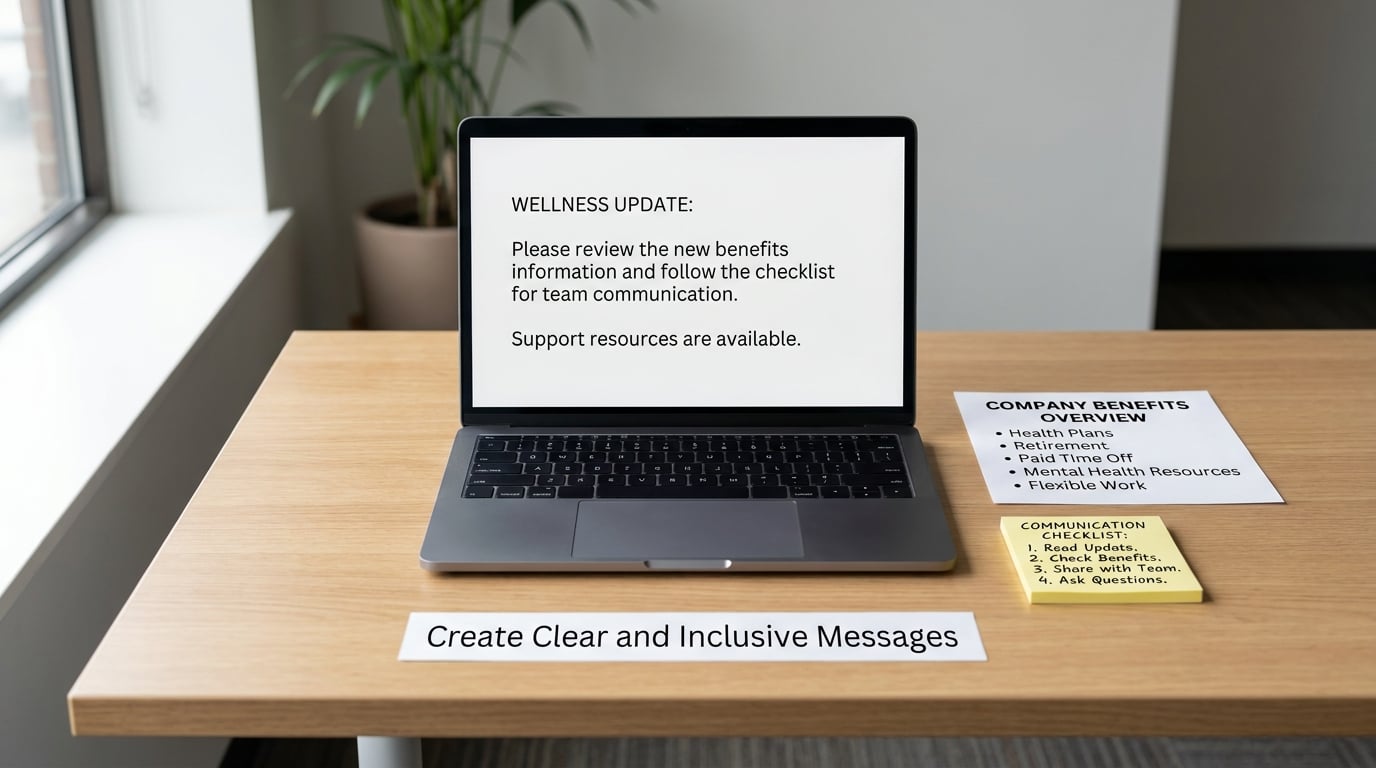
Every message covers the same eight things in the same order. What the program is, who can use it, what it offers, how to join, what it costs if anything, what stays private, where to get help, and when it begins.
Keep each piece short enough to survive a scan. Subject line under fifty characters, three or four lines of body copy, one call to action, one link.
Email subject: Your wellness benefit, what it covers, and when it starts
Email body: We are adding a wellness benefit this month. Every employee gets six free counseling sessions and a gym membership subsidy, and neither one affects your paycheck or your performance reviews. Enroll by signing up in the intranet, or ask your manager for the printed form if you do not have a work login. Questions go to our HR team.
Poster line: Free counseling and gym support for every employee, starting this month. Ask your manager or HR.
Manager script, twenty seconds: We launched a wellness benefit this month. It covers counseling sessions and a gym subsidy, it is completely voluntary, and nothing you do or do not do affects your review. Here is the link. Let me know if you have questions and I will get you an answer.
When you list program examples, keep them concrete. Common workplace wellness program examples include step or activity challenges, an Employee Assistance Program, mental health days, on-site or subsidized fitness access, health risk assessments, biometric screening events, nutrition or cooking sessions, ergonomic assessments, financial wellness sessions, and caregiver support resources.
The same principle applies if you frame the program around the widely used five pillars of wellness: physical, mental, financial, social and lifestyle. Most workplace programs cover two or three of them well rather than all five badly.
Test Before You Launch
Send the draft to a small group first. Six to ten people works well if you include at least one hourly employee, one remote employee and one person who uses assistive technology.
Ask them five questions. What do you think this is? What do you get? Who can use it? What does it cost? Where do you sign up? Any gap between their answers and your intent is a sentence you need to rewrite.
Then check the practical things yourself. Does the link work on a phone? Does the form load without a VPN? Does the PDF read aloud correctly? Does the printed version fit on one page? Is the privacy statement specific rather than a promise that data is secure?
Rewrite once based on what you learn. Two rounds is usually enough to fix confusing language.
Train Managers and Support Leads
Managers are the channel employees actually hear from, and unprepared managers are where trust breaks. Give them a short script, answers to the five most common questions, and a clear boundary on what they are not responsible for.
That boundary matters. Managers must not pressure anyone, request health details, track who joined, or discuss participation with anyone else. They forward questions to HR rather than guessing.
Three questions come up more than the rest. Can my manager see if I participate? Does this affect my job review? Does my manager find out if I opt out? The answers are the same every time, and the script needs to state them out loud so nobody has to ask their boss and get an awkward guess.
Launch Through Multiple Channels
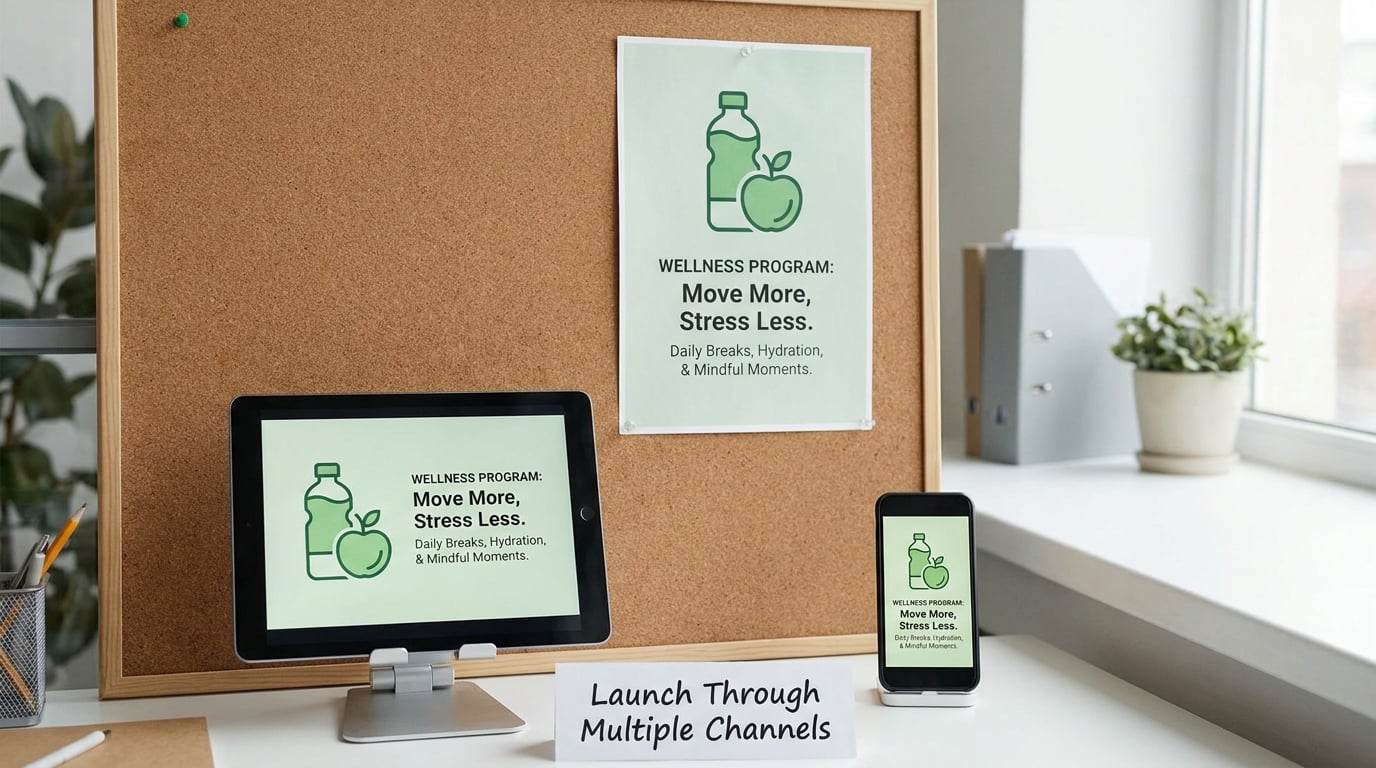
Reach depends on channel coverage, not message variety. The same core message repeated across five channels beats five different messages in one channel.
| Channel | Best use | Cadence | Owner |
|---|---|---|---|
| Full announcement with the link | Launch, then every 3 weeks | HR communications | |
| Team meeting | Live explanation and questions | Launch week, then quarterly | Direct manager |
| Chat channel | Short reminders and links | Weekly during enrollment | Wellness champion |
| Intranet page | Full details, FAQ, privacy policy | Always current | HR operations |
| Printed poster and paystub insert | Hourly, shift, and no-computer staff | Launch and enrollment close | Site facilities |
| Digital signage | Onsite awareness in break areas | Monthly rotation | Marketing |
Run the same message on the same day across email, chat and the intranet page. Staggering them means people encounter two versions and trust neither.
Reinforce the Message Without Nagging
Launch week is not the finish line. A program that gets one announcement has a participation spike in week one and a trough by week four.
Set a realistic reminder cadence based on your enrollment cycle. A rule of thumb some HR teams use is the 5-3-1 rhythm: five reminders around launch, three during enrollment, one weekly nudge while the enrollment window stays open. Adjust it to your actual dates rather than forcing the count.
Reminders should carry new information each time. What is new this week, who is helping, what question we answered, what changed. A reminder that repeats the launch email verbatim gets filtered out.
Stop somewhere. Weekly wellness messages for a year become background noise, and message fatigue reads as a program the company is trying to force. Most employers settle on weekly during enrollment and monthly the rest of the year.
Collect Feedback and Adjust
Measure the communication itself, separately from any health or cost outcome. Mixing the two makes both useless.
Track four things. Reach, which is delivery and open rates by channel. Comprehension, which you can test with two or three survey questions about what the program is and how to join. Action, meaning enrollment clicks and completed sign-ups. And friction, which is the questions and drop-off points employees report.
Do not collect health information to do this. Ask about the communication, not the employee’s blood pressure or stress score. Individual results belong to the vendor under the privacy policy you published.
Review at thirty, sixty and ninety days. If reach is fine but sign-ups are not, the problem is trust or clarity, so fix the message. If reach is poor, the problem is channel coverage, so fix distribution. Diagnose it before you send another message.
What to Do When Participation Stays Low
Do not respond to a flat launch with more reminders. More of the same message reads as a program nobody believes in.
Ask for feedback instead. A short anonymous survey asking why people did not join will outrank any guess you make. Common answers cluster into four buckets: unclear what the benefit is, no time, a belief the employer is collecting data, or an assumption it was only for a fitness-minded crowd.
Each bucket needs a different fix. Clarity problems get rewritten copy. Time problems get a five-minute version of the activity. Privacy fears get the specific data statement, not a reassurance. The fitness-only assumption gets a message that names benefits suited to people who will never set foot in a gym, such as counseling sessions, financial coaching or caregiving support.
Then re-announce as a new enrollment period with new content, not a repeat of the failed launch.
Common Mistakes in Wellness Program Communication
Announcing once and going quiet
The most common failure by far. Set a cadence before launch and treat reinforcement as part of the program budget, not an extra.
Writing in benefits jargon
Replace “utilize,” “utilization,” and “resources” with words a first grader would understand. Jargon signals that the message was written for the vendor, not the employee.
Letting each manager say something different
Supply a script. When five managers describe the same program five ways, employees pick the most confident version, which is rarely the most accurate one.
Leading with health claims
Promise access to benefits, not better health. Employers that promise health improvements end up defending claims they cannot support.
Leaving privacy vague
“We take your privacy seriously” is not an answer. State who sees individual data, and confirm plainly that managers receive only aggregate numbers, never names.
Email only
Hourly, shift, and plant staff are routinely missed. Add printed materials and say it out loud in team meetings.
Publishing documents that do not work for everyone
Test screen readers, phone screens and print layouts before you send. An inaccessible PDF excludes the employees the program was meant to help.
Judging success only by enrollment
Low enrollment tells you the communication failed, not why. Look at reach, comprehension and the reasons people give for opting out before you redesign the program.
Quick Tips
- Lead with what the employee receives, not what the company gains.
- Repeat one call to action everywhere. Two or more links split attention and halve the response.
- Say voluntary once, early, and without hedging.
- Name real benefits, with real dates, in the first two lines.
- Answer the privacy question before anyone asks it.
- Track communication results separately from health results, so neither pollutes the other.
Frequently Asked Questions
How should employers communicate a wellness program without pressuring employees?
State plainly that participation is voluntary, that opting out affects nothing about employment status, pay or reviews, and that managers receive only aggregate numbers. Avoid linking benefits to performance, team goals or manager approval. When a program includes incentives, make them available through a route that does not require anyone to disclose that they joined, and let managers state this out loud in team meetings rather than leaving it in written policy.
What information should a manager share about an employee wellness program?
Managers need the benefit list, eligibility rules, cost to the employee, the signup link, and the exact privacy language, plus a short script. They should not answer health questions, request personal health details, track who enrolls, or discuss participation with anyone. The best setup gives managers one page to hold and a named contact for anything outside that page.
How can a workplace wellness program reach employees on different shifts?
Email alone misses most shift workers. Use printed posters and paystub inserts, ask each site lead to say it during shift handover meetings, and place one wellness champion per shift so someone is present at every changeover. Offer a signup route that does not require a work computer or VPN. Then measure sign-ups by shift to confirm the gap actually closed.
Should employers collect health information when promoting a wellness program?
Not for communication purposes. Evaluating whether your message worked requires counts and survey answers about the message, not health data. If the program itself includes a health risk assessment or biometric screening, individual results should stay with the vendor, and you should publish who holds that data and what a manager can see. Never request health details to follow up on enrollment.
How can an employer communicate wellness benefits to remote employees?
Meet the remote workforce where they already are. Put the full details and FAQ on the intranet, post the short version in the chat channel employees already read, and schedule one live session with a recorded version for time zones that miss it. Send anything that requires action twice, since email timing across countries is unreliable, and check the signup page on a phone before you announce it.
How should employers respond when employees do not engage with the program?
Do not simply send the same message again. Run a short anonymous survey asking why people did not join, then group the answers into unclear benefit, no time, privacy concern, and belief it is only for fitness-minded staff. Fix each group differently, then reopen enrollment as a new period with new content. Track communication reach and comprehension alongside sign-ups so you know which problem you solved.
Conclusion
Learning how to communicate a wellness program to employees comes down to three things: one short employee-centered message, explicit privacy and participation safeguards, and a named channel for every shift, site and language you employ people in.
Start now by writing that core value statement in a single sentence, then pick the one action you want each employee to take in week one. Everything after that, the channels, the cadence, the manager script, is built around those two pieces.