
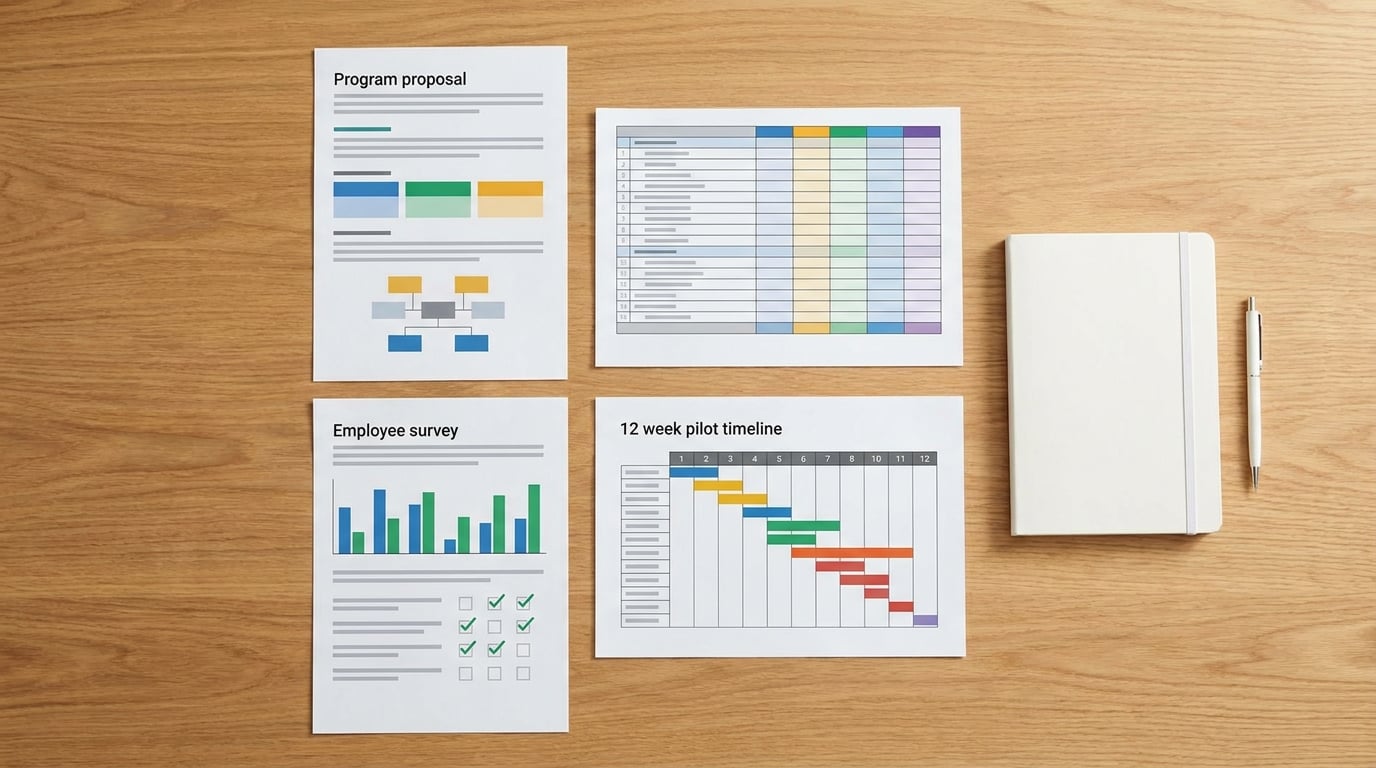
Leadership buy-in is the visible, ongoing commitment from senior leaders: approved budget, a public endorsement, and their own participation. To get it, stop pitching wellness as a benefit and build a proposal around a business problem leaders already track, back it with data you collected yourself, and ask for one small, reversible decision rather than a companywide rollout.
In practice that means the work happens long before the meeting. Most wellness proposals fail for a boring reason: they arrive as an idea instead of a decision request, and the executive in the room has no way to say yes or no to a feeling. A good proposal gives them a specific ask with a small downside, evidence they trust, and a date they can put in a calendar.
Below is the process I watch HR and benefits leads use when the budget is contested and a prior wellness attempt quietly died. It takes roughly six to ten weeks of preparation before you sit down with a decision-maker, and most of that time goes into evidence rather than slides.
Last updated: October 2026
Table of Contents
- What You Need
- Step-by-Step: How to Get Leadership Buy In for a Wellness Program
- Common Mistakes
- Frequently Asked Questions
- What does leadership buy in for a wellness program actually mean?
- How do I convince executives that workplace wellness is a business issue?
- What data should I bring to a wellness program proposal?
- How can I present a wellness program when the budget is limited?
- Which wellness program measures show leadership value without overstating results?
- How do we keep a wellness pilot from becoming a one-time initiative?
What You Need
Six things. If you are missing any of them, the meeting will stall, and you will spend the first ten minutes answering questions you should have brought answers to.
- Business data you already have. Absence days, turnover, job postings filled time, workers compensation claims, safety incident reports, and your medical cost trend. Pull three years if the system will give it to you.
- Employee insight from your own people. A short anonymous survey, listening sessions, or exit and engagement data. Employee demand collected on site persuades executives in a way that a vendor brochure does not.
- Proposed program elements. Three to five concrete components, each with what it costs to run and what it asks of employees and managers. Resist listing twenty ideas.
- Budget assumptions. A per-employee-per-month figure built from vendor fees, incentive spend, and the internal staff time it consumes. Finance will ask for the staff time even if you do not volunteer it.
- Two or three success measures. Chosen before launch, with a baseline captured before anything starts, so you are not arguing about what counts later.
- An identified decision-maker and a date. One person who can actually approve the money, and a specific ask you want answered in that room.
If the last item is unclear, nothing else matters yet. Find out who signs off, what their approval threshold is, and what else is competing for the same budget cycle.
Step-by-Step: How to Get Leadership Buy In for a Wellness Program
Start With a Business Problem, Not a Wellness Benefit
Executives do not have a wellness problem on their list. They have a staffing problem, a safety problem, a retention problem, or a rising cost problem. Your first job is to attach the proposal to one of those, and to say plainly which one you are targeting and why.
Absenteeism in a warehouse operation is a different conversation from burnout retention in a software team. Pick the problem where you have the clearest operational numbers and the shortest distance to a decision. A narrow framing that leaders recognize gets a yes far more often than a broad one about culture and morale.
One caution: do not promise that a wellness program will fix the problem. You are proposing to test whether it moves a specific measure. That sentence alone removes a lot of executive suspicion.
Use Workforce Data to Show the Opportunity
Start with data that already exists inside the organization. Absence records, turnover by team and tenure, job posting time to fill, first aid and incident logs, and your insurance renewal trend all tell a story about where capacity is being lost.
Read it carefully. A rise in absence days can reflect a new scheduling system or a plant closure rather than a health problem, and a sharp turnover spike is often a manager problem, not a wellness gap. When you have competing explanations, say so in your materials. Naming the alternative reading and explaining why you still think the case holds reads as competent in a way that claiming certainty never does.
When the data is thin, fill the gap with a short employee survey rather than an assumption. Six questions is enough: what most affects your ability to work well, what support you would use, what already exists that you value, what gets in the way of taking a break, and how healthy you would rate your current workload. Report what people asked for and how many people answered, and keep it anonymous.
Be straight about survey limitations. A 22 percent response rate is a real signal about the people who answered, not a verdict on the whole workforce, and saying that protects you when a skeptical executive asks.
Build a Small, Low-Risk Proposal
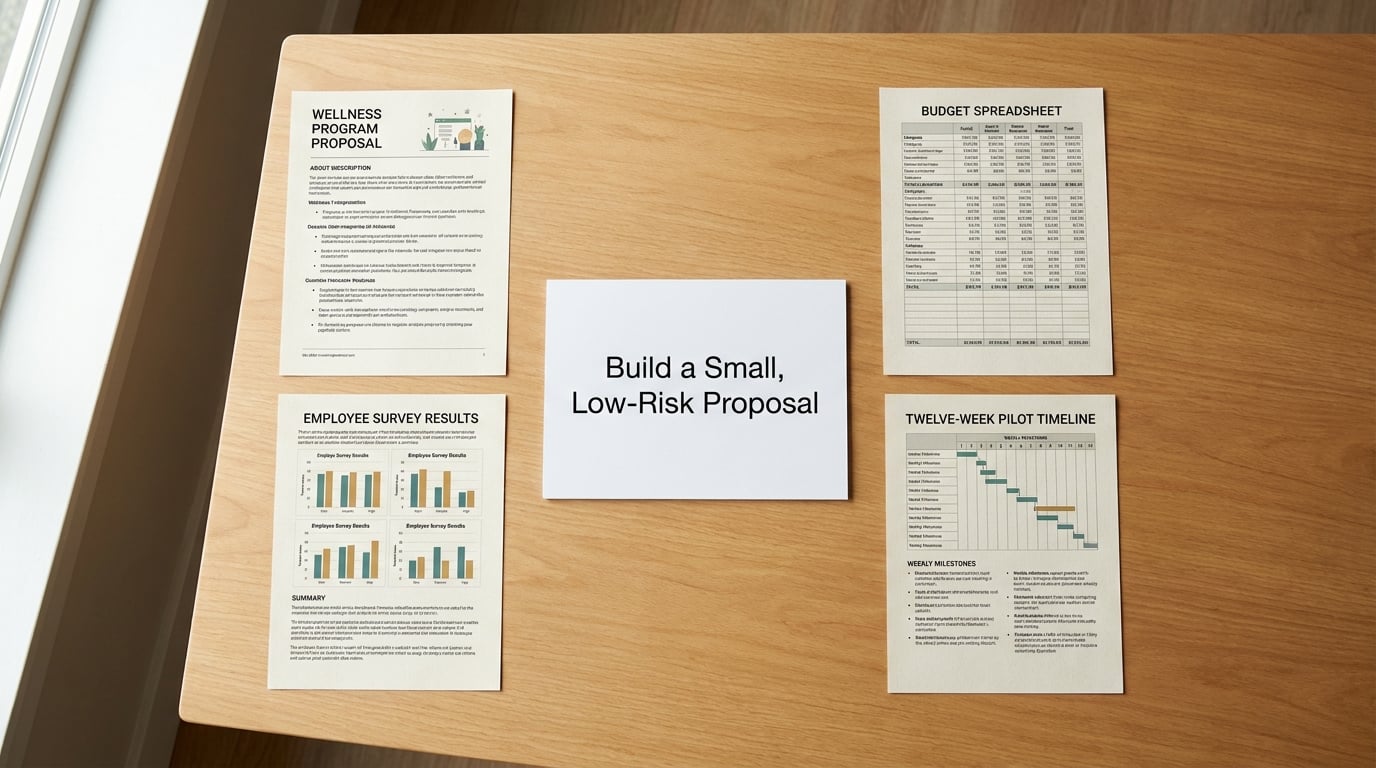
A twelve-week pilot at one or two sites, or one department, with a defined participation goal and a written end date, converts an open-ended request into a testable one. Executives approve experiments more readily than transformations, mostly because an experiment has a stopping point built into it.
Spell out four things in the proposal: what you are running, what it requires from managers, what the participation target is, and what happens at week twelve. A participation target around a quarter to a third of the pilot population is a reasonable planning assumption to state, with the note that the pilot exists partly to test whether that number is realistic in your workforce.
Also name the risks out loud. Time managers spend facilitating, employees who do not have access to a gym or private space, shift workers who cannot join a midday session, and employees with disabilities who need different formats. Listing those risks tells a leader you have thought about implementation, which is a different signal from listing only benefits.
If your workforce includes frontline or shift staff, design the pilot with them from the start. One option a manager can take in ten minutes at the start of a shift will reach more people than a seminar that requires a laptop and an hour away from the floor.
Make the Business Case With Clear Measures
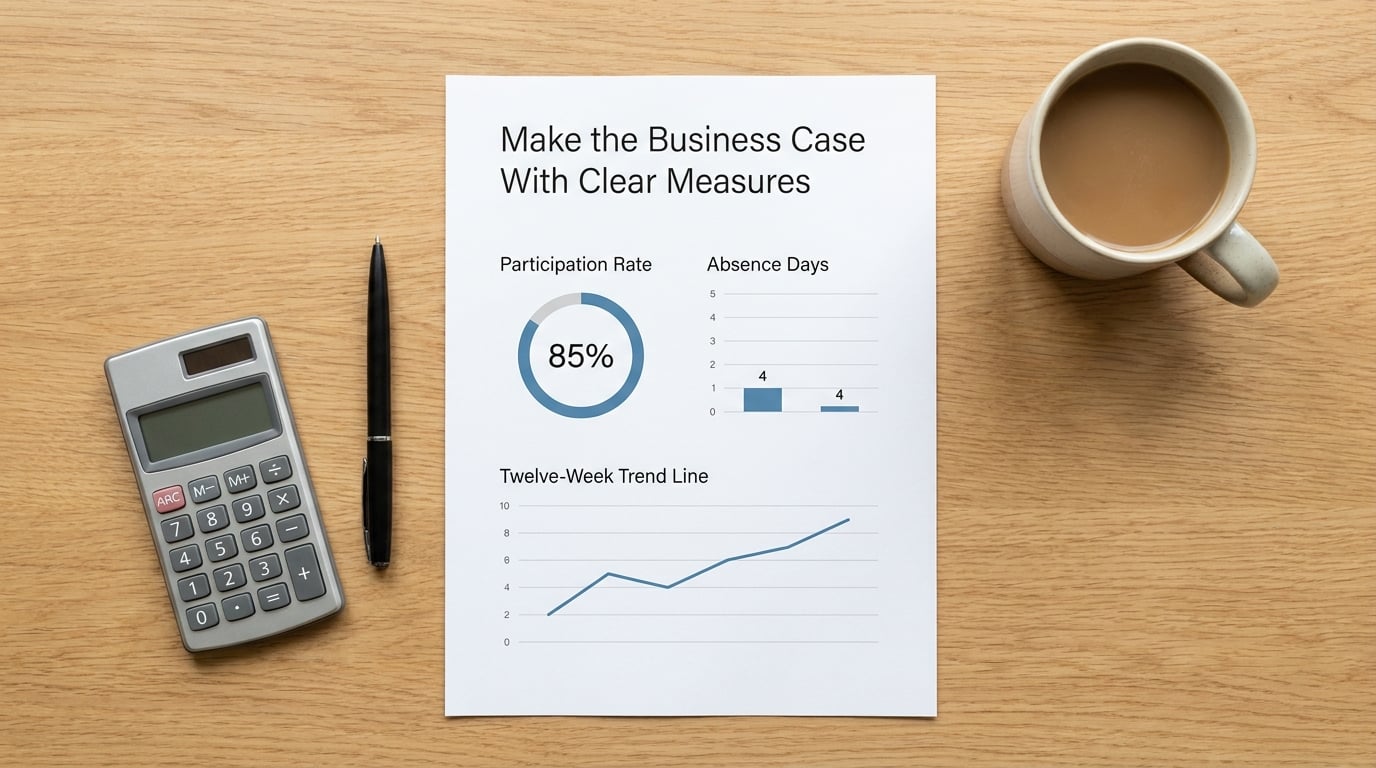
Pick two or three measures, not ten. Participation rate is the obvious first one because it is fast, it is honest, and it is entirely within your control. Add one outcome measure connected to the business problem you chose, such as absence days in the pilot group, and one experience measure, such as a short satisfaction pulse at the end.
Capture the baseline before launch. Twelve weeks of participation data with no pre-period tells a leader very little, and the first question you will face is how you know anything changed.
On return on investment, stay conservative. Independent evaluations of employer wellness programs, including long-running work from RAND, have found that average effects on health measures and cost savings are often modest, with the strongest results coming from programs that combine health content with changes to the work environment itself. Vendor-sponsored CEO surveys point the other way: Wellhub’s Return on Wellbeing 2025 CEO Edition reports that 94 percent of CEOs allocate some wellness budget, and that 90 percent of organizations measuring results see positive returns. Both things are true, and an executive who knows you understand the difference trusts you more, not less.
Frame the money as a cost of doing business against a rising baseline rather than as a savings promise. Unplanned absence has a known per-day cost in your organization. Adding a modest, predictable program cost next to that number is a comparison a finance leader can accept; promising to recover two dollars for every one spent is a claim most of them have heard before and stopped believing.
Present the Proposal in a Decision Meeting
Keep it to about twenty minutes and structure it in the same order every time: the ask, the evidence, the options, your recommendation, the decision you need, and the follow-up date. Consistency makes you easy to follow and hard to stall.
Your opening sixty seconds can be scripted almost word for word: what problem you are raising, the one or two numbers that describe it, what you want to test, and the decision you are asking for. Then stop talking. A rehearsed opening is not stiff, it is fast.
Have the options ready, because leaders often prefer to choose rather than to agree. Option one is the twelve-week pilot as described. Option two is a longer program that starts after the pilot. Option three is to do nothing this cycle. Naming the third option honestly does not weaken the ask; it shows you understand the trade-off, and it is the option they were going to choose anyway if you left it unsaid.
Expect the same objections. Wellhub’s CEO survey data suggests the leading hesitations are fear that employees will not use the program, cited by about 30 percent of respondents, cost at 29 percent, and worry about the HR workload at 21 percent. Have a short answer ready for each:
- “Our employees will not use it.” Agree, and set the target low enough to be credible. The pilot exists to test demand, and you will report actual numbers rather than projections.
- “We have other budget priorities.” Ask for the pilot only, priced against the cost of the problem rather than the annual budget.
- “We already support wellbeing.” Ask what the existing support actually reaches. An employee assistance program used by a small share of staff is not the same as a strategy, and the survey data will show the gap.
- “Wellness programs do not change health outcomes.” Say that the evidence is genuinely mixed, then point to the measures you will track and the decision you will make at week twelve.
- “This will overload HR.” Show the admin hours per month, name who owns each task, and offer vendor administration for the parts that consume time.
Whatever you do, do not make health claims on the company’s behalf. You cannot promise anyone fewer diagnoses, lower medical costs, or a longer life, and a leader who hears that promise will later hold you to it. Keep every statement about outcomes framed as something you will measure.
Pilot, Listen, and Reduce Friction
Run the pilot as a learning exercise, not a launch. That means weekly, five-minute conversations with the managers involved and a simple open channel where employees can say what is not working.
The most common failure I see is friction nobody admitted to. A program that only runs at lunch, a sign-up process that takes four steps on a phone, an incentive that rewards people who already had time to exercise. Fix those before you ask anyone to try harder.
Publish what happens when someone raises a problem. A short note in the same channel saying the Friday session moved to a second shift because twelve people asked for it does more for future participation than any launch announcement.
Participation above your target is not automatically good news either. If 60 percent of a department signs up and nothing else moves, ask what happened. Sometimes a program gets used heavily by a small group while the rest disengage, and expanding on that basis means expanding a program that does not reach the people you were trying to reach.
Report Results and Scale With Permission
Write the pilot report in the same shape as the original proposal: the measure, the baseline, the result, and the limits. Two pages, no jargon, and a recommendation at the top.
Separate the strong signal from the weak one. A rise in participation from 8 percent to 31 percent in a pilot with a well-publicized incentive is a real result. A two-day dip in absence days across a pilot group of forty is noise, and saying so out loud protects your credibility for the next ask.
State the limitations you already know: short timeframe, no control group, self-reported satisfaction, a population that opted in. Then request something specific: continuation funding, expansion to two more departments, or a decision on whether the program continues past the pilot at all. A specific request is easy to approve and hard to ignore, and it gives you a second budget conversation in twelve weeks rather than a vague hope that it continues.
Common Mistakes
Leading with industry trends. A slide full of program types and market growth tells a decision-maker nothing about their organization. Fix: open with your own data and your own people.
Making health or savings claims. The moment you promise reduced medical cost, you have made a promise your pilot cannot verify. Fix: promise measurement, not outcomes.
Sending data instead of an argument. Twenty slides of analytics buries the one thing you want remembered. Fix: one page, three numbers, one recommendation, everything else in an appendix that you do not present unless asked.
Offering too many choices. A menu of ten program options transfers the hard thinking back to the leader who has least context. Fix: recommend one, name one alternative.
Measuring participation only. Participation is a measure of interest, not of value, and a program can show 40 percent engagement and change nothing. Fix: pair it with one business outcome and one employee experience measure.
Launching without a named executive sponsor. If no leader mentions the program publicly, employees read the silence as disinterest and participation fades after the first incentive cycle. Fix: ask for a sponsor by name, and a sentence in an existing all-hands or newsletter slot, before the pilot starts. Visible participation from senior leaders is the factor most consistently tied to engagement.
Two guardrails to put in writing before anything launches. Participation must be voluntary, with a genuine alternative for anyone who cannot take part, and no wellness data may be used in performance reviews, promotion, insurance pricing, or employment decisions. Second, keep individual health data with the vendor under a confidentiality agreement, aggregate anything you report, and confirm with your legal or compliance team how biometric screenings and health risk assessments will be handled under disability and discrimination law. The Centers for Disease Control and Prevention is a reasonable starting point for survey design; your counsel decides the legal questions.
On sequencing, in most organizations the useful order is middle managers first, then the C-suite, then the board. Managers feel the program before their leaders do, and a manager who has already handled the practical questions becomes a credible ally rather than a skeptic you have to argue around. The exception is a leadership team that explicitly ignores employee feedback, where going straight to the executive sponsor is faster.
Frequently Asked Questions
What does leadership buy in for a wellness program actually mean?
It means visible, ongoing commitment from senior leaders: approved budget, public endorsement in existing communication channels, and their own participation. Verbal agreement at one meeting is not buy-in. The test is whether a leader mentions the program unprompted six months later and whether the budget line survived the next planning cycle.
How do I convince executives that workplace wellness is a business issue?
Attach it to a problem they already carry: absence days, turnover in a critical role, recruitment time, or rising medical cost trend. Bring your own operational numbers, set one measure connected to that problem, and propose a short test rather than a permanent commitment. The pitch works when it sounds like a business review with a health component, not the reverse.
What data should I bring to a wellness program proposal?
Three years of absence days, turnover by team and tenure, job posting time to fill, incident and safety reports, and your medical cost trend from the broker. Add a short anonymous employee survey so demand comes from your workforce, not a vendor. Show three numbers on the cover and keep everything else in an appendix.
How can I present a wellness program when the budget is limited?
Ask for the smallest test that produces a decision: one department, twelve weeks, a defined participation target, and a written end date. Price it per employee per month and set it beside the cost of the problem you are targeting, such as the daily cost of unplanned absence. Offer a no-spend internal version and a vendor-supported one so the leader can choose.
Which wellness program measures show leadership value without overstating results?
Use three: participation rate, which you fully control; one business outcome tied to your framing problem, such as absence days; and a short satisfaction pulse. Capture a baseline before launch, report the result next to that baseline, and state the limits in the same paragraph. Avoid savings ratios you cannot verify from your own records.
How do we keep a wellness pilot from becoming a one-time initiative?
Write the decision criteria into the pilot proposal before it starts, including what happens at week twelve in every outcome including stopping. Book the follow-up meeting on the calendar on day one, publish a two-page report with a specific recommendation, and ask for a defined next phase rather than open-ended continuation. If the pilot continues, refresh the content and the champions each cycle.
Start with one afternoon of work rather than a new deck. Pull the absence and turnover numbers, run a six-question survey, and pick the single business problem those numbers point to. Everything after that is a matter of asking for a small, dated decision and then reporting back on it honestly.