
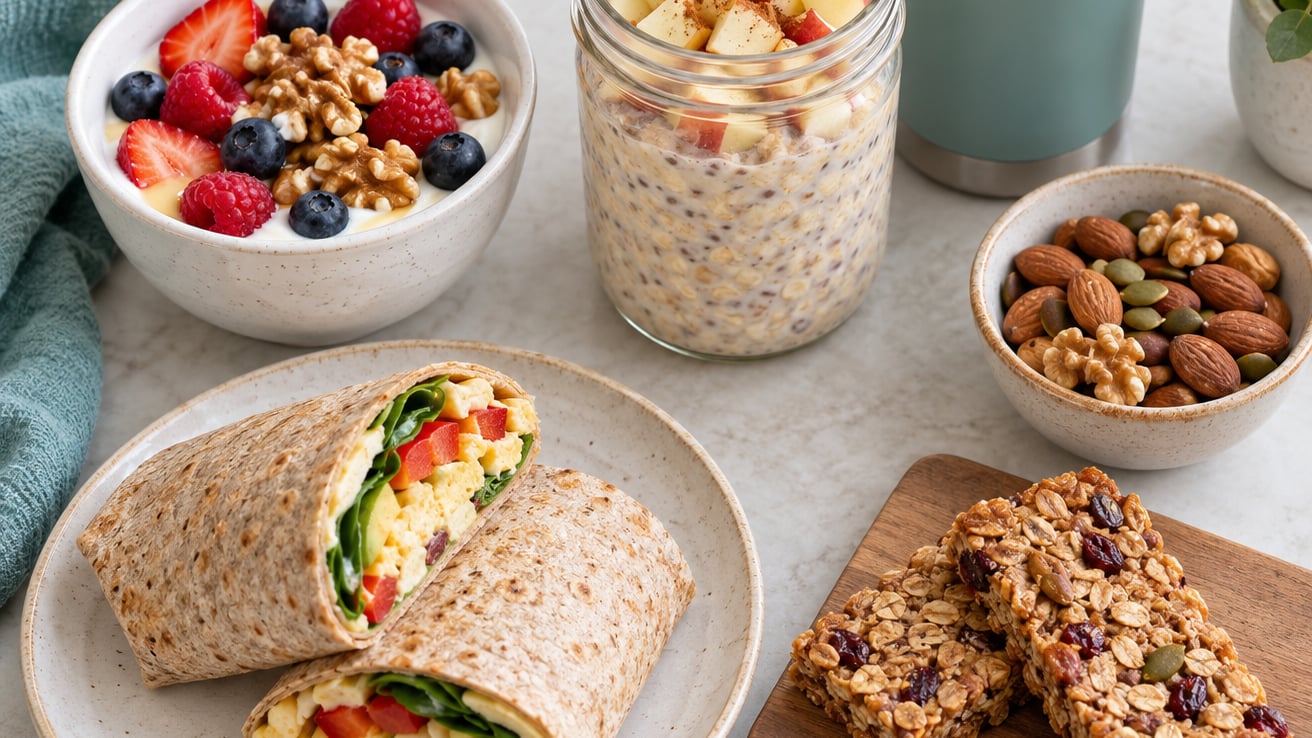
Healthy breakfast ideas for busy workdays come down to one rule: cook once, eat five times. Overnight oats, yogurt cups, make-ahead wraps and baked oat bars can all be built in a single Sunday session, then portioned into containers that survive a commute or a desk lunch. Here are 12 options that take five minutes to assemble or a single batch to cook.
This list is aimed at desk workers, commuters and shift workers who want steady energy through a long morning without spending it at the stove. Each entry covers how long it takes, whether it travels, and which schedule it fits best. For ideas that work when food is part of the meeting rather than a private affair, read our healthy meeting food ideas for modern workplaces first.
One note before we start. This is general nutrition information, not medical advice. If you have diabetes, a food allergy, or any condition where diet matters clinically, check with a doctor or a registered dietitian before changing your routine.
Table of Contents
- Healthy Breakfast Ideas for Busy Workdays at a Glance
- 1. Greek Yogurt with Fruit, Nuts, and Granola
- 2. Overnight Oats with Apple and Cinnamon
- 3. Peanut Butter Banana Oatmeal
- 4. Spinach and Egg Breakfast Wrap
- 5. Cottage Cheese Toast with Peach
- 6. Protein Smoothie for a Commute
- 7. Whole-Grain Waffle with Berries
- 8. Yogurt and Berry Parfait
- 9. Egg and Avocado Breakfast Sandwich
- 10. Overnight Chia Pudding
- 11. Breakfast Rice Bowl
- 12. Nut Butter and Fruit Oat Bar
- Frequently Asked Questions
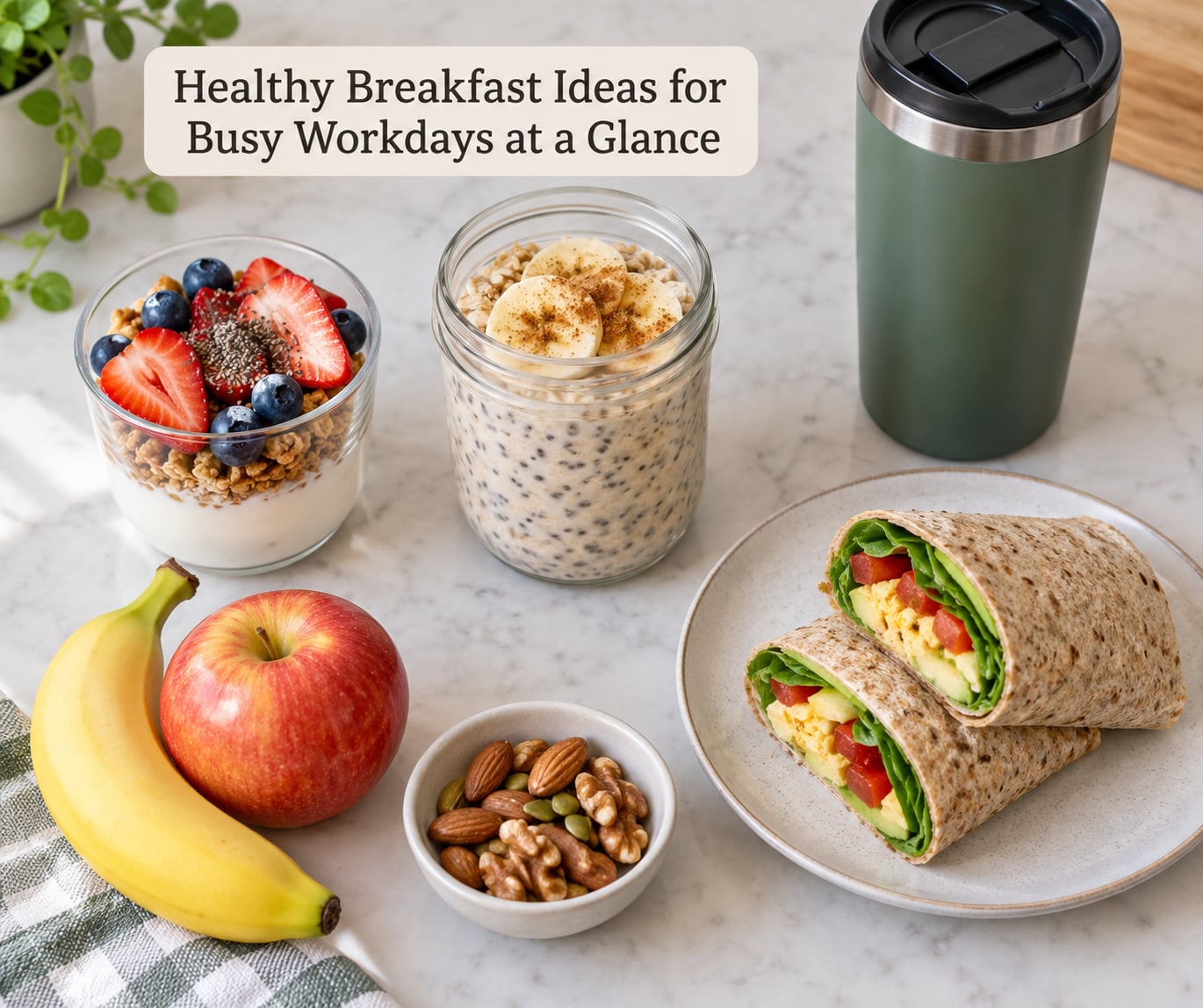
Healthy Breakfast Ideas for Busy Workdays at a Glance
| Breakfast | Prep time | Portability | Best schedule fit | Main nutritional benefit |
|---|---|---|---|---|
| 1. Greek yogurt cup | 5 min | Excellent, cold | Desk or hybrid mornings | Protein plus calcium, no cooking |
| 2. Overnight oats with apple | 8 min at night | Excellent, cold or hot | Any schedule | Oats and fibre for slow energy |
| 3. Peanut butter banana oatmeal | 7 min | Good in a wide bowl | Waking up at home | Whole grain, fruit, protein |
| 4. Spinach egg wrap | 20 min batch | Good, reheat 60-90 seconds | Office microwave mornings | Complete protein, vegetables |
| 5. Cottage cheese toast | 4 min | Good, eat within an hour | Short breaks and late starts | High protein, low effort |
| 6. Commute smoothie | 3 min blend | Best in a sealed bottle | Driving and transit | Protein and fruit in one |
| 7. Whole-grain waffle | 15 min batch | Good, reheat crisp | Home mornings, hybrid week | Fibre plus topping protein |
| 8. Berry parfait | 5 min assemble | Excellent if cereal is separate | Cold mornings, fridge at work | Probiotic yogurt, antioxidants |
| 9. Egg avocado sandwich | 10 min | Fair, keep layers separate | Home starts, early shifts | Protein and unsaturated fat |
| 10. Chia pudding | 6 min at night | Excellent, spoonable | Overnight and early shifts | Omega-3 fats, fibre |
| 11. Breakfast rice bowl | 15 min from leftovers | Good, reheat 90 seconds | Meal prep rotations | Balanced carbs, protein, fat |
| 12. Nut butter fruit oat bar | 30 min batch | Excellent, no chilling needed to travel | Travel and late office mornings | Fibre and healthy fats |
Storage times below follow the standard rule from food safety authorities: cooked and prepared food keeps in a refrigerator at 40°F or below for three to four days, and raw or undercooked eggs need cooking to 160°F before eating. Freezer time runs two to four weeks for most cooked breakfasts.
1. Greek Yogurt with Fruit, Nuts, and Granola
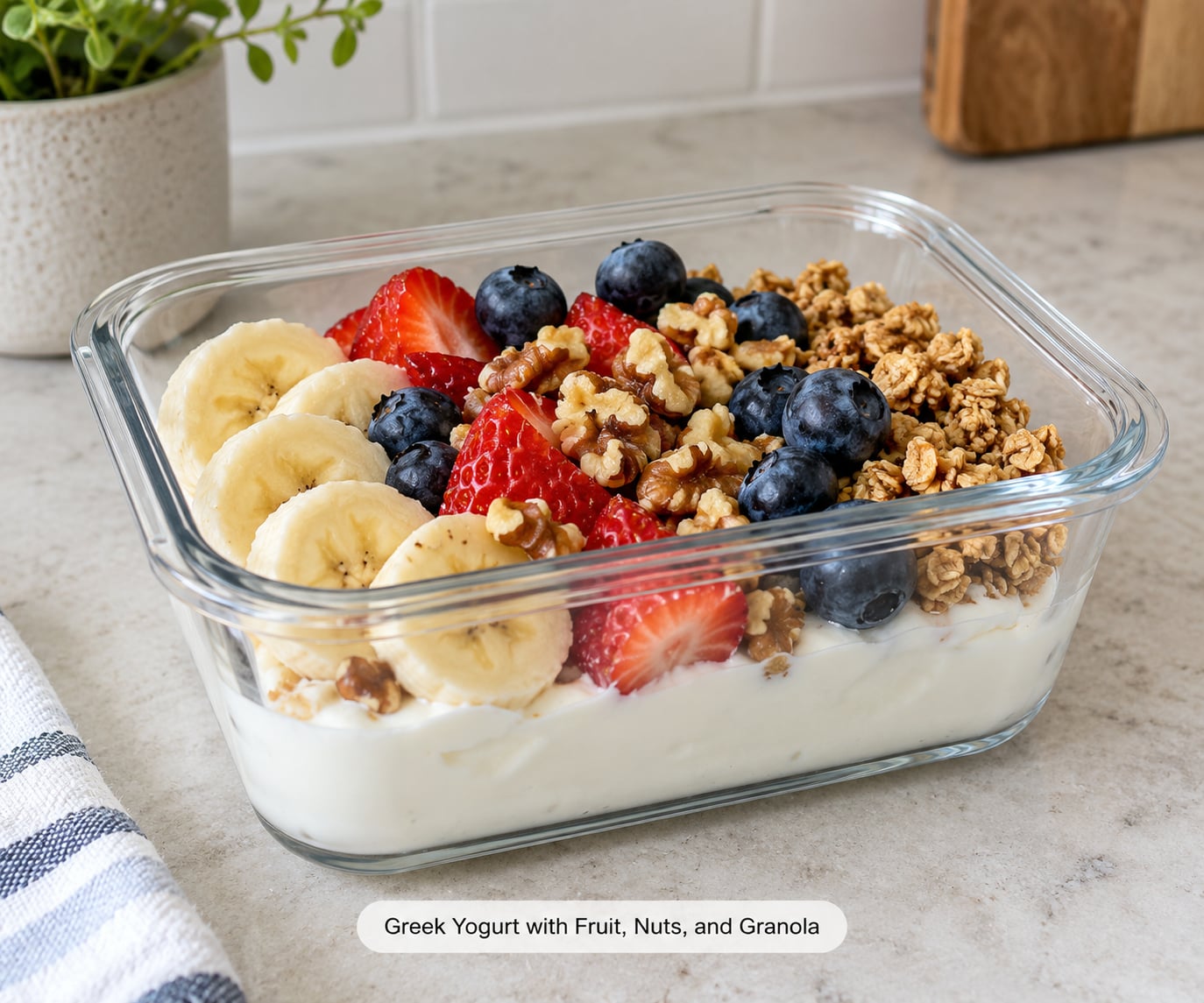
This is the five-minute breakfast that works when your first meeting starts at 8:30 and you are still finding your shoes. Greek yogurt supplies the protein that keeps you full past 10 a.m., the fruit adds water and fibre, and a small spoon of granola handles the crunch that plain yogurt never quite delivers.
Build it in layers in a jar or a wide-mouth container so you can eat it with a spoon straight from the lid. Skip the sugar-added varieties and sweeten with sliced banana or a spoonful of berries instead. Keep a backup portion of nuts in a separate little cup if your commute is rough, because granola softens fast and nobody wants breakfast that turns to paste in a backpack.
Plain, unsweetened varieties work best here. The thicker ones hold their texture longer and pair better with fruit that has a little acid, like raspberries or kiwi.
How to build a week of yogurt cups
A working portion is about three-quarters of a cup of yogurt, half a cup of fruit, two tablespoons of nuts and two tablespoons of granola. Multiply that by five on a Sunday and you have most of the week handled in about fifteen minutes of actual work.
Keep the wet and dry parts separate if you are packing more than a few hours ahead. A container of yogurt with granola sitting in it all morning is a container of soggy granola by 11 a.m.
Frozen berries work better than fresh for this, because they release less water as they sit. If you use fresh, add them on top rather than stirring them through.
Four days is the reliable refrigerator window for prepared food kept at 40°F or below. Beyond that the fruit starts to break down and the texture gets grainy, which is why people end up tossing the last jar on Thursday night.
2. Overnight Oats with Apple and Cinnamon
Overnight oats are the most forgiving make-ahead breakfast there is, because you assemble them at night and eat them cold at your desk with a spoon. The trick is add-ins that hold their texture overnight, and that rules out anything watery.
Dice a crisp apple rather than using banana, stir in a spoon of chia or ground flax for staying power, and add cinnamon and a small amount of honey or maple in the morning instead. Rolled oats work better than steel-cut, which stay firm even after two days in the fridge.
If you want it hot, microwave in short bursts with a splash of milk, since oats thicken noticeably while sitting. Some people find the texture works better cold the next morning anyway, and you can decide for yourself after one batch.
The base ratio, and three flavours worth trying
A jar that works well is half a cup of rolled oats to three-quarters of a cup of milk, plus a tablespoon of chia or ground flax. That ratio sets overnight without going cement-hard by Thursday.
- Apple and cinnamon: one diced apple, a teaspoon of cinnamon, and a spoonful of chopped walnuts.
- Peanut butter and cocoa: a tablespoon of peanut butter stirred into the liquid before the oats go in, with a teaspoon of cocoa powder.
- Berry and ginger: a spoonful of freezer raspberries added at serving time and a small pinch of grated ginger in the jar.
Steel-cut oats are the one to skip for this. They stay firm, which sounds like a bonus, but after two nights they turn chewy rather than creamy, and you end up chewing breakfast on a bus.
3. Peanut Butter Banana Oatmeal
Old-fashioned rolled oats simmered with milk and topped with peanut butter and banana take about seven minutes and beat the flavour of anything instant. The peanut butter and milk bring the protein, the banana handles the sweetness, and the oats keep your blood sugar steadier through the morning than a sweetened cereal will.
Portion oats into jars the night before and add the liquid in the morning, or cook a double batch and refrigerate it for up to four days. Reheat with a splash of liquid so it loosens back to a workable consistency.
For nut allergies, sunflower seed butter or a pumpkin seed spread works from a texture standpoint, though the flavour shifts. Check that your oats are certified gluten-free if that matters to you, since regular oats are frequently milled alongside wheat.
Stovetop, microwave, and the overnight version
On the stovetop, bring a cup of milk to a simmer, stir in half a cup of oats, drop the heat and stir for about five minutes until thickened. On the microwave, cover a bowl of oats and milk for two minutes, stir, then add another minute if it needs it. The microwave method is faster and it is the one most mornings actually use.
The real time saver is the overnight version. Put half a cup of dry oats and a cup of milk in a jar, leave it in the fridge, and stir in the peanut butter and banana in the morning. It thickens overnight into something that eats like oatmeal without a pan.
Make two jars at once on Sunday for the commuting days. They keep three to four days refrigerated, and thinner oats reheated with a splash of milk come back close to the stovetop version.
4. Spinach and Egg Breakfast Wrap
A make-ahead wrap solves the reheated-egg problem, because eggs go into the tortilla while still slightly underdone at the centre, then finish cooking in the microwave. Cook a dozen eggs to 160°F, let them cool, and fill four whole-grain tortillas with chopped spinach, peppers and any chopped vegetables you have left in the crisper drawer.
Roll tightly, wrap each one in a slice of cheese to stop it unrolling, and refrigerate for up to four days. At the office, 60 to 90 seconds in the microwave brings a cold wrap back to eating temperature. Hold the filling in the middle rather than the edge, which is where wraps tend to dry out first.
If the wrap is going straight from the fridge to your car, put the seam side down in the container. That one habit has saved more hurried lunches than any container gadget.
What to put in it, and how long it lasts
The filling formula is roughly one scrambled egg plus a cup of raw spinach per wrap, cooked together in a pan with a little oil until the spinach collapses. Add pre-cooked chopped peppers, onions, or a handful of black beans for staying power.
Cook the egg mixture to 160°F, the standard safe internal temperature for eggs, and let it cool in the pan for a few minutes before rolling. Filling a warm tortilla guarantees a soggy one by 10 a.m.
Four wraps fit a week’s worth of commuting mornings. Refrigerated they keep up to four days; for longer storage, cool them completely, wrap each in foil or parchment, and freeze for two to four weeks. Reheat from frozen in two to three minutes, or overnight in the fridge if you want it ready when you wake.
If your office kitchen has only a hot plate and no microwave, egg muffins are the version that works. Same mixture, poured into a greased muffin tin and baked until set, then frozen and reheated one at a time.
5. Cottage Cheese Toast with Peach
Cottage cheese carries nearly as much protein as Greek yogurt and does not need any prep beyond opening the tub. Spread it thickly on whole-grain toast, add sliced peach or pear, and finish with a little cinnamon or a drizzle of nut butter if you have it.
This is a desk breakfast rather than a commuting one, since the toast softens within an hour. It suits short breaks and late starts, when a bowl feels like too much commitment before 9 a.m.
Full-fat cottage cheese works better here, since the fat helps carry the fruit’s sugars and keeps you satisfied longer. Blended varieties are smoother on bread, which matters if you are not slicing anything.
Making it a proper meal instead of a snack
Two slices of whole-grain toast with cottage cheese and fruit is roughly the same protein as a Greek yogurt cup, and it takes less time because nothing needs assembling. That is why it suits a short break or a start time later than 9 a.m.
The one thing it lacks is staying power if you go heavy on the fruit. Add a tablespoon of nut butter or a hard-boiled egg if your morning runs past a long stretch of meetings.
Watch the salt if you buy the large tub. A quarter cup of cottage cheese spread across two slices is a reasonable amount, and it pairs better with pepper or black pepper than with more salt.
It also reheats and travels poorly, which is why it sits near the end of the commute window. Made to order in the first ten minutes of the day, it is one of the few breakfasts here that involves no planning at all.
6. Protein Smoothie for a Commute
A smoothie is the one breakfast you can eat while driving, provided you seal the lid properly. Use the formula: a liquid, a protein source, a fruit, and greens if you want them. That gives you roughly 20 grams of protein per serving without any cooking.
Frozen fruit instead of fresh blends smoother and chills the drink, so you can leave out ice and save room. A tablespoon of nut butter adds fat and thickness; without it the blend can taste thin and get watery by the second mile.
Use a bottle that fits your cup holder and has a flip-top or screw cap with a gasket. A vacuum blender on a portable base lets you blend the night before and drink cold, though texture is usually better in the first few hours. If you blend it the night before, loosen it with a splash of liquid in the morning.
The formula, and why each part is there
A cup of liquid, one to two scoops of a protein powder or a cup of yogurt, one cup of frozen fruit, and a handful of greens is the whole template. The liquid carries the blend, the protein keeps you full, the fruit does the sweetening, and the greens you will not notice.
Aim for roughly 20 grams of protein per serving if protein is what you are after, and check the label because powders vary widely. A tablespoon of nut butter or half an avocado adds fat and thickness, which is what stops a green smoothie tasting like cold juice.
Fill the bottle no more than two-thirds full and screw the cap on before you invert it. A full blender bottle expands in the bag and becomes a problem you deal with on someone else’s desk.
Four combinations that keep things from getting boring: banana and cocoa, mango and ginger, strawberry and vanilla, or apple and cinnamon with a handful of oats blended in for fibre. Frozen fruit blends smoother than fresh and keeps the drink cold without ice.
7. Whole-Grain Waffle with Berries
Making waffles on a Sunday sounds fussy until you realise a waffle iron produces four at once and they reheat like nothing else. Cook a double batch, let them cool completely on a rack, then refrigerate in a single layer or freeze in a bag.
Crisp them in a toaster oven or a dry pan at the office rather than the microwave, which softens them. Top with Greek yogurt and berries to get protein and fibre alongside the refined carbohydrate, and skip syrup entirely if you want the bowl to fill you up past lunch.
Store refrigerated waffles for up to four days. For longer storage, freeze them in a single layer, then move them to a sealed bag so they do not clump.
Batch cooking and reheating without the sogginess
A standard waffle iron makes four at a time, so one double batch is eight waffles and roughly a week of breakfasts on two days. Cook them on a Sunday while you are already in the kitchen for something else.
Let them cool on a rack, not stacked. Warm waffles stacked on a warm rack steam each other into dampness within the hour, and you end up reheating something that was never properly crisp in the first place.
At the office, four minutes in a toaster oven at 375°F brings a refrigerated waffle back close to fresh. In a microwave you get a soft waffle in 40 seconds, which is faster but not the same food. If there is no toaster oven, make the batch smaller and accept the microwave result.
The topping is doing real work here. A waffle on its own is refined carbohydrate, so pair it with Greek yogurt and berries, a boiled egg, or a spoonful of peanut butter to turn it into a balanced breakfast.
8. Yogurt and Berry Parfait
A parfait is the fastest assembly in this list, and the failure mode is well known: cereal at the bottom turns to mush by 11 a.m. The fix is simple. Keep the granola in a separate small container and add it right before you eat, or add it as the top layer so it sits in dry air above the yogurt.
Layer thick yogurt, then berries, then yogurt again, and finish with something crunchy. Two minutes of jar work buys you a breakfast you can eat anywhere, including a desk or a shared break room with nothing more than a spoon.
If the office kitchen has a refrigerator but no decent coffee shop nearby, keep shelf-stable single-serve yogurt cups on hand for mornings when even assembly feels like too much. Our notes on healthy vending machine options for the workplace cover how to build that backup so it is not a soda habit.
Layering order that keeps it crisp
The fix is not more yogurt. It is putting the crunch where it does not sit in liquid. Yogurt on the bottom, fruit in the middle, yogurt again on top, granola as the very last layer pressed against the lid.
Wide-mouth jars beat narrow glasses because they fit in a bag and take a full spoon. If your jar has no lid, this is not the right breakfast and I would not fight it.
Make four or five in one sitting on a Sunday and refrigerate. Keep the fruit on top of the yogurt rather than mixed in, and hold the granola back until the morning you intend to eat it.
A quarter cup of granola is a sensible portion. Twice that is what turns a breakfast jar into something you are still eating at 10:30.
9. Egg and Avocado Breakfast Sandwich
A scrambled egg and mashed avocado sandwich on whole-grain bread takes about ten minutes and stays edible for a couple of hours, which is what makes it viable for a commute.
The soggy-sandwich problem comes down to where the moisture sits. Salt the avocado lightly, mash it into the egg rather than spreading it as a separate layer, and let the egg cool before assembling. If the sandwich will sit for more than an hour, wrap it in parchment paper instead of foil, which traps steam.
For an early shift where cooking is not happening at all, hard-boil six eggs on Sunday and make the sandwich when you wake, with the avocado added last.
Preventing the soggy sandwich before you commute
Moisture is the whole problem, and it comes from three places: the egg water, the avocado, and steam trapped in foil. Address all three and the sandwich survives a 40-minute drive.
- Cook the eggs and drain any liquid before scrambling, so there is nothing watery to spread into the bread.
- Salt the avocado lightly and mash it into the eggs rather than slicing it into a separate layer.
- Wrap in parchment paper rather than foil, which traps steam and softens the crust.
- Eat it within two hours of assembly if you can.
If your commute is longer than that, the egg and avocado sandwich is not the right pick. Choose the make-ahead wrap or a yogurt cup instead, both of which hold their texture in a container for hours.
Nutrition-wise this is a solid option: whole-grain bread for fibre, egg for complete protein, and avocado for unsaturated fat. It is more calorie-dense than most of the other entries, which suits people who skip lunch.
10. Overnight Chia Pudding
Chia pudding is oats with more staying power. Stir three tablespoons of chia seeds into a cup of milk of any kind, add a sweetener if you like, and refrigerate for at least four hours. By morning it sets into something spoonable that keeps you full for longer than most breakfasts.
The texture is the only real adjustment point. Too fast and it turns gummy in the mouth, so refrigerate overnight rather than the minimum four hours. Too thick and you loosen it with a splash of milk the next morning.
Fruit goes on at serving time, not at mixing time, or you get a pink, watery base. A serving is about a quarter cup of seeds, so one jar makes three breakfasts.
Overnight oats and chia pudding: which one suits your morning
The two get mixed up constantly because they use the same jar and the same fridge spot. They are not the same food, though.
Oats are chewy and filling, so they suit a morning when you want to chew something and stay full until lunch. Chia sets into a pudding texture, higher in fibre and omega-3 fats, and suits a morning when eating something smooth at a desk is the appeal.
For chia, three tablespoons of seeds per cup of liquid is the working ratio. Refrigerate at least four hours, but overnight gives the better texture because a set that has had longer to thicken is smooth rather than gummy.
Stir the mixture before it goes in the fridge rather than after. Seeds that have settled into a solid layer at the bottom of the jar need breaking up with a spoon, and doing it at the start is easier.
Three to four days refrigerated is the reliable window for both. Past that the oats get pasty and the chia starts to smell flat, which is your cue to stop forcing it.
11. Breakfast Rice Bowl
A bowl built on leftover brown rice, a fried or boiled egg, sautéed vegetables and sliced avocado is a balanced breakfast that costs almost nothing extra, because the rice and vegetables are already cooked. It also reheates better than almost anything else on this list.
Microwave for 90 seconds with a splash of water to keep the rice from drying out, then add the avocado and any fresh toppings after reheating. Warm grains with cold avocado is exactly how this bowl is meant to be eaten.
The practical version is a rotation: cook a batch of brown rice and roast a sheet pan of vegetables on the same night, then build four bowls across the week. A boiled egg per bowl takes two minutes if the eggs are already in the pot.
Cooking the egg safely and keeping vegetables bright
Whether you fry, boil or scramble, cook the egg to 160°F internal temperature, which is the safe minimum for eggs, and check the thickest part with a thermometer. If it is for someone else in the household who is pregnant, elderly or immunocompromised, that check matters more, not less.
Vegetables go on the same sheet pan as the rice, not before, so they roast rather than steam. Broccoli, peppers, sweet potato and mushrooms all hold up well and reheat without turning to mush.
Add avocado and any fresh herbs after reheating, never before. Microwaved avocado turns to mush and loses the colour that made it worth adding.
Cooked rice keeps three to four days refrigerated and about three months frozen if you portion it into flat containers and press out the air. Flattened rice freezes faster and reheats more evenly than a deep mound.
12. Nut Butter and Fruit Oat Bar
An oat bar is the breakfast you can eat in a car, a train platform, or a conference room at 9:45 without looking twice. Bake a double batch, cut into eight bars, and store them in a sealed container at room temperature.
Press the mixture firmly into the pan. Loose oats crumble into a granola bar instead of a chewy one, which is not a disaster but changes the character of the whole thing. A layer of nut butter in the middle keeps the bars from drying out over several days.
For a nut-free version, seed butter or a sunflower seed spread works. To reduce added sugar, mash very ripe bananas or dates for the sweetener and pull back on any added sugar, expecting a chewier and less sweet result. If bars are part of a broader workplace nutrition effort, our employee wellness program ideas for small business cover the small-team version.
Baking, portioning and storage
A standard 8-inch square pan gives you eight bars, or sixteen if you cut them in half. Bake at 350°F for about 25 minutes and pull them when the centre still looks slightly underdone, since they set as they cool on the pan.
Cool completely before cutting, then wrap individually rather than stacking them. Bars stacked without separation compress and crumble into the container, which is how you end up with a bag of crumbs on the commute.
At room temperature in an airtight container they keep about a week, which makes them the longest-lasting item in this list. Refrigerated they stay chewy longer, and frozen they hold two to four weeks.
A can of oats, a jar of nut butter, a bag of dried fruit and one egg covers sixteen bars. That is the cheapest breakfast here per serving, and the one most worth batching on a Sunday.
Frequently Asked Questions
What is the best breakfast for a busy day?
The best breakfast for a busy day is one you prep ahead and can eat without cooking. Overnight oats, a yogurt cup with fruit, and a make-ahead breakfast wrap cover protein, fibre and staying power, and each keeps four to five days in the refrigerator.
What are some easy egg breakfast ideas?
Easy egg breakfast ideas include muffin-tin omelets, hard-boiled eggs with spinach and wraps, and a breakfast casserole cut into portions. Cook eggs to 160°F, cool them fully, refrigerate for up to four days, and reheat portions in the microwave for 60 to 90 seconds.
What are some ideas for baked breakfast?
Baked breakfast ideas include nut butter and fruit oat bars, muffin-tin egg frittatas, banana oat muffins, and baked oatmeal squares cut into portions. Most keep three to four days in the refrigerator and two to four weeks frozen, and bars travel best with no chilling.
What are some good breakfast treats to bring to the office?
Good breakfast treats for the office are ones that need no utensils and no fridge: oat bars, trail mixes, roasted nuts, whole-grain crackers with nut butter, and small yogurt cups. Portion them into containers so nobody is grazing from a shared bag by mid-morning.
How long do overnight oats and chia puddings last?
Both keep three to four days refrigerated in a sealed container, which is the standard window for prepared food kept at 40°F or below. Add fruit and granola at serving time rather than at prep time so nothing goes watery, and loosen chia puddings with a splash of milk before eating.
Can you freeze breakfast wraps and make-ahead eggs?
Yes. Cooked breakfast wraps freeze two to four weeks once cooled and wrapped tightly, and they reheat from frozen in two to three minutes. Cooked egg dishes freeze best as scrambled eggs or muffins rather than whole fried eggs, which tend to become rubbery.
Pick one item from this list of healthy breakfast ideas for busy workdays and make a double batch this weekend. Greek yogurt cups, overnight oats and oat bars take under ten minutes of active work each, and one session covers most of the week. Start there, then add a second idea next week once the first one stops feeling like a chore.