
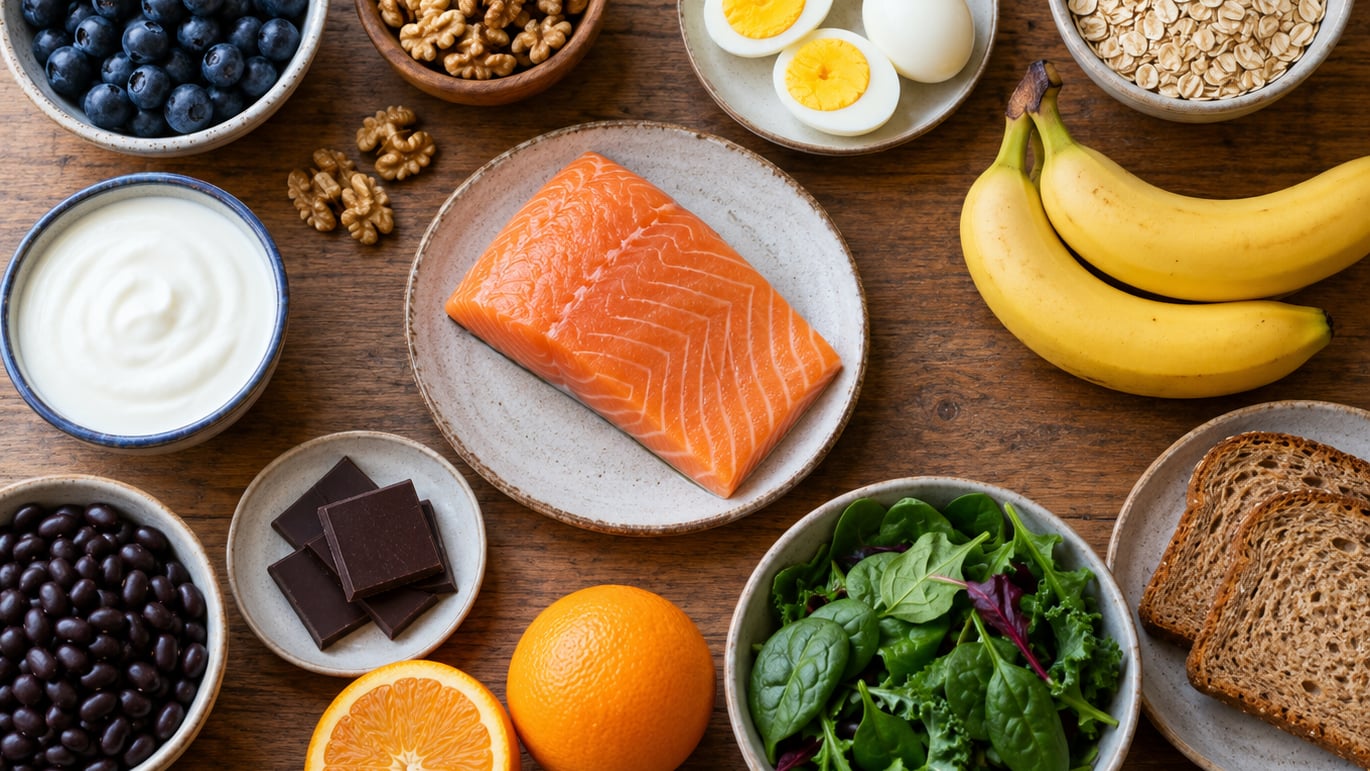
If you want the short version: the foods that help you focus and concentrate are the ones that keep your blood glucose steady and supply structural fats and micronutrients the brain cannot make itself. Fatty fish, nuts and seeds, eggs, leafy greens, berries, legumes, oats, whole grains, plain yogurt and a little dark chocolate make up the well-supported list. No single food is a magic switch, though. The pattern of eating regular, balanced meals beats any one “brain food” by a wide margin.
This guide is written for people whose attention has to hold up for hours: desk workers, shift workers, students revising for exams, and anyone dealing with the notorious 3pm fog. Every entry below gives you the nutrient, what it actually does, a realistic portion, and how strong the evidence really is. Where the science is thin, we say so.
Table of Contents
- Foods That Help You Focus and Concentrate at a Glance
- 1. Blueberries for Steady Brain-Friendly Fuel
- 2. Salmon for Omega-3 Fat and Focus
- 3. Walnuts for Plant-Based Omega-3 Fat
- 4. Eggs for Protein and Breakfast Focus
- 5. Oats for Slow-Releasing Morning Energy
- 6. Leafy Greens for Nutrient-Dense Meals
- 7. Bananas for Convenient Energy and Hydration
- 8. Plain Yogurt for a Balanced Snack
- 9. Beans and Lentils for Fiber and Lasting Satisfaction
- 10. Dark Chocolate as a Small Mindful Treat
- 11. Oranges for Vitamin C and Refreshing Snacks
- 12. Whole-Grain Toast for a Simple Balanced Base
- How to Build a Focus-Supporting Workday Meal
- What Foods Can Disrupt Focus at Work?
- Frequently Asked Questions
- Conclusion: Start With One Balanced Food Habit
Foods That Help You Focus and Concentrate at a Glance
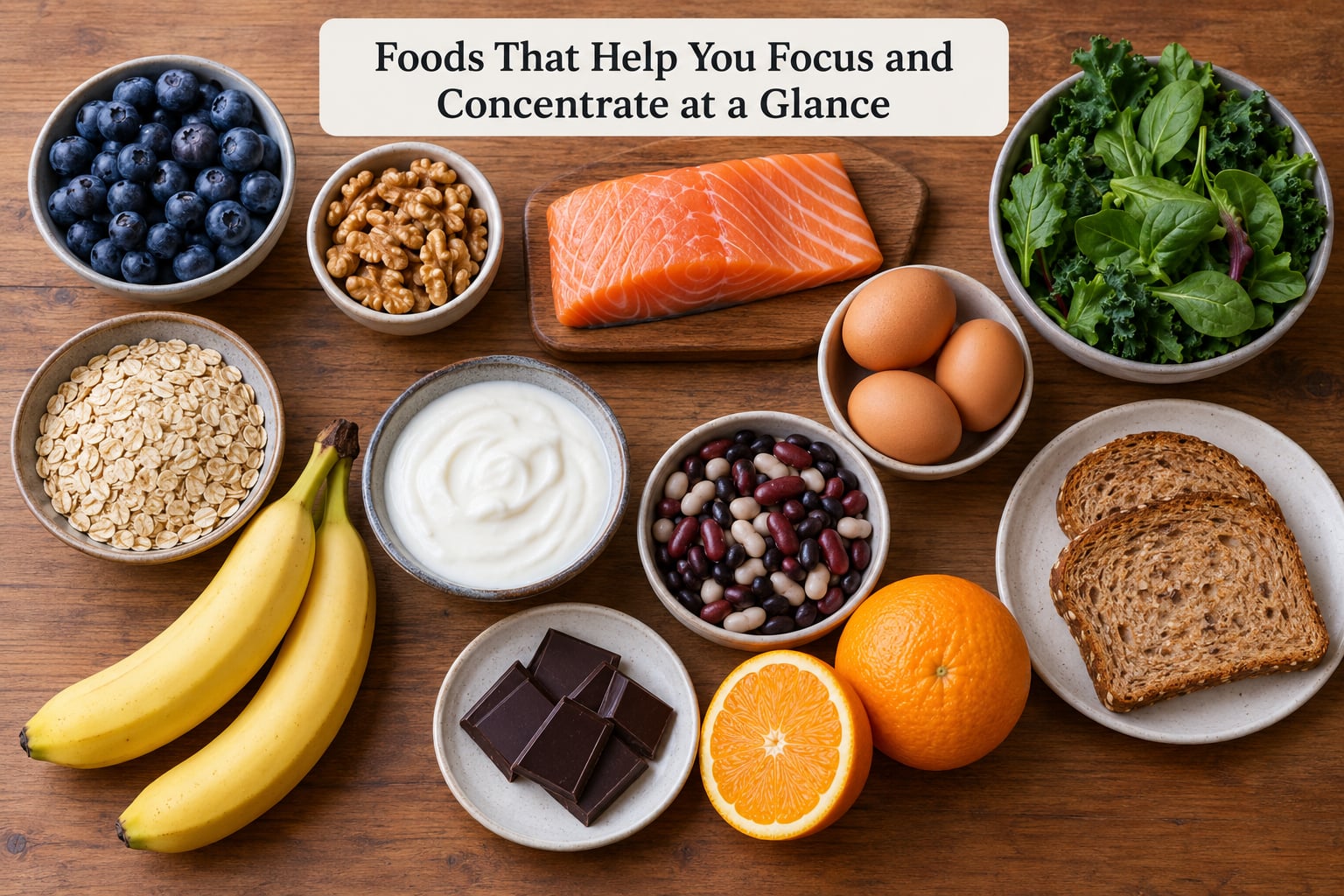
Quick answer before the detail: no food makes you sharper in the same way coffee does, because caffeine acts on the bloodstream in minutes while nutrients build over weeks. What food does is keep the boring things from working against you, mainly energy swings and nutrient shortfalls.
Each food carries an evidence label in this guide. Strong means human trials or consistent large-scale dietary research support the effect. Moderate means the evidence is real but smaller, mixed, or mostly observational. Emerging means promising mechanism with limited human data.
| Food | Key nutrient | Why it helps focus | Portion and best time |
|---|---|---|---|
| Blueberries | Fiber, vitamin C, anthocyanins | Low sugar density with steady energy plus antioxidant compounds | Half a cup, breakfast or mid-morning |
| Salmon and other oily fish | DHA and EPA omega-3 fats | Structural fat for neuronal membranes; strongest single-food evidence | 3 to 4 ounces, two or three times a week |
| Walnuts | ALA plant omega-3, healthy fats, fiber | Portable omega-3 source that travels to the desk | One ounce, about a small handful |
| Eggs | Choline, complete protein, B12 | Choline is the raw material for acetylcholine, a key attention neurotransmitter | Two eggs, any time before demanding work |
| Oats | Soluble fiber, complex carbohydrate, some protein | Slows glucose release so the morning starts without a spike and crash | Half a cup dry, breakfast |
| Leafy greens | Folate, vitamin K, magnesium, fiber | Folate supports neurotransmitter synthesis; adds bulk and satisfaction | Two cups raw or cooked, one meal a day |
| Bananas | Carbohydrates, potassium, fiber | Portable energy plus potassium, useful before long afternoon stretches | One medium banana |
| Plain yogurt | Protein, calcium, live cultures | Protein plus carbohydrate slows the crash; cultures feed the gut-brain axis | Three-quarter cup plain, with fruit added |
| Beans and lentils | Plant protein, fiber, complex carbohydrate, iron | Cheapest stable-energy protein available; fiber smooths glucose handling | Half a cup cooked, at lunch |
| Dark chocolate | Cocoa flavanols, a little caffeine | Flavanols affect blood flow; enjoy it as a deliberate small treat | One ounce, 70 percent or darker |
| Oranges | Vitamin C, fiber, fluid, carbohydrate | Refreshing, filling, hydrating, and easy to eat away from a kitchen | One medium orange |
| Whole-grain toast | Complex carbohydrate, fiber, B vitamins | Simple base you can build a balanced breakfast or lunch on in two minutes | Two slices, topped with protein and produce |
1. Blueberries for Steady Brain-Friendly Fuel
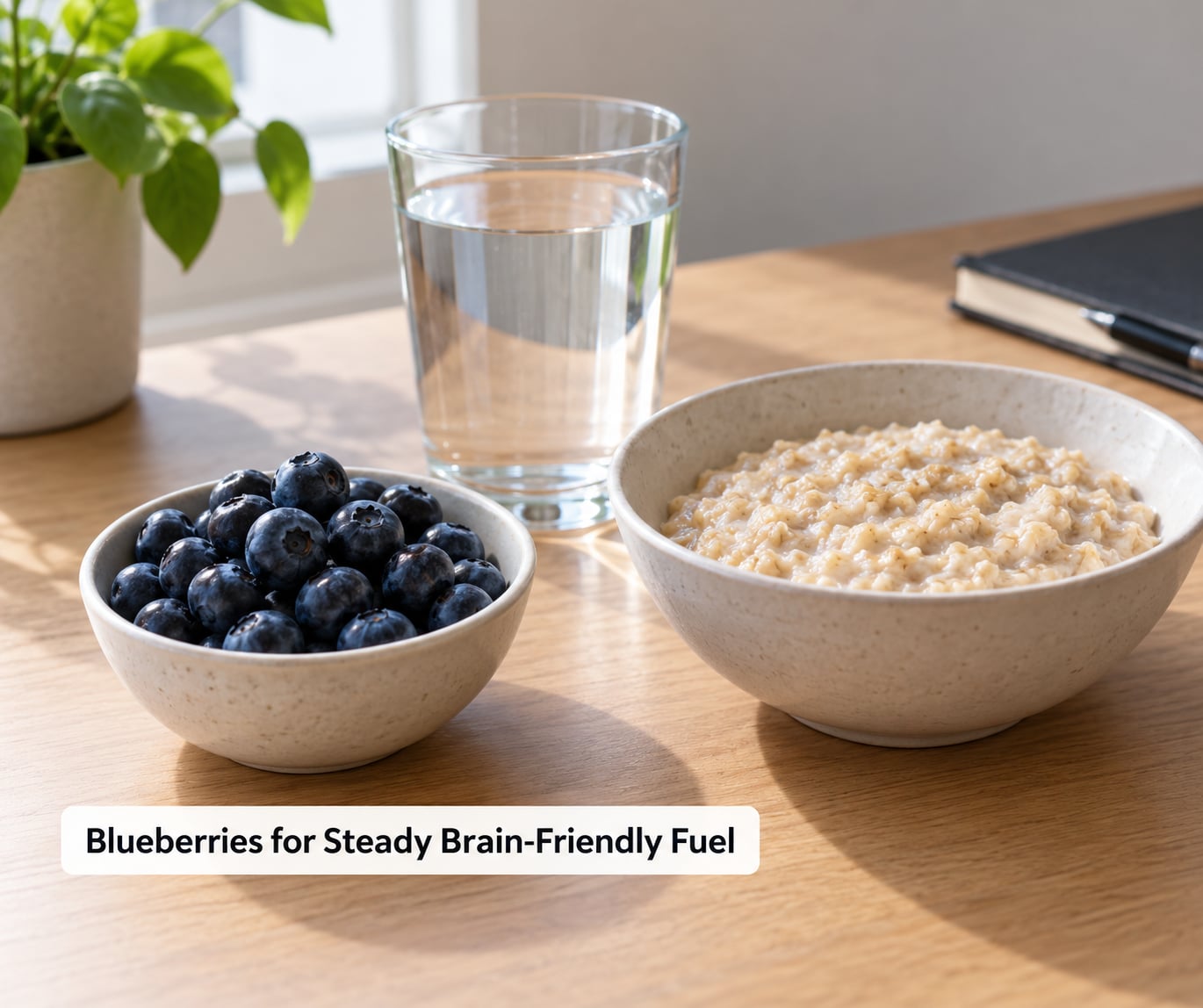
Blueberries are one of the easiest focus foods to work into a normal week, because they need no prep and they travel well in a container. Evidence strength: moderate.
What sits in that bowl is fiber, vitamin C, and a group of anthocyanin pigments. The fiber and water mean the sugar arrives slowly, so you get energy without the sharp spike and drop that a pastry gives you. The anthocyanins are the part researchers keep coming back to, and the honest position is that most of the support is from laboratory and animal work rather than long human trials.
How to use them: half a cup on top of oats, folded into plain yogurt, or eaten straight from a container at your desk around 10am, when most people have started to fade. Frozen works fine for baking, and the flavor is sharper, so a lot of people like them that way.
2. Salmon for Omega-3 Fat and Focus
Salmon is the closest thing to a defensible answer when someone asks for the single best food for concentration. Evidence strength: strong for dietary patterns, moderate for a single food in isolation.
Fatty fish supplies DHA and EPA, two omega-3 fats that become part of the membrane surrounding every neuron. That matters for how cells signal, and for the inflammation that creeps up with poor diet and poor sleep. Studies that track fish intake over years generally find better outcomes on memory and thinking speed.
Which is exactly why nobody should promise you a serving of salmon will fix an afternoon of poor attention. The honest framing is that regular fish intake supports cognitive health over years, and the fastest wins come from eating more of it and less of the fried, ultra-processed meals that crowd it out.
Practical portions and prep: 3 to 4 ounces of cooked salmon, two or three times a week. Cook fish to 145 degrees Fahrenheit, 63 degrees Celsius, and use it within two days of cooking or keep it frozen. Canned salmon is the cheapest route and works fine in a wrap with greens and mustard, or stirred through a grain bowl with cucumber and lemon.
3. Walnuts for Plant-Based Omega-3 Fat
Walnuts are the plant answer to oily fish, and for a desk worker they are the most realistic option because they need no fridge and no preparation. Evidence strength: moderate.
A walnut’s fat is mostly ALA, a plant omega-3 that the body converts to small amounts of the marine forms. The conversion is inefficient, and researchers are honest about that, so walnuts are a supporting player rather than a replacement for fish. What they do offer in a useful package: unsaturated fats, protein, and fiber, which together slow digestion and blunt the mid-morning hunger that ends in vending-machine food.
A small handful, roughly one ounce, is a sensible desk portion. Eat them alongside fruit rather than as a stand-alone snack if you can, because the combination of fat and carbohydrate is what keeps you satisfied. Store them in the freezer or in an airtight tin, because the oils in a bag left open on a desk turn rancid within a few weeks.
4. Eggs for Protein and Breakfast Focus
Eggs earn their place on this list mostly because of choline, a nutrient most people get too little of. Evidence strength: moderate.
Choline is the precursor for acetylcholine, a neurotransmitter involved directly in attention and memory. Your liver makes some choline, but not reliably enough for many diets, particularly for people who eat little liver and eggs. That is a gap-filling argument rather than a performance argument, and it is worth being precise about the difference.
The practical case for eggs is broader than choline. Two eggs give you about 12 grams of complete protein plus B12, selenium, and vitamin D, which makes them a fast breakfast that will not leave you hungry an hour later. For safety, cook until the whites and yolk are firm, about 160 degrees Fahrenheit, 71 degrees Celsius, and refrigerate anything left within two hours.
How you cook them matters less than most food writing suggests. Scrambled, boiled, or poached all work. If you are trying to lower cholesterol, that is a conversation to have with your doctor, since individual response to dietary cholesterol varies a lot.
5. Oats for Slow-Releasing Morning Energy
Oats are the cheapest way to avoid the 10am crash, and they are better supported than most “superfood” claims in this list. Evidence strength: strong for blood sugar control, moderate for a direct attention effect.
The mechanism is unglamorous and real. Beta-glucan, a soluble fiber in oats, slows how quickly glucose enters the bloodstream after a carbohydrate meal. With oats you get carbohydrate plus about five grams of fiber plus a little protein, which is a combination that releases energy over a couple of hours instead of thirty minutes.
Build it as a base rather than a finished dish. Half a cup of dry oats cooked with milk or fortified soy milk, then topped with a spoonful of yogurt, berries, and walnuts, is a breakfast that will hold until lunch. That combination covers carbohydrate, protein, fat, and something colorful before 8am, which is more than most office breakfasts manage.
Steel-cut and rolled oats behave similarly. Instant oats are more processed but not meaningfully worse for this purpose, and they cook in three minutes, which on a weekday morning is the difference between eating breakfast and not.
6. Leafy Greens for Nutrient-Dense Meals
Leafy greens do almost nothing dramatic on their own, and anyone promising otherwise is selling something. Evidence strength: moderate through dietary pattern, weak in isolation.
Spinach, kale, arugula, and chard bring folate, vitamin K, magnesium, fiber, and volume. Folate matters because it is involved in synthesis of neurotransmitters, and magnesium plays a role in hundreds of enzyme reactions including ones tied to energy production. The volume is the underrated part: two cups of greens lets you build a salad or bowl that fills you up without a heavy sauce doing the work.
The reason to eat them has more to do with what they replace than what they add. A lunch built around greens, a protein, and a whole grain tends to hold energy better than one built around a sandwich and a sugary drink. That is where the focus benefit actually shows up.
Two cups a day, raw or cooked, is a reasonable target. If raw salad bore you, sauté spinach with garlic or add kale to soup and stews where it disappears.
7. Bananas for Convenient Energy and Hydration
Bananas are the most underrated item in any office kitchen, mostly because they solve a logistics problem rather than a biological one. Evidence strength: moderate.
Nutritionally you get carbohydrate for fuel, potassium for normal muscle and nerve function, and roughly three grams of fiber. Their real contribution is that they are available. No preparation, no refrigeration, no decision fatigue at 3pm, and they survive in a bag.
A medium banana is a good snack before an afternoon block of writing, analysis, or editing. For longer or higher-intensity work, pairing one with a handful of walnuts or a yogurt cup slows digestion and keeps you fuller, which matters because a banana alone may not hold you through a three-hour session.
If you have kidney disease or are on certain medications, potassium intake is something your doctor should weigh in on. For most people it is a non-issue.
8. Plain Yogurt for a Balanced Snack
Plain yogurt is the most useful snack food in this article, because it combines protein, carbohydrate, calcium, and live cultures in one container. Evidence strength: moderate.
Its value comes from the protein. Roughly ten grams per serving, which is enough to slow digestion and reduce the rebound hunger that sends people back to the biscuit tin at 4pm. The fermentation also puts live cultures into your gut, and the gut-brain axis research connecting gut bacteria to mood and cognition is promising but still early enough that we would not oversell it.
Choose plain and add your own fruit. Flavored versions often carry as much sugar as a dessert while tasting less rewarding, and swapping in fresh berries or chopped banana gets you the same texture with fiber and volume instead of added sugar.
Three-quarter cup is a normal serving. Greek style is higher in protein and lower in sugar, which helps if you are trying to hold through a long afternoon, though it is not essential. If you are lactose intolerant, live-culture yogurt is often tolerated better than milk.
9. Beans and Lentils for Fiber and Lasting Satisfaction
Beans and lentils are the best value in this entire guide, and the fact that most office lunches skip them says more about office lunches than about beans. Evidence strength: strong for dietary patterns, moderate for a direct attention effect.
Three things arrive together here: plant protein, a large amount of fiber, and complex carbohydrate that digests slowly. The fiber is doing the important work. It blunts the glucose response of everything else on the plate, which is the single most reliable way to avoid a 2pm crash.
They are also a decent source of non-heme iron and folate. Iron matters because low iron reduces oxygen-carrying capacity and low iron shows up as fatigue and fogginess before it shows up as anything dramatic. If you suspect low iron, food alone is not the fix, and a blood test is the right next step.
Half a cup of cooked beans at lunch counts. Lentil soup, chickpea salad, black beans in a wrap with salsa and avocado, or a warm bowl with farro and roasted vegetables all work. Canned is fine; just rinse it, since the brine carries a good deal of sodium.
10. Dark Chocolate as a Small Mindful Treat
Dark chocolate earns its place as a deliberate small pleasure, not as a cognitive enhancer. Evidence strength: emerging for flavanols, moderate for enjoyment.
Cocoa flavanols do affect blood flow, and vascular health is part of cognitive health. Trials in older adults have found improvements in processing speed on higher-flavanol cocoa. This is real but modest, and none of it applies to a square of milk chocolate or a candy bar.
What makes chocolate genuinely useful at work is more ordinary than the science: a small, deliberate, high-quality treat can be a short mental break, and enjoying something on purpose is not the same as grazing while distracted. One ounce, 70 percent or darker, eaten sitting down rather than over a keyboard.
Two cautions. Chocolate contains caffeine, usually 20 to 50 milligrams in an ounce depending on the bar, which matters if you are sensitive or trying to sleep. And the milk fat in milk chocolate saturates faster than you would like before a block of demanding work.
11. Oranges for Vitamin C and Refreshing Snacks
Oranges are a genuinely useful desk snack, though not for the reason most people assume. Evidence strength: moderate for hydration and vitamin C, weak for a direct attention effect.
The real value is that an orange is water, fiber, and carbohydrate in a peel you can open with one hand. That combination is more filling than a glass of juice, and the act of peeling and segmenting takes a minute or two, which is a decent micro-break on its own.
Vitamin C has a solid role in general health, though claims that it boosts immunity or cognition beyond normal status are overstated. If you already get enough fruit and vegetables, one more orange is pleasant rather than corrective.
Pair it with a small handful of walnuts and you have a snack with carbohydrate, fat, and fiber that will hold until dinner. Two ounces of cheese makes it more filling if that is what you are after.
12. Whole-Grain Toast for a Simple Balanced Base
Whole-grain toast is not exciting, which is precisely the point: it is the fastest reliable route to a balanced base for a meal eaten at a desk. Evidence strength: strong for dietary pattern.
Look for bread where whole grain or whole wheat is the first ingredient, with at least three grams of fiber per slice. That fiber is what distinguishes it from white bread, and it is the reason it holds you until the next meal instead of leaving you hungry by 11am.
Two slices become a full breakfast in about four minutes with sensible toppings: scrambled egg and a tomato gives you protein, B vitamins, and something fresh. Avocado and a poached egg gives you fat and protein. Cottage cheese with tomato and black pepper on rye is a version that works for people who dislike avocado.
The trap is sweet spreads. Jam and Nutella turn a good base into a sugar delivery system, and the fiber advantage disappears behind the spike. Cream cheese and butter are fine in normal amounts.
How to Build a Focus-Supporting Workday Meal
The useful version of this guide is not the list, it is the assembly rule. A focus-supporting meal contains carbohydrate, protein, fat, fiber, and something raw, and it is eaten at roughly regular hours.
Carbohydrate is not the enemy here. The brain runs substantially on glucose, and the problem is never the carbohydrate itself but the speed it arrives without fat or fiber to slow it. Protein and fat are what convert a carb-heavy meal into one that lasts.
A template that works: breakfast of oats with yogurt, berries, and walnuts, or two slices of whole-grain toast with egg and fruit. Lunch of beans or lentils, a whole grain, and greens with an olive oil dressing. A snack of an orange and walnuts or plain yogurt around 3pm. That pattern covers the essentials without any single item being exotic.
Timing matters more than most people expect. Eat something substantial before a deep work block rather than arriving at 9am running on coffee alone, and avoid a heavy high-fat meal in the hour before you need to think, because digestion competes for attention. For shift workers the same logic applies to waking hours, which is covered in more detail in our guide to sleep hygiene tips for workers who fit shifts.
If a new eating habit is going to fail for you, it is usually a logistics failure rather than a taste failure. Stock the two or three items you will actually eat, keep them where you can see them, and worry less about the full list. Sitting or standing at work also affects how you feel by mid-afternoon; we looked into whether anti-fatigue mats do anything for standing workers if that is closer to your day than a desk.
What Foods Can Disrupt Focus at Work?
Nothing on this list is a banned food, and how you respond to something is individual. But four patterns reliably make concentration harder for most people.
A large high-sugar meal. The clarity that follows is real, and it is followed by a drop as insulin overshoots. Most people report the worse hour, not the good ten minutes.
Heavy fried or ultra-processed food. Large amounts of saturated fat and refined carbohydrate sit in the stomach for hours, and fried food high in advanced glycation end products has been linked in observational work to slower processing speed.
Alcohol. Even moderate amounts impair attention and working memory the following morning, before any intoxication the night before. Sleep quality takes the bigger hit, which matters more than the drinking itself.
Excess caffeine. Caffeine is useful and also the most common focus disruptor at work. Tolerance builds, withdrawal headaches appear, and because caffeine has a half-life of roughly five to six hours, a 3pm coffee is still working at bedtime. Around 400 milligrams a day is the widely cited ceiling for healthy adults, and roughly 200 milligrams is where many people start sleeping badly. Green tea is a reasonable middle ground because its L-theanine softens the jitter while the caffeine still works.
Individual triggers matter too. If a specific food reliably leaves you uncomfortable or foggy, that is data, not weakness. Many readers with sensory sensitivities or digestive conditions find standard nutrition advice unusable, and swapping in tolerated foods rather than forcing unfamiliar ones is the practical move.
There are also questions about concentration that food cannot answer. Persistent fog alongside fatigue, mood changes, snoring, weight change, or feeling cold may point to anemia, thyroid problems, sleep apnea, or a vitamin shortfall such as iron, B12, or vitamin D. A doctor can order blood tests for all of those in a single visit. Nothing on a list fixes a medical cause, and anyone managing ADHD, or dealing with concentration problems that started suddenly, should get that assessed rather than self-treating with food.
Frequently Asked Questions
What food helps you focus immediately?
For effects within minutes, you want low-preparation foods that digest quickly: a banana, a small handful of walnuts, plain yogurt with berries, or a cup of green tea for L-theanine. Fast-acting options work because of caffeine and steady blood sugar, not because they build cognition. Structural nutrients like omega-3 take weeks or months, so keep both ideas separate.
What is the #1 brain food?
Fatty fish such as salmon has the best evidence behind it as a single food, largely because of DHA and EPA omega-3 fats that become part of neuronal membranes. But there is no true number one. Research consistently supports overall eating patterns, particularly Mediterranean-style diets, more than any individual food. Choose the pattern you will actually repeat.
What foods help with brain fog?
Brain fog is more often driven by sleep, stress, or a deficiency than by food. Food helps when it corrects a shortfall: iron from beans, lentils, and red meat, B12 from eggs, dairy, fish, and fortified foods, vitamin D from oily fish and fortified milk, and magnesium from nuts, seeds, and whole grains. Persistent fog warrants blood tests rather than another food experiment.
What are the 5 worst foods that can lead to memory loss?
No single food has been shown to cause memory loss on its own, and lists claiming otherwise are usually misleading. Patterns of concern are heavy alcohol use, diets dominated by refined sugar and ultra-processed food, high sodium alongside low potassium, and chronic deficiency. Replacing a pattern matters far more than eliminating one ingredient.
How much caffeine actually helps focus?
Around 200 milligrams a day is where most people notice real benefit, roughly two cups of brewed coffee. Around 400 milligrams is the widely cited daily ceiling for healthy adults, and going over it commonly brings jitteriness and poor sleep. Since caffeine has a half-life of five to six hours, timing matters as much as the total.
Do supplements work better than food for focus?
Usually not. Supplements make most sense when a deficiency has been confirmed by blood tests, or when a dietary restriction makes a nutrient hard to obtain, as with B12 for vegans. A supplement cannot replace the fiber, protein, and water that come with whole foods, and high-dose single nutrients can even be harmful. Speak to a doctor before starting any.
Conclusion: Start With One Balanced Food Habit
Pick one combination and make it automatic this week: oats with berries and walnuts at breakfast, or whole-grain toast with egg and fruit if mornings are rushed. Whatever you choose, keep water within reach, eat at roughly regular hours, and treat caffeine as a tool with a ceiling rather than a refill.
And remember what food cannot fix. If your concentration is failing alongside fatigue, poor sleep, or mood changes, book the appointment rather than the grocery run. Employers looking at the wider picture of how habits affect output can start with wellness program incentives that actually motivate employees, where nutrition is one component among sleep, movement, and workload design.
This article was last reviewed in 2026. It offers general nutritional information, not medical advice.