

Mental health awareness month activities for work work best when they are optional, happen during paid hours, and lead to a change someone can actually feel — a lighter workload, a private conversation with a manager, or an easier route to counseling. The twelve ideas below are ordered roughly by how much planning each one takes, from a breakfast that needs a pot of coffee to a 90-day action plan that needs an executive sponsor.
Here is the honest part. Awareness month is not a substitute for staffing levels, realistic deadlines or a workload people can survive. Posters and pizza do not fix a structurally broken job, and employees notice when they are handed a wellness app nobody has time to open while the same two people cover every shift. What awareness month can do is open a door: let people say what is hard, teach managers not to flinch at the conversation, and connect the people who are struggling to support that already exists.
A note on framing before you read further: nothing in this article is medical advice. These activities are general workplace programming, not diagnosis or treatment. Anything touching an individual’s health belongs with a qualified professional, an employee assistance program or a clinician, and in the United States the 988 Suicide and Crisis Lifeline is available by call or text. Where a legal question comes up — confidentiality, medical leave, accommodations — your HR and legal partners should answer it, not this page.
One more thing worth saying early. The most useful planning signal is employee input gathered before you pick the calendar. A five-question anonymous survey sent three weeks ahead of awareness month will tell you more than a month of guessing, and it costs nothing but a form and an honest reply to results. Several of the activities below are built around exactly that step.
Table of Contents
- Mental Health Awareness Month Activities for Work at a Glance
- 1. Hold a Workplace Mental Health Listening Breakfast
- 2. Run an Inclusive Mental Health Awareness Workshop
- 3. Host a Lived-Experience Employee Panel
- 4. Organize a Mental Health and Workplace Well-Being Fair
- 5. Offer Guided Stress-Reset Sessions
- 6. Train Managers to Recognize and Respond Well
- 7. Launch a Voluntary Peer Support Initiative
- 8. Create a Private Employee Check-In Week
- 9. Run a Workplace Psychological Safety Audit
- 10. Build a Mental Health Community Connection Week
- 11. Launch a Team Self-Care and Connection Challenge
- 12. Turn Awareness Into a 90-Day Workplace Action Plan
- Frequently Asked Questions
- When should employers plan mental health awareness month activities for work?
- How much should a workplace mental health awareness event cost?
- What are good mental health activities for remote employees?
- Should employers require employees to participate in mental health activities?
- How can a company measure whether its awareness activities helped?
- What should a manager do if an employee appears to be struggling?
- Conclusion
Mental Health Awareness Month Activities for Work at a Glance
The table below covers all twelve activities so you can scan for setting, time required, who it serves and the thing most likely to go wrong.
| Activity | Best setting | Time required | Primary benefit | Main planning consideration |
|---|---|---|---|---|
| Listening breakfast | On-site or hybrid | 60 to 90 minutes | Surfaces conditions behind the stress | Follow-through after the meeting |
| Inclusive awareness workshop | On-site or virtual | 90 minutes plus prep | Reduces stigma, builds language | Facilitator credentials |
| Lived-experience panel | On-site, recorded, or virtual | 2 to 3 hours with rehearsal | Normalizes help-seeking | Consent and privacy safeguards |
| Well-being fair | On-site | Half day | Low-pressure access to resources | Private consultation space |
| Stress-reset sessions | Virtual or quiet rooms | 5 to 20 minutes each | Fast regulation skills | Never mandatory, never tracked |
| Manager training | On-site or virtual | Half day with scenarios | Better first conversations | Not a substitute for training budget |
| Peer support network | All formats | Ongoing, supervised | Support between scheduled appointments | Supervision and referral boundaries |
| Private check-in week | All formats | 15 to 30 minutes each | Early warning without disclosure | No mandatory screening |
| Psychological safety audit | All formats | 2 to 4 weeks | Measures whether speaking up is safe | Minimum reporting thresholds |
| Community connection week | Virtual or on-site | One week | Bridge to care beyond the company | Vetting external partners |
| Self-care and connection challenge | Team level | One to four weeks | Low-cost habit building | Avoid weight and fitness stigma |
| 90-day action plan | Organization level | 90 days | Turns awareness into change | A named owner and budget |
1. Hold a Workplace Mental Health Listening Breakfast
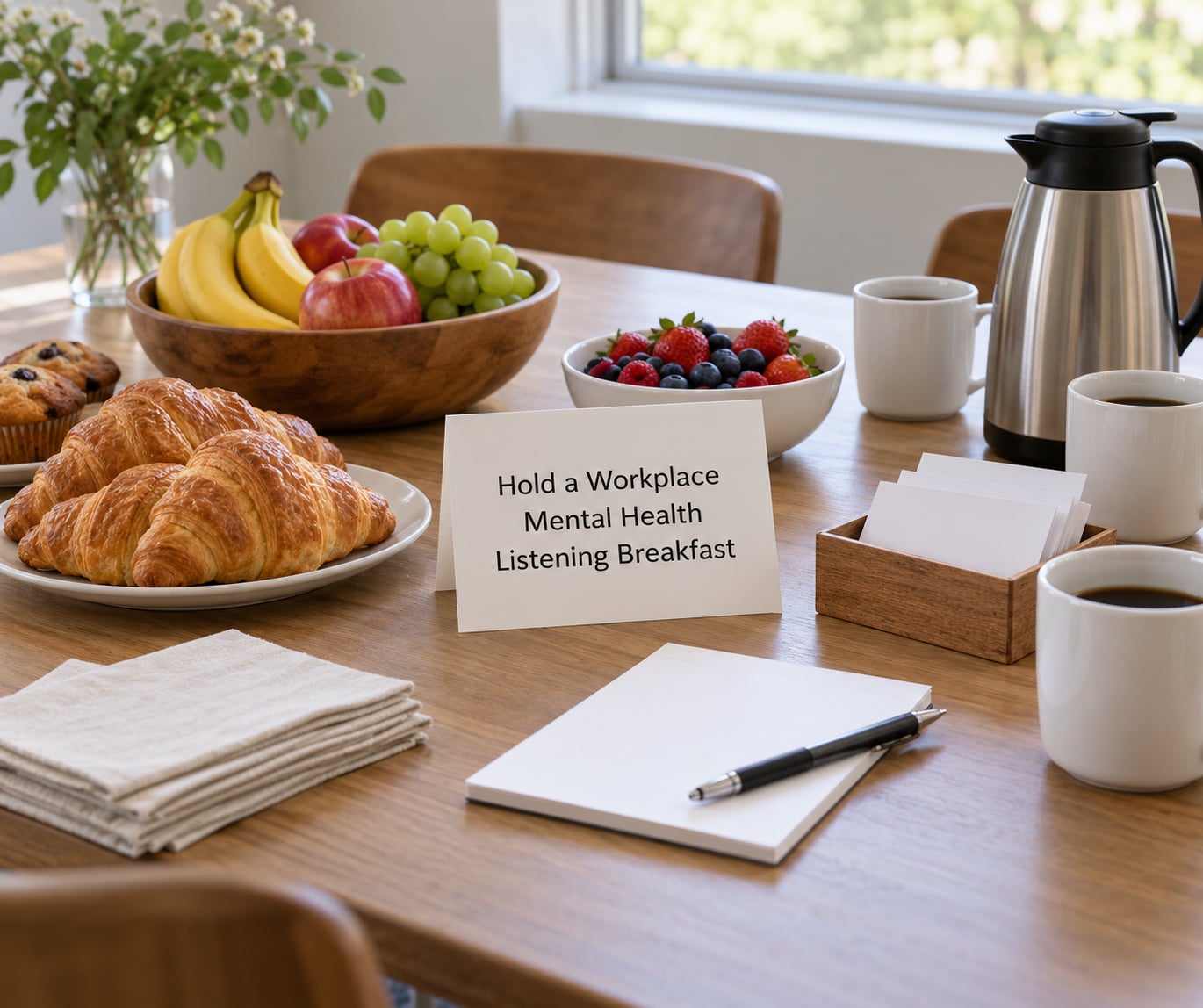
A listening breakfast is the cheapest useful activity on this list and often the most revealing. The format is simple: 60 to 90 minutes, optional attendance, food that requires almost no preparation, and a facilitator whose only job is to listen and take notes.
What you ask matters more than what you serve. Open with the physical environment — noise, crowding, temperature, whether people have a space they can take a call in privately. Then move to conditions: deadlines, staffing, handoffs between shifts, the software people are forced to use. Close by asking what the company could change in the next 90 days without needing a budget increase.
Put index cards and a box by the door so people can write anonymously and drop them in. That single detail converts the quiet half of your workforce from audience into participants. Read the cards aloud without attribution, then send a short written follow-up within two weeks describing the themes you heard and what is actually going to change. Skip the follow-up and the next one you host will have a much shorter card box.
Accessibility details that cost nothing: hold it at a time shift workers can attend without losing pay, offer a virtual version for remote staff, avoid scented products in the room, and label dietary options clearly. People with food allergies or sensory sensitivities should be able to take part without an explanation.
2. Run an Inclusive Mental Health Awareness Workshop
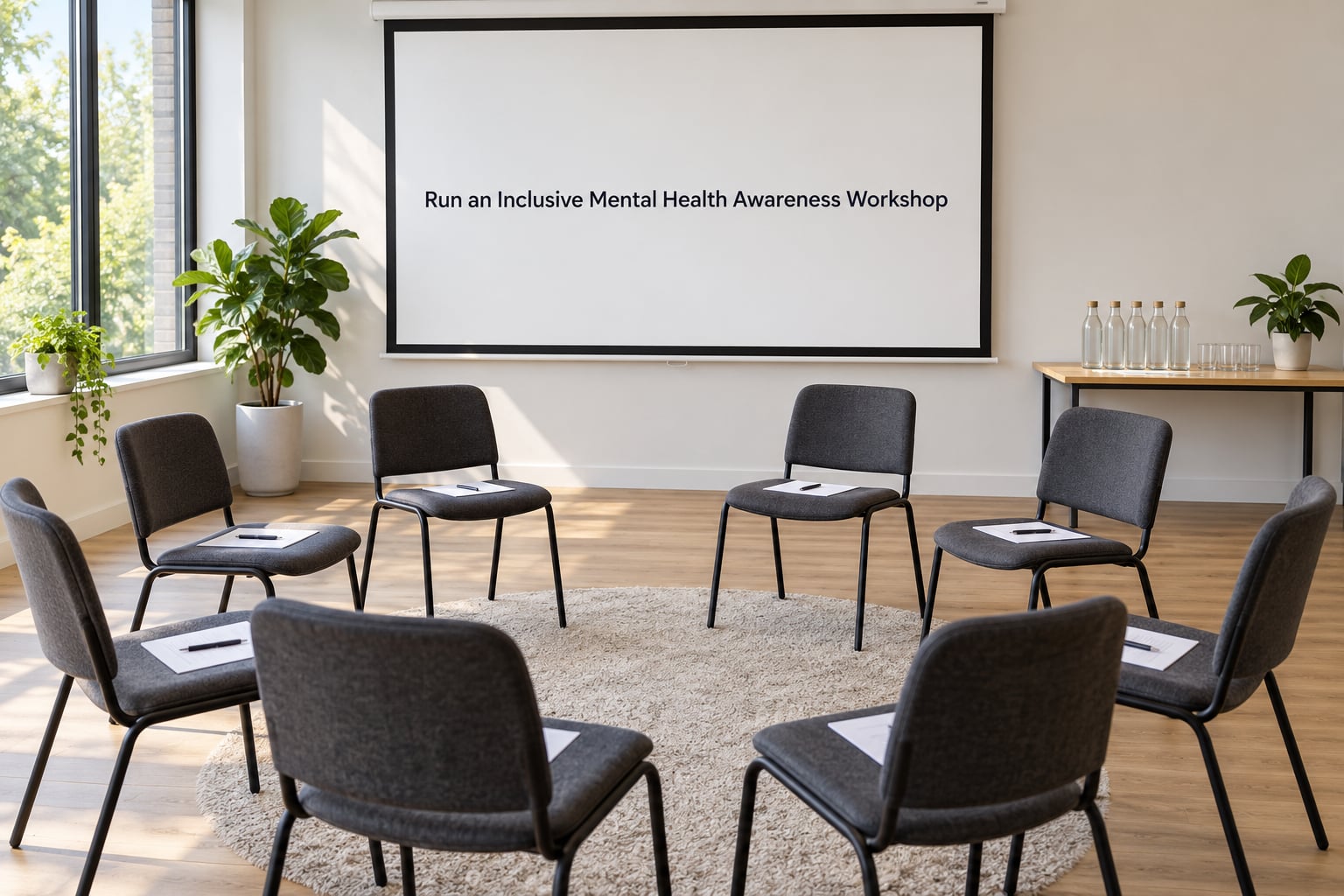
A workshop is the classic awareness month activity and also the easiest one to get wrong. The failure mode is a generic slide deck delivered by someone who reads a script about stress while the room sits quietly and checks email.
What makes a workshop land is a qualified facilitator, employee-shaped content, and a clear route to support at the end. Cover three things well: the language people can use when a colleague seems off, the warning signs worth noticing without diagnosing, and the specific places an employee can go in this organization. Naming a real internal resource — a counseling benefit, an EAP with hours and languages covered, an HR contact who answers within a day — does more for stigma than any poster.
Build for the room you actually have. Distribute materials in advance in large print and as plain digital files. Offer breaks. Let people leave and come back without explanation. Keep the tone plain: this is education, not assessment, and nobody will be asked to share their own history.
End with the referral process, in writing, on a single page: what the service is, who pays, whether anything appears on a personnel record, how to reach it confidentially, and what happens in an emergency. In the US, 988 is the Suicide and Crisis Lifeline. Everywhere, the local crisis line belongs on that page too. Personal clinical questions should always go to a doctor or licensed counselor, not to the facilitator after the session.
3. Host a Lived-Experience Employee Panel
A panel of volunteers talking about their own experience with support, accommodations and workplace culture can move stigma further in one hour than a month of posters. It also carries the most risk, because the stories belong to real people with real jobs.
Recruit by open invitation, not by nominating the person who seems most open about their struggles. Explain in writing what participation means before anyone signs up: they can pass on any question, skip any question, stop mid-answer, or withdraw the week before. Offer rehearsal. Most first-time speakers need one practice run with the moderator to know the shape of the hour.
Moderate in advance. Write down the questions you will not ask — anything about diagnosis, medication, a specific person’s performance, or the reason someone left a team — and let the panel know those boundaries exist in advance so it is not a surprise. Frame the conversation around systems and support, not inspiration. The panel should not be made to represent an entire group of people, and the moderator should interrupt gently if a story turns graphic or begins to read as a warning sign.
Two practical safeguards. Do not record without written consent from every panelist. And tell the room beforehand that the panel is about one person’s path, not a template anyone is expected to follow — that framing keeps the session from turning into pressure on people who are still deciding what to do.
4. Organize a Mental Health and Workplace Well-Being Fair
A well-being fair works because it removes the awkwardness of asking for help. Nobody has to schedule a therapy appointment or tell a colleague they are struggling; they just walk past a table and pick up information.
Plan the floor in stations rather than booths, with roughly 15 minutes per station for a small group. Useful stops include benefits navigation (how the mental health coverage actually works, what the copay is, what sessions count), stress and sleep information from a qualified professional, quiet room availability, and a private booking desk where a person can schedule a first counseling appointment on the spot.
Bring in community organizations, not only vendors. A local nonprofit, a public health department and one external provider group give employees options outside your company, which matters for people who do not want to use an employer-referred service. If you run an employee assistance program, staff that table with trained people who can explain session limits honestly. Employees have told forums and HR groups that limited, hard-to-reach EAP sessions do more harm than good, because a low ceiling turns a first call into a dead end.
Logistics worth stealing: two private consultation rooms away from the main floor, a printed resource sheet people can take without talking to anyone, at least one station in the employee’s most common language, and no gift-incentive tables that turn a health fair into a sales floor. If you want the mechanics, our guide on how to run a health fair at work covers the layout and staffing in more detail.
5. Offer Guided Stress-Reset Sessions
Short guided resets are the easiest activity to fit into a working day: 5 to 20 minutes, no equipment, no change of clothes. Breathing, grounding, gentle movement and plain quiet breaks all fall into this category.
The design rule that matters is optionality. No sign-up sheet with names. No attendance report sent to a manager. Cameras off by default. A person who wants to close their laptop and walk away should be able to do so without anyone noticing, which means the facilitator never asks people to report how they feel and never counts heads.
Choose instructors carefully. Look for someone whose training is in the specific method they teach and who will say plainly what the practice is and is not — a breathing exercise is a tool for settling attention, not a treatment for anxiety or depression. Anyone with a specific condition should check with a clinician before trying a new practice, and the invite should say so.
Accessibility needs real thought. Offer a seated version and a no-movement version of everything. Skip guided eye-closing. Avoid background music with abrupt changes, and keep sessions at times that include remote staff and every shift rather than only the 9-to-5 crowd. Neurodivergent employees often prefer written instructions over spoken cues, so publish the technique beforehand in a short text version.
6. Train Managers to Recognize and Respond Well
If you can only fund one thing this awareness month, fund manager training. Every other activity in this list ends with someone handing a person to their manager, and untrained managers are the most common failure point reported by employees.
Teach four behaviors: notice the change in behavior without labeling it, check in privately, listen without diagnosing or fixing, and direct the person to appropriate support. Practice them in scenarios, because a manager who has only read about it will freeze when it is real.
A workable opening line: “You have seemed stretched lately. No pressure to talk about anything — I wanted to check in and offer anything you might need.” Then listen, thank them, and ask what would be useful: a workload conversation, a schedule adjustment, information on counseling coverage, or just awareness that you noticed.
Set the boundaries explicitly. Managers are not mental health professionals, should not ask about diagnoses, and should not promise confidentiality they cannot keep — if someone describes an immediate safety risk, the manager has a duty to involve the designated response team or emergency services. Spell out what those routes are in writing and rehearse the escalation once.
Give managers a one-page conversation guide they can carry, and ask them to make one explicit change that removes friction: a meeting moved off the back-to-back stack, an after-hours message boundary, a handoff that stops falling through. Managers report feeling more anxious about these conversations than employees do; a script and a rehearsal fix most of that. Our piece on how to support employee mental health at work has the longer version.
7. Launch a Voluntary Peer Support Initiative
Peer support fills the gap between appointments — the 2 a.m. worry, the week before a review, the month when a counselor is not available. Run well, it is genuinely useful. Run carelessly, it is a liability.
Recruit volunteers by open call, then train them: active listening, boundaries, when to refer, and how to avoid giving clinical advice. The line to hold is simple: peers listen and connect; they do not assess, diagnose, counsel or treat. Anything clinical goes to a qualified professional, immediately.
Every peer needs supervision from someone qualified to supervise the program, on a regular schedule, plus a private referral route and a clear confidentiality agreement. Make the scope explicit in writing so nobody is left guessing whether a conversation is covered by company privacy policy.
Handle urgent concerns with a defined protocol: the peer disengages from the peer role and connects the person to the trained response team or emergency services. Do not improvise this. If your organization has no response team, that is the first thing to build, not the peer program.
Employees tend to be more willing to talk to a colleague than to HR, which is the whole appeal. Keep participation voluntary, cap the load on volunteers, and rotate so the program does not quietly depend on two or three people who never say no. Our guide to running a peer support program at work covers recruitment and supervision structure.
8. Create a Private Employee Check-In Week
A check-in week is a low-tech activity with a high hit rate: one week where any employee can request a short private conversation with a manager or an HR partner about workload, support, accommodations or resources.
Keep it voluntary and keep it short. Fifteen to 30 minutes, booked through a calendar link so nobody has to explain themselves to request one, offered across all shifts and time zones, and identical for every employee rather than targeted at teams the organization finds worrying.
Write down the privacy rules before you open the calendar. What gets recorded, who sees it, and whether it appears anywhere near a performance file. Most check-ins are better with no written record at all — keep a note of commitments rather than content, and let the employee know that is what you are doing.
Close the loop within a week: every conversation should end with something concrete, even if it is “I have to ask my director and will come back Thursday.” An unresolved check-in does more damage than never offering one.
Skip mandatory screening questionnaires and public wellness assessments. Forcing people to rate their own distress in a system that is supposed to be safe is exactly the surveillance dynamic that makes people hide struggling. If you need data on prevalence, use an anonymous third-party survey with minimum reporting thresholds, and keep it separate from any individual record.
9. Run a Workplace Psychological Safety Audit
Psychological safety means people can raise a concern about their own mental health or ask for an accommodation without being made to feel foolish. Most organizations assume they have it. A short audit tells you whether they actually do.
The method: an anonymous survey of 8 to 12 items, then listening sessions by team, then a written summary with owners. Good survey items are behavioral rather than sentimental — “I would feel comfortable telling my manager my workload is affecting my health” predicts more than “I am satisfied with workplace culture.” Add items for remote employees, shift workers and anyone who uses an accommodation, so you can see whose experience differs.
Set a minimum reporting threshold before you launch (often 7 to 10 respondents) and report only above it, so no team can be identified or outed. Feedback goes back within two weeks with the top findings and what is changing. Findings reported upward without action are worse than no audit, because the next survey comes back with less honesty.
Turn findings into owned actions: a named person, a date, a visible progress note. Our pick for a team that wants a template for this is the psychological safety audit format described in our workplace mental health support guide.
10. Build a Mental Health Community Connection Week
This week is about the handoff that many employers never make: what support exists outside the company for someone the company cannot help. Invite two or three vetted nonprofit or public mental health organizations to run virtual or on-site education, and pair them with local community services.
Vetting means checking accreditation, reviewing how they handle referrals, confirming they are not selling a package at the end of the talk, and asking what they do when a session ends. A partner who cannot describe their referral pathway is not a partner.
Include family-oriented conversations, because care responsibilities are a real strain and a parent attending a session alone is a scheduling problem, not a lack of interest. Provide multilingual materials and simultaneous interpretation where the workforce needs it. Keep the tone trauma-informed: no surprise content warnings skipped, no public sharing of personal stories, no activities that require disclosure.
Set the promotional limit before you start. No booth selling a coaching package at the end of each session, no sign-up tables that require personal details for a prize. Organizations can fund the week without turning it into a sales funnel — and if one does, that tells you everything about whether to invite them back.
11. Launch a Team Self-Care and Connection Challenge
Challenges are the lowest-cost activity here and the easiest to design badly. The pattern that works: a small voluntary habit, run for one to four weeks, with no scoring and nothing shared publicly.
Ideas that work well include screen-free break blocks, walking meetings where people opt out and meet by video instead, a weekly “no agenda” check-in, a sleep-routine discussion with a nurse or a physician if one is available, and peer connection in mixed-location teams where someone is always left out of the in-office version.
Avoid anything built on weight, fitness level or appearance. Step counts, weigh-ins and body-focused language land badly for a real share of your workforce, and they signal that the company cares about how people look rather than how they are doing. Avoid competition with public leaderboards, and avoid anything that requires spending money, which quietly excludes the people under the most pressure.
No personal health disclosure. Nobody should have to say what they are working on or why in order to participate, and no one should be tracked. If a team finishes the week having taken four screen-free breaks, that is a win worth noting — without announcing who did what.
12. Turn Awareness Into a 90-Day Workplace Action Plan
The month ends. The posters come down. Most organizations never touch the subject again until next May, which is why employees learn to treat awareness month as theater. The 90-day plan is the antidote: it converts the month into two or three changes that actually alter working life.
Days 1 to 30: review participation and feedback. Look at what people actually attended, what they wrote on the cards, and which questions came up in check-ins. Write down the three themes that repeat. Then select one or two priorities only — a program with five priorities has none.
Days 31 to 60: assign owners and timelines. Every priority gets a named person, a first milestone date, and whatever budget it needs. In many organizations the honest priority is not a new program at all but a structural one: a meeting-free block, a staffing gap, a workload review, a manager’s after-hours boundary.
Days 61 to 90: publish the status, including the parts that slipped. Reporting that something did not happen yet does more for trust than silence. Then check the question that matters most: can an employee use the support without anyone at work finding out or commenting? If not, the plan is not finished.
How to Choose Mental Health Awareness Month Activities for Work
Match the activity to the constraint you actually have, not to the one the plan suggests. Teams under 50 people can run items 1, 6 and 12 well with an HR generalist; a distributed organization with 2,000 people needs 8 and 9 first, because those scale without a budget.
Work through four filters. Format: if most of your workforce is remote or on shifts, skip anything that assumes a physical room, and rewrite items 4 and 11 so remote and shift employees are included by design rather than invited. Budget: items 1, 5, 8 and 11 cost staff time and nothing else, while 2, 3 and 4 need facilitators or partner fees — a small business can run the first group and get most of the value.
Prep time: five minutes of setup fits into a normal day, a listening breakfast needs three weeks of emails, and a panel needs recruitment, consent and rehearsal. Goal: stigma reduction points to 2 and 3, early warning points to 6 and 9, access points to 4 and 10, and durable change points to 8 and 12.
One rule cuts through most of it. Ask employees which single thing would make the biggest difference in their week. Whatever the answers cluster around is your first activity — and it is nearly never a pizza party.
Frequently Asked Questions
When should employers plan mental health awareness month activities for work?
Start six to eight weeks before the month begins. Employees need a short anonymous survey two to three weeks in advance, and that input shapes which activities you run. Panelists need three weeks to be recruited and rehearse, and a facilitator or partner organization needs a month to confirm availability. Working backward from the first week of May, six weeks is the realistic minimum and eight weeks avoids scrambling.
How much should a workplace mental health awareness event cost?
It depends entirely on which activities you pick. A listening breakfast, private check-ins, stress-reset sessions and a team challenge cost staff time and little else. A facilitated workshop, a lived-experience panel or a well-being fair with external partners costs more, mostly in fees and coverage while staff attend. Most of the value in mental health awareness month activities for work comes from time and follow-through, not spend.
What are good mental health activities for remote employees?
Remote-friendly options include a virtual listening session with anonymous questions collected in advance, a facilitated workshop delivered online with cameras optional, short optional stress-reset sessions that can be joined with cameras off, and a psychological safety survey with follow-up listening sessions by team. Screen-free break blocks and walking meetings translated into optional video check-ins work at a distance. Avoid anything that requires being physically present to participate.
Should employers require employees to participate in mental health activities?
No. Make awareness month activities voluntary, during paid work hours, and untracked. Forced participation reliably backfires: employees in HR and other forums describe mandatory wellbeing sessions during lunch as another obligation rather than support. If an activity is optional but happens on work time with no attendance reporting, participation rises and the stigma signal disappears.
How can a company measure whether its awareness activities helped?
Measure process and access rather than health outcomes. Track whether resources were actually used, how many employees requested support, whether manager training was completed, and what changed structurally as a result of feedback. A short anonymous pulse survey four to six weeks later tells you what employees noticed. Be careful not to promise health improvements or publish individual-level data.
What should a manager do if an employee appears to be struggling?
Check in privately, keep it simple, and avoid guessing at a diagnosis. Say something like: you have seemed stretched lately, I wanted to check in. Listen more than you talk, ask what would be useful, and point to specific support such as counseling coverage or an employee assistance program. If the person mentions immediate danger or self-harm, contact the trained response team or emergency services the same day.
Conclusion
The twelve activities above are not a menu to clear. Pick one that matches a need you already know about, give it a named owner, decide what privacy looks like before the first invitation goes out, and put a follow-up date in the calendar before you add anything else. A listening breakfast and manager training alone will outperform a full month of events nobody asked for.
Keep the door open past the month. Mental health awareness month activities for work only matter when the next ninety days show a workload change, a manager who knows how to respond, and a route to professional help that nobody has to ask twice.