

To support employees with anxiety, you listen first, agree on practical workplace adjustments, signpost them to professional support, and check in privately. You are not a therapist and you do not diagnose. Your job is to remove barriers, keep expectations clear, and make it easy for someone to ask for help twice.
This guide is written for line managers, team leads and small-business owners in the US and UK who have an employee disclosing anxiety right now. Anxiety is the most common mental health condition in the workforce; an American Psychiatric Association poll reported 43% of US adults describing themselves as more anxious than a year earlier, up from 37% the year before. The World Health Organization puts the global cost at 12 billion working days lost each year to depression and anxiety, so this is a work-risk issue as much as a personal one.
Two rules hold the rest of this together. Support and accountability are not opposites, and privacy is finite. Keep both in view and you will rarely say the wrong thing.
Table of Contents
- What You Need
- Step-by-Step: How to Support Employees With Anxiety
- Common Mistakes
- Tips for Building a Supportive Workplace Culture
- Frequently Asked Questions
- Do I have to tell the rest of the team about an employee’s anxiety?
- Is anxiety a disability under the ADA, and can HR deny the accommodation?
- How do I support an employee with anxiety without overstepping?
- How do I give feedback to an employee whose anxiety makes criticism hard?
- What should I do if an employee discloses anxiety during probation?
- How do I keep performance standards while supporting an anxious employee?
- Conclusion
What You Need
Before you sit down with anyone, five things make the conversation go far better.
- A private room and enough time. Thirty minutes with the door shut and no interruptions. Never in a corridor, a car park or a team channel.
- Your current policy set to hand. Know your sick leave rules, your flexible working policy, your mental health benefit and your HR or accommodation contact’s name and email.
- A written note of what you will and will not share. Decide your confidentiality limits before you hear the disclosure, not during it.
- Your resource list. Employee Assistance Program number, health plan behavioural health details, and the name of your HR partner.
- A backup resource for employees who cannot use your benefits. Someone in probation, on a contractor agreement, or in a team too small to run an EAP. The US National Institute of Mental Health findtreatment.gov locator and local community mental health centres work for anyone, eligibility aside.
If you have no EAP at all, that is a gap worth raising with HR. Plenty of mid-sized employers still have no mental health provision at all, and the employee assistance program is the cheapest fix available to them.
Step-by-Step: How to Support Employees With Anxiety
1. Listen Without Trying to Fix the Problem
Open with what you observed and what you are offering, not with questions. “I’ve noticed you’ve missed two stand-ups and seemed distracted in the last few weeks. I wanted to check in privately. Is now a good time for fifteen minutes?”
Then stop talking. Anxiety disclosure is uncomfortable, and most managers fill that silence with reassurance that lands badly: “I’m sure it’s nothing,” “just relax,” “don’t worry so much.” NAMI, the US National Alliance on Mental Illness, is blunt about those two phrases being on the list of things to avoid. They tell the employee their experience is a problem to be managed by willpower, which is the opposite of support.
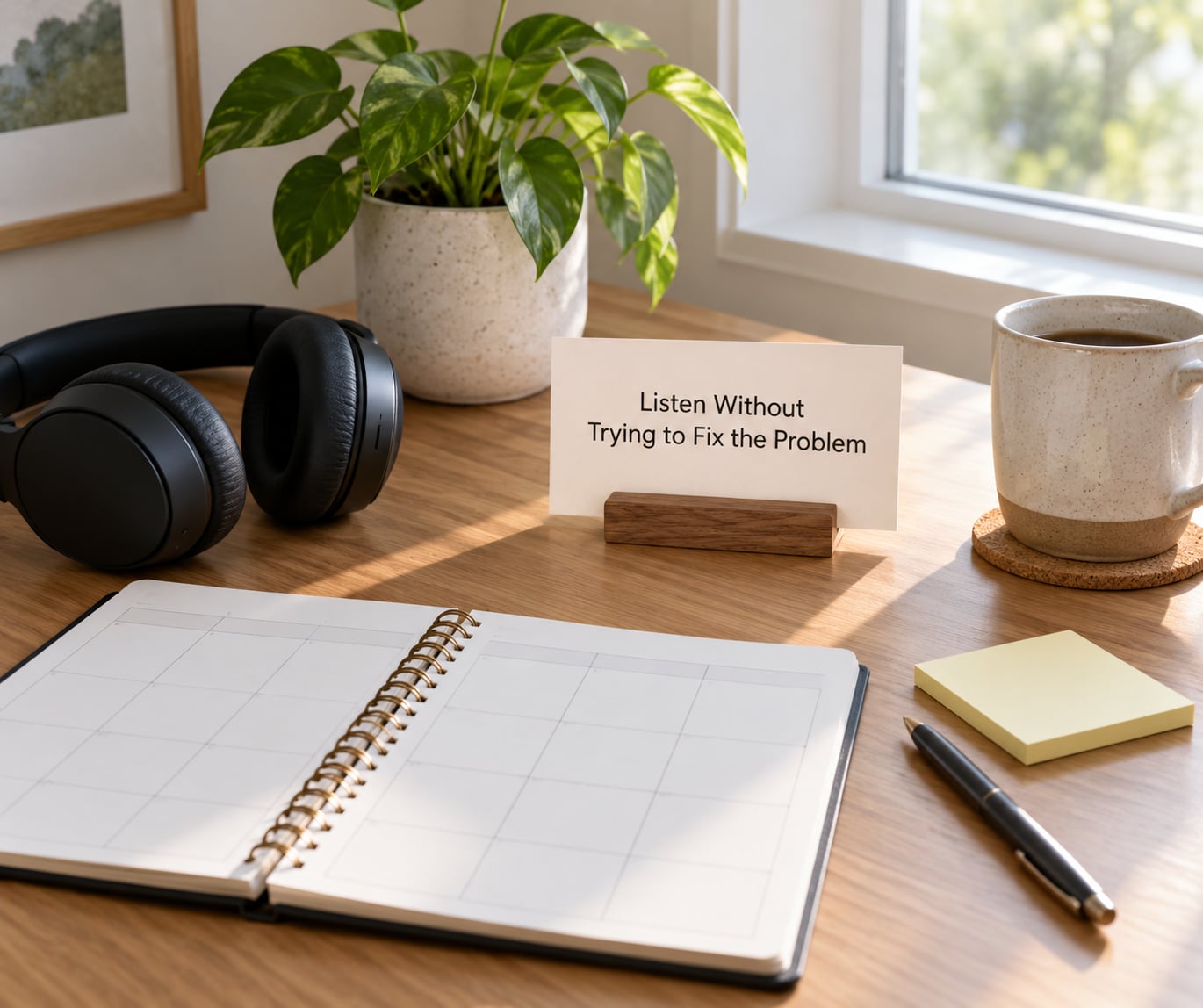
Useful phrasing, lifted from real manager guides: “Thank you for telling me.” “That’s a lot to carry.” “You don’t have to explain anything you’re not ready to.” Close the listening stage with the question NAMI recommends: “What can we do to make things more manageable?” It hands the next move to the person who knows the work.
You will hear physical symptoms too, because anxiety fires the fight-or-flight response: racing heartbeat, shallow breathing, sweating, a churning stomach. If someone describes those, that is a cue to point them toward a clinician, not to assess them yourself.
2. Ask About Work-Related Needs and Barriers
Ask about the work, not the diagnosis. “What gets in the way of doing your job well right now?” beats “Do you have an anxiety disorder?” every time. You want the operational detail, because that is what you can actually change.
The barriers managers hear most often cluster into a handful of shapes. Concentration and switching: open-plan noise, phone alerts, and tasks that need long unbroken blocks. Meetings and visibility: speaking in front of colleagues, presenting, being put on the spot without warning. Transition and predictability: unclear priorities, last-minute changes, ambiguous instructions, deadline stacking. Feedback: criticism or poor performance reviews landing harder than they should. Physical workplace environment: temperature, crowds, commuting, open-plan seating. Recovery: breaks being skipped, lunch taken at the desk, no real down time.
Ask what already helps, because they will know more than any guide will. Then ask one more thing: “What has made it worse?” Managers on workplace mental health forums say the question employees most want to hear is what would make things more manageable, and the most common complaint is being told what to do instead.
For a wider framing of where employee wellbeing sits in the management role, see our guide to how to support employee mental health at work.
3. Make Reasonable Workplace Adjustments
Adjustments fall into two groups: the ones you can do informally this week, and the ones that need a formal request through HR. A reasonable accommodation, in plain terms, is a change to the job that lets someone do the work without the disability being the obstacle.
The adjustments with the best evidence behind them, from the Job Accommodation Network and SHRM’s accommodation guidance:
- Flexible start and end times around commute, appointments and medication, so peak-anxiety hours are not the ones spent commuting.
- Remote or hybrid working on high-symptom days, agreed as a standing option rather than a one-off favour.
- A quiet workspace, noise-canceling headphones, or a cubicle screen where open plan makes focus impossible.
- Reduced meeting load, permission to leave calls when the discussion does not need them, and pre-circulated agendas so nobody has to react cold.
- Written instructions and clear success criteria rather than verbal briefs, which cuts the reworking that rumination feeds on.
- Modified break and task flow, such as protected short breaks, extra recovery time after a demanding piece of work, or a task checklist to stop work being held over into the evening.
Anything that reduces workload permanently, changes a core duty, or is needed long-term usually belongs in the formal process. In the US that is the interactive process under the Americans with Disabilities Act: the manager and employee talk, the employee may provide documentation, and the employer must engage rather than ignore the request. Denial needs a reason. In the UK, the Health and Safety at Work Act and the Equality Act place a similar duty to make reasonable adjustments on employers.
Route formal requests to HR the same day, and keep the conversation going in the meantime. Our guide to accommodating workers with disabilities at work covers the documentation and timing side in more detail.
4. Connect the Employee With Appropriate Resources
Share resources, not treatment advice. The distinction is practical: recommending a service is within your role, telling someone what they need or how to think about their condition is not.
The list worth having ready covers four things. The Employee Assistance Program, usually free, confidential, and reachable by phone with a few sessions included. The health plan’s behavioural health cover and its own care navigator, where one exists. Community and public options, including the NIMH findtreatment.gov locator and local community mental health centres, for employees not eligible for private benefits. And peer support groups, which work for some people and not others, so offer them as one option among several.
Do not make use of support a condition of the workplace adjustments. Employees skip EAPs because they assume the call will show up in front of the promotion panel. Say plainly what happens with the call, and let them decline the referral without consequence.
Resources matter less without permission to use them, so normalise them out loud. SHRM’s most recent Employee Benefits Survey found 82% of US employers offer an EAP, but far fewer offer the quiet rooms, on-site stress programmes and coaching that make the benefit usable.
5. Check In Respectfully and Protect Privacy
Agree a cadence before you leave the first meeting. Weekly fifteen minutes, or a monthly catch-up for someone who finds weekly check-ins itself a source of pressure. Keep the agenda predictable: the same three questions, every time.
On privacy, be precise rather than reassuring. You can promise to tell nobody else anything. You cannot promise that HR, payroll, or a manager covering your leave never hear of anything, because absence and workload changes are visible facts. Say what you can do: no diagnosis in any file, no name on a team-wide announcement, no detail beyond what a task handoff requires.
Document minimally. Notes should cover the adjustments, the review date and the agreed actions, not the condition. Someone in HR, an occupational health adviser or a legal advisor may need to know, and only what they need.
Managers ask this more than almost anything else, so here is the direct answer: no, you are not required to tell the rest of the team. The team needs to know operational changes only. “A colleague is handling the client reporting this quarter” is a fact. “A colleague has anxiety” is not yours to share.
Where a supervisor’s own position matters, the reporting line and the limit of a manager’s role are covered in supervisor support and the employee health connection.
6. Review Whether the Support Is Working
At the first review, ask two questions: what is helping, and what is not. Adjustments that are not reviewed quietly become permanent habits nobody agreed to, or quietly die out because nobody noticed they stopped.
Measure practical things. Is the work being delivered to standard? Is the sick leave pattern changing? Is participation in team work recovering? Is rework going up or down? Managers on workplace mental health forums report that regular low-pressure one-to-ones cut both rework and sick leave, and that anxious employees are often still high performers whose output dips only around new projects or presentations.
For a return from anxiety medical leave, phase it rather than dropping the person back into a full load. Weeks one and two, reduced hours and low-intensity tasks, no major deadlines. Weeks three and four, normal hours with a single clear priority. A named contact outside the team, and a no-blame rule if something has to be missed. If an employee in probation discloses anxiety, treat it the same way: set explicit ramp-up milestones in writing, adjust the supervision cadence, involve HR early, and be honest that probation standards still apply.
Accountability is the part managers worry about most, so say it plainly. A diagnosis does not change the job description, and vague kindness just delays the same difficult conversation later. Better to hold the standards conversation and the support conversation as two separate meetings than to blur them into one.
Escalate to HR or an occupational health adviser when a request becomes formal, when absence is climbing, when sick leave is exhausted, or when you are seriously worried about someone’s safety. Anxiety can bring suicidal thoughts. If someone tells you they are thinking about ending their life, do not handle that alone: stay with them, remove immediate means of harm where you safely can, and contact emergency services or a crisis line in their country. UK and Ireland readers can call Samaritans on 116 123, free, 24 hours.
Common Mistakes
These come up repeatedly, and each has a straightforward correction.
- Diagnosing or playing therapist. “You might have social anxiety.” Correction: recommend a resource and let a clinician assess.
- Forcing disclosure. Asking about health in front of the team, or repeatedly asking why they are not using the EAP. Correction: ask once, privately, and accept a no.
- Promising total confidentiality. Then discovering payroll needs an absence code. Correction: state your limits before they tell you anything.
- Changing the schedule without agreement. A flex arrangement you invented unilaterally is not an accommodation, it is a demotion in disguise. Correction: agree it with the employee in writing.
- Dropping performance standards. Support without expectations creates resentment across the team, especially in small ones. Correction: keep standards, change the conditions.
- Treating it as a motivation problem. Increased sick leave reads as disengagement. Correction: look at the pattern, not the attendance chart.
- Absorbing the whole load yourself. In a team of under twenty, one person’s adjustments become everyone else’s extra work. Correction: rebalance explicitly, with the team, without naming a reason.
The phrase swap matters more than it looks. Say “what would make this more manageable” instead of “you need to calm down.” Say “let’s adjust the deadline and keep the quality bar” instead of “try to relax and it will be fine.” Say “I want to make sure I understand the impact on your workload” instead of “are you sure you need that?”
Tips for Building a Supportive Workplace Culture

One employee’s support does not fix a workplace that produces anxious employees. Culture work is slower and it does more.
- Train supervisors. Two hours on recognising signs, having the conversation and handling disclosure beats any policy document. The CIPD found only around half of UK managers are trained to support staff with mental health conditions, and fewer to spot warning signs.
- Make breaks normal. “Take twenty minutes” said by the manager first, without recording it, changes what everyone else does.
- Use plain language. Say “mental health” rather than “personal issues.” It is the smallest possible signal that asking is allowed.
- Build defaults that need no disclosure. Agendas circulated 24 hours ahead, no unexpected fire drills at meetings, protected focus blocks on shared calendars. These help everyone, so nobody has to explain why they need them.
- Know the difference between burnout and anxiety. Burnout is depletion from sustained overwork: cynicism, exhaustion, everything feels heavy. Anxiety is threat-driven: worry about a specific upcoming event, avoidance, physical symptoms, worry that persists on weekends. Someone can have both, and the response differs.
- Look after yourself. Supporting a distressed person is hard. Supervisor wellbeing breaks, peer support for managers and protected time are not perks, they are how the support stays available.
Frequently Asked Questions
Do I have to tell the rest of the team about an employee’s anxiety?
No. You are generally not required to disclose a colleague’s mental health condition, and doing so without consent can breach privacy rules. The team only needs the operational facts: who owns a task, whether a deadline moved, who to contact. Write down work allocations and agreed adjustments, not the condition itself. If the employee wants their role shared, such as when chairing a regular meeting, let them say so.
Is anxiety a disability under the ADA, and can HR deny the accommodation?
Anxiety can qualify as a disability under the Americans with Disabilities Act when it substantially limits a major life activity, and an employer cannot retaliate for requesting accommodation. HR can refuse a request, but only with a reasoned justification, such as undue hardship on the operation, and after engaging in the interactive process. Treat this as general information rather than legal advice, and route formal requests to HR or your legal adviser the same day.
How do I support an employee with anxiety without overstepping?
Stay on the work side of the line. Ask what gets in the way, agree adjustments, share resources and check in. Do not assess, diagnose or suggest treatment. If you catch yourself thinking about why they behave a certain way, that is the signal to stop and redirect to the employee’s own clinician. Your value here is removing obstacles and reducing risk, not providing care.
How do I give feedback to an employee whose anxiety makes criticism hard?
Be more explicit and more frequent, not less. Small corrections early land lighter than one annual review, and unclear expectations feed the rumination that drives rework. Agree the format in advance, write down what good looks like, and close with what is working well. Managers report that reassurance paired with clear expectations is what most reduces rework and sick leave for anxious employees.
What should I do if an employee discloses anxiety during probation?
Run the same process as anyone else, and adjust the ramp rather than the standards. Document the conversation, involve HR early, and do not advertise benefits the employee is not yet eligible to use. Point them to public options such as the NIMH findtreatment.gov locator or a community mental health centre. Set explicit milestones in writing, and be upfront that probation expectations still apply.
How do I keep performance standards while supporting an anxious employee?
Hold the standards and change the conditions. The job description does not change, and in a small team, quiet leniency creates resentment that shows up as workload conflict later. Meet separately about support and about performance so neither muddies the other. If performance is genuinely affected, say so plainly, agree what good looks like by a date, and involve HR so the process is documented and consistent.
Conclusion
Start with a private conversation, ask what gets in the way of the work, and agree one or two concrete adjustments you can make this week. Share a resource or two, set a short check-in cadence, and keep the performance standards where they are. That sequence is enough to change how an employee experiences their job, and it takes an hour, not a project.