
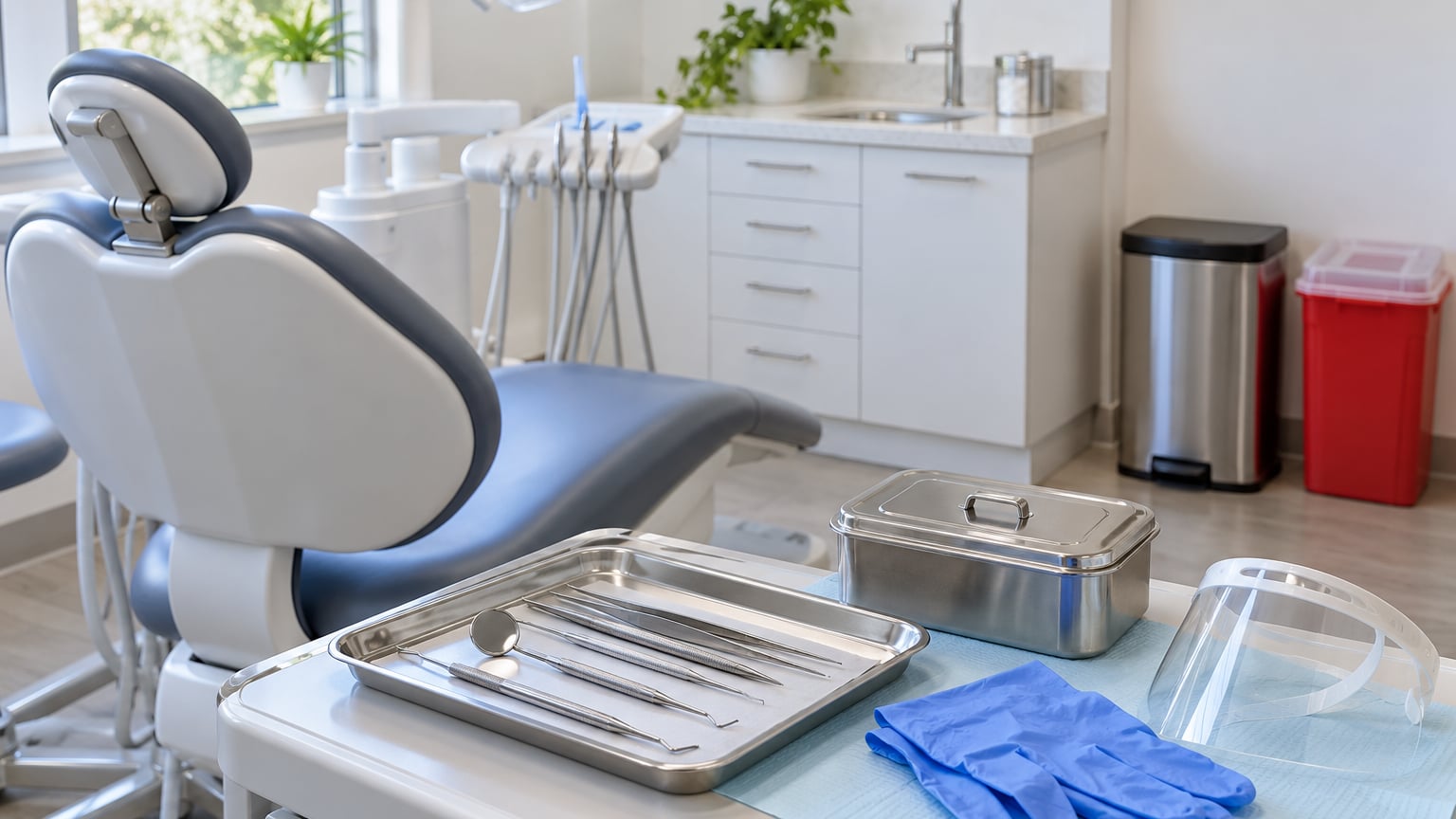
Dental office safety hazards are the risks that come with the work itself: needles, aerosols, disinfectants, ionizing radiation, high-speed equipment, and hours spent folded over a patient in an awkward position. Most practices know the rules exist. Fewer know exactly what to do when an inspector walks in, or when a squeeze bottle of disinfectant has sat unlabeled for six months. This guide walks through the hazard classes, the OSHA standards attached to each, and the controls that actually work day to day.
I have sat through enough of these walkthroughs to know where practices stumble. It is almost never the clinical knowledge. It is the paperwork, the labels, and the five minutes it takes to pull the right document out of a binder.
Table of Contents
- Dental Office Safety Hazards at a Glance
- What Are the Most Common Dental Office Safety Hazards?
- Biological and Infection-Control Hazards
- Chemical, Medication, and Material Hazards
- Radiation, Equipment, and Environmental Hazards
- Ergonomic and Musculoskeletal Hazards
- How Can a Dental Office Reduce These Hazards?
- What Should a Dental Office Do After an Exposure or Incident?
- How Can Teams Keep Dental Office Safety Improvements Working?
- Frequently Asked Questions
- What are some examples of dental hazards?
- What is the most common OSHA violation in dental offices?
- What are the OSHA requirements for dental offices?
- What are the five major types of hazards in the workplace?
- Why does OSHA recommend being cautious about chemical exposure?
- How do I keep my dental office safe day to day?
- Conclusion
Dental Office Safety Hazards at a Glance
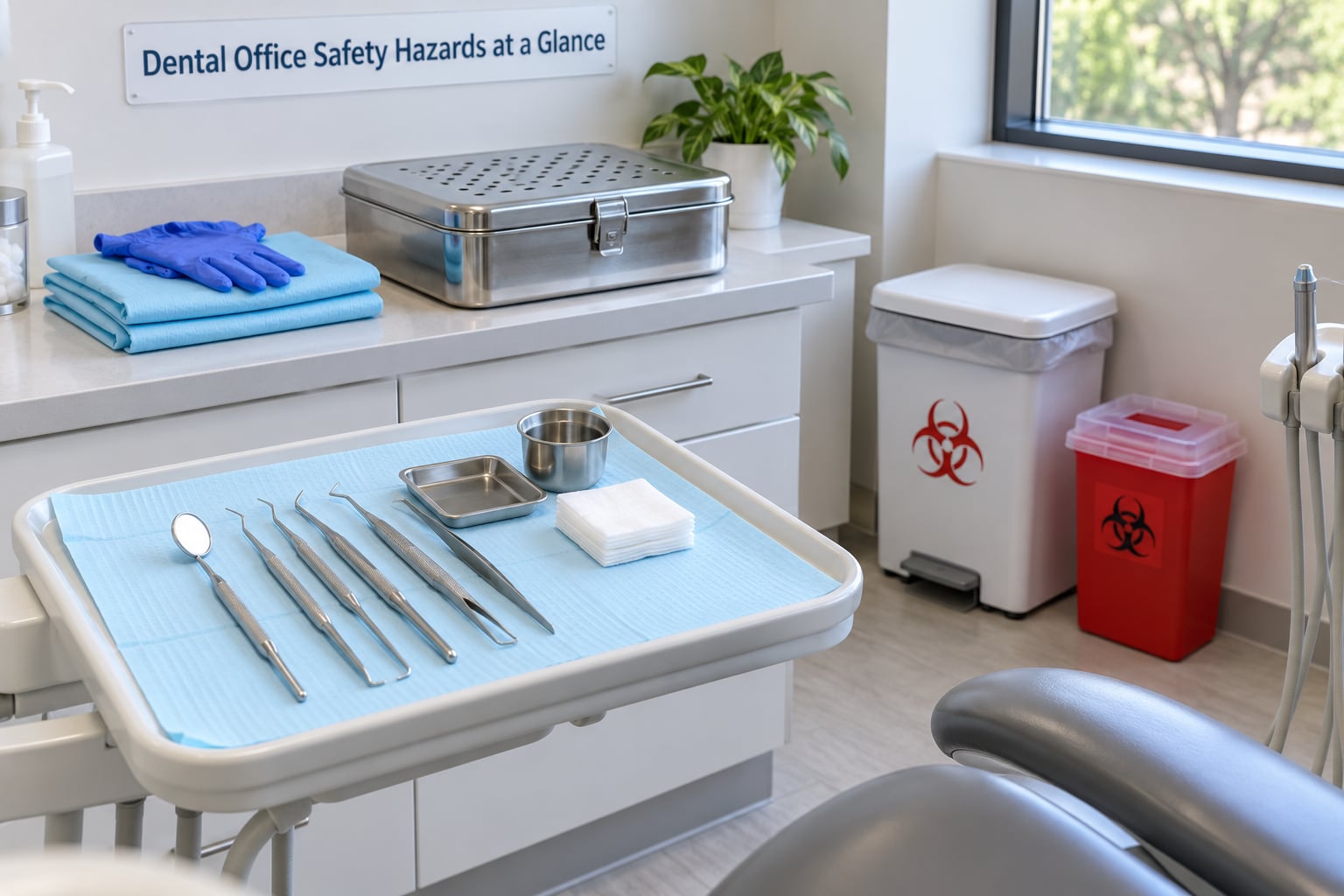
The table below maps each hazard class to what it actually looks like in a dental office, the OSHA standard that governs it, and the control most practices are expected to have in place.
| Hazard class | Real examples in a dental office | Applicable OSHA standard | Typical control |
|---|---|---|---|
| Biological | Needlestick injuries, aerosol and spatter from ultrasonic scaling and high-speed handpieces, contaminated instruments, regulated medical waste | 29 CFR 1910.1030 Bloodborne Pathogens | Written Exposure Control Plan, sharps safety devices, PPE, sterilization protocol |
| Chemical | Disinfectants, cold sterilants, x-ray developer, bonding agents, impression materials, amalgam dust, acrylic resin dust | 29 CFR 1910.1200 Hazard Communication | Written HazCom program, safety data sheets, labeled secondary containers |
| Physical | Ionizing radiation, electrical equipment, compressed gases, handpiece noise and vibration, slips and falls, fire | 29 CFR 1910.1096 Ionizing Radiation; 1910.132 PPE; 1910.22 walking-working surfaces | Lead aprons and collars, equipment maintenance, anti-slip flooring, exit signage |
| Ergonomic | Awkward neck and back posture, repetitive finger motion, patient transfers, prolonged standing | General Duty Clause; no specific ergonomic standard | Adjustable stools, magnification loupes, sit-stand setups, task rotation |
| Psychosocial | Workplace stress, burnout, patient aggression, compassion fatigue, shift work | General Duty Clause; state plan rules in some jurisdictions | De-escalation training, staffing ratios, debriefing, employee support channels |
Two things stand out. Ergonomic and psychosocial hazards have no dedicated federal standard, which is exactly why they get skipped. And most citation categories cluster in the first two rows, because those are the ones with paperwork attached.
What Are the Most Common Dental Office Safety Hazards?
Dental office safety hazards are workplace risks unique to a clinical dental setting that can injure or expose staff, patients, and visitors. They fall into five classes: biological (bloodborne pathogens, needlestick injury, aerosols), chemical (disinfectants, developer solutions, bonding agents, mercury and acrylic dust), physical (ionizing radiation, noise, vibration, slips and falls), ergonomic (posture and repetitive strain), and psychosocial (stress, burnout, patient aggression).
That five-class grouping is the standard occupational health taxonomy, and it is the fastest way to make sense of a practice. Once every task in the office is sorted into one of the five buckets, each one has an obvious next question: who gets hurt, how badly, and what stops it.
Which hazards hit staff, and which hit patients?
Most of the daily risk lands on staff. The hygienist leaning over a patient at 11 a.m. accumulates neck and shoulder load that does not show up on any log. The assistant recapping a needle under time pressure is the single most cited injury in the profession. The sterilization tech breathing in whatever the cold sterilator gives off is a respiratory exposure nobody sees.
Patients and visitors carry a different set. Patients absorb radiation dose, aerosol exposure, and medication errors. Visitors move through hallways with wet floors, encounter unlabeled chemical carts, and trip over cords in operatories they were not meant to be in.
Prevalence data from a peer-reviewed survey of dental practitioners helps put this in proportion. Among respondents, noise exposure was reported by 97.0 percent, light-curing unit use by 96.7 percent, dust exposure by 94.1 percent, and volatile substances by 86.0 percent. Those are self-reported exposures, not injuries, and they show how routine the exposure is even where the harm is slow to appear.
Biological and Infection-Control Hazards
Biological hazards are the reason most dental offices employ a full-time compliance program, and they are the category that generates the most citations. A 2021 study of OSHA citations in dental practices found bloodborne pathogens violations outnumbered every other category by a wide margin.
Sharps injuries
A needlestick is a puncture with a contaminated needle or a cut with a sharp instrument. Dental workers suffer needlestick injuries at rates well above most other healthcare settings, and most of them come from a small number of predictable behaviors: recapping, passing instruments hand to hand, and overfilling a sharps container past the fill line.
The controls that matter are dulling devices that let a surgeon remove a blade without fingers, safety-engineered syringe needles with a built-in needle guard, and containers mounted at the point of use rather than across the room. If the sharps container is in the sterilization area while the procedure is in operatory 2, someone will carry a used instrument to reach it.
Aerosols, spatter, and splashes
Spatter and splatter are visible droplets that land on surfaces and skin. Aerosols are much smaller particles that stay suspended in air for minutes afterward and can be inhaled or swallowed. Aerosol-generating procedures include ultrasonic scaling, high-speed handpiece use, air polishing, and spray rinsing.
This distinction matters because the control for spatter is a gown and a face shield, while the control for aerosol is high-volume evacuation, a rubber dam where possible, and room ventilation between patients. Face shields alone will not stop what you cannot see. Practitioners who treat aerosol as a separate transmission route rather than a footnote to spatter tend to get both better.
Contaminated instruments and waste
Instrument processing is where a single lapse cascades. Reusable instruments need cleaning, packaging, sterilization, and storage with a verified cycle, and the verification step is often a biological indicator or spore test run on a schedule and retained for a defined period. Damaged or expired packaging voids the sterilization claim regardless of what the autoclave printout says.
Regulated medical waste, including sharps, goes into containers that are not overfilled, closed, and stored away from patient areas until pickup. Hand hygiene sits underneath all of it: before and after every patient, after glove removal, after touching the phone, after handling waste.
Chemical, Medication, and Material Hazards
Why OSHA is cautious about chemical exposure
OSHA treats chemical exposure cautiously because the harm is often invisible at the moment it happens and shows up years later. Many dental chemicals irritate airways on contact, and repeated low-level exposure to sensitizing agents can leave a worker unable to work near the product at all. Because consequences are delayed, employers are required to communicate hazards in advance through labels and safety data sheets rather than relying on workers to notice.
What is actually in the chemical cabinet
A typical operatory cabinet holds surface disinfectants, an ultrasonic cleaner solution, cold sterilant glutaraldehyde or hydrogen peroxide, bonding agents, impression compound, acrylic monomer, and sometimes x-ray developer where film processing is still done on site. Each carries a different risk profile.
- Disinfectants are used wet and often in a small closed space, so vapor concentration builds. Use the contact time the label requires, not the time that feels long enough.
- Cold sterilants can cause chemical burns and respiratory irritation, and glutaraldehyde has a recognized occupational asthma link. Closed systems and vapor control matter more than open trays.
- Developer and fixer are skin irritants and can stain. Where digital sensors have replaced film in most practices, this hazard may already be gone.
- Bonding agents and impression materials produce strong odors and, for some people, contact sensitization. Uncapped bottles release vapor into the whole operatory.
- Amalgam involves mercury-bearing material, and carving and finishing generate fine particulate. Practices removing amalgam need an amalgam separator and a written protocol.
- Acrylic resin and denture repair dust is a laboratory hazard that migrates into clinical areas on the same air system.
Labeling and storage
The single most common HazCom failure I hear about is unlabeled secondary containers. A practice buys a gallon of disinfectant, decants half into a squeeze bottle, and that bottle now needs a label identifying the product, the hazards, and the manufacturer. A chemical cart that is not labeled for the specific product is the same violation in a different location.
Storage needs its own pass. Chemicals go in a closed, labeled, ventilated cabinet, segregated by compatibility, away from food and away from patient reach. Medication and anesthetic agents follow a separate rule set: secured, access-controlled, and counted.
Material sensitization
Latex exposure produces allergic contact dermatitis and, more seriously, latex allergy in a small but meaningful share of workers. Powdered latex gloves and latex-containing rubber dam material are the usual sources. Nitrile has replaced most of this, but the material still sits in supply drawers and on patient charts.
Radiation, Equipment, and Environmental Hazards
Ionizing radiation
Dental x-ray units produce a low but real dose. The controls are procedural: operator position behind a barrier or outside the room during exposure, lead aprons and thyroid collars for anyone who must stay in the room, positioning and technique that reduce retakes, equipment calibration, and a dosimetry program where monitoring is required. Barriers should be checked for damage, since a cracked apron plate does nothing.
Noise and vibration
The safe noise exposure limit recommended for an 8-hour workday is an average of 85 decibels. Above that, employers are expected to implement hearing conservation controls.
High-speed turbines, ultrasonic scalers, and lab sandblasters exceed that. The 97.0 percent prevalence figure above is not a surprise once you understand the geometry: a noise source four feet from your ear is dramatically louder than the same source at the chairside arm’s length. Hoses run long, turbines get laid down across the tray, and a practice treats every room’s noise as ambient background. Sound-damped motor housings and shorter hose runs help more than most people expect.
Electrical, gases, and the building
Equipment defects cause more fires than most practices expect. Frayed cords, water near powered connections, an aging chair motor, and a compressor with no water separator all belong on an inspection list. Wall outlets in clinical areas need GFCI protection and periodic thermal checks.
Compressed gas cylinders, if present, need securing against movement and correct storage. Nitrous oxide requires scavenging; without a nasal hood and scavenging system, the room accumulates nitrous oxide, with documented reproductive effects in exposed staff.
Ventilation and temperature drive more complaints than any other environmental factor. Six operatories with no fresh-air exchange produce a stale, chemical-laden atmosphere by mid-afternoon. Slips, trips, and falls come from wet floors near sinks, cords across walkways, and storage stacked in aisles. A written emergency action plan, posted exit routes, monthly extinguisher checks, and an accessible eyewash station cover the rest.
Ergonomic and Musculoskeletal Hazards
This is the slowest hazard in the office and the one that most reliably ends a clinical career. Back pain, neck pain, and carpal tunnel symptoms in dental professionals typically build over years, and by the time they are obvious, the damage is established. It is also the category most likely to be sitting unaddressed in your practice, because no citation or inspection forces anyone to raise it.
The mechanism is predictable: a dentist or hygienist holds a static, twisted neck position for 20 to 40 minutes per patient, repeats small precise finger movements thousands of times a day, and does it standing for most of a shift. Add patient transfers, instrument retrieval outside the neutral zone, and a stool set at the wrong height, and the workday becomes a slow-motion repetition of the same strain.
What actually moves the needle:
- Saddle or fully adjustable stools set so the clinician’s thighs stay roughly parallel to the floor and the elbows fall near 90 degrees.
- Sit-stand capability so a clinician can change position between patients rather than holding one posture for an hour.
- Magnification loupes with adequate field of view, which pull the working distance out of the neck’s danger zone.
- Patient positioning that puts the mouth at the clinician’s elbow height and keeps the chin from being held at a fixed tilt for the whole procedure.
- Instrument placement inside the neutral zone, so handoffs and reaches do not require shoulder elevation.
- Task rotation and microbreaks, since no single workstation adjustment fixes cumulative load.
Treat musculoskeletal complaints as reportable events. Practices routinely normalize back and neck pain as part of the job, which guarantees the trend never reaches anyone who could change the setup.
How Can a Dental Office Reduce These Hazards?
You reduce these hazards by working through a documented risk assessment in priority order, matching each hazard to the standard that governs it, and layering controls so the outcome does not depend on a clinician remembering something. Practices that skip the written step tend to rediscover the same gap every year.
A workable sequence looks like this:
- Walk the practice with the people who work in it. Ask the assistant what is hardest to reach, the hygienist which patients wreck their posture, the sterilization tech which chemical smells worst. A 30-minute walkthrough with two staff usually surfaces more than an hour of solo review.
- List every task by job classification. Cleaning, chairside assistance, radiographic exposure, instrument processing, medication handling, laboratory work, and waste handling each get named.
- Classify each task into the five hazard classes and identify who is exposed and how.
- Match each hazard to its standard and confirm what written program already covers it.
- Apply the control hierarchy in order: eliminate the task if you can, substitute a safer material or device, use an engineering control such as high-volume evacuation or a sharps container at the point of use, change the work practice, then supply PPE as the last layer.
- Ask the employees who do the work to evaluate the control before you buy it. Controls that are slower than the old method get abandoned within a month.
- Record the result with a date, the hazard addressed, the control chosen, and the responsible person’s name.
- Set a review cycle and trigger an out-of-cycle review after any incident, any new product, or any new equipment.
If your practice is small and the paperwork feels disproportionate, the safety audit checklist for a small business gives you a structure to work from rather than a blank page.
Two written programs carry most of the regulatory weight. The Exposure Control Plan addresses bloodborne pathogens and must be reviewed and updated at least annually, including after an exposure incident. The Hazard Communication Program covers every chemical in the building, with safety data sheets accessible to any employee during every shift, not stored in an office nobody enters. Alongside them sits a written PPE hazard assessment documenting which protection each job classification needs and why.
What Should a Dental Office Do After an Exposure or Incident?
After an exposure, you act immediately, then document, then follow up. The order matters more than the paperwork. This is a process description, not medical guidance; individual evaluation belongs with the treating physician or occupational health clinic.
Sharps injury. Stop work, wash the site with soap and running water, apply an antiseptic, cover with a dressing, and notify the supervisor immediately. Do not squeeze or suck the wound. Capture the sharps injury log entry, the source and status of the source patient, and the employee’s hepatitis B vaccination status.
Splash to eyes or mouth. Flush at the eyewash station for the full 15 minutes the standard specifies, lifting the lids, and take out contact lenses if present. Mouth exposures get a rinse or spit-out rather than swallowing. Note the time the exposure happened, because the flush duration is measured from it.
Splash to skin. Remove contaminated clothing, wash with soap and water for several minutes, and dry.
Equipment or chemical incident. Isolate and shut off the source if it is safe to do so. Move to fresh air for inhalation. Have the specific product’s safety data sheet available before anyone attempts cleanup, because the sheet dictates first aid and disposal.
Fire, spill, or patient event. Evacuate, call emergency services, and follow the emergency action plan. Do not fight a fire beyond a small incipient-stage fire.
Within the shift, report the event through the practice’s internal system. The post-exposure evaluation follows the treating clinician’s protocol, including source-patient testing arranged through the clinician rather than the employer. The Exposure Control Plan gets reviewed and revised after the event, and the corrective action is documented with a date. A 1-page tool safety inspection checklist can serve as the basis for the equipment portion of that report.
How Can Teams Keep Dental Office Safety Improvements Working?
Controls fail quietly. A filled sharps container gets replaced, an eyewash station runs dry after two weeks, an exposure control plan goes a year without an annual review, and nothing changes until someone looks. Keeping dental office safety improvements working takes a named coordinator, a short recurring checklist, and a few numbers worth watching.
Name one coordinator. In the practices I have worked with, the office manager taking on the role is the single change that makes the difference. Ownership has to sit with a person, not with the concept of the practice.
Set a training cadence. Orientation covers the essentials, then annual refresher sessions and a trigger training whenever a new chemical, device, or procedure enters the building. Training records should carry the date, the content, the trainer, and the attendee signature, because those four fields are what an inspector asks for first.
Use short checklists with owners. Daily checks for eyewash access, sharps fill levels, and floor dryness. Monthly checks for extinguisher tags, eyewash flushing, and waterline testing. Annual checks for the exposure control plan, HazCom program, and radiation dosimetry. A checklist with no name attached to each line does not get done.
Post signs where decisions happen. Eyewash location, sharps container location, restricted access areas, and where to find safety data sheets. One sign at the right eye height beats a page in a manual.
Make near-miss reporting easy. A near miss is an event that could have caused harm but did not. Under-reporting is itself a hazard, because it hides the pattern until the pattern shows up as an injury. A single-line paper form or a shared digital log is enough; the threshold is that anyone can file one without permission.
Watch a few numbers. Sharps injuries per 1,000 procedures, post-exposure evaluations completed within the required window, training completion rate, and percentage of spills cleaned up within the same shift. The guide to tracking safety metrics in a small company covers how to pick indicators you will actually keep measuring.
Audit annually. Pull each document and confirm it is practice-specific rather than a downloaded template. Generic plans with someone else’s job classifications are the most common finding in a document review.
Frequently Asked Questions
What are some examples of dental hazards?
Common examples include needlestick injuries from recapping needles, aerosol and spatter from ultrasonic scaling and high-speed handpieces, chemical exposure to disinfectants and bonding agents, ionizing radiation from dental x-ray units, handpiece noise and vibration, neck and back strain from sustained posture, and slips from wet floors. These fall into five classes: biological, chemical, physical, ergonomic, and psychosocial.
What is the most common OSHA violation in dental offices?
Bloodborne pathogens violations are the most frequently cited category in dental practices, usually for gaps in the written Exposure Control Plan, an incomplete hepatitis B vaccination offer or signed declination form, missing training records, or overfilled sharps containers. Hazard Communication violations follow closely, most often unlabeled secondary containers and safety data sheets that staff cannot reach during a shift.
What are the OSHA requirements for dental offices?
The main federal requirements are 29 CFR 1910.1030 for bloodborne pathogens, 1910.1200 for hazard communication, 1910.132 for personal protective equipment, and 1910.1096 for ionizing radiation if you operate an x-ray unit. Dental practices are classified under NAICS 621210. Small-practice exemptions exist for certain recordkeeping obligations, and state-plan states may add stricter rules.
What are the five major types of hazards in the workplace?
The most widely used framework groups workplace hazards into five classes: biological, chemical, physical, ergonomic, and psychosocial. Some sources use a seven-class version that splits physical into separate categories such as radiation, noise, and electrical. For a dental office, the five-class grouping is easier to apply because ergonomics and psychosocial risks are easy to lose when everything is filed under physical.
Why does OSHA recommend being cautious about chemical exposure?
Because the harm is often invisible at the moment of exposure and appears years later. Repeated low-level exposure to dental disinfectants, sterilants, and bonding agents can cause chemical burns, respiratory irritation, and occupational asthma, and sensitizing agents can leave a worker permanently unable to work near the product. Because effects are delayed, employers must communicate hazards in advance through labels and safety data sheets.
How do I keep my dental office safe day to day?
Assign one named coordinator, run short recurring checklists for eyewash access, sharps fill levels, spill response, and floor dryness, refresh training annually and whenever a new product or device arrives, and keep the Exposure Control Plan and Hazard Communication Program current and practice-specific. Track a few numbers, such as sharps injuries per 1,000 procedures and training completion rate, and hold an annual audit that verifies each document rather than confirming the binder exists.
Conclusion
Start by identifying the hazards most likely to cause harm in your specific practice rather than in the average one. Most offices have a primary exposure: sharps, chemical vapor, or accumulated ergonomic load. Then review the controls with a trained infection control lead and your safety coordinator, and document every corrective action with a date and an owner.
That is the whole job. Recognize the hazard, match it to the standard, apply the strongest control available, and write down who is responsible for keeping it in place.