
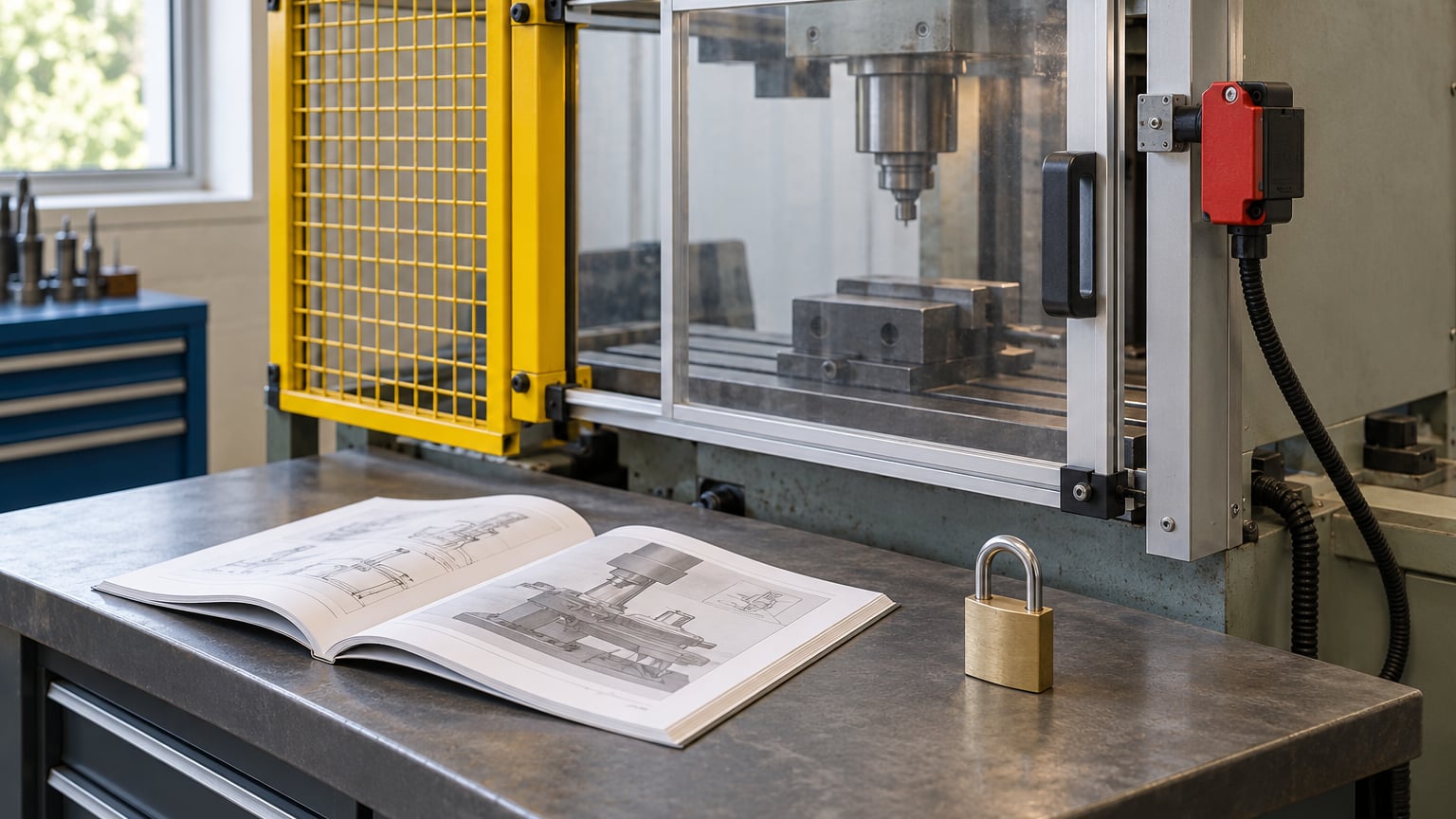
Machine guarding basics come down to one rule: a person and a moving part must never be able to meet. A guard is a barrier, a cover, a tunnel or a locked door that keeps hands, arms, hair and loose clothing away from the point of operation, rotating shafts and in-going nip points. Any site running presses, lathes, conveyors, saws or drill presses needs some version of it, and an unguarded machine is one of the easiest things for an inspector to cite.
This guide covers what machine guarding is, which guard types exist, how to pick one, how to install and test it, and how to keep it doing its job after the paperwork is done.
Table of Contents
- What Is Machine Guarding and Why Does It Matter?
- Machine Guarding Basics: Common Types of Machine Guards
- How to Choose the Right Guard for a Machine
- How to Install and Test Machine Guards Safely
- How to Inspect and Maintain Machine Guards
- Machine Guarding Basics for Training and Safe Work Practices
- Common Machine Guarding Mistakes and How to Fix Them
- When to Involve a Qualified Safety or Equipment Professional
- Frequently Asked Questions
- Conclusion
What Is Machine Guarding and Why Does It Matter?
Machine guarding is a physical barrier or safeguard system that separates people from the dangerous moving parts of a machine, so contact cannot happen during normal operation or during servicing. It covers the point of operation, rotating components, in-going nip points and flying parts such as an unguarded flywheel.
The point of operation is where the work happens: where a cutting tool, blade or punch meets the material. An in-going nip point is where two rotating surfaces draw something in, like a roller pulling a belt into a gap. Rotating parts include shafts, couplings, sheaves, pulleys and fan blades, which catch clothing and hair rather than cutting it.
Guarding and training solve different problems. A guard removes the possibility of contact no matter what a person does on a bad day. Training changes behaviour, which depends on attention, workload and how busy the shift is. Where a hazard can be engineered out, engineering controls come first; training is the layer on top, never a substitute.
Enforcement is steady. OSHA’s fiscal year 2024 Top 10 citation list put 29 CFR 1910.212, the machine guarding general requirement, in ninth place with 1,541 citations. It has sat in that top group for years because guarding is cheap to inspect and expensive to ignore.
If your site handles presses, cutting or grinding equipment, lathes, conveyors, food processing lines, agricultural equipment or maintenance workshop tools, this applies to you, including temporary and contract workers. Sites in energy and extraction often carry the same exposure with more weather and fewer spare parts, which is covered in our oil and gas field worker safety basics.
Machine Guarding Basics: Common Types of Machine Guards
Guards fall into five families. Fixed, adjustable, self-adjusting and interlocked are the classic four; point-of-operation guarding describes what it protects rather than how it is built.
| Guard type | Best suited for | Key strengths | Limitations | Maintenance burden |
|---|---|---|---|---|
| Fixed | Machines with no frequent in-process access, such as belt drives and rotating shafts | Cheapest, no power, cannot fail to respond | Must be opened for service, so it can be left off | Low, mostly fasteners |
| Adjustable | Varying stock or part sizes on the same machine | Handles size changes without swapping guards | Needs range limits and frequent setting accuracy checks | Medium, frequent adjustment |
| Self-adjusting | Blades and discs that change size between cuts | Tracks the hazard automatically | Moving parts of its own, more failure modes | Medium to high |
| Interlocked | Doors, gates and covers that must open for feeding or loading | Stops hazardous motion when opened | Needs wiring, a safety relay and diagnostic testing | Medium, periodic function checks |
| Point-of-operation | The work zone itself on presses, saws and grinders | Addresses the closest and worst hazard | Can obstruct the work or trap operators in position | Varies by design |
Fixed guards: the default in machine guarding basics
A fixed guard is permanently secured and does not move during operation. It is the simplest type and the one most plants rely on, because it works without electricity, without sensors and without any reset step.
Fixed guarding suits belts, pulleys, couplings, fans, gearboxes and any rotating part that does not need daily access. It suits a die area on a press that is loaded from the side. It stops working the moment someone unbolts it, so the fasteners and any tool access points are worth designing deliberately rather than leaving to whoever is nearest the breakdown.
Adjustable guards
Adjustable guards change position to fit the work while keeping a set separation from the hazard. Think a lathe shield that slides for a long or short piece, a press die guard set for a range of stock thicknesses, or a saw guard that tracks blade diameter.
The setting has to be bounded. A guard that slides freely can be pushed out of position by a stock piece or a chuck key, so adjustable guarding normally includes stops, scale markings and a defined range. Treat an out-of-range setting as a defect, not a preference.
Interlocked guards
An interlocked guard is wired so that opening it stops hazardous machine motion. On a press, lifting the gate during a cycle should either stop the press or refuse to start it until the gate is closed and the controls are reset.
Interlocking suits machines that need regular access, because it lets work happen without removing anything. Plain interlocking suits lower-risk cycles. Guard locking, where the guard stays shut until the drive has come to a complete stop, is the stronger option for machines with long stopping times, stored energy or heavy closing hazards. Both are easier to defeat than a bolted cover, which is why inspection matters.
Point-of-operation guards
Point-of-operation guarding sits over the place where the cut, punch or shear happens. It is a location, not a construction method, so it can be a hinged cover, a tunnel, a light curtain or a restraint system.
The distinction from perimeter guarding matters. A perimeter fence or enclosure stops a person walking into the machine, usually from a distance, and is often about housekeeping and unauthorized access. Point-of-operation guarding is the last barrier between a body part and the working zone. A machine can be fully enclosed and still badly guarded if nothing covers the point of operation.
How to Choose the Right Guard for a Machine
Work through these questions in order rather than picking a guard from a catalogue and fitting the hazard around it.
- What is the hazard? Rotating parts, nip points, point of operation and flying fragments each need a different answer. A mesh screen that stops a hand may not stop a wheel fragment.
- What can you afford to lose? If a person can reach the hazard from a normal working position, treat it as a point-of-operation problem even if the distance looks generous to you.
- How often does someone need access? Rare access suits a fixed guard bolted in place. Daily or hourly access suits an interlocked guard or a hinged cover.
- Does part size change? One fixed job, one fixed guard. Mixed sizes and mixed stock mean adjustable, self-adjusting, or a quick-change guard that still sets to a marked position.
- What does it cost to maintain? Count the removal cycles per week. A guard removed daily is a guard that will eventually stay off, and the cost model should assume a labelled spare and a reinstallation step.
On opening size, the rule of thumb is that the largest opening should not allow a finger to pass through toward the hazard, and reach distance matters as much as hole size. Where a specific measurement is required, the manufacturer’s manual and the applicable standard govern, not a general rule of thumb.
How to Install and Test Machine Guards Safely
Installation is maintenance work, so it happens under lockout. Isolate and verify the energy state before removing a single fastener.
- Review the machine manual and identify any points intended for guarding.
- Lock out and tag out the machine, then verify zero energy by trying a start control.
- Fit the guard so it cannot reach the hazard at any point of travel, including during the closing stroke.
- Check for new hazards: sharp edges, pinch points where a person reaches through, and unstable fixtures.
- Restore energy and test each function separately. Open the interlock, break the beam, try the reset from a blocked start.
- Record what you tested and the date, then have a second person repeat the check.
If the machine has more than one operating mode, test every mode. A press in inch mode and a press in continuous mode can behave very differently, and a guard that works in one says nothing about the other.
How to Inspect and Maintain Machine Guards
The most common real-world failure is not a bad guard. It is a guard removed for a quick task and never put back, usually because nothing makes anyone notice it is missing.
Run three tiers. A pre-use check is the operator glancing for a missing cover, a loose fastener or a tape or wire over an interlock. A routine check is a scheduled walk with a short list, run by the operator or a lead. A documented inspection is periodic, signed and retained, and it should attempt to defeat the safeguard the way an accident would.
Stop the machine and tag it out when you find missing fasteners, bent or cracked panels, missing fasteners on a hinged cover, interlocks taped or wired down, light curtain beams blocked or muted, guards fitted after a collision, or any sign of heat or friction damage. Do not reset and walk away; the interlock exists to stop something, and a fault there is a fault in the safety system.
Label every guard with the machine it belongs to. Guarding that is not in the maintenance system never gets inspected properly.
Machine Guarding Basics for Training and Safe Work Practices
Training should cover the people who run the machine, the people who service it, and the supervisors who approve shortcuts. Everyone needs to know what the guard is for, what happens when it is opened, and what to do when it fails.
Cover four things in any session. How the machine creates the hazard and why the guard sits where it does. How to isolate energy before removing anything. How to report damage or a missing guard, and to whom. What to do in an emergency, including where the stop control and the release are.
Retrain when the machine changes, when a guard type changes, when a new shift or language group starts, when an incident or near miss involves the machine, and when someone has been away from it for a long stretch. Record who was trained and on what.
Fatigue is part of guarding, not a separate topic. A tired operator misses the loose fastener and the slow change in machine behaviour, so managing that sits in the same fatigue risk management program basics for safety teams.
Common Machine Guarding Mistakes and How to Fix Them
- A guard that comes off for every changeover. Fix it with an interlocked guard or a hinged cover, so the machine will not run while the guard is open.
- An improvised barrier. Cardboard, foam or a curtain tied in place looks like protection and does nothing in a crash. Replace it with a purpose-made guard and keep the frame space free.
- Defeated interlocks. Taped switches, bypassed light curtains or a magnet holding a sensor closed. Remove the bypass, investigate why it was needed, and change the design so the workaround is no longer necessary.
- A guard with no way to get the tool you need. If technicians keep removing the guard, the design failed. Provide tool access ports or a service procedure that does not mean stripping the guard.
- Energy isolation skipped. Lifting a guard and reaching in is the highest-consequence sequence on any machine. Treat it as a lockout task with a written procedure and a second check.
- Nothing verifies the safeguard actually works. A guard that has never been tested after installation may not stop anything. Add a function check to commissioning and to the periodic inspection.
On sites with heavy equipment and awkward access, the same fixes apply, and our oil and gas field worker safety basics covers the surrounding housekeeping that guards depend on.
When to Involve a Qualified Safety or Equipment Professional
Bring in the manufacturer or the machine’s original equipment supplier before you modify anything. A rebuilt or relocated machine often has guarding designed for a different method, and a home-made cover on a press is a poor trade for a part that was specified for it.
Get a qualified machine-safety specialist involved when the hazard needs a safeguarding device rather than a barrier, when a risk assessment has to be written or reviewed, when you are moving to another country with a different machine safety regime, or when a citation or an incident means someone outside the site has to verify the work.
Check who actually regulates the site. Mining in the United States falls under MSHA rules rather than OSHA, some states run their own OSHA-approved plan, and equipment shipped into Europe or Canada is usually built to EN ISO or CSA machinery safety standards. Our trench safety basics for excavation crews covers the other side of that equipment exposure, where the hazard is the ground rather than the machine.
If a solution sounds improvised, that is the signal. Documented risk assessments and manufacturer guidance take hours and save weeks.
Frequently Asked Questions
What is the 7-foot rule for machine guarding?
The 7-foot rule is a training shorthand, not an OSHA rule. Safety trainers use it to mean that anything a person can reach or lean into from about seven feet away needs guarding. The legal requirement is simpler and stricter: guard the point of operation, in-going nip points, rotating parts and flying parts wherever a worker can contact them. Treat seven feet as a prompt to look closer, never as a safe distance.
What are the four types of machine guards?
The four classic types are fixed, interlocked, adjustable and self-adjusting. Fixed guards are bolted in place and do not move. Interlocked guards stop hazardous motion when opened. Adjustable guards shift to suit different part sizes within a marked range. Self-adjusting guards move on their own to follow a hazard that changes, such as a blade of shifting diameter.
What are the OSHA guarding requirements for machines?
29 CFR 1910.212 says guards must prevent the operator and others from reaching points of operation, rotating parts, ingoing nip points and flying parts. A guard must be secured against removal by anyone other than the person doing maintenance, must create no new hazard, must not interfere with the work, and must allow lubrication and routine service. Where guarding conflicts with production, the answer is a better guard, not a removed one.
When can a machine guard be removed for maintenance?
Only under lockout. Isolate and tag all energy sources, verify zero energy, then remove the guard for the task. Put it back and confirm the machine will not run with the guard open before anyone resumes work. If the guard comes off frequently, the design is the problem and an interlocked guard should replace it.
How do you inspect machine guards?
Use three tiers: a pre-use visual check by the operator, a routine scheduled check, and a periodic documented inspection with a signature. Look for missing fasteners, bent or cracked panels, taped or bypassed interlocks, blocked light curtain beams and any sign of collision damage. Any of those findings means the machine is stopped and tagged until fixed and re-tested.
Who is responsible for machine guarding at a workplace?
The employer is responsible under OSHA, not the operator, the maintenance tech or the equipment supplier. That covers providing appropriate guarding, maintaining it, training people to use it properly, and having a procedure for reporting damage. Individual workers still have a duty to report a missing or damaged guard and to stop working on a machine that is unguarded.
Conclusion
Start by walking the floor with a list of every machine where someone can reach a moving part, and mark which ones have nothing at the point of operation. Fix the missing guards first, then test each safeguard the way an accident would, and put the inspection routine on a calendar so the guard that came off for a quick job gets put back.