

The best electrician safety tips all follow one habit: assume every conductor is energized until you have proven otherwise with a properly rated tester. De-energize first, isolate and lock out the energy source, verify absence of voltage with a test-and-retest method, and only then touch the work. Everything else — the right PPE, a clear work area, inspected tools, honest communication — protects the plan that habit sets in motion.
That order matters because electrical work has one of the highest fatal-injury rates of any occupation, and most of those deaths trace back to a shortcut rather than a lack of knowledge. Electricians on r/electricians and electriciantalk keep returning to the same theme: LOTO gets skipped on low-voltage control circuits, panels are poorly labeled, cheap gloves show up instead of arc-rated gear, and an apprentice gets pushed onto a live panel before they understand approach boundaries.
This list is written for electricians and apprentices, but supervisors, facility managers, and employers own most of the controls in it. Every step here has to match the manufacturer’s instructions, your site’s energy-control procedure, applicable OSHA requirements, and NFPA 70E where it is recognized. Nothing in an article substitutes for training or for a qualified person’s assessment of the actual hazard.
Table of Contents
- Electrician Safety Tips at a Glance
- 1. Review the Drawings, Scope, and Hazards
- 2. Secure the Work Area and Control Access
- 3. Shut Down, Lock Out, and Tag Out Energy Sources
- 4. Prove the Circuit Is Dead With a Test-and-Retest Method
- 5. Treat Exposed Live Parts as Energized
- 6. Match PPE and Arc-Rated Clothing to the Risk
- 7. Inspect Hand Tools, Test Instruments, and Power Tools
- 8. Choose and Inspect the Right Ladder or Work Platform
- 9. Keep Conductors, Terminals, and Tools in a Clear Work Position
- 10. Communicate, Buddy-Check, and Stop Work When Conditions Change
- 11. Respond to an Electrical Contact or Arc Flash
- 12. Report, Record, and Correct Near Misses
- Frequently Asked Questions
- What should you do if an electrician is shocked or is in contact with live electricity?
- Is testing a voltage tester on a receptacle enough to prove the circuit is dead?
- When is it acceptable to work on energized electrical equipment?
- How often should electricians inspect their tools and protective equipment?
- What is the difference between voltage-rated gloves and arc-rated gloves?
- Who is responsible for enforcing workplace electrical safety procedures?
- Conclusion: Begin With the Job-Specific Energy Assessment
Electrician Safety Tips at a Glance
Here is the whole list in one place, with the hazard each tip controls and who should verify it. If you are building a job-site briefing, this table is the agenda.
| # | Safety tip | Main hazard it addresses | Required action | Verifies it |
|---|---|---|---|---|
| 1 | Review drawings, scope, and hazards | Working from a plan that does not match the field | Walk the drawings at the pre-job briefing; stop work on conflict | Qualified person |
| 2 | Secure the work area and control access | Unintended contact, trips, unauthorized energization | Barricade, sign, route pedestrians, control who may energize | Supervisor |
| 3 | Shut down, lock out, tag out | Unexpected energization from stored or re-energizing sources | Shut down, isolate every source, apply personal locks and tags | Authorized employee |
| 4 | Prove dead with test and retest | Trusting a label instead of a measurement | Test instrument on a known source, test conductors, retest on the source | Electrician doing the work |
| 5 | Treat exposed live parts as energized | Assumption errors, unmarked feeders | Set boundaries from the risk assessment; qualified persons only | Qualified person |
| 6 | Match PPE to the risk | Shock, arc flash, arc blast, flying debris | Voltage-rated and arc-rated gear selected by assessment, not guesswork | Qualified person |
| 7 | Inspect tools, instruments, power tools | Faulty insulation, false instrument readings | Pre-use check; tag out and remove damaged equipment from service | User, plus tool crib |
| 8 | Choose the right ladder or platform | Falls, contact with overhead lines | Stable base, correct angle, three-point contact, clearance verified | User |
| 9 | Keep conductors and tools in a clear work position | Fall hazards, accidental contact, tension damage | Support and guard conductors, manage cables, relieve strain | Electrician |
| 10 | Communicate, buddy-check, stop work | Missed hazards, pressure to hurry | Brief the crew, use radios or hand signals, stop when conditions change | Whole crew |
| 11 | Respond to contact or arc flash | Second injury, worsening burns, fire | De-energize if safe, call for help, first aid within training | Anyone present |
| 12 | Report, record, correct near misses | Repeat incidents, blame culture, silent defects | Report promptly, preserve evidence, verify corrective actions | Employer |
All electrical work follows the manufacturer’s instructions for the equipment, your site procedures, applicable OSHA requirements, and NFPA 70E where it is recognized.
1. Review the Drawings, Scope, and Hazards
Start every job at the pre-job briefing, not at the panel. Walk the current drawings, confirm the load information and the scope you were actually given, and ask what is known to be different about this installation.
Drawings go stale. A panel was replaced, a feeder was resized, another trade landed on the same wall. If the field condition conflicts with the plan, you stop and involve the qualified person — that is not a judgement call about how confident you feel, it is the procedure working correctly.
Same rule when the work is beyond your training or your authorization. Apprentices run into this constantly, and the honest answer from every experienced electrician I have heard on the forums is the same: knowing when a job is past your competence is a skill, not a weakness.
How to apply electrician safety tips before starting work
A repeatable pre-work sequence takes about five minutes and catches most of what goes wrong later.
- Identify every energy source. Electrical feeders, control transformers, backfeed paths, capacitors, and stored mechanical energy. Anything that can move or energize counts.
- Establish the approach boundary. Set the limited and restricted approach distances your risk assessment calls for before anyone crosses into the work space.
- Select controls and PPE. Decide what protects the approach — insulation, barriers, arc-rated clothing — before equipment comes out of the truck.
- Confirm equipment and permits. Instruments in calibration, ratings appropriate to the voltage, barricades and signage on hand, energy-control permit filled out.
- Locate emergency shutoff and communication. Know the disconnect location, the emergency stop, and how you reach someone outside the work area.
If you cannot complete all five, you are not ready to start. That is a plan, not a pep talk.
For residential and renovation work, add two items to that sequence. Confirm where the panel is, whether it is labeled, and what feeds it, because an unlabeled residential panel means the isolation plan is guesswork before you touch anything. And identify every other trade’s planned hole before yours, because a plumber’s drill through a buried cable is a shared hazard that no electrician planned around.
For industrial and maintenance work, the same sequence applies with one addition: check the equipment’s condition and process state. A motor that somebody else is about to start, a control system with an automatic restart, or a battery-backed supply that re-energizes on power return can all undo an isolation that looked complete.
2. Secure the Work Area and Control Access
Barricades and restricted-area signs do something no PPE can: they stop the walk-in. A cord dropped across an open aisle is a trip hazard for the whole building, and an unbarricaded open panel is an invitation to the next person who wanders past.
Housekeeping is electrical safety. Clear debris, keep materials out of the egress path, route pedestrian traffic away from the work zone with temporary barriers, and keep cords off walkways instead of stapling or wrapping them tight enough to damage insulation.
Also control who can energize the equipment. The person restoring power should be the same authorized person who applied the control, and nobody should re-energize on assumption. In commercial and industrial work this is where unlabeled disconnects cause real trouble — the plan says one disconnect, the field has three candidates, and only one is correct.
Barricade line placement is worth thinking about rather than defaulting. Tape off far enough that a person carrying a ladder or a sheet of drywall cannot reach into the work zone, but close enough that a passerby is clearly being asked to go around. A restricted-area sign only works if it faces the approach a person actually walks, not the one facing the aisle you happen to be standing in.
On home and remodel work the equivalent control is a conversation at the door. Family members and occupants do not know an open panel means stay out, and they will not see your barriers from inside the house.
3. Shut Down, Lock Out, and Tag Out Energy Sources
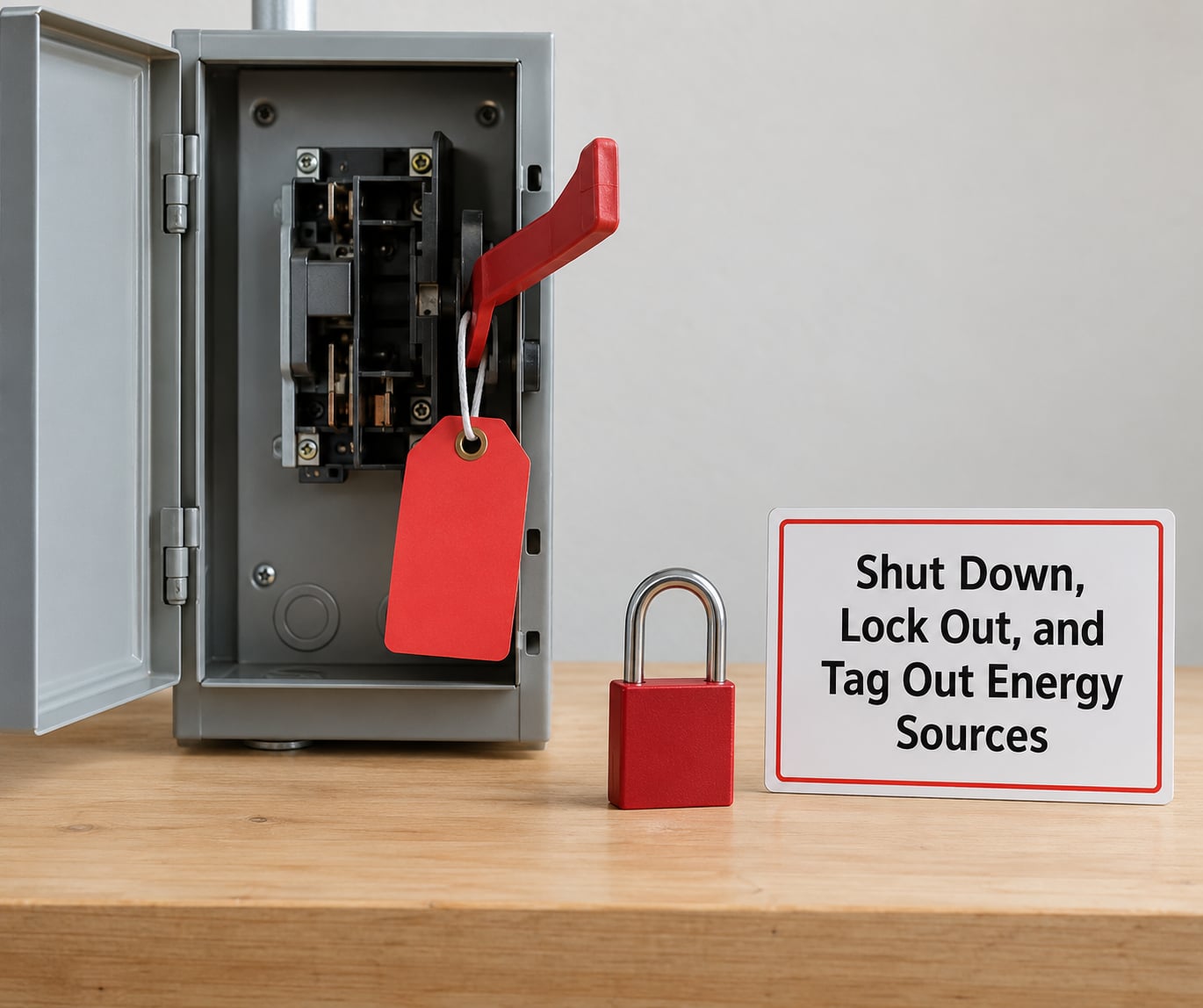
The lockout/tagout procedure your employer wrote is the control that makes everything else optional. It runs in order: shut the equipment down by its normal stopping procedure, isolate every electrical and stored-energy source, apply your personal lock and tag, release or restrain stored energy, then verify.
Every worker applies their own lock. That is the part that gets compromised — a supervisor holds the key to a group lockbox and someone skips their personal lock because the box is already on. A group lockbox supplements personal locks, it does not replace them.
Only authorized employees may perform or remove these controls, and each person removes their own lock when done. This is also where the recurring forum complaint shows up: LOTO gets treated as overkill on low-voltage DC and control circuits. Low voltage is not zero voltage, and control circuits frequently backfeed through interposing relays from a source nobody put on the isolation list.
Group lockout covers a crew working on one isolation point: each worker locks into the box and the authorized person keeps the key. It only works when the box is filled in and cleared out in front of everyone. A log of who is locked in is what tells the authorized person it is safe to re-energize, and skipping that log is how somebody ends up on the other side of a panel that was supposed to be dead.
Shift change needs the same rigor as lockout. The crew leaving explains what was isolated and what is still open; the crew arriving applies its own locks before touching anything. Verbal handoffs across a shift break are a routine source of the assumption that the isolation was removed when it was not.
4. Prove the Circuit Is Dead With a Test-and-Retest Method
A voltage reading you trust comes from a method, not a hope. The standard sequence is test before, test, retest after: check your tester on a known live source, test all conductors and the relevant circuit elements, then check the tester again on the same known source.
The retest catches the most common failure — a tester with a dead internal battery that reads zero on everything, which looks exactly like a safe circuit. If your instrument does not respond as expected at either known-source check, treat the circuit as energized and replace or service the instrument.
Use a rated instrument appropriate to the voltage, and for absence-of-voltage verification a meter with a self-check function or a non-contact voltage detector used as a secondary confirmation, not as the sole proof. When the expected result cannot be obtained, that is an escalation, not a retry with a different probe.
Test every conductor, not just the one you expect to be hot. In a cable with a neutral and two hots, checking one leg proves very little, and a multi-wire circuit with a shared neutral or a missed equipment grounding conductor will find you the phase you did not look at. Phase-to-phase, phase-to-neutral, and phase-to-ground all matter, because the fault path is whichever one the equipment presents.
Proving dead is only half the method. Re-energize and retest at the end of the job if the equipment must be returned to service, and finish with the conductors in a safe state behind barriers rather than exposed terminals for whoever works next.
5. Treat Exposed Live Parts as Energized
Labels, drawings, and the fact that the breaker was off yesterday do not establish absence of voltage. Electricians describe “assume it is live” as their core mental rule for good reason — labeling errors are common in both residential and commercial panels, and the cost of being wrong is measured in seconds.
Panel labeling is itself a safety control, not housekeeping. A directory that matches what is actually in the panel is what makes an isolation reliable; a directory that lists a circuit which was abandoned five years ago makes the whole panel suspect. When you find the two do not agree, treat it as a defect and get it corrected rather than working around it.
Set the voltage and clearing boundaries the risk assessment requires, keep unqualified people outside restricted areas, and treat any exposed live part as energized until the qualified person has established otherwise.
Energized work is permitted only by qualified persons under an approved energized work approach, with the right protective equipment, an arc-flash and shock risk assessment behind the decision, and the justification for why de-energizing was not possible. If nobody can articulate that justification, the correct answer is to shut it down.
Live-line work is a different discipline with its own qualifications, minimum approach distances, and weather limits, and it is not something a crew picks up on a commercial job. If the assignment involves working on energized lines or line-side equipment, that goes to someone trained for it, and the approach boundary table for the voltage involved governs everything before the task does.
The boundary rules are not negotiable by convenience. Standing closer because the panel is only 208 volts, because the drawing says 120, or because a peer is already inside doing the same thing are the exact arguments the standard exists to close.
6. Match PPE and Arc-Rated Clothing to the Risk

Electrical PPE does two different jobs that get confused constantly. Voltage-rated equipment, including dielectric gloves with leather protectors, protects against electric shock. Arc-rated clothing and face protection protect against the thermal blast and molten metal of an arc flash event. One rating does not substitute for the other.
- Eyes: safety glasses or goggles for impact and debris; a face shield or arc-flash hood where the assessment requires it
- Hands: voltage-rated gloves worn with leather protectors, class matched to the voltage; rubber insulating gloves need periodic dielectric testing
- Feet: insulating footwear with an established rating
- Head: hard hat, non-conductive type where required
- Body: arc-rated clothing at a minimum incident-energy value matched to the risk assessment
Ordinary work gloves are not arc-rated protection, and worn-out voltage-rated tools are worse than nothing because they look like protection. Ratings must match the hazard assessment and the manufacturer’s instructions — a common complaint from crews is cheap gloves with no arc rating at all.
Two details get missed in the rush. Metal jewelry, watches, and rings come off before any work near energized parts, because a ring bridges skin to skin across a contact point and conducts straight through the finger. And an arc flash risk is not predicted by voltage alone: a 480-volt system can produce incident energy well above what a worker’s existing clothing will survive, which is why the assessment drives the clothing class rather than the nameplate.
If your employer supplies PPE, check that it actually matches what the job needs before you rely on it. Electrician safety tips are only as good as the gear behind them, and mismatched or unrated equipment is a control that looks present on a checklist and does nothing in an event.
Water is the condition crews most consistently underrate. Damp conduit, a leaking roof, sweat on a forearm, and standing water on a slab all lower body resistance and raise the current a shock can deliver. Practitioners talk about this constantly in the field, and it is why the moisture check belongs in the pre-job assessment rather than in the moment somebody steps in a puddle.
Flammable material is the other one. Gasoline, solvents, aerosols, and some spray finishes near an energized panel turn a small fault into an ignition, so store and stage them away from the work zone before you open the enclosure, not after.
7. Inspect Hand Tools, Test Instruments, and Power Tools
A pre-use inspection takes about a minute. Look at the cord for cuts, crushed sections, or missing insulation; check the housing for cracks; confirm guards are present and intact; make sure plugs and connectors are not altered or missing pins; and note if the tool is wet or has been wet.
Then check the calibration date on anything that measures. An overdue-calibration meter is not a reliable absence-of-voltage device, no matter how confident the display looks.
Damaged equipment goes out of service immediately — tag it, take it out, get it repaired or replaced. Users report keeping frayed cords and cracked tools in service because replacement is slow and awkward, which is exactly why the tag-and-remove step has to be the non-negotiable part.
The quieter failures matter just as much. A two-prong adapter on a tool that needs a ground, tape wrapped around a nicked cord, a tool with a missing guard running anyway because the job is nearly done. Each one removes the protection that made the tool safe to pick up in the first place, and none of them look like a defect on a quick glance.
Test instruments need their own habits. Confirm the lead jacks are seated and undamaged, check the function or self-test before the job starts, and keep the batteries fresh even if the instrument is not due for calibration. A meter that fails on the known-source check has told you something important — listen to it.
Extra care applies to double-insulated tools (their protection depends on the housing being intact, so never remove the label or alter the plug), grounded tools (verify the ground pin and never use an adapter to defeat grounding), and cordless equipment (check the battery pack, contacts, and charger for swelling, heat, or impact damage). If you want a repeatable sequence for this, our Tool Safety Inspection Checklist: 8-Step Workplace Guide lays out the full pre-use routine.
8. Choose and Inspect the Right Ladder or Work Platform
Ladder accidents on job sites are rarely dramatic. They are a folded step on a wet floor, a rail not fully engaged, a base sitting on a cable ramp.
Check stable, level ground and a clean, dry base. Set the correct height so you work at belt level without standing on the top step or the top cap. Keep the rails fully extended and confirm the locking rails or rope are engaged. Maintain three points of contact the whole time you are climbing or working, and tether tools rather than carrying them up in a belt or bucket that swings.
Overhead clearance is the electrical part. Never assume a line is de-energized because it looks unused, and confirm the approach distance required for the voltage before bringing a ladder, boom, or conductive material near overhead conductors. The energization status of overhead lines has to be established by the utility or the owner, not inferred from the view.
Ladders are for access and light work. When the task needs both hands, a stable stance, and reach, that is a platform with a guardrail.
Non-conductive ladders earn their reputation in one place only: near overhead conductors. They do nothing for the far more common causes of ladder injuries, which are a wet surface, missing feet, and overreaching, so a fiberglass ladder does not replace the inspection habit. Treat a damaged fiberglass rail the same as any other defect: it fails without warning and without looking damaged in a way you would notice.
For residential and service work, extension cords get the same scrutiny as any other ladder. Keep them out of walkways and off stair treads, never run them under a mat or a door, and never chain them end to end to reach further than one is rated for.
9. Keep Conductors, Terminals, and Tools in a Clear Work Position
How you arrange conductors matters as much as whether they are de-energized. Exposed conductors left hanging become fall hazards and contact points for the next person who walks through. Guard terminals that remain live, route cable so it does not cross an aisle, and relieve strain so no conductor carries tension from a temporary connection.
A concrete example: if you need a temporary jumper to hold a control circuit in its current state, support the jumper at both ends so its weight is carried by the support and the enclosure, not by the conductor it lands on. Do not leave it hanging off a terminal screw with the tension pulling against the lug.
Forum users describe near-misses with exposed conductors discovered while organizing wires behind a panel — the ones that looked finished until somebody pushed a bundle aside. Take the extra minute to make the work position safe, not just the work safe.
Work position also decides how you handle the tools. Set them where you can see them and reach them without leaning across a live bus. A dropped needle-nose plier in the bottom of a live panel is the kind of thing that gets found later by someone who is not expecting it.
10. Communicate, Buddy-Check, and Stop Work When Conditions Change
Most incidents involve two people and a gap in what each one believed. A pre-work briefing sets the plan, a designated qualified person owns the decisions, and radios or agreed hand signals close the loop when the work area is out of sight or hearing.
The buddy check is simple: before starting, one person confirms the isolation, the boundaries, and the PPE of the other. Ten seconds, every time.
Stop work authority is real and it is expected in a functioning safety culture. When the drawing, the scope, the weather, the equipment state, or a piece of equipment condition changes, stop — isolate safely, reassess, correct the hazard, then continue. If the pressure is coming from a client or a foreman to move faster, that is a management problem to escalate, not a safety margin to spend on their behalf.
Crew habits stick when the training is practical rather than a slide deck. Safety Training That Employees Actually Remember covers why some programs change behavior and most do not.
Psychological safety is the part that decides whether any of this holds. The apprentice who asks what is feeding that panel, the journeyman who says the labeling is wrong, and the supervisor who backs them up in front of the crew are what keep a good procedure from becoming a written rule nobody follows.
Foreman role clarity helps more than another training module. When it is clear which decisions belong to the qualified person and which belong to the crew, arguments about a change of conditions resolve in a minute instead of becoming a standoff. Where that line is blurry, people guess, and guessing is what the rules were written to prevent.
11. Respond to an Electrical Contact or Arc Flash
If someone is shocked or in contact with energized equipment, do not touch them. They are conducting current to ground and you will join the circuit. De-energize first — throw the disconnect, pull the breaker, kill the supply — only from a position where doing so is safe for you.
Once the source is gone, call emergency services and give them the location, the type of incident, and whether anyone is still in contact with equipment. Provide first aid or CPR only within the level of training you actually hold.
For arc flash, treat burns as deeper than they look. Entry wounds and small surface blisters can hide extensive internal tissue damage, and smoke inhalation needs attention even when skin damage looks limited. Disrupted clothing, singed hair, or any breathing symptom means an immediate medical evaluation regardless of how the person feels.
Secondary injuries are common, so send someone to meet the responders, keep the area clear of onlookers, and preserve the equipment and PPE for investigation rather than discarding them.
Do the same for a fire started by an electrical fault. De-energize the supply if it can be done safely, then use an extinguisher rated for electrical fires only while you still have a clear path out. Nobody is obligated to fight a fire they cannot control, and a missing step in the process is how a call for help turns into two casualties.
After the emergency, the incident still has a job ahead of it: preserve the failed equipment, note the conditions and the sequence of events, and get everyone involved in the debrief. Arc flash investigations routinely find contributing factors that were invisible before the event — an incorrect label, an undersized breaker, a missing barrier, a procedure nobody had looked at in three years.
12. Report, Record, and Correct Near Misses
Report shocks, arc events, damaged equipment, unexpected conditions, and near misses promptly — and report them without informal blame. A near miss reported without consequences gets reported again. A near miss that turns into a search for someone to blame gets hidden, and hidden hazards are the ones that hurt somebody.
On the employer side, the response that matters is investigation of the system cause rather than the person: unlabeled panels, inadequate PPE availability, a procedure that assumes everyone reads it, a replacement process slow enough that people keep damaged tools. Preserve the evidence, update the risk assessment and the procedure, share what happened with the crews who work there, and verify the corrective action actually held.
Small employers can work through this in a structured way using our Safety Audit Checklist for a Small Business, which makes the review repeatable instead of annual and theoretical.
The 12 electrician safety tips in this list work as the agenda for that review. Run them against one recent job and one planned job, and the gaps show up fast: no isolation list for stored energy, no labels in the panel, a PPE supply that does not match the arc-flash assessment, no one on site who knows where the emergency shutoff is.
Frequently Asked Questions
What should you do if an electrician is shocked or is in contact with live electricity?
Do not touch the person — they may be carrying current to ground. De-energize the circuit first, from a position that is safe for you, using the disconnect or breaker. Then call emergency services, give them the location and the type of incident, and provide first aid or CPR only if you are trained. Any electrical contact, however brief, needs medical evaluation because internal and cardiac effects can appear hours later.
Is testing a voltage tester on a receptacle enough to prove the circuit is dead?
No. A tester that reads correctly on a receptacle only proves the receptacle is live and the instrument responded once. It does not prove the conductor you are about to touch is de-energized, and it will not reveal a tester with a failed battery or a dead internal fuse. Use the full test-before, test, test-after sequence: check on a known source, test all conductors and circuit elements, then re-verify the tester on the known source.
When is it acceptable to work on energized electrical equipment?
Only when the work is performed by a qualified person under an approved energized electrical work program, with a documented shock and arc-flash risk assessment, an energized work permit where required, and protective equipment matched to that assessment. The justification for not de-energizing has to be written down — for example, de-energizing would introduce additional hazards or interfere with a load that cannot be interrupted. If nobody can state that justification, shut the equipment down.
How often should electricians inspect their tools and protective equipment?
Tools and test instruments should be inspected before every use, and by the tool crib or employer on a defined schedule, with a documented record. Insulating gloves need periodic dielectric testing at the interval set by the manufacturer and your program, and arc-rated clothing needs inspection for damage, contamination, and a legible label or test date. Anything damaged, contaminated, or overdue comes out of service, gets tagged, and is repaired or replaced before it goes back in a bag.
What is the difference between voltage-rated gloves and arc-rated gloves?
Voltage-rated gloves with leather protectors are designed to prevent electric shock by limiting current through the body; their class must match the voltage you may encounter. Arc-rated gloves are designed to withstand the thermal effects of an arc flash for a stated incident-energy value. A voltage-rated glove with no arc rating offers no protection from an arc event, and an arc-rated glove without a voltage rating and dielectric testing cannot be relied on for shock protection.
Who is responsible for enforcing workplace electrical safety procedures?
The employer holds primary responsibility for the written energy-control and electrical safety program, for providing training, equipment, and properly rated PPE, and for enforcing it. A designated qualified person owns the technical decisions: the risk assessment, the approach boundaries, and the authorization for energized work. Every employee shares responsibility for following the procedure, inspecting equipment before use, and stopping work when a hazard control is missing.
Conclusion: Begin With the Job-Specific Energy Assessment
Before anyone changes a wire or opens an enclosure, the electrician safety tips above collapse into a short sequence: review the plan, establish the boundaries, control every energy source, verify absence of voltage with test and retest, and confirm the crew has the training, equipment, and authorization for the actual work rather than the job as it was described on Monday.
Stay current on 2026 codes and standards, and treat any of these steps that your site does not cover as a gap worth raising with your supervisor or employer.