
A working alone policy template is a ready-to-fill safety document that defines who works without close supervision, how that work is risk assessed, and what happens when a check-in goes unanswered. Copy the structure below, replace the bracketed placeholders with your own details, and you have a usable document in a couple of hours. Most employers need one the first time a staff member works a closing shift, a night clean or a solo site visit.
The risk in lone work is rarely the task itself. It is the gap between something going wrong and somebody finding out. An injured or unconscious worker cannot call for help, so if nobody is appointed to notice a missed check-in, no help arrives until someone happens to look.
No US federal rule bans working alone. The duty comes from the General Duty Clause in Section 5(a)(1) of the OSH Act, which requires a workplace free from recognized hazards that are likely to cause death or serious harm, and that applies to lone workers. UK and Australian employers work under different rules, including HSE guidance and regulation 48 of the model work health and safety regulations. Requirements vary by state and by country, so check the rules that apply where your workers actually are.
If your organisation does not yet have a broader safety framework to hang this on, start with how to write a workplace health and safety policy and treat the lone working document as one module inside it.
Table of Contents
- What You Need Before You Draft the Policy
- Step-by-Step: Build the Working Alone Policy Template
- 1. Define the scope and assign responsibility
- 2. Complete a working alone risk assessment template
- 3. Set controls based on the risk level
- 4. Write communication and check-in rules
- 5. Create emergency and incident procedures
- 6. Add training, records and review requirements
- Common mistakes and how to correct them
- Frequently Asked Questions
- What to do first
What You Need Before You Draft the Policy
You cannot fill in the template until you know the shape of the problem. Collect the following, ideally in a single page, and the drafting itself takes about two to three hours.
- Who works alone. List every role that spends part of a shift out of sight of a colleague: closing and opening retail staff, overnight cleaners, field technicians, drivers, security patrols, home visit workers, agricultural operators, plant room technicians and employees working from home.
- Where and when. Note the sites, the neighbourhood, the hours of solo cover and how long a person is out there on their own. Night and weekend cover usually carries a very different risk profile from a daytime shift in a busy building.
- Named people, not job titles. You need a policy owner, a designated contact who takes calls during the day, an out-of-hours escalation contact, and a first aider or first aid point. “Management” is not a name, and a rota that leaves the role blank on a Sunday is not a control.
- Communication method. Decide what the worker will use: charged mobile, two-way radio, personal alarm, landline, or a check-in app. Test coverage at the actual sites, not at the office, and write down which spots have no signal.
- Emergency information. For each site: full address including floor and unit, gate or keypad access, nearest hospital, emergency assembly point, who holds site keys, and the address a paramedic should be taken to.
- Which rules apply. Your state or country, your sector rules, and any client or insurance requirements. Care and home visit work often carries extra obligations beyond general safety law.
- History. Past incidents, near-misses, first aid incidents and any complaint about working alone. They show which situations your workers already think are risky.
- Worker input. Two or three lone workers who can tell you where the phone signal drops out and which tasks feel unsafe. Consultation is expected, and it makes the policy stick.
Step-by-Step: Build the Working Alone Policy Template
Work through the six sections below in order. Each one answers a question a supervisor, an auditor or an injured worker will eventually ask, and each one can be copied straight into your own document.
1. Define the scope and assign responsibility
Open the policy with a plain definition of who and what it covers, then name who is accountable. Vague scope is the single most common reason a lone working policy fails in practice: if two people are technically in the building but on different floors with no line of sight, that is still lone work.
Write a definition that covers three cases: working alone at a site with no other staff present, working alone in a workplace where help is not immediately available, and working alone away from the employer’s premises including home working and travel to a job. Say plainly that contractors, agency staff and volunteers are covered too, because the duty does not disappear because someone is not on your payroll.
Then assign three sets of duties. The policy owner maintains the document, keeps risk assessments current and runs the review. Supervisors confirm the check-in arrangements each shift, carry contact details for the designated contact, and act when a check-in is missed. Lone workers carry a charged device, check in on time, report hazards and stop work when conditions change. Add the line that any worker may stop a task they believe is unsafe without needing permission first.
2. Complete a working alone risk assessment template
A lone working risk assessment asks one question: where could this worker be without help, and what stops that becoming an emergency. Work through the eight factors below for each role and location, and record the result in a table with a named owner and a review date.
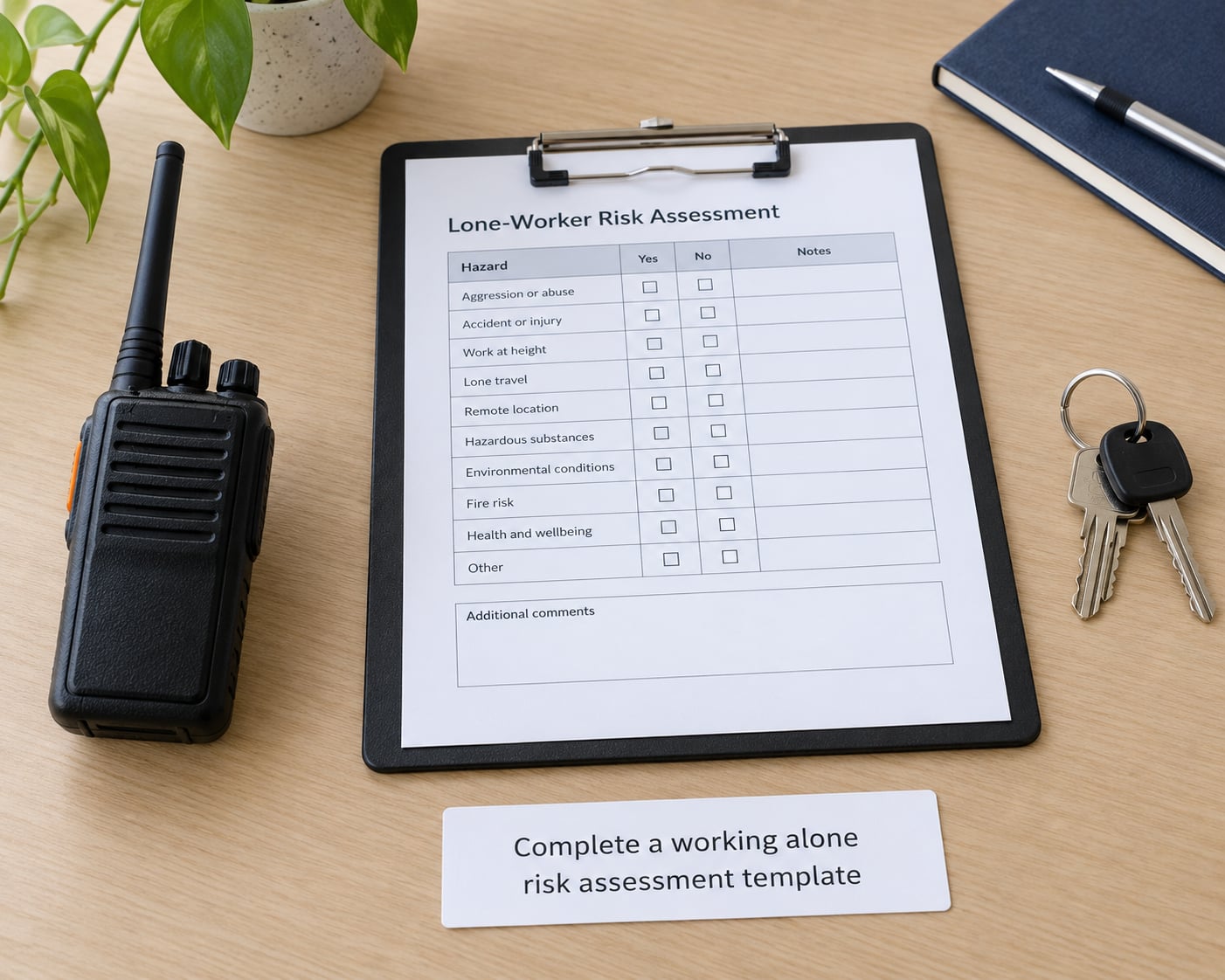
| Factor | What to ask | Controls that reduce the risk |
|---|---|---|
| Nature of the task | What can go wrong here that a second person would normally catch? | Written task procedure, pre-job brief, two-person rule for high-consequence steps |
| Location | How long until help can physically arrive? Does a responder know how to get in? | Site address card, access codes, gate instructions, nearest hospital noted |
| Time and duration | Is the worker solo at night, at a weekend, before dawn, or for long unbroken hours? | Restrict solo shifts, stagger starts and finishes, second person for the final hour |
| Communication | Is there signal at the site? Whose phone is charged and carried? | Coverage test, two-way radio, satellite messenger for dead zones, charged personal device |
| Public interaction | Who else is around, and could the encounter turn hostile? Is cash handled? | No-cash handling, safe collection routine, alarm button within reach of the counter |
| Equipment and workload | Does the job need two people, or need a fit and rested person? | Training and fit-for-duty checks, manual handling limits, rest breaks, no solo lone work above set weights |
| First aid and response | Who calls emergency services, and can they find the casualty? | First aid kit on site or carried, trained first aider on call, emergency contact card |
| Consultation and knowledge | Do lone workers know the risks, the check-in rules and who to call? | Consult workers directly, refresher training, handover notes, dynamic reassessment each shift |
A worked example: a field service technician calls at suburban homes during the day and one warehouse site after 6pm. The warehouse is a higher risk because there is no line of sight from the office, the lift is a confined space, and the technician finishes alone. The controls become a pre-job hazard check with the site contact, a scheduled 45 minute check-in at the office, a second person on site until the technician leaves, and a written address on the work order. The same technician at a residential address with a customer present is a lower risk and needs a lighter arrangement. Same person, same job, different rating.
3. Set controls based on the risk level
Match the control to the rating instead of applying one arrangement to everything. Group the work into low, moderate and higher risk, and give each group a defined set of controls.
- Low risk: daytime work in an occupied building, short duration, someone within a few minutes. Controls: a charged phone, a named contact, and a check-in at the end of the task. Written confirmation that the worker has left site.
- Moderate risk: regular public contact, cash handling, lone work after dark, isolated sites. Controls: a fixed check-in schedule with a timed escalation ladder, a personal alarm or two-way radio, a route and schedule shared with a designated person, and a rule that the worker does not carry cash.
- Higher risk: work at height, confined spaces, live electrical work, plant room or cold store isolation, agricultural machinery, environments where an injury could incapacitate the worker. Controls: a second trained person present or a documented alternative such as a monitored personal device with a response service, restricted hours, formal permit systems, and a documented emergency rescue plan. Where a task cannot be made safe to do solo, the policy should say the task is not done alone. That sentence does more work than any device.
Be honest about where technology sits. A tracker or alarm is near the bottom of the hierarchy of control because it does not remove the hazard, it only tells somebody about it after the fact. Eliminating solo work for a high-consequence task, or adding a second person, removes the exposure. A device is worth having, and for a small employer it may be the only realistic control, but it should never be the only line in the risk assessment.
If money is tight, the low-budget path still works: restrict who works alone, set the hours solo work happens, pair people for the riskiest part of the job, share the schedule and route with a named person who has a written rule to act on a missed check-in, and keep a stocked first aid kit with the worker. Done properly, that covers most of what a device would.
4. Write communication and check-in rules
Check-in rules only work if they say what happens in the minutes after nobody answers. This is the section most policies skip, and skipping it is why policies fail. Use six steps and fill in real times.
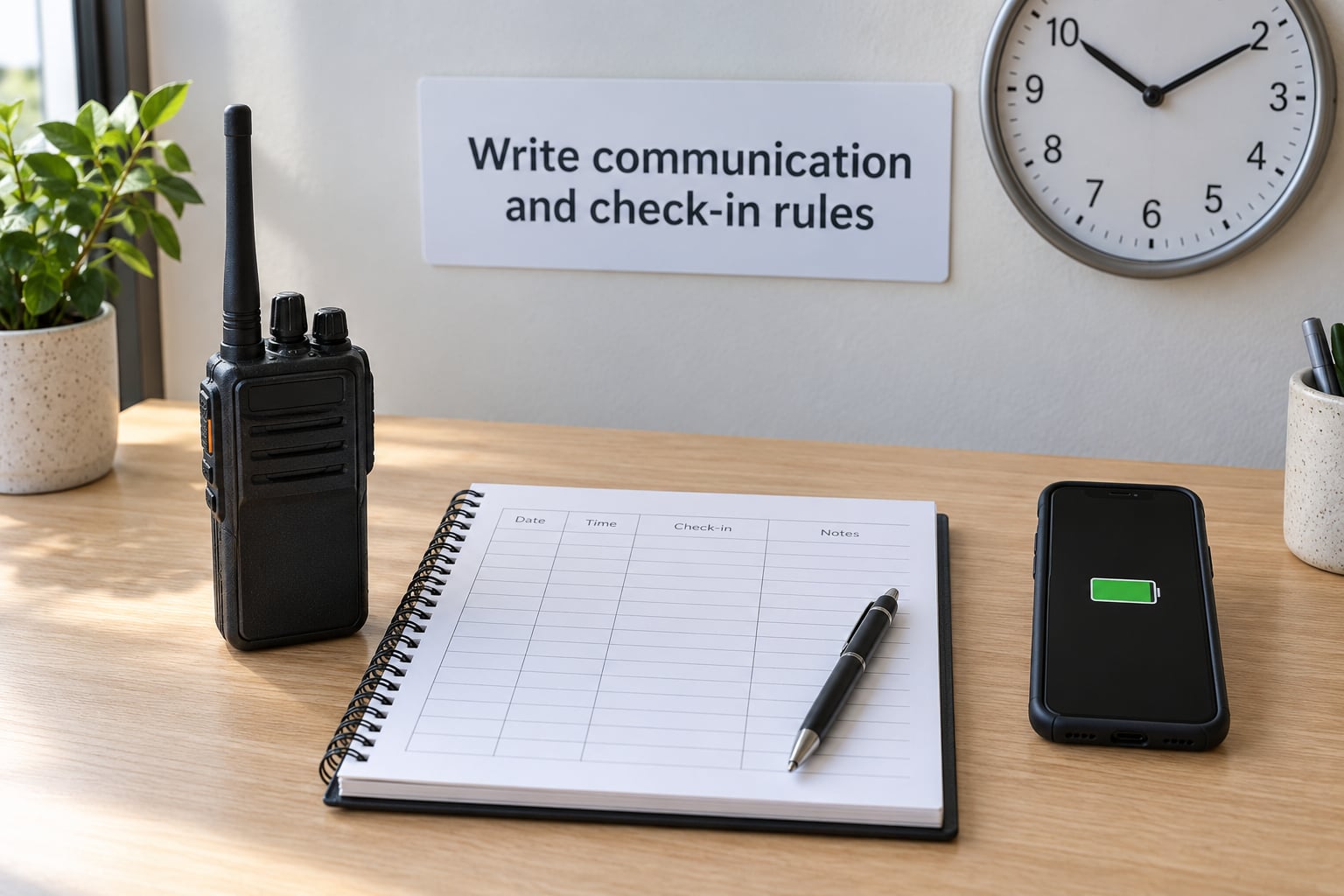
- Set the interval. Agree a check-in frequency based on the risk rating, for example every hour for moderate risk and every two hours for low risk, with one scheduled check-in at the end of every task.
- Agree the method. Name the exact action: reply to a call, send a coded text, press a check-in button, or speak a set phrase over radio. One method per role keeps it simple and auditable.
- Set the timeout. Write the number of minutes the designated contact waits before acting, for example ten minutes for a text and one missed call for a phone check-in. Put the real number in the policy, not “a reasonable period”.
- Define the escalation ladder. Step one is a second attempt by phone. Step two is contact by radio or text asking for a location. Step three is notifying the supervisor and the out-of-hours contact. Step four is calling emergency services with the site address and last known location. State the trigger time for each step.
- Name who does what. The designated contact is the person who runs the check-in schedule. State explicitly that if they cannot make contact, they move to the next step without seeking permission. An unappointed role is not a control.
- Cover the exceptions. What happens when a phone dies, a battery is flat, the worker enters a dead zone, or a customer refuses to let them leave. The answer is a fallback: a known safe point, a pre-agreed message to the office, or ending the task and reporting in.
Once the timings are settled, it helps to write them into the same communication plan format you use for wellness and staff programmes, so the designated contact, the backup and the escalation route are documented in one place rather than scattered across three files.
5. Create emergency and incident procedures
The emergency section should read as a sequence, because that is how it gets used. Write each stage and, just as importantly, the way it fails when nobody owns it.
| Stage | What it requires | Common failure |
|---|---|---|
| 1. Alarm raised or check-in missed | A reliable trigger, either a conscious worker activating an alarm or an automated missed check-in | Device muted, or the worker is incapacitated and cannot raise it at all |
| 2. Alert received | A named person watching the system during the working period | No one is appointed to watch, so the alert is logged and forgotten |
| 3. Worker located | Current site address, last known location, access instructions and key holder | Out-of-date address, so a response is sent to the wrong building |
| 4. Response dispatched | A written escalation list with phone numbers that are tested monthly | Numbers belong to people who left the business two years ago |
| 5. First aid and handover | Trained first aider on site or on call, stocked kit, clear incident record | Nobody knows who is first aid trained on a night shift |
Then cover the practical parts. Write the emergency services address for each site, the internal escalation list, the evacuation or shelter procedure for the specific hazard, the first aid arrangements, and the assembly point. For a medical event, say who calls, who meets the ambulance and who contacts the family. After any failed check-in, injury or near-miss, require an investigation that updates the risk assessment and the policy itself.
Test the chain rather than assuming it works. Run a drill once a term: choose a worker, trigger a check-in without warning, and see how long it takes to reach the site contact. Most organisations find a gap somewhere between step two and step three, and it costs an afternoon to find.
6. Add training, records and review requirements
A policy that has never been explained is a document, not a control. Close the template with the parts that keep it alive: who has been trained, what is signed, what is retained and what triggers a review.
- Training. Every lone worker needs the check-in rules, the escalation ladder, the location-specific emergency details, how to raise a duress alarm, and their stop-work rights. Supervisors need extra time on running a check-in schedule and acting on a missed one, because that is the part they will be doing at 9pm on a Sunday.
- Acknowledgment. Keep a signed record that each person has read the policy, been trained and understands the check-in arrangement for their role. This is the record an auditor asks for first.
- Records. Retain risk assessments, check-in logs, drill results, training records and incident reports. Three to five years is a common employer practice; check what your state or national rules and your insurer require, and write that period into the policy.
- Review triggers. Review the policy at least annually, and immediately after an incident, a near-miss, a change of site, a change of shift pattern, new equipment, a new worker role, or a change in the law. Put a review date on the document: [Date] 2026.
- Specific clauses. Add a home and remote working clause covering equipment provision, working hours agreed in writing and the right to disconnect from work arrangements. Add a fit-for-work clause allowing an individual assessment where a pre-existing condition, pregnancy or disability affects personal safety, handled confidentially and in line with disability and privacy rules.
- Consultation. Record when you consulted lone workers and what changed as a result. Six months after adoption, ask them whether the check-in times are realistic. Usually some are not, and you would rather hear it from them.
Absence and return-to-work rules touch the same population, since lone workers are often the first affected when someone is unwell. Our guide to designing a paid sick leave policy covers the notification side that sits alongside these check-ins.
Common mistakes and how to correct them
Most weak policies share the same handful of problems. Each of these is quick to fix once you can name it.
- A vague definition of lone work. “Solo work” is written without saying that out of sight counts, that home working counts, and that contractors count. Fix: use the three-case definition from step one and list the roles covered.
- Assuming a phone is enough. A mobile with no signal, a flat battery or a locked screen is not a control. Fix: test coverage at each site, name a backup method, and keep a charged device issued as equipment rather than a personal phone.
- A missed check-in that alarms nobody. The policy describes the alarm but never says who is watching for it. Fix: name the role, name the backup, state the timeout in minutes and the escalation steps, and run a drill.
- No supervisor training. Workers are trained, supervisors are not, and the check-in system quietly stops after a few weeks. Fix: a short supervisor module and a quarterly refresher, with the drill as the practical test.
- Missing emergency detail. The policy says call emergency services without giving the site address, access details or the first aid arrangement. Fix: attach a site information sheet to every assessment and update it whenever a site changes.
- One rule for every situation. A policy that treats a daytime retail shift and a solo roof inspection identically will be ignored by the people it protects. Fix: risk tier the work and give each tier its own controls.
- Home workers left out of scope. Employees working from home are the largest and least protected group of lone workers in many organisations. Fix: a specific clause covering hours, equipment, incident reporting and how a lone worker at home raises an urgent problem.
To implement: approve the policy with a named signatory, tailor every bracketed placeholder, train the affected groups, tell everyone it exists, run one drill, and set the review date. The first month is where these documents succeed or quietly fail, so schedule a thirty minute check with the lone workers themselves and fix what they report.
If your organisation runs a wellness or staff support programme alongside safety, a wellness program communication plan template is a useful model for naming owners and backup contacts, and the same habit transfers straight into the escalation ladder above.
Frequently Asked Questions
What is a working alone policy template?
A working alone policy template is a ready-made safety document that sets out who in your organisation works without close supervision, how that work is risk assessed, and what happens when a check-in is missed. A usable template covers scope and definitions, responsibilities, the risk assessment procedure, check-in and escalation rules, emergency arrangements, training, and records. The version below is jurisdiction-neutral, so swap the clause references for your own state or country before you sign it off.
Is a working alone policy required by OSHA?
No US federal rule specifically requires a written working alone policy, and no general rule bans working alone. The duty flows from the General Duty Clause, Section 5(a)(1) of the OSH Act, which requires a workplace free from recognised hazards likely to cause death or serious harm, and it applies when a worker is alone. That obligation is case-by-case and assessed through the hazard you actually face. Some states, sectors, insurers and clients set their own expectations, so check your local rules too.
What should a lone-worker policy include?
Include these sections: purpose and scope, a definition of lone working covering out-of-sight work, home working and contractors, named responsibilities for owners, supervisors and workers, the risk assessment procedure, controls matched to risk level, check-in and escalation rules with real times, emergency and incident procedures, training and acknowledgment, and records with review triggers. Add site-specific clauses for your sector. A policy missing any one of these tends to fail the first time somebody asks a supervisor what happens after a missed check-in.
How often should workers check in when working alone?
Set the interval from the risk rating, not from habit. Low risk daytime work in an occupied building may need a single check-in at the end of the task. Moderate risk work, such as public contact or cash handling, usually supports hourly check-ins. Higher risk work needs shorter intervals or a monitored device with a response service. Whatever you choose, write the timeout in minutes, name the person who watches for the check-in, and state the escalation step for every missed response.
How can an employer reduce risk for remote or field employees working alone?
For field workers, confirm mobile coverage at each site before the visit, share the route and schedule with a named contact, and use a personal alarm or two-way radio where the risk warrants it. For remote and home workers, agree working hours in writing, supply the equipment, keep a phone check-in on high-concern days, and publish an escalation route for urgent personal situations. In both cases, pair people for the riskiest part of the task and record the arrangement, since supervision and support cut risk more effectively than tracking alone.
What to do first
List every role that spends part of a shift out of sight of a colleague, then pick the highest risk one and write its risk assessment. That single document, with a check-in schedule, a named contact and a tested escalation list, is the whole job for most organisations. The rest of this working alone policy template can be filled in over the following fortnight, but do not wait for the finished document to start the conversation with the people who work alone. They know where it gets risky, and they will tell you if you ask.