
Noise induced hearing loss signs rarely arrive with drama. The first thing most people notice is that speech sounds muffled for a few hours after a loud shift, or that a high-pitched sound like a smoke alarm seems harder to catch. Others notice a ring in the ear that fades overnight.
The catch is that none of this is where the story usually starts. Early damage to the cochlear hair cells produces no symptoms at all. By the time tinnitus, muffled hearing or trouble following a conversation shows up, part of the loss has already settled in, and hair cells that die do not grow back.
This guide explains what to watch for, how to tell a temporary shift from a lasting one, and what a worker or employer can actually do about it. It is general information, not a diagnosis. If any of it sounds familiar, an audiologist or an occupational health clinic can measure your hearing properly in about an hour.
Reviewed for accuracy in 2026. Nothing here replaces advice from a clinician who knows your history.
Table of Contents
- What Are the Early Signs of Noise Induced Hearing Loss?
- Noise Induced Hearing Loss Signs: Temporary vs. Permanent Changes
- What Does Noise Induced Hearing Loss Usually Sound Like?
- Which Workplace Noise Exposures Should Raise Concern?
- How Can Employers and Workers Respond to These Signs?
- When Should Someone Seek Professional Evaluation?
- Frequently Asked Questions
- Can noise induced hearing loss signs go away after a loud workday?
- Does tinnitus after workplace noise exposure always mean permanent hearing damage?
- What should an employee do if coworkers seem to hear normally but they do not?
- Can hearing protection prevent noise-induced hearing loss?
- Are hearing loss symptoms different after one loud event than after long-term exposure?
- When should an employer refer a worker for a hearing evaluation?
What Are the Early Signs of Noise Induced Hearing Loss?
The most commonly reported signs of noise-induced hearing loss are ringing in the ears, muffled or distorted speech, difficulty catching high-pitched sounds, and trouble understanding speech once a room gets noisy. Most of them are behavioural rather than medical, which is exactly why people miss them for years.
- Ringing, buzzing or hissing in one or both ears after a shift
- Speech sounds muffled or underwater for hours after work
- High-pitched sounds like birds or alarms seem harder to catch
- You ask people to repeat themselves mid-sentence
- A conversation is easy alone but impossible in a noisy room
- The TV or radio goes louder than it used to
- Phone calls are harder on one ear than the other
- A plugged or full feeling in the ear after exposure
- Ordinary sounds start feeling harsh rather than loud
- You need to shout for someone a foot away to hear you
- A normal day of talking leaves you more tired than it should
Noise-induced hearing loss usually settles in symmetrically across both ears when the exposure is steady and day after day. One-sided changes after a single very loud event, a blast or an earplug problem are a different story and deserve their own appointment.
Workers who post on workplace health forums describe tinnitus appearing within weeks of starting a new noisy job, then gradually fading once they left the environment. That pattern matters, because it is the opposite of the idea that hearing damage announces itself loudly and obviously.
Why the signs show up at work before they show up at home
A quiet kitchen at home is a forgiving environment. You hear the fridge, you hear your partner, and nothing is competing. A warehouse, a plant floor or a restaurant dining room is a completely different test, and that is why the same person can pass a phone conversation and fail a safety briefing.
If your workplace has open-plan seating, headset calls all day or a break room with a television on permanently, it is worth reading office worker health risks explained alongside this one. Noise exposure in offices is usually quieter but far longer.
Noise Induced Hearing Loss Signs: Temporary vs. Permanent Changes
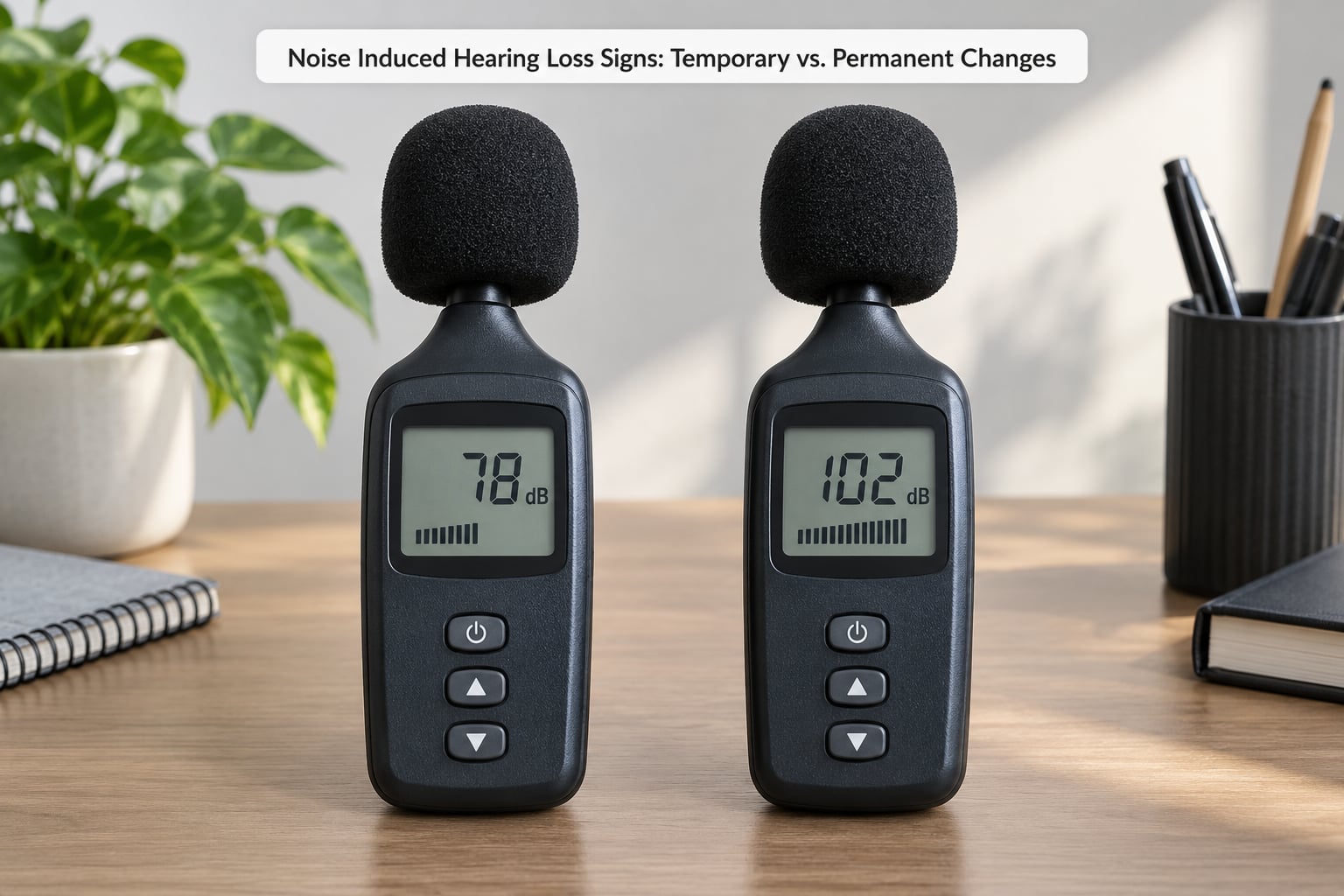
Temporary changes come back. After a loud evening, everything sounds dull and a bit underwater, and by the next morning most of it has cleared. Permanent changes do not. The word to hold onto is threshold shift: how much quieter a sound has to be before you can detect it.
A temporary threshold shift is that dull, plugged feeling, and it typically fades over hours to a couple of days. A permanent threshold shift does not fade. Repeated temporary shifts are still a reason to pay attention, because each recovery is not guaranteed to be complete.
What happens in the first 24 to 72 hours
Immediately after a loud event, many people report reduced hearing, a sense of fullness and ringing that seems louder in a quiet room than in the noise itself. As the day goes on, hearing often improves and the ringing fades.
If two or three days pass and the ringing or the dullness is still there, that is a signal to stop waiting it out and get tested. Sudden hearing loss that comes on within hours or days should be treated as urgent, because the window for recovery is short.
| When it shows up | What people notice | What it usually means |
|---|---|---|
| During or right after a loud event | Reduced hearing, plugged ears, immediate ringing | Trauma plus a temporary threshold shift; worth testing if it does not clear |
| First 24 to 72 hours | Dull hearing, ringing louder in silence, fatigue | Recovery is usually happening here; persistent symptoms need an audiogram |
| First weeks in a new noisy job | Ringing most evenings, TV turned up, avoiding the phone | Accumulating exposure; a baseline test is worth having now |
| After years of exposure | Missed words in meetings, one-sided phone calls, social withdrawal | Likely permanent sensorineural change; manage exposure and assess hearing |
What Does Noise Induced Hearing Loss Usually Sound Like?
It is not usually a drop in volume across everything. Loud sound does its most consistent damage at the frequency where the ear canal and eardrum naturally amplify sound, which is why an audiogram often shows a dip at about 4,000 Hz while the rest of the chart still looks acceptable.
In plain terms, that is the range that carries the small, sharp consonants. S, t, f and the “ee” sound in words like people or see become the first things to go. Voices start sounding garbled rather than quiet, which is why people often describe it as people mumbling.
Three more everyday experiences show up regularly. In a restaurant with a fan overhead, you can see the speaker’s mouth moving and still lose the sentence. On the phone, you turn the affected ear toward the handset and miss the rest. And after a full day of listening, you feel hollow, because effort replaces clarity.
Some people notice that ordinary sounds have become unpleasantly sharp, a condition called hyperacusis. Others describe a hearing test that came back normal while real conversations in noise still fall apart, sometimes called hidden hearing loss. Both are worth raising with a clinician rather than explaining away.
Which Workplace Noise Exposures Should Raise Concern?
Most workplace standards use 85 decibels A-weighted, averaged over an eight-hour shift, as the point where exposure becomes regulated. Noise is measured on a logarithmic scale, so a few extra decibels are a lot more sound and considerably more exposure.
| Noise source | Typical range | Where it happens | Pattern that deserves a closer look |
|---|---|---|---|
| Hammer drilling, jackhammers, demolition | 90-110 dBA | Construction and road work | Full-shift exposure several days a week |
| Presses, grinders, stamping lines | 85-105 dBA | Manufacturing and fabrication | Ringing that lasts into the evening |
| Screens, crushers, conveyor equipment | 90-110 dBA | Mining and quarrying | Years of exposure with no baseline test |
| Engines, augers, grain handling | 85-100 dBA | Farming and fieldwork | Seasonal bursts followed by long quiet periods |
| Locomotives, baggage equipment, tugs | 80-100 dBA | Rail and airport ground crews | Intermittent peaks that add up over a shift |
| Stage monitoring, club systems | 100-140 dBA peaks | Musicians, DJs, nightlife staff | Short sessions with very high peaks |
| Motorcycles, chainsaws, angle grinders | 85-115 dBA | Leisure and personal projects | No hearing protection at all |
| Firearm discharge | 140-165 dBA peaks | Range work, hunting, service | A single exposure per shot |
Levels are approximate and vary by machine, distance and enclosure. What matters is the pattern: high levels that repeat across the shift, and short bursts that are far louder than the daily average.
The CDC has reported that close to one in four US adults aged 20 to 69 shows signs of possible hearing loss from noise in one or both ears, so this is not a niche occupational issue. It sits quietly behind the same symptomless early stage described above.
How Can Employers and Workers Respond to These Signs?
If someone on the team reports ringing ears or trouble following speech after a shift, the useful response is practical and quick rather than reassuring.
- Report it. Say what was noticed and when, in the same week it happened. Small, dated reports build a pattern that is far easier to act on.
- Measure the noise. Ask for a sound level survey or dosimetry for the area, task and shift, not just a single spot reading.
- Reduce the exposure first. Maintenance on bearings and fans, quieter equipment, isolating enclosures, moving break rooms away from production areas, and scheduling noisy tasks away from the quietest part of the shift all beat relying on earplugs alone.
- Use properly fitted hearing protection. That means training, correct selection for the measured level, and fit testing with plugs or earmuffs, which are not interchangeable.
- Arrange a hearing conservation programme. In the US, OSHA’s occupational noise standard covers workers exposed at or above 85 dBA TWA and requires monitoring, audiometric testing, training and hearing protection.
- Get a baseline audiogram. A test taken before the exposure continues makes later change measurable, and it is far more useful than a test taken years into the problem.
For a fuller look at the engineering and administrative side, read how to prevent hearing loss from workplace noise. Managers often see the first signals as a performance or conduct issue rather than a health one, which is where burnout signs in employees managers should watch for overlaps: persistent exhaustion, withdrawal from conversations and difficulty concentrating are shared signals.
When Should Someone Seek Professional Evaluation?
An audiologist can measure the exact threshold at each frequency, and that measurement is the only reliable way to know whether hearing has actually changed. Book an evaluation when any of these are true.
- Ringing in either ear lasts more than a few days after a loud event
- Symptoms have appeared after weeks or months of repeated exposure
- You are missing parts of conversations at work or at home
- Hearing dropped suddenly, or dropped in only one ear
- Sound has become painfully sharp or unbearable in normal settings
- A baseline test has never been done and exposure is ongoing
Sudden hearing loss is the exception that deserves same-day contact with a clinician rather than a routine appointment. It is usually treated as urgent, and delay can matter.
Nothing on this page identifies whether your hearing has changed. Only a test can do that, and the earlier it happens the more useful the result.
Frequently Asked Questions
Can noise induced hearing loss signs go away after a loud workday?
Often, yes. Reduced hearing and a plugged feeling after one loud day usually ease within hours or a couple of days as the ear recovers. That recovery is called a temporary threshold shift. The part worth watching is the pattern: if the same dull hearing and ringing are still there after a few days of quiet, or if they keep returning every work week, that points to lasting change rather than a normal rebound.
Does tinnitus after workplace noise exposure always mean permanent hearing damage?
No. Tinnitus is extremely common after loud exposure and usually fades with rest and time away from noise. It is still worth taking seriously, because noise-related tinnitus that lingers tends to arrive alongside measurable hearing change at the frequencies where damage happens first. Anyone whose ringing persists beyond a few days, or returns on every noisy shift, should have an audiogram rather than guessing.
What should an employee do if coworkers seem to hear normally but they do not?
Start with a hearing test, then take the result to your supervisor or occupational health contact. Speak-listening problems in noise are a documented pattern that can appear before anyone, including family, notices anything. Bring a short written note of when it started and which tasks are hardest, and ask whether a noise survey has been done for your area.
Can hearing protection prevent noise-induced hearing loss?
It can cut exposure substantially, which is why it is a core part of every hearing conservation programme. Protection works best when it is the right type for the measured noise level, fitted correctly and worn consistently. On its own it is weaker than removing the noise at the source, so treat engineering and administrative controls, such as quieter equipment and maintenance, as the first line of defence.
Are hearing loss symptoms different after one loud event than after long-term exposure?
Yes, the timeline and pattern differ. A single very loud event causes immediate symptoms: reduced hearing, fullness and ringing within hours or days, sometimes with a sudden drop in one ear. Long-term exposure tends to produce no immediate symptoms at all. Instead, people report years of exposure followed by a gradual realization that conversations are unclear and the television is louder than it used to be.
When should an employer refer a worker for a hearing evaluation?
Refer when the worker reports symptoms that follow repeated exposure, when tinnitus persists past a few days, or when a noise survey shows levels at or above the action level used by the applicable standard. Employers running a hearing conservation programme in the US are expected to cover audiometric testing for covered workers. Sending someone before symptoms become obvious is the point of the programme, not an admission of failure.
The most useful single step is a hearing test, because noise induced hearing loss signs only tell you that something happened, while an audiogram tells you how much changed and where. Get one before the exposure continues, keep a copy of the result, and use it as your baseline for every check that follows.