

Lead exposure prevention for construction workers is straightforward in principle: find the lead before anyone disturbs it, knock the dust down at the source, keep contaminated dust off skin and out of homes, and check workers’ blood to confirm the controls worked. Most lead injuries happen on renovation, demolition, abatement and maintenance jobs where paint chips, solder, dust and soil are disturbed in buildings that were finished before 1978.
The federal construction standard, 29 CFR 1926.62, sets the enforceable numbers: an airborne permissible exposure limit of 50 micrograms per cubic metre as an 8-hour time-weighted average, and an action level of 30 micrograms per cubic metre. Because lead leaves the body slowly and stores in bone, control work has to be verified, not assumed.
Table of Contents
- What You Need
- Step-by-Step: Lead Exposure Prevention for Construction Workers
- 1. Identify Lead Hazards Before Work Starts
- 2. Assess and Document Exposure Risks
- 3. Control the Hazard at the Source
- 4. Train Workers and Supervisors
- 5. Use the Correct PPE and Work Practices
- 6. Prevent Contamination Away from the Work Zone
- 7. Verify Lead Exposure Prevention With Monitoring and Records
- 8. Respond to Suspected Exposure or Contamination
- Common Mistakes
- Frequently Asked Questions
- Conclusion
What You Need
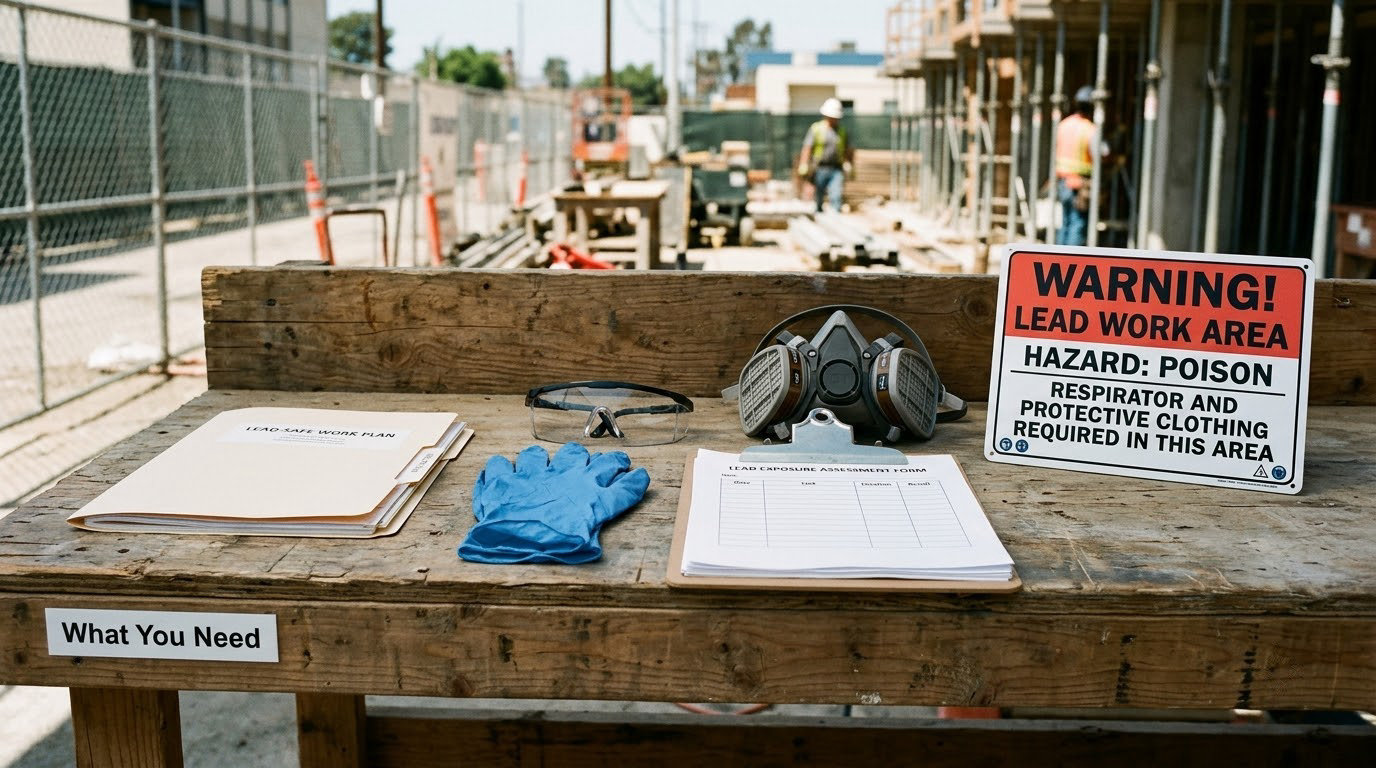
Before the first tool touches a wall, an employer should be able to put five things on the table. The first is the regulatory reference, which is 29 CFR 1926.62 for construction and 29 CFR 1910.1025 for general industry work, plus any stricter state-plan rule that applies to the job. California, and several other state-plan states, run lead rules that are more protective than the federal standard, and getting that distinction wrong has real consequences.
The second item is a written exposure assessment for the specific task, not a generic company template. A renovation that sands drywall in a 1970s classroom and a plumber replacing a soldered joint in a mechanical room do not produce the same dust, and treating them identically is one of the most common site errors.
Third, you need a task plan and a worker protection plan covering methods, sequencing, restricted access and decontamination. Fourth, the protective equipment itself: an approved respirator where controls do not hold exposure below the permissible exposure limit, protective clothing, gloves, eye and face protection, and laundering or disposable coveralls handled by the employer. Fifth, the support pieces that make controls work, which include a HEPA vacuum, wet-cleaning supplies, a change room or clean/dirty separation, washing facilities with soap and warm water, and blood lead level testing through a medical surveillance programme.
A competent person drives the whole thing. That is usually a safety officer with exposure assessment training or an industrial hygienist qualified to take personal air samples and interpret them, and the employer should know which of those two they have on hand before the job starts.
Step-by-Step: Lead Exposure Prevention for Construction Workers
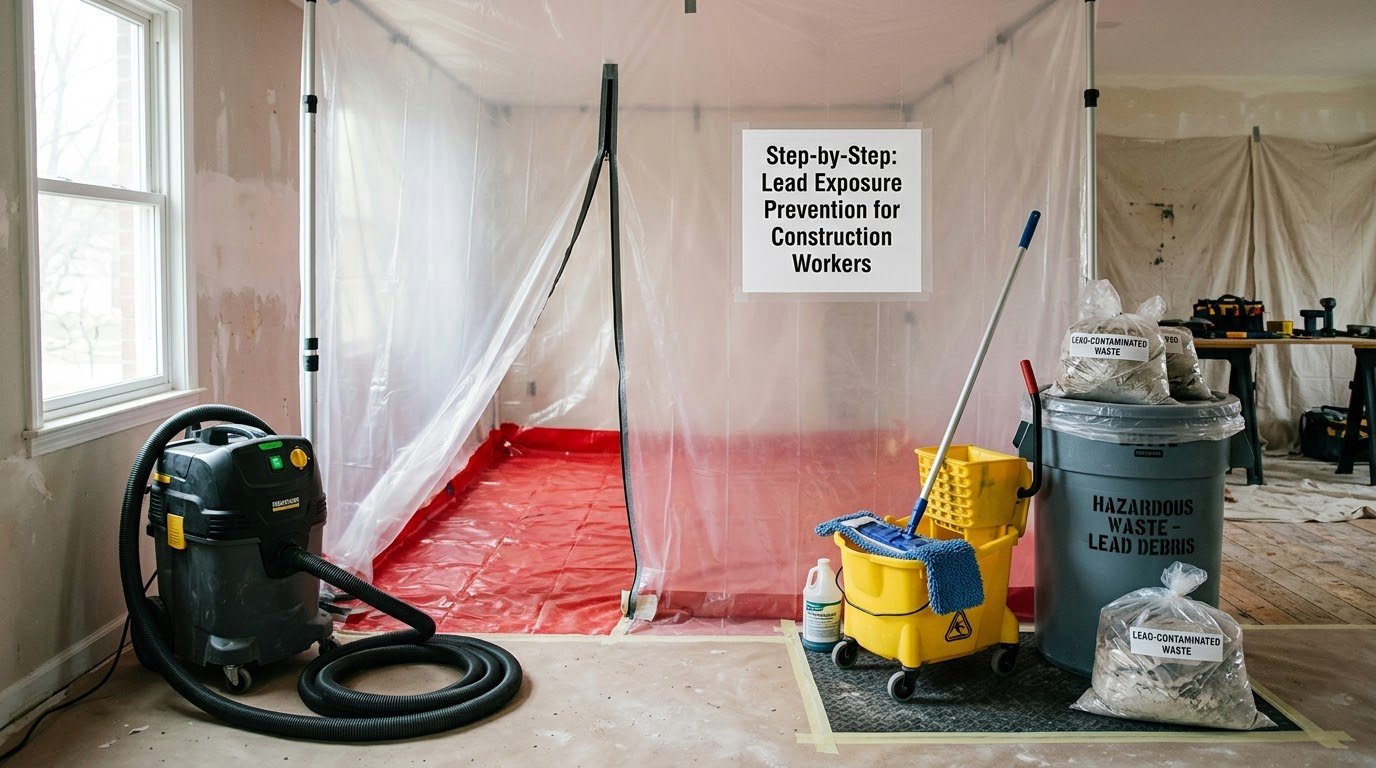
Prevention works in layers, and the layers are ordered. Elimination first, then substitution, then engineering controls, then work practice controls, and personal protective equipment at the bottom. Skipping to the bottom tier is the reason so many sites rely on a dust mask and call it a plan.
1. Identify Lead Hazards Before Work Starts
Lead shows up on construction sites in predictable places. The big one is lead-based paint on any building finished before 1978, disturbed during window replacement, demolition, structural renovation, sanding, sawing, scraping, or interior repainting that includes prep work. Beyond paint, lead turns up in plumbing solder and fittings, in bridge and highway maintenance with old lead-based traffic coatings, in shooting range and firing range work, in soil disturbance and excavation on older properties, in welding and torch cutting on coated or painted steel, and in emergency and post-disaster debris removal where paint chips, dust and soil all mix together.
Finding it takes three passes: review the building’s age, plans and any previous assessment; check the work scope and materials actually on site; and confirm the task-specific hazards with the crew doing the work. Renovations in child-occupied facilities, such as schools and daycares, carry extra obligations under the federal RRP rule, administered by EPA, so a residential habit is not enough there.
2. Assess and Document Exposure Risks
Have a qualified safety or industrial hygiene professional evaluate the job. Personal air sampling on the worker, area sampling, surface wipe sampling and bulk paint chip sampling all answer different questions, and the right one depends on whether dust, fume or soil is the concern. Credible measurements beat assumptions, and the results belong in a written record that the employer can produce later.
OSHA’s lead standard for construction requires an initial assessment to determine whether each employee may be exposed at or above the action level of 30 micrograms per cubic metre as an 8-hour TWA. Repeat assessment is required whenever conditions change, new information suggests exposure is higher, or a worker shows signs of lead poisoning. Documenting the decision matters as much as making it, because the record is what proves the employer checked.
3. Control the Hazard at the Source
The highest-value controls happen before anyone opens a work area. Contain the work with taped plastic and rigid sheeting, and keep the containment under negative pressure where the task generates dust. Use local exhaust ventilation at the source, such as a shrouded grinder fitted with a HEPA vacuum, instead of relying on a room fan that spreads dust around the building.
Then work wet. Wet methods suppress dust during demolition, cutting and sanding, and are required where dry methods would raise airborne lead. Use a HEPA vacuum, never a household or shop vacuum, for cleanup and for dust-loaded surfaces. Keep debris and scrap in closed, labelled containers, remove waste as it accumulates, and restrict access to the area. Only after these are in place does a respirator become part of the answer rather than the whole answer.
4. Train Workers and Supervisors
Lead exposure prevention for construction workers only works if the people doing the work understand what the controls are and why they exist. Training covers hazard communication and signage, the task procedure and its sequence, respirator selection, use, fit and limitations, the limits of gloves and coveralls, hygiene and laundering rules, and emergency procedures.
Supervisors need their own version, because they are the ones who notice a mask worn under a beard, a coverall unzipped at the waist, or a worker eating on the deck. Ask each worker to describe back the control they rely on for their task; if they cannot, retrain that person. Documentation of who was trained, on what date, in which language, is part of the record the employer has to keep. New crew members coming on mid-project need the same briefing as everyone else, not a quick walk-behind.
5. Use the Correct PPE and Work Practices
Personal protective equipment in a lead job has to be employer-provided, selected by someone who understands the exposure, and used inside a written respiratory protection programme meeting 29 CFR 1910.134. That programme includes a medical evaluation before fit testing, an annual or event-triggered fit test, training on donning and doffing, a cartridge change schedule, and a storage and maintenance plan.
Beyond the respirator, the standard requires protective clothing such as coveralls, gloves, and eye or face protection where splashes or dust are possible. Disposable footwear or overshoe covers keep dust out of boots and out of vehicles. Anything that gets contaminated is laundered or disposed of by the employer, and workers should never be asked to wash it at home. Outdoor renovation crews in winter face a second problem, since cold weather PPE that fits properly over winter layers often no longer passes a fit test when the weather turns, and our guide to cold stress prevention for outdoor workers covers that side of it.
6. Prevent Contamination Away from the Work Zone
Take-home exposure is the route that reaches the workers’ families, and it is the single behaviour change with the largest effect. Contaminated dust rides out on work boots, under fingernails, in vehicle seats, in tool bags and in lunch boxes. Research and field studies keep finding the same pattern, and a community-based study out of the public health literature focused on exactly this problem found a short, practical training session changed what workers took home.
Split the site into clean and dirty zones, with a change room and a defined path between them. Provide washing facilities with soap and warm water, plus a place to store clothing that keeps contaminated workwear separate from street clothes. Ban eating, drinking, smoking, cosmetics and contact lens handling in contaminated areas. Bag and seal debris before it moves, and clean or HEPA-vacuum vehicles before they carry anyone else.
One caution worth knowing: cleaning alone does not always lower blood lead. In Rochester, New York, cleaning interventions cut surface lead levels by 30 to 60 percent without a matching drop in blood lead levels. Dust removal is necessary, and on its own it is not the same as protection.
7. Verify Lead Exposure Prevention With Monitoring and Records
Controls decay. Filters clog, plastic gets cut, signs get covered, and a job that started careful drifts by the third week. Put air, surface and biological monitoring on a schedule rather than reacting to a complaint. Personal air sampling tells you whether the respirator and containment are holding, surface sampling tells you whether cleanup is complete, and blood lead level testing tells you whether the worker is actually protected.
Inspect enclosures, respirator cartridges, HEPA filters, housekeeping and signage on a documented schedule, and record the corrective actions that closed each gap. The paperwork is not admin overhead here; exposure assessment records, monitoring results, medical surveillance records, training records and inspection logs are the evidence an employer stands on.
8. Respond to Suspected Exposure or Contamination
When something goes wrong, work through a fixed sequence instead of improvising. Stop the task and end exposure. Move affected workers to fresh air and out of the contaminated area. Provide washing and decontamination, and change contaminated clothing. Get the person to a healthcare provider for evaluation rather than deciding on site that they are fine, since early symptoms are easily missed.
Report the incident internally, investigate the cause, and check whether anyone else shared the exposure. Then clean the contamination properly: wet methods and HEPA vacuuming, not sweeping or a shop vac, with the same PPE used for the original task. If workers carried lead home, treat that as an exposure event in its own right, notify the employer, and get clothing handled according to the decontamination plan rather than washed at home. Workplace incidents that are not chemical still follow a familiar reporting and evaluation routine, which our piece on what to do after a bloodborne pathogen exposure sets out in detail.
Common Mistakes
Skipping the exposure assessment. The fix: have a competent person evaluate the task before work starts, and document the result. Guessing is not an assessment, and a job scoped as a small patch repair in a pre-1978 building is still an assessment question.
Handing out a dust mask and calling it respiratory protection. The fix: run a written programme under 29 CFR 1910.134 with medical evaluation, fit testing and cartridge schedules, and select the respirator for the measured exposure.
Using a household or shop vacuum for cleanup. The fix: HEPA-filtered vacuum equipment rated for lead dust, and wet methods for surfaces that cannot be vacuumed.
Letting contaminated clothing go home. The fix: employer-provided laundry or disposal, a change room, and a clean/dirty split with a washing facility on site.
Skipping the wash before eating or leaving the site. The fix: scheduled decontamination time built into the shift, not something workers remember to do, with soap and warm water available.
Forgetting to document the follow-up. The fix: retain assessment records, sampling results, training sign-offs, inspection findings and corrective actions in one place. An undocumented control is hard to defend and easy to lose.
New workers tend to absorb these habits quickly when the basics are written down for them, and our warehouse safety tips for new workers makes the same argument about onboarding checklists on a different site.
Frequently Asked Questions
Is a dust mask enough for lead exposure on a construction site?
No. A disposable dust mask filters particles but does not seal to the face, is not fit tested, and provides no protection by itself. When exposure cannot be kept below the permissible exposure limit with engineering and work practice controls, employers must supply an approved respirator under a written programme meeting 29 CFR 1910.134, including medical evaluation, fit testing, training and a cartridge change schedule.
Who needs medical surveillance and blood lead level testing?
Under the federal lead standard, medical surveillance and blood lead level testing apply to employees exposed at or above the action level of 30 micrograms per cubic metre as an 8-hour TWA, and to any employee who shows signs or symptoms of lead poisoning, such as abdominal pain, fatigue, or anaemia. Testing is arranged by the employer and results go to the employee’s physician. A positive result triggers specific protections, including medical removal protection at higher levels.
Can I take contaminated work clothes home to wash?
No. Washing lead-contaminated clothing at home spreads lead dust into the washer, the drying machine, the home and to family members. The OSHA lead standard requires employers to provide laundry or disposal service, and where laundering is used, the garments must be bagged and labelled, handled by the employer, and washed in a facility that prevents dust release. Report contaminated clothing to your supervisor rather than taking it home.
What should an employer do after a suspected lead exposure?
End the exposure first: stop the task, move the worker to fresh air, provide washing and change contaminated clothing, and get the worker evaluated by a healthcare provider. Then report the incident, investigate the cause, and check whether other workers shared the exposure. Clean the area with wet methods and HEPA-filtered equipment, and confirm that no contaminated clothing or debris was carried off site. Keep the paperwork, because exposure records are required.
Is there a safe level of lead exposure?
There is no known safe level. Lead is a neurotoxin with no established threshold below which risk disappears, which is why the standard sets a permissible exposure limit and a lower action level rather than a harmless dose. Effects build up over time, lead stores in bone and can re-enter the bloodstream decades later, and there is no at-home remedy or detox that reverses it. Prevention through controls and monitoring is the approach that works.
Conclusion
If you take one thing from this, make it the first one: get a task-specific lead hazard assessment done before the work starts, and let the result drive the controls rather than the other way around. Contain the work, use wet methods and a HEPA vacuum, keep contaminated dust off workers and out of their homes, and verify with air sampling and blood lead level testing that the plan is holding.
Lead exposure prevention for construction workers is not one piece of equipment. It is an assessment, a control plan, trained work practices, hygiene that is built into the shift, and records that prove it all happened. Start with the assessment; almost everything else follows from it.