
A safety climate survey is a confidential questionnaire that measures how employees perceive the organisation’s commitment to safety: leadership behaviour, hazard and near-miss reporting, worker participation, training and emergency readiness. It reads the conditions behind safety rather than counting injuries after the fact, which is why the wording of the questions matters so much. The 24 items below are grouped into the four dimensions most surveys use, ready to paste into a survey tool or an LMS module.
Updated for 2026. If you want the wider cultural groundwork first, how to build a safety culture at work covers the behaviours that the questions here are designed to detect.
Table of Contents
What Is a Safety Climate Survey?
A safety climate survey is a measurement of shared perceptions about safety, not a count of injuries. Respondents rate statements on a fixed scale, and the average of each group of statements gives you a picture of where the organisation is strong and where it is not.
Four terms get mixed up constantly, and keeping them apart makes the results easier to act on:
- Safety climate — what people perceive right now, at this site, with this management team.
- Safety culture — the deeper values, assumptions and unwritten rules that produce that climate. Culture moves slowly; climate can shift within a year.
- Safety performance — the outcomes: recordable incident rates, near-miss volumes, audit findings, days without lost time.
- Psychological safety — the willingness to speak up or ask a question without managing the social cost of doing so. It overlaps with employee voice below, but it is not a safety question on its own.
The reason to measure climate separately is timing. Injury statistics are lagging indicators: they record failure after someone has been hurt, and they move slowly enough that a good quarter can hide a bad one. Climate items are leading indicators — they tell you whether people are reporting hazards, trusting supervisors and stopping unsafe work before the record shows it.
Run a survey when you need a baseline, before an audit or a certification milestone, after a serious incident or a leadership change, and annually as a benchmark. A short pulse between full runs keeps you current without burning out your response pool. Writing a workplace health and safety policy gives you the document side of the same conversation, and it is worth having both in the same cycle.
Safety Climate Survey Questions: What to Measure

Most working safety climate survey question sets cluster into four dimensions: leadership commitment, employee voice, hazard recognition and prevention, and training and participation. Grouping matters more than length, because you can only build a corrective action plan around a theme that has enough items to be reliable. Six items per theme is a workable floor; three is not.
Every item below is written to be read aloud, pasted into a form, and answered on a five-point agreement scale from strongly disagree to strongly agree. Keep that scale fixed across all 24 so the averages stay comparable.
Leadership and Management Commitment
These items test whether safety is a stated value or an actual one, and they usually produce the sharpest contrast between a site’s own management team and everyone below it.
- My manager talks about safety at the same time they talk about production and cost.
- When a safety decision and a schedule decision conflict, the safety decision wins.
- The resources I need to do my job safely are available when I need them.
- My manager follows the same safety rules that apply to everyone else, with no exceptions for senior staff.
- Safety expectations at this site stay consistent from one shift to the next and from one supervisor to another.
- My manager visits the work area and looks at conditions rather than only at paperwork.
Employee Voice and Psychological Safety
These are the reporting items. They tell you whether a hazard report is a normal act or an act that carries a personal cost, and that single fact drives most of what you can prevent.
- I can report a hazard without worrying about how it will be received.
- When I raise a safety concern, I do not get blamed for causing the problem.
- I can stop work I believe is unsafe without needing permission first.
- My questions about safe working are answered by someone who knows the answer.
- People here are comfortable disagreeing with a supervisor about safety.
- If I report a near miss, I hear back about what happened next.
Hazard Recognition and Prevention
These items test whether hazards get found and fixed, or found and tolerated. Low scores here with high reporting scores usually point to a backlog rather than a culture problem.
- I know how to spot hazards in my own work area before they cause harm.
- The controls in place for a hazard I report are actually used, not just signed for.
- Unsafe conditions I report get corrected within a reasonable time.
- The procedures I am asked to follow match the way the job is really done.
- I receive safety information that is useful for my work, not just generic notices.
- Housekeeping, equipment condition and material storage are kept under control in my area.
Training, Communication, and Participation
These items cover whether people are prepared and included. They are worth asking even in sites where everything else scores well, because preparedness shows up first during an emergency.
- The safety training I received was clear and I could use it on the job.
- I know where to find the emergency procedures for my area.
- Evacuation routes, exits and emergency equipment are what the plan says they are.
- I have a say in decisions that affect how I work safely.
- I take part in safety inspections, safety meetings or risk assessments where I work.
- People who speak up about safety are recognised for it, not just for the output.
If you also run an engagement or well-being survey, keep the two files separate and compare the overlap. Well being survey questions for employees covers items that sit alongside these rather than inside them, and merging the sets dilutes both.
How to Write Neutral and Useful Survey Questions
A safety climate survey question is a measuring instrument, and most bad items are instrument errors. Four patterns cause most of them.
Leading items assume the answer. “Management puts safety first” tells respondents what you want, and agreement scores tell you almost nothing. Write it as a behaviour instead: “My manager discusses safety at the same time as schedule and cost.”
Double-barrelled items ask two things and only record one answer. “Training is informative and delivered on time” means a low score gives you no idea which half failed. Split it in two and let each carry its own number.
Double negatives confuse respondents and, on a five-point scale, quietly attract careless clicking. “It is not true that reporting gets you in trouble” is harder to process than “Reporting a hazard is safe.” If you do keep a negatively worded item, reverse-code it before you average the theme, and tell people you have done it.
Loaded or job-specific wording narrows the question to one role. “Our forklift pre-start checklist” is a good question on a warehouse floor and meaningless elsewhere. Write the item generically, then add role-specific variants in a separate block that only the relevant staff see.
| Instead of | Ask |
|---|---|
| Does management care about your safety? | My manager visits the work area and checks conditions, not just records. |
| Training is good and equipment is well maintained. | Split into a training item and an equipment item. |
| You can report hazards safely, right? | I can report a hazard without worrying about how it will be received. |
| How do you rate safety here, 1 to 10? | Six separate statements, each on a five-point scale. |
Two more design choices pay for themselves. Put one optional write-in box at the end of each theme, and keep demographics to the minimum you need for analysis: role, department, tenure, shift and work arrangement. Every extra demographic field costs you responses, and small group sizes get suppressed later anyway.
How to Choose a Response Scale
Match the scale to the question, and use one scale consistently within each theme. Switching formats mid-theme makes an average meaningless.
| Question type | Scale | Example |
|---|---|---|
| Attitudes and perceptions | Five-point agreement, strongly disagree to strongly agree | My manager follows safety rules with no exceptions. |
| Behaviour and frequency | Five-point frequency, never to always | I receive safety information about changes in my area. |
| Priority ranking | Pick up to three, then rank them | Which three things would most improve safety here? |
| Open detail | Free text, optional | What is one change that would make your work safer? |
Report the full distribution, not just the average. A theme where 40 percent strongly agree and 40 percent strongly disagree has an average near the midpoint and contains two entirely different workplaces. Percentages per response option cost you nothing extra and stop you drawing a conclusion the data does not support.
Keep five points, not seven or ten. With more points, most respondents cluster on the middle two and the extra categories come back empty, which weakens the statistics without adding insight. Avoid scales with a neutral midpoint labelled “neither agree nor disagree” if you can, since that option collects a large share of answers and no information about which side people lean toward.
How to Administer a Safety Climate Survey
Administration is where most surveys are lost. The questions are the easy part; getting honest answers out of people who suspect the results will be used against them is the work.
State the purpose in one paragraph. Say what will be measured, who sees the results, what you will do with them and when you will report back. Vague cover notes read as vague intentions.
Build confidentiality in, do not just promise it. Report no group with fewer than about five responses, strip free-text comments that identify an individual or a small team, and let respondents skip any question. If the platform stores IP addresses or timestamps that could identify a shift worker, configure it not to, and say so.
Pilot with five to ten people first. You are testing comprehension, not results. If someone asks what a phrase means, that phrase is not ready for the full run.
Time it away from busy periods. Two weeks of access, reminders at day seven and day twelve, and no survey running in the same fortnight as a major production push or an incident investigation. Running a climate survey while an investigation is open reads to staff as surveillance, and the reporting items will not survive it.
Watch the response rate by group, not just overall. A 70 percent total can hide a crew where four of twenty-six people responded, and those four are rarely representative. If a group is thin, fix the access problem — shift timing, language, literacy — rather than treating the group as done.
How to Analyze and Act on Survey Results
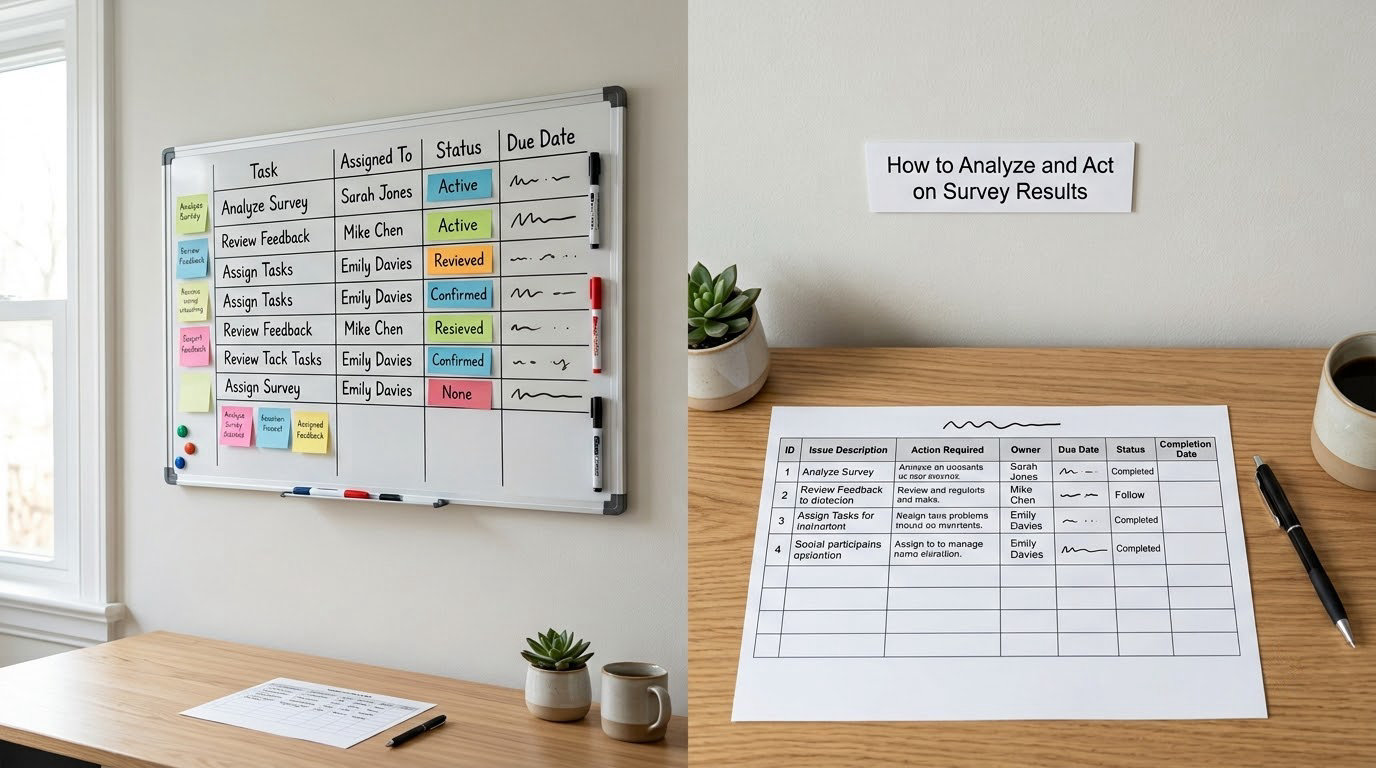
Score each theme as the average of its six items, with any reversed items flipped first, and then set bands that describe a response rather than a verdict.
| Theme average | What it usually means | What to do |
|---|---|---|
| 4.0 and above | Strong, and often visible in incident trends | Protect it. Document the behaviours and share them with sites that score lower. |
| 3.0 to 3.9 | Mixed. Sound in some groups, weak in others | Break the theme down by department and shift before acting on the average. |
| 2.0 to 2.9 | Weak. Reporting or trust is the usual bottleneck | Interview three or four people from the lowest-scoring group and fix the named barrier. |
| Below 2.0 | Not a survey problem. Stop the work and find out why | Treat as a safety issue in its own right, with an executive owner this week. |
Separate leading from lagging indicators before you write the report, because they behave differently and mixing them produces nonsense.
| Leading (survey-derived) | Lagging (outcome-derived) |
|---|---|
| Reporting items, participation items, perceived leadership behaviour | Recordable incident rate, lost-time injuries, near-miss volume |
| Moves first, moves often | Moves last, moves slowly |
| Can be gamed by answering carefully | Cannot be gamed, but can be under-reported |
| Use to choose what to fix | Use to check whether the fix worked |
Near-miss counts sit awkwardly in that second column: a rise usually means reporting is working, not that things got worse, and interpreting them as a scorecard punishes the site that reports most.
Then write the corrective action plan while people still remember the survey. Four to six actions, no more. Each one needs a named owner, a due date and a description of what employees will see differently. If the top scoring issue is reporting not being closed out, the action is a published closure log with dates on it, not a training course.
Report back within a month. Tell each site what its own themes scored, what the organisation is doing, and by when. A survey that produces no visible change lowers response rates the next time you ask, and it does so permanently.
Frequently Asked Questions
How many questions should a safety climate survey have?
Twenty to thirty is the working range. Fewer than about fifteen gives you too few items per theme to see a pattern, and more than forty starts to wear respondents out mid-way, which shows up as straight-lining on the last pages. Six items across each of four themes is a solid core. Add role-specific items only for the crews that need them, and keep the total under one page of screen time.
Should safety climate surveys be anonymous?
Anonymity is close to essential for reporting items, because the whole point is to find out whether people expect a consequence for speaking up. Full anonymity is ideal; where that is not possible, publish the suppression threshold, strip identifying detail from free text, and never trace individual responses back to a person. If respondents doubt this, your reporting scores will be optimistic and you will not know by how much.
How often should you run a safety climate survey?
Run a full survey annually as a benchmark, and add a short pulse of three to five items every three to four months on the themes that matter most locally. Run an additional full survey after a serious incident, a leadership change or an acquisition. Doing it more often than that tends to lower response rates without adding much, because the answers do not change that fast.
How long should a safety climate survey take to complete?
Ten minutes or less for a core instrument, including the cover note. Longer surveys attract a self-selected group of unusually engaged employees, and that group is systematically more positive about safety, so your results skew. If your instrument runs past fifteen minutes, cut items from the lowest-priority themes rather than extending the window.
What are the four C’s of safety culture?
The most widely used version is commitment, competence, compliance and communication, with the single C version dropping communication to focus on the first three. The lists differ between sources, so adopt one and define it in your own documentation rather than borrowing a definition that conflicts with your policy. Your survey items should map to whichever set you choose, so the framework and the questionnaire stay aligned.
What are the 5 E’s of workplace safety?
The five E’s are usually listed as engagement, empowerment, evaluation, enforcement and education, and they map cleanly onto survey items: participation, freedom to stop work, measurement, accountability and training. Variants exist, some replacing enforcement with enthusiasm. Pick the version your leadership will act on, because the value of the framework is that it tells you which section of the questionnaire to read first.
Conclusion
Start smaller than feels comfortable. Take the six leadership items, the six reporting items, run them on one five-point scale with a published suppression rule, and put a named owner and a date against the one theme that scores worst.
Then report back. The survey earns its keep the first time workers see a change they asked for, and the second time they answer as honestly as the first.