
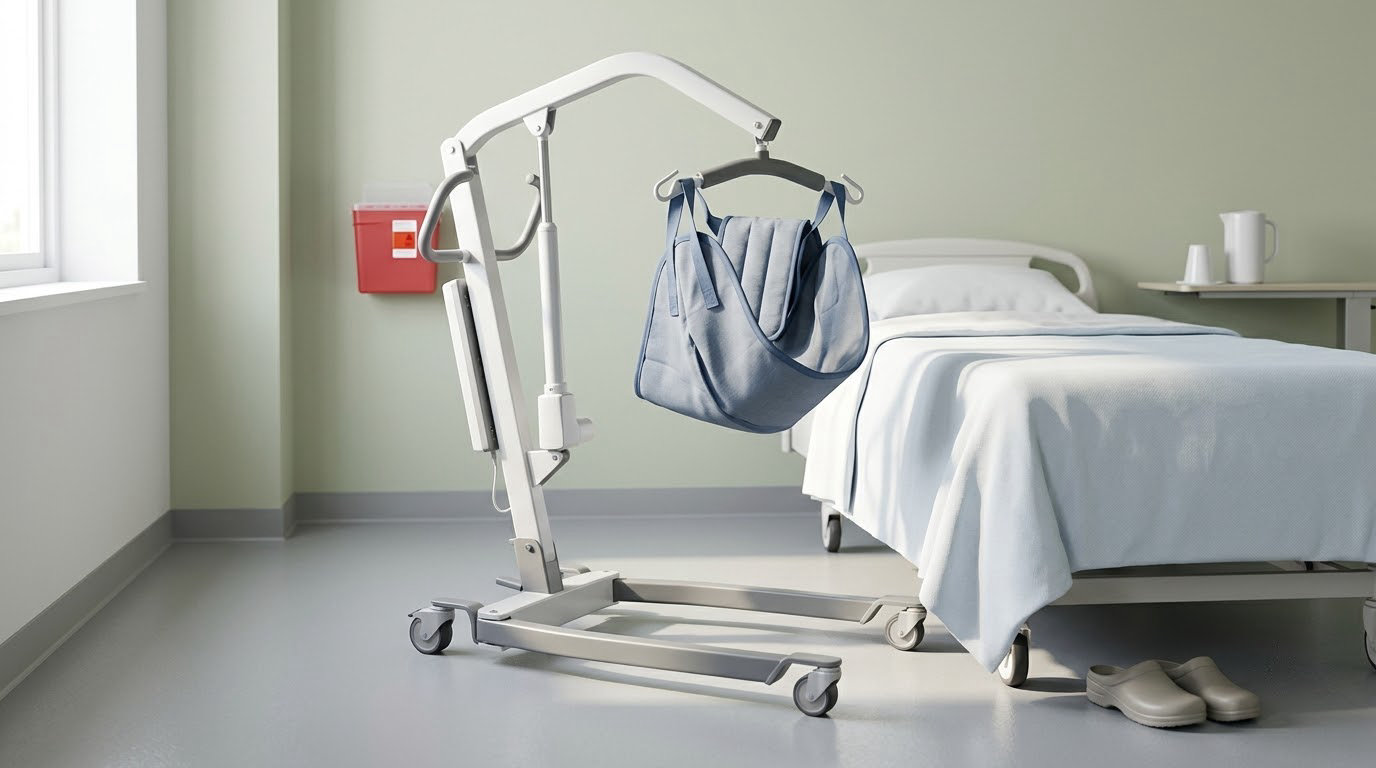
Hospital worker injury prevention is the set of controls a hospital puts in place so that nurses, aides, technicians, physicians, and support staff can do their jobs without getting hurt. In practice it means finding out where injuries actually happen, fixing the tasks that cause them, and measuring whether the fixes worked.
Healthcare is one of the most injury-prone industries in the country, and the reasons are specific rather than general. Staff lift, hold, push, pull, and turn other human beings for a living. They work around needles, chemicals, radiation, and violent behavior in buildings that were designed for patients, not for workers who move heavy loads all shift. Getting the program right takes more than posting a poster and handing out back belts.
The plan below walks through ten steps, in the order they tend to work. It is written for hospital occupational health staff, safety officers, nurse managers, and administrators. Budget most of your effort on the first four steps; the rest is maintenance.
Table of Contents
- What You Need
- Step-by-Step Hospital Worker Injury Prevention Plan
- Step 1: Map hazards across every hospital department
- Step 2: Build a hospital-wide team for hospital worker injury prevention
- Step 3: Set measurable prevention priorities
- Step 4: Redesign high-risk patient-handling tasks
- Step 5: Control needlestick and sharps hazards
- Step 6: Prevent slips, trips, and workplace violence
- Step 7: Improve ergonomics for repetitive hospital work
- Step 8: Train workers in task-specific safe work practices
- Step 9: Inspect equipment and maintain a reporting culture
- Step 10: Review injury data and improve the program
- Common Mistakes
- Frequently Asked Questions
- Conclusion
What You Need
You cannot run hospital worker injury prevention without knowing what your own hospital is experiencing. The federal data tells you the national picture, but the program that works is the one built on your own logs, your own near misses, and the tasks your staff actually perform.
Baseline data. Pull three years of injury and illness records, first report of injury forms, workers’ compensation claims, and workers’ compensation claim denials. Separate them by department, job title, shift, and body part. Most hospitals already have the raw material sitting in a drawer; almost none of it has been read side by side.
A hazard assessment method. Pick one and use it consistently. A structured walk-through of each unit works; so does a task-by-task review with the people who do the work. Write findings down by location and by job task, not by general category.
Equipment and budget authority. You will need a decision path for purchasing safety-engineered sharps devices, mechanical lifts, sliding boards, gait belts, and gait-belts-plus friction-reducing sheets, plus replacement schedules. Know who signs off on a capital request and how long it takes.
Training capacity. Hands-on training with return demonstration needs a trainer and a room. Budget for backfill so staff can leave the unit without leaving it short-staffed.
Named people. A program without owners decays in about a year. You need an executive sponsor, a safety lead, an employee health or occupational health contact, an infection preventionist, a facilities representative, and at least one frontline representative from each shift.
A reporting channel that works at 2 a.m. Whatever form you design, it has to be reachable from a phone, in a few fields, without a supervisor in the loop.
Step-by-Step Hospital Worker Injury Prevention Plan
Each step below should end with a documented decision, a named owner, and a date for review. A program that lives only in a presentation is not a program.
Step 1: Map hazards across every hospital department
Build the map by location, shift, and job task, not by department name alone. The same unit generates different risks on day shift and night shift, and the same task is dangerous in one room configuration and not the next.
Walk each area and write down what you see. In a patient room you will likely find overhead storage requiring a step stool or a reach, cords on the floor near the bed, a bed at the wrong height for the task, a sharps container mounted where staff must walk away from the bed to reach it, and a room too tight for two people plus equipment. In a utility area you will find chemical storage, unlabeled secondary containers, and wet floors. In the laundry room you will find lifting loads that exceed what one person should move, unguarded cart wheels, and narrow aisles. In the emergency department you will find all of the above plus a high rate of patient-to-worker aggression.
Add housekeeping, food service, transport, sterile processing, and pharmacy. They are part of the same workforce and they carry the same slips, strains, and exposure risks as the bedside staff nobody thinks about.
Step 2: Build a hospital-wide team for hospital worker injury prevention
Spread responsibility across the people who actually control the hazards. The team should include a nurse manager, an occupational health or employee health nurse, an infection preventionist, a facilities or engineering representative, security, a physical therapist or ergonomist, a pharmacy or lab representative, a labor or employee representative where one exists, and frontline staff from day, evening, and night shifts.
Set the meeting rhythm in advance. A monthly safety huddle works for most hospitals; a quarterly full-team review works better for program-level decisions. Define the escalation rule in writing: who gets contacted the same day, within 24 hours, and at the next governing board meeting.
The rule I watch for is whether frontline staff can raise a hazard at a meeting without being talked over by a physician or an administrator. If that never happens, the team is a formality and the data you get back will be unusable.
Step 3: Set measurable prevention priorities
Rank hazards using the numbers you already have: recordable injury rate by department, near-miss reports, employee hazard reports, how often the task is performed, and how bad the worst plausible outcome is. Frequency alone is misleading. A task performed twice a year can still deserve a control if the consequence is severe.
Build a simple scoring sheet. Here is a workable starting format, scored by your team rather than by a formula:
| Hazard | Frequency | Worst-case severity | Controls in place today | Priority |
|---|---|---|---|---|
| Manual patient lifting and repositioning | Every shift, multiple units | High | Partial | Top |
| Slips on wet or contaminated floors | Daily, mostly entry points and patient rooms | High | Partial | Top |
| Percutaneous injury during device activation | Weekly across the hospital | High | Good on paper, inconsistent at the bedside | Top |
| Prolonged standing and awkward reaching | Continuous | Moderate | Minimal | Medium |
| Patient-to-worker aggression | Rising, concentrated in ED and psych | High | Varies by unit | Top |
Keep the sheet visible. A priority list nobody has seen cannot change anybody’s budget request.
Step 4: Redesign high-risk patient-handling tasks
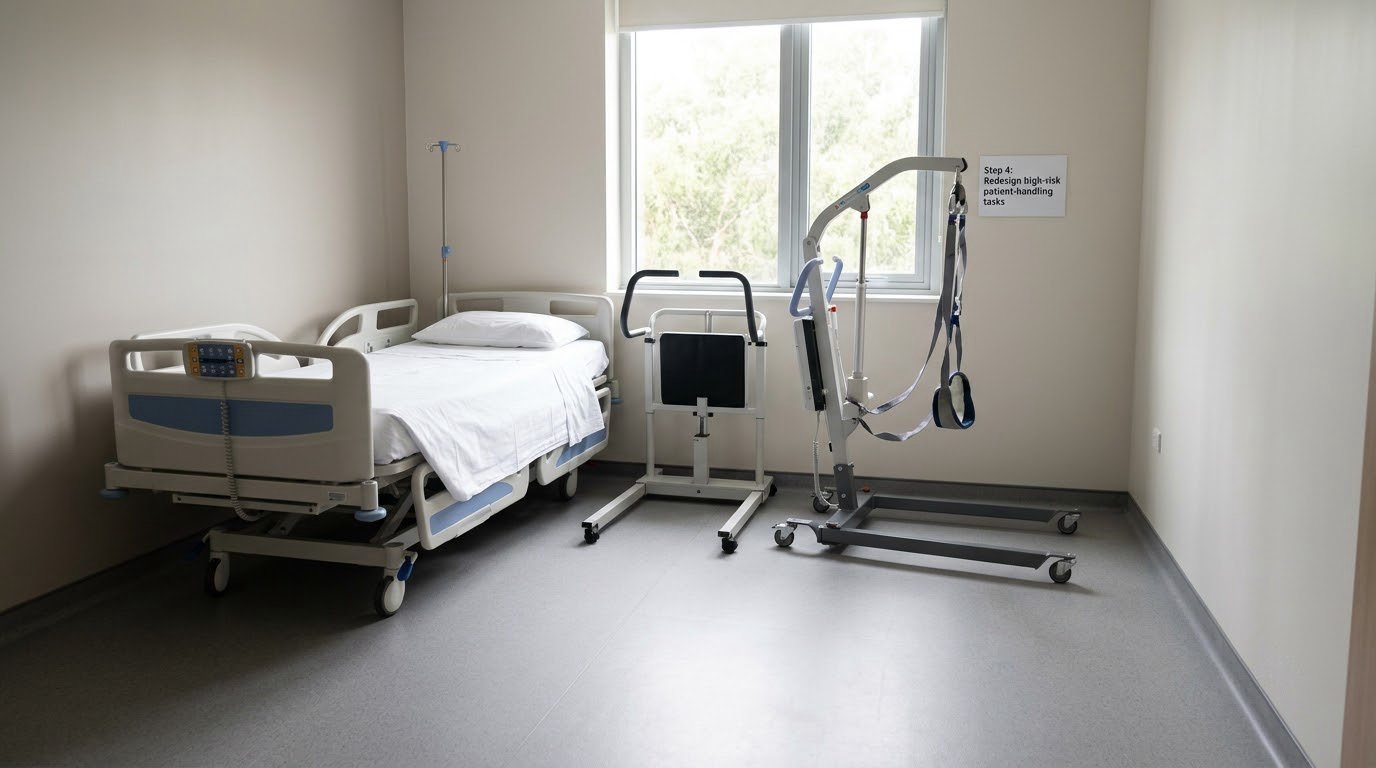
Manual patient handling is the single biggest lever most hospitals have, and it is a design problem before it is a technique problem. Evidence-based safe patient handling programs that pair training with mechanical lifting and dedicated lift teams have been shown to reduce musculoskeletal injury in nursing staff. The training alone is not what does the work.
Start with the task itself. Can the bed height be set so the caregiver’s elbows stay near waist level? Is there a second person scheduled, or is the assumption that someone will help if they are available? Is a gait belt in the room before the transfer starts, or in a closet down the hall? Are the floor space and lighting clear enough to roll equipment?
Take one common transfer and write it out. Moving a patient from bed to chair: raise the bed to transfer height, lock the wheels, set the chair at a slight angle facing the bed with the brakes locked, apply a gait belt or use a slide sheet, position the lift or transfer aid, move on a count of three, and have the patient push through their near leg rather than being pulled across the gap. Then check whether the staffing on that shift made that sequence possible. If two caregivers were scheduled for a four-patient assignment, the written procedure is fiction.
Adopt a no-lift or minimal-lift policy for high-dependency patients and back it with enough equipment that following the policy is the easy choice. Policies without equipment are the most common failure in this program.
Step 5: Control needlestick and sharps hazards
Most needlestick injuries are preventable with equipment that already exists, which is why this category responds so well to attention. CDC surveillance through its NaSH system has long estimated that roughly 64 percent of sharps injuries are preventable with current technology. The same surveillance shows where the failures sit: a large share of device-related injuries happen before appropriate activation, and a substantial number happen because the device was never activated at all.
That tells you what to fund. Put the sharps container at the point of care, within arm’s reach, at a working height, and mount it so it does not block the workflow. Verify that the safety device is on the supply shelf in the room rather than only in the storeroom. Audit actual device use on the unit, because the device being present and the device being used are different facts.
Keep the written exposure control plan current, review it with the sharps injury log, and make sure the log is actually completed after every percutaneous injury. Never recap, and enforce a no-recapping expectation for everyone including physicians. Train staff to fill the container before it reaches the overfill line. Offer hepatitis B vaccination as required under the OSHA bloodborne pathogens standard, along with the post-exposure evaluation and follow-up, and remind people the offer is available regardless of how long they have worked there.
After an exposure, workers should wash the site, report immediately, and follow current facility policy for medical evaluation and follow-up through occupational health. They should never wait to see whether the source patient is known.
Step 6: Prevent slips, trips, and workplace violence
These two hazards rarely get program attention and they are both preventable with housekeeping and design. For slips, the failure points are predictable: overflowing sinks, patient rooms where a commode, IV pole, and laundry hamper share a walkway, cables crossing traffic routes to monitors, and spills that sit for minutes because the spill kit is in a supply room three corridors away. Fix them with a spill kit on every unit, a clear egress path in every room, cable management at the bed head, dry floor maintenance schedules that match patient volume, and lighting that actually reaches the floor.
For violence, treat Type II events, meaning patient-to-worker incidents, as a design problem too. It means a reporting path that a victim can use at 2 a.m., de-escalation training for everyone who works alone on a unit, a security response protocol with defined arrival expectations, a flagging system that alerts staff to a known risk before they enter a room, controlled access in waiting and public areas, and post-incident support. Data-driven programs built on documented incidents have been tested in hospital settings and are worth copying rather than reinventing.
Do not skip the post-event review. Every serious incident gets the same question: what allowed this to happen, and what changes on Monday.
Step 7: Improve ergonomics for repetitive hospital work
Repetitive hospital work is mostly awkward posture held too long. That means reaching overhead for supplies, bending to reach a low drawer, twisting to reposition a patient, pushing a cart or bed across a long corridor, standing for hours at a workstation, and eight hours at a computer charting station.
Set the bed to a height that matches the task rather than to whatever the last person left it at. Move frequently used supplies between waist and shoulder height. Keep heavy items off high shelves and off the floor. Alternate tasks instead of doing one repetitive motion for an entire shift, and give staff a way to request an anti-fatigue mat or a footrest where prolonged standing is unavoidable. Repeated wrist and forearm work at a charting keyboard is its own category; our guide to carpal tunnel prevention at work covers the workstation changes that help most. Staff who kneel for tasks like wound care or retrieving low storage tend to feel it in the knees first, which is why knee pain from kneeling at work is worth reading before a task gets normalized.
Bring in an occupational health professional or ergonomist for the awkward roles rather than guessing. Back supports do not make a two-person 200-pound lift safe, and a poorly fitted assistive device can cause the injury it was meant to prevent.
Step 8: Train workers in task-specific safe work practices
Generic annual training is easy to deliver and easy to forget. Make it task-specific instead: the lift for this patient, the device sequence for this room, the spill response on this unit.
Use hands-on practice with a return demonstration. A nurse who has not actually operated the ceiling lift in front of a trainer has not been trained on it. Check competency at hire, at six months, annually, and again after any incident involving the task or any equipment change.
Provide materials in the languages your staff actually read, and keep the content short. Train supervisors separately, because a supervisor who interrupts a two-person lift to save a minute will undo the training faster than any policy can build it. Then send a trainer to the next hire so the unit is never one person away from losing the program.
Step 9: Inspect equipment and maintain a reporting culture
Inspection is a scheduled task with a name and a date. Walk beds and their brakes, lifts and their straps and batteries, sliding sheets and gait belts, sharps containers and their mounting, doors and closers, lighting, floor surfaces, and the availability of required personal protective equipment. Log what fails and who owns the repair.
On the reporting side, the goal is volume, not perfect compliance. Make hazard and near-miss reporting possible from a phone in under a minute, accept anonymous reports, and publish what happened to the last five reports that were submitted. Workers keep quiet when reporting feels pointless or risky, and underreporting of workplace injuries is estimated to run as high as 70 percent in some surveys. A program that measures itself on a declining report count is measuring silence. For anyone who already has had an incident, our walkthrough of what to do after a workplace injury covers the reporting sequence and the paperwork deadlines that follow.
Expect a temporary rise in reported injuries after a new device or program launches. That usually means people are reporting, not that the unit got more dangerous. Say so out loud, or the numbers will be used against you.
Step 10: Review injury data and improve the program
Review on a fixed schedule and always answer three questions: are we getting hurt less, are we reporting more, and did the controls we bought actually get used. Track the recordable injury rate by department, near misses, hazard reports by category, training completion and competency results, and equipment failures and repair turnaround.
Look for department-level trends rather than a hospital-wide average, which hides too much. If one unit’s musculoskeletal reports dropped after a staffing change, the trend is telling you to reallocate staff, not to praise the unit. If sharps injuries are flat while device availability is high, the problem is adoption, and the fix is coaching and workflow rather than more purchasing. If a piece of equipment has failed repeatedly, replace it.
Then set the next quarter’s priorities and publish the review. Program reviews that stay in a binder stop protecting anyone within a year.
Common Mistakes
Writing the policy without the people who do the work. Staff can tell within one shift when a procedure was drafted in an office that does not stock a bed at the right height. Bring two bedside nurses and an aide into the room when you write it.
Asking workers to lift safely without staffing or equipment. This is the most damaging mistake in the category because it moves risk onto staff who have no authority to change the conditions. If the unit runs at four patients per nurse, safe lifting policy is a sentence in a binder and nothing else. Fix the staffing and the equipment or stop implying the technique is protective.
Treating near misses as noise. A near miss is free information. Someone caught a falling tray, a missed step on a wet floor, or a needle stick that did not penetrate. Track them with the same seriousness as injuries and you get a leading indicator instead of a lagging one.
Skipping supervisor training. Supervisors set the real pace on a unit. If they rush transfers, override the lift team, or joke about reporting, no amount of staff training survives.
Failing to measure whether controls work. Buying a device is not an outcome. If nobody checks activation rates, the program has spent money and learned nothing.
Assuming one report means the problem is over. Underreporting pushes the count down for the wrong reasons. Watch report volume and injury rate together, and treat a sudden drop as a question rather than good news.
Implementation tips that save the first quarter
Pick one department and one hazard, not the whole hospital. A med-surg unit’s patient lifting is a reasonable first project because the data is usually good and the fix is visible.
Get the executive sponsor in the first meeting, not the fifth. Staff will tell you whether a program is real by how quickly something gets bought.
Run a pre-shift or shift-change observation in your own unit. You will find more in fifteen minutes than in a two-hour document review.
Build the reporting form before the training. A program that asks staff to report into a system that does not exist yet teaches them that reporting does not work.
Write down what you will measure and when you will look, at the start. Programs get cancelled during budget season when nobody can show a result.
Frequently Asked Questions
What are the 3 Es of injury prevention?
The 3 Es come from NIOSH and are engineering controls, education and enforcement, and ergonomics. In practice they mean designing the task so injury is harder to commit, teaching and enforcing the correct method, and fitting the work to the body. Many programs add a fourth element, evaluation, so you can tell whether the first three worked. The five-level hierarchy of controls, from eliminate down to PPE, is a separate and more detailed framework.
What are the OSHA requirements for healthcare workers?
The main federal requirement is the bloodborne pathogens standard at 29 CFR 1910.1030, which requires a written exposure control plan, hepatitis B vaccination offered to all covered employees, post-exposure evaluation and follow-up, required personal protective equipment, and recordkeeping including the sharps injury log. Injury and illness data must also meet OSHA recording criteria and appear on the 300 log. State-plan states may add requirements, including needle-safety protections, so check your state agency.
What is the most common injury among hospital workers?
Overexertion from lifting, pushing, and pulling patients is the leading category, and the resulting musculoskeletal injuries to the back, shoulder, and knee account for the largest share of healthcare worker injuries. Within healthcare specifically, needlestick and other percutaneous injuries are the leading entry route for bloodborne pathogen exposure, and patient-to-worker violence is one of the fastest-rising threats. All three concentrate in bedside staff and in aides, who do the most manual handling.
How to handle injuries at work?
Get first aid or care immediately, then tell your supervisor or designee and complete the second employee injury report the same shift. Report needlestick or splash exposures to employee health or occupational health right away rather than waiting to learn whether the source patient is known. Document the sequence of events while it is fresh, and follow up on the paperwork, since workers compensation deadlines are short. Any injury that meets OSHA recording criteria also has to reach the hospital recordkeeping process.
Do hospitals have to provide patient lifts?
There is no single federal rule that requires a mechanical lift in every hospital room. What the law does require is that the employer address the hazard, and OSHA has cited hospitals for overexertion hazards when staffing and equipment left staff no safe way to move a patient. Several states have adopted safe patient handling requirements, and many are more specific than the federal baseline. Your obligations depend on your state plan, your union agreements, and your own written program.
Why do healthcare workers underreport injuries?
Most often it is not indifference, it is workload. Staff are stretched, they do not want to slow down a unit, they assume the injury is normal, and they do not want to be seen as unable to do the job. Some also fear that reporting will follow them onto staffing assignments. Nonpunitive reporting, anonymous hazard channels, visible follow-through on past reports, and leaders who thank people for reporting are the interventions that move the number most.
Conclusion
Hospital worker injury prevention works when it starts with the specific tasks that hurt people, not with a general wellness message. Identify your highest-risk tasks, put the people who perform them on the team, give them staffing and equipment that make the safe method the easy one, and review the results on a schedule that somebody owns.
You do not need to fix the whole hospital to start. Pick one department and one hazard, fix it properly, and let the results speak. Programs that start small and actually follow through tend to be copied across the organization, and hospital worker injury prevention becomes a standard rather than a slogan.