

If you are searching for the answer to incentive limits for wellness programs, here it is in plain terms: there is no single federal dollar cap on most workplace wellness incentives today. What still constrains you is the design of the program, the coverage it sits inside, the Americans with Disabilities Act, the Genetic Information Nondiscrimination Act, and how the Internal Revenue Service treats the reward. This guide walks through each of those, with dollar illustrations and a practical design framework, so you can size an incentive without guessing.
I want to be upfront about one thing before we get into the details: this is general information about how these rules usually work, not legal or tax advice for your organisation. Rules change, state law adds its own layer, and plan documents control. Have your benefits team and employment counsel check your specific design before employees are enrolled or rewarded.
Table of Contents
- Incentive Limits for Wellness Programs: What Employers Need to Know
- Which Wellness Incentive Limits Apply to Your Program?
- How Do You Calculate the Maximum Incentive?
- How to Apply Incentive Limits to Different Coverage Scenarios
- What Exceptions May Allow a Larger Incentive?
- Why the ADA and Disability-Related Programs Need Special Attention
- What Privacy and Communication Duties Apply?
- How to Design a Compliant and Appealing Wellness Program
- Common Employer Misunderstandings
- Frequently Asked Questions
- Do all employee wellness programs have the same incentive limit?
- What is the common maximum wellness incentive amount?
- Can an employer offer cash for completing a wellness activity?
- Does the ADA limit incentives in every workplace wellness program?
- How should an employer document the value of a wellness reward?
- Conclusion
Incentive Limits for Wellness Programs: What Employers Need to Know

An incentive limit is simply the boundary on how much value an employer may give an employee in exchange for participating in a wellness program or reaching a health goal. Sometimes that boundary is a percentage of the insurance premium. Sometimes it is a privacy duty rather than a dollar figure. Sometimes nothing limits the amount, and the real constraint is that the reward may become taxable income.
The confusing part is that the limit depends entirely on what kind of program you built. The same gift card can be entirely unrestricted in one design and squarely regulated in another, based on nothing more than how you word the participation requirement.
Two labels do most of the work in this area. A participatory wellness program rewards people for being enrolled, or for completing a health risk assessment, a biometric screening or a health activity. It does not require a specific health outcome. A health-contingent wellness program requires the employee to reach or stay at a specified health standard, such as a blood pressure or cholesterol target, to keep the reward.
Four US regimes can apply to an employer at the same time:
- The Americans with Disabilities Act (ADA) — governs disability-related inquiries, medical examinations and whether participation is genuinely voluntary.
- GINA Title I — bars covered employers from asking about or acting on genetic information, including family medical history in health risk assessments.
- GINA Title II — bars insurers and group health plans from genetic-based eligibility or pricing decisions.
- HIPAA — the 2013 privacy rules and the wellness-program provisions that contain the only dollar-style incentive limits still in force federally.
The reason a single answer does not fit every employer is structural. These rules are administered by different agencies, they attach to different parts of your organisation, and they trigger on different facts. A benefits team, a vendor contract and a payroll process may each be affected by a different one.
If you are still working out participation numbers, my guide on how to get employees to participate in wellness programs is a better use of time than another compliance nuance.
Which Wellness Incentive Limits Apply to Your Program?
Not every workplace wellness incentive is subject to the same limits, and the difference is driven by program design rather than by the dollar value you choose. Use this table to classify your program before you size anything.
| Program type | What it asks of employees | Governing rules | What constrains the incentive |
|---|---|---|---|
| Participatory, outside a group health plan | Completing an HRA, biometric screening or activity; no health outcome required | ADA and GINA Title I; no HIPAA wellness provisions | No federal dollar cap. Voluntariness, genetic-information and confidentiality duties still apply |
| Health-contingent wellness program tied to a group health plan | Meeting a specified health standard to keep the reward | HIPAA wellness provisions, ADA, GINA | Up to 30 percent of the cost of self-only coverage; up to 50 percent where designed to prevent or reduce tobacco use |
| Tobacco-use prevention or cessation program within a group health plan | Enrolling in or completing a program aimed at reducing tobacco use | HIPAA wellness provisions | The higher 50 percent figure, subject to the same conditions |
| Disease management program offered by a group health plan | Meeting clinical targets for a diagnosed condition | HIPAA plan rules, ADA | Generally not treated as a wellness program incentive; reviewed as a clinical benefit |
| Voluntary gym or fitness reimbursement | Submitting proof of an expense; no health information required | ADA if tied to a health condition; federal tax rules on reimbursement | No wellness cap. Payroll treatment depends on the award structure |
Read the second column carefully. The same reward — say a gift card — lands in a regulated category or an unregulated one based on what triggers it, not on what it costs you.
How Do You Calculate the Maximum Incentive?
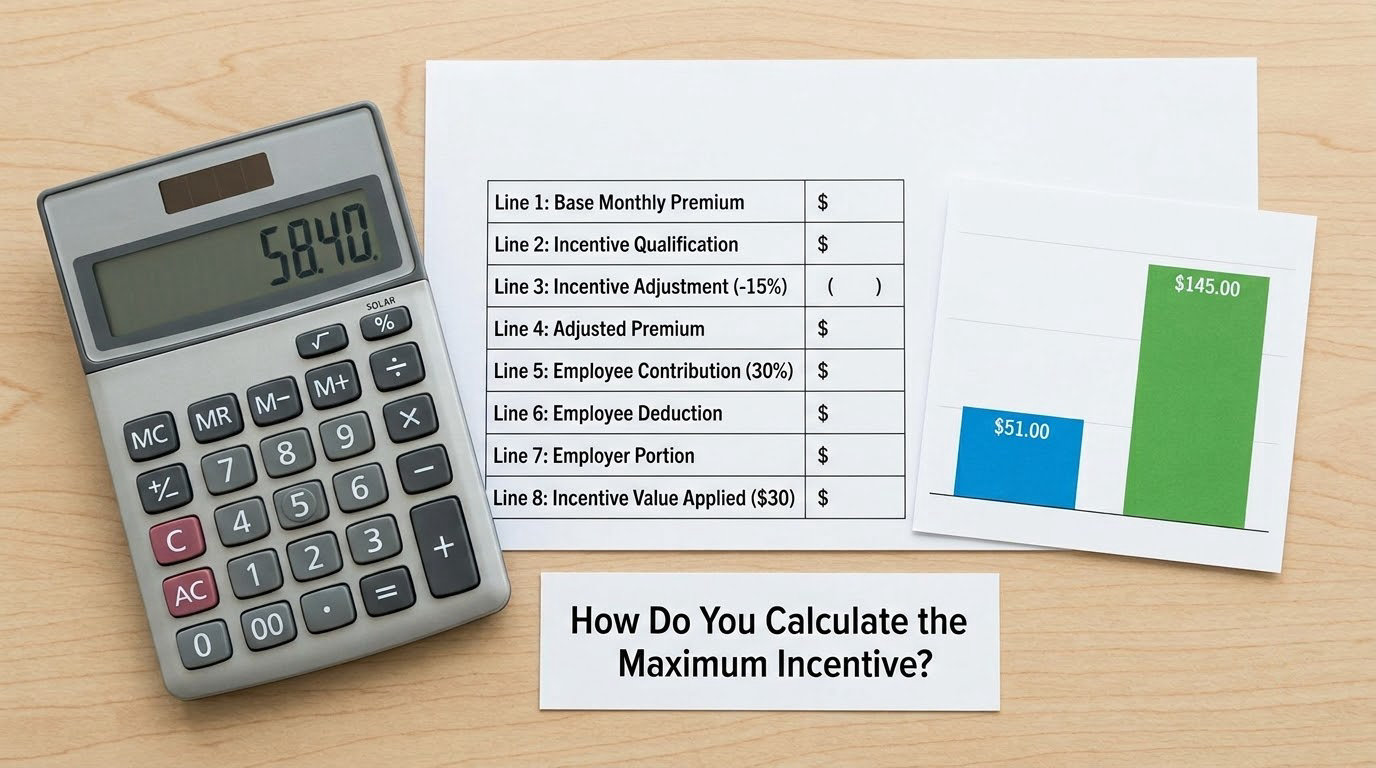
The familiar formula is a percentage of the cost of self-only coverage. Under the HIPAA wellness provisions that remain in force, a health-contingent program may offer an incentive worth no more than 30 percent of the cost of employee-only coverage. Where the program is designed to prevent or reduce tobacco use, that figure rises to 50 percent.
Self-only coverage means the employee’s own tier of coverage, not family coverage and not the total employer cost. If an employee’s employee-only premium contribution for the plan year is 900 dollars, then 30 percent is 270 dollars. At 1,200 dollars, 30 percent is 360 dollars. At 1,500 dollars, it is 450 dollars.
| Employee-only premium contribution for the plan year | 30 percent ceiling | 50 percent ceiling (tobacco-focused programs) |
|---|---|---|
| 900 dollars | 270 dollars | 450 dollars |
| 1,200 dollars | 360 dollars | 600 dollars |
| 1,500 dollars | 450 dollars | 750 dollars |
Two cautions sit on top of that arithmetic. The correct base is the coverage cost for the specific plan year and the specific tier, not an employer-wide average. And the percentage ceiling is not the only condition: the HIPAA provisions carry additional requirements that must also be met, covered below.
Many HR managers ask the same practical question here, so it is worth saying plainly: you cannot copy a dollar figure from another employer’s programme and assume it carries over. Premium bases differ, plan years differ, and coverage designs differ.
Before you build anything, also settle the wellness programme ROI framework — deciding what the incentive is meant to buy you makes the legal design much easier to defend internally.
How to Apply Incentive Limits to Different Coverage Scenarios
The allowance moves with the base, which is why two employees at the same company can have different ceilings. An employee on employee-only coverage where the premium contribution is 900 dollars sits at a 270 dollar ceiling. A colleague on the same plan who elects family coverage is measured against the employee-only figure, not the family premium, because the formula is defined on self-only coverage.
That distinction trips up a lot of first-time programme designers. The family premium is a larger number, and it feels like the fairer base, but the formula as written points at self-only coverage. If you want to use a different or more generous base, treat that as a design decision to document rather than a default to assume.
The second scenario worth handling carefully is where the reward comes from a health spending account. A health savings account balance, a flexible spending account contribution and a wellness payment are three different things, and they do not substitute for one another.
A premium contribution reduction is also distinct. When an employer lowers what an employee pays toward coverage because of a wellness outcome, that change may carry its own consequences under the ADA, because it can operate as a penalty if an employee cannot meet the standard. That is a design question, not an accounting one.
So the practical rule is: decide which pocket the money comes from before you decide how much it is. Once the source is fixed, the limit calculation becomes checkable.
What Exceptions May Allow a Larger Incentive?
Two routes genuinely change the numbers. The first is a tobacco connection. A program designed to prevent or reduce tobacco use may use the 50 percent figure rather than 30 percent. Employers have built cessation programmes into broader wellbeing platforms this way, and the higher ceiling gives real headroom for a stronger reward.
The second is the special-purpose exception under the HIPAA wellness provisions, which can allow a plan to offer a larger incentive where the program is tied to a health risk assessment and satisfies specific conditions. It is the practical route many employers use for HRA-linked programmes, and it is worth raising with your benefits counsel because it is frequently overlooked.
Programs connected to an employer-provided health condition or a specific medical treatment can also sit outside the standard wellness framework and be handled as a clinical or disease management benefit instead. That changes the analysis rather than simply raising the ceiling.
Whatever route you use, write down the reasoning at the time. A short memo explaining why a specific exception applies to your design is the single most useful artefact you will produce, because it is what a regulator, a plaintiff’s attorney or an auditor will ask to see first.
Why the ADA and Disability-Related Programs Need Special Attention
The ADA does not set an incentive amount. What it does is decide whether a programme that touches disability-related information is structured in a way the law permits, and that analysis starts with voluntariness.
The operative question is whether a reasonable employee with a disability would feel they had a real choice. Four conditions usually matter: participation is not required by anyone with authority over them; the programme is not a gatekeeper to a group health plan; no adverse employment action follows from declining or failing; and the incentive offered is within whatever limits apply.
A programme that is designed to manage, treat or prevent an individual disability or health condition sits in a more sensitive place than one encouraging general activity. In that setting, a reward that an employee can keep only by meeting a clinical target can function as a benefit denial for someone who cannot meet it, and reasonable alternatives become important rather than optional.
Equal access matters too. A programme that screens with a device or metric some employees cannot use, or that assumes a fitness standard an employee cannot meet, can exclude people without anyone intending to.
One more risk has grown in recent years: tying access to weight-loss medication to wellness participation. Coverage conditioned on participation in a programme can function as an incentive under the HIPAA wellness provisions. I would flag it to counsel rather than try to solve it internally.
What Privacy and Communication Duties Apply?
Collect only what the programme needs. Every additional field you gather is data you hold, and health information collected through an employer is sensitive in a way that a fitness tracker is not.
Keep medical information separate. Employee health files from a wellness vendor should not sit in the same general personnel file, and access should be limited to people who genuinely need it for the programme’s administration.
Explain the programme in plain language before anyone signs up. People need to know what is voluntary, what data is collected, who sees it, and what the reward is. Vague consent language is where most disputes start.
Give people a real route to ask questions. A named contact at the employer, plus a vendor contact, beats a shared mailbox nobody monitors.
Publish a notice describing what individual health information is collected, how it is used, who has access and for how long it is kept. In GINA-covered employers, get written authorisation before collecting genetic information, and never let it reach an employment decision.
How to Design a Compliant and Appealing Wellness Program
Work through these seven steps in order. The sequence matters because each step constrains the ones after it.
- Define the health goal in one sentence. If you cannot, the programme is decoration and the compliance analysis will not settle.
- Choose the incentive type. Participation-based, outcome-based, reimbursement or account contribution. This single decision determines which rules apply.
- Classify the programme. Use the table above. Participatory or health-contingent, inside or outside a group health plan.
- Check the ceiling. If it is health-contingent, calculate against self-only coverage for the plan year and subtract nothing from the figure — set the reward at or below it.
- Test accessibility and nondiscrimination. Reasonable alternatives, equivalent routes for those who cannot complete an activity, no clinical standards applied to general wellness.
- Build the privacy controls. Separate files, limited access, a published notice, written authorisation where genetic information is involved.
- Document and review. Memo your design rationale, the ceiling calculation, and the voluntariness analysis. Have benefits counsel and your tax adviser sign off before launch.
Then measure what happened. Participation rate, engagement depth and health outcome changes tell you whether the incentive was worth the compliance work, and our piece on wellness programme incentives that actually motivate employees covers how to read those numbers.
Common Employer Misunderstandings
Assuming every wellness programme has the same cap. The percentage figure applies to health-contingent programmes tied to a group health plan. Participatory programmes outside a group health plan have no federal dollar cap at all.
Treating a biometric or screening programme as a harmless optional benefit. It is not optional in the legal sense if a reward hangs on completing it, and biometric data carries state-level requirements in several jurisdictions that sit on top of the federal floor.
Promising tax-free treatment without checking the facts. Whether an award is taxable depends on its structure. A small item may fall within the de minimis fringe benefit exclusion; a points award is generally taxable when redeemed rather than when accrued, which is a timing difference employees notice; a reimbursement of a qualified medical expense may follow different rules again. Payroll decisions belong with your tax adviser.
Using rewards that discourage protected accommodations. A design that requires the one activity an employee cannot perform, with no equivalent alternative, invites a disability discrimination claim regardless of the dollar value.
Ignoring state and local law. Several states impose their own wellness-pay and biometric-information requirements. National guidance will not tell you whether your state adds something on top.
Leaving the paper trail behind. A programme with no design memo, no ceiling calculation and no voluntariness analysis is harder to defend than one with modest incentives and careful documentation.
Frequently Asked Questions
Do all employee wellness programs have the same incentive limit?
No. The percentage ceiling applies to health-contingent programs offered through a group health plan. Participatory programs run outside a group health plan have no federal dollar cap, though ADA voluntariness, GINA and confidentiality duties still apply. Classification comes before calculation: decide what employees must do to earn the reward, then check which rules attach.
What is the common maximum wellness incentive amount?
For a health-contingent program tied to a group health plan, the ceiling under the HIPAA wellness provisions is 30 percent of the cost of self-only coverage, rising to 50 percent where the program is designed to prevent or reduce tobacco use. The base is the employee-only coverage cost for that plan year, so the dollar figure differs by plan. Verify the number against your own plan documents.
Can an employer offer cash for completing a wellness activity?
Nothing in federal law bans cash for participation in a purely participatory program, because no federal dollar cap applies there. The reward is usually taxable wages unless it falls within a specific exclusion, and it must not be structured so that refusing to participate costs an employee coverage or employment. Bonus programs for outcomes tied to health conditions carry separate ADA and HIPAA analysis.
Does the ADA limit incentives in every workplace wellness program?
The ADA does not set a dollar figure for any programme, but it applies wherever a programme involves disability-related inquiries or medical examinations. The question becomes whether participation is genuinely voluntary, whether the programme gates access to a group health plan, whether declining carries an adverse action, and whether a reasonable alternative exists for employees who cannot complete the activity.
How should an employer document the value of a wellness reward?
Keep a short design memo per programme: the health goal, the incentive structure, whether it is participatory or health-contingent, the self-only premium figure used as the base, the resulting ceiling, and the resulting reward. Record why any exception applies, and store the analysis with the plan documents. Have benefits counsel and a tax adviser review it before enrolment opens.
Conclusion
Start by classifying the programme, not by picking a dollar figure. Confirm which incentive limits for wellness programs attach to your design and the self-only coverage base they must respect, write down the reasoning, and have your benefits and legal teams review it before employees are enrolled or any reward is paid. Re-run that review at each plan year renewal, because the premiums and the rules both move.